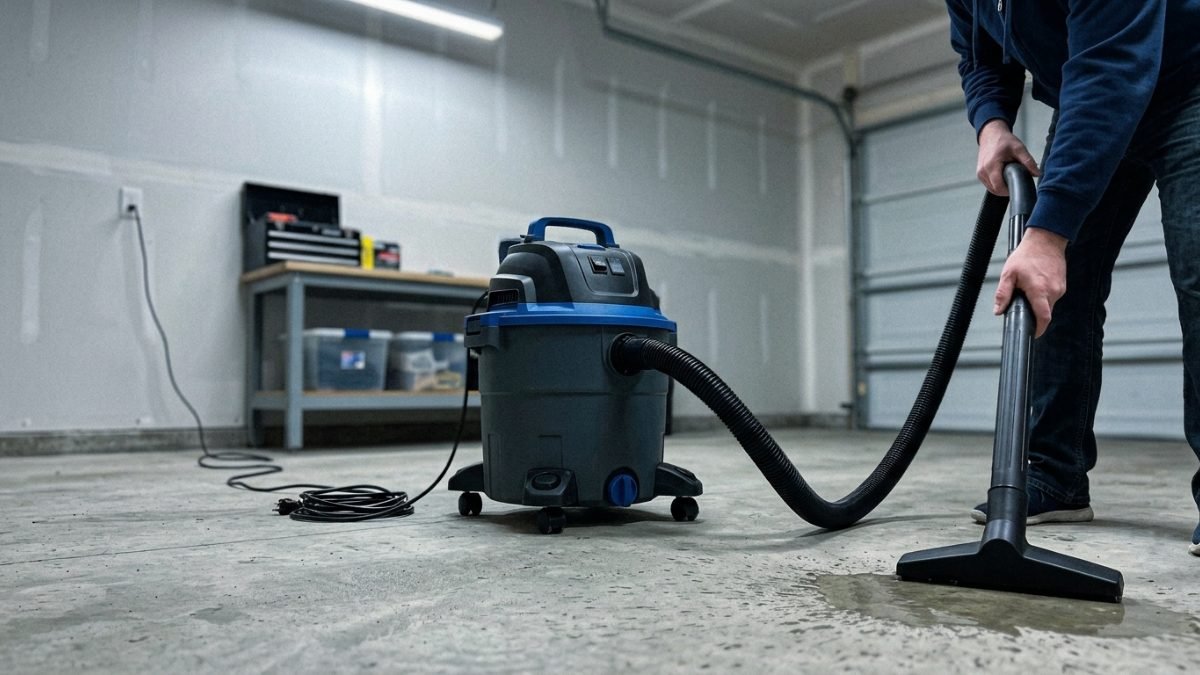
A wet and dry vacuum is a barrel machine built to pick up liquid as well as dust, using a sealed path and a float shut-off that keep water out of the motor. An ordinary household vacuum meeting a spill destroys itself, which is the single reason this category exists. Choosing the best wet and dry vacuum in Australia comes down to tank capacity, whether fine dust is separated before the filter, and whether the machine also blows.
Four things divide this market once liquid handling is taken as given. Tank capacity sets how often a job stops. Cyclonic separation decides whether fine dust blinds the filter. Power take-off sockets sync the vacuum to a running tool. Blower functions reverse the airflow to clear surfaces before pickup.
Tank sizes here run from 15 litres, about 4 gallons, up to 34 litres, close to 9 gallons, and motors from 1000 to 2000 watts. Capacity matters more than wattage on most jobs, because emptying a drum of plaster dust costs ten minutes and a mask while a slightly weaker motor costs seconds. Beyond those, check whether the tank is metal or plastic, since that decides how a machine smells after wet use. For dry household floors rather than workshop debris, the best vacuum cleaner covers the domestic side.
Ten machines are compared below, ordered from the unit held in Australian affiliate stock through the trade and workshop barrels to the occasional-use models.
Quick Picks
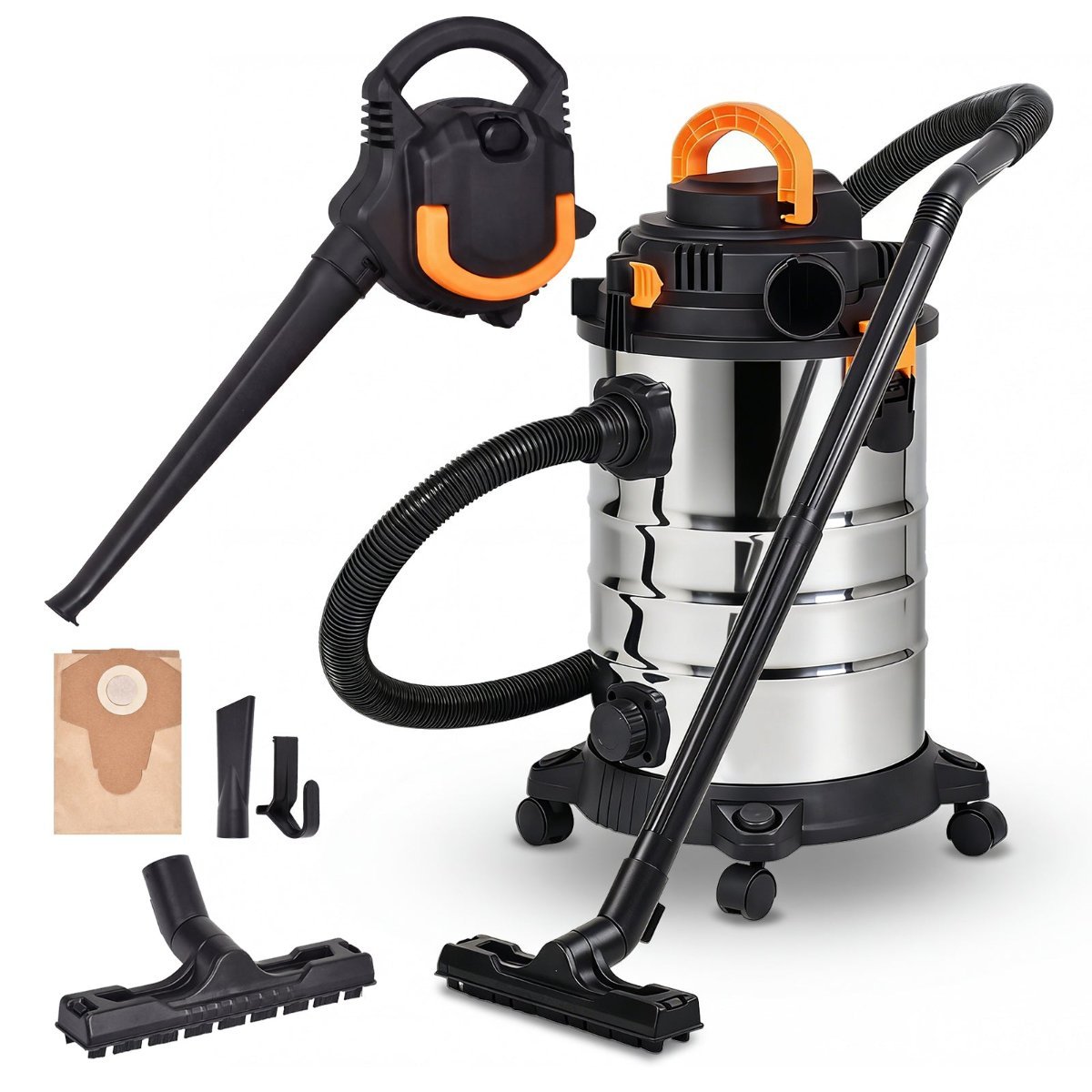
Advwin Wet Dry Vacuum Cleaner with Handheld Blower
A 30 litre stainless tank with a detachable handheld blower built into the same body.
CHECK CURRENT PRICEWet and Dry Vacuums Compared
| Product | Link | Type | Best For | Key Spec |
|---|---|---|---|---|
| Advwin Wet Dry Vacuum Cleaner with Handheld Blower | Check price | Barrel | General workshop use | 30L, 1200W, 17kPa |
| DeWALT 34L Heavy Duty Wet and Dry Vacuum | Check price | Barrel | Large jobs | 34L, 1200W |
| Akitas W8S 2000W 30L with Power Take-Off Socket | Check price | Barrel | Power tool dust | 2000W, 30L, tool socket |
| Akitas W8 2000W 30L Cyclonic Wet and Dry Vacuum | Check price | Barrel | Fine dust | 2000W, 30L, cyclonic |
| Bosch 1200W Wet and Dry Vacuum with Foldable Handle | Check price | Barrel | Small garages | 1200W, 15L, folding |
| Bosch 1000W Wet and Dry Workshop Vacuum | Check price | Barrel | Regular light use | 1000W, 15L |
| Shop-Vac 1400W 20L with Stainless Steel Tank | Check price | Barrel | Wet pickup | 1400W, 20L, stainless |
| Bosch Cordless Wet and Dry Vacuum with Inflator | Check price | Cordless barrel | Away from power | Cordless, inflator |
| Unimac 20L 1400W Wet and Dry Vacuum with Blower | Check price | Barrel | Value | 1400W, 20L, stainless |
| Spector 1200W 20L Wet and Dry Shop Vacuum | Check price | Barrel | Occasional use | 1200W, 20L, metal tank |
1. Advwin Wet Dry Vacuum Cleaner with Handheld Blower – Best All-Round
Thirty litres of stainless steel tank, 1200 watts and a rated 17 kilopascals, with a detachable handheld blower built into the same body. It is the only wet and dry vacuum held in Australian affiliate stock.
A blower matters more in this category than the specification sheets suggest. Half the work a shop vacuum does is clearing sawdust and leaves off a surface before anything gets picked up, and reversing the airflow saves fetching a second machine to do it.
Suction sits below the 2000 watt units further down and the tank is not the largest here. As one machine covering a garage, a car interior and a leaf-strewn driveway, it needs the fewest accessories to get there.
Pros
- Detachable handheld blower built in
- Thirty litre stainless steel tank
- Handles wet spills and dry debris
- Covers garage, car and outdoor clearing
Cons
- Lower suction than the 2000 watt machines here
- Tank is not the largest in this guide
Key specs: Barrel wet and dry vacuum, 30 litre stainless tank, 1200 watts, 17 kilopascals, detachable handheld blower.
CHECK CURRENT PRICE2. DeWALT 34L Heavy Duty Wet and Dry Vacuum – Best Large Capacity
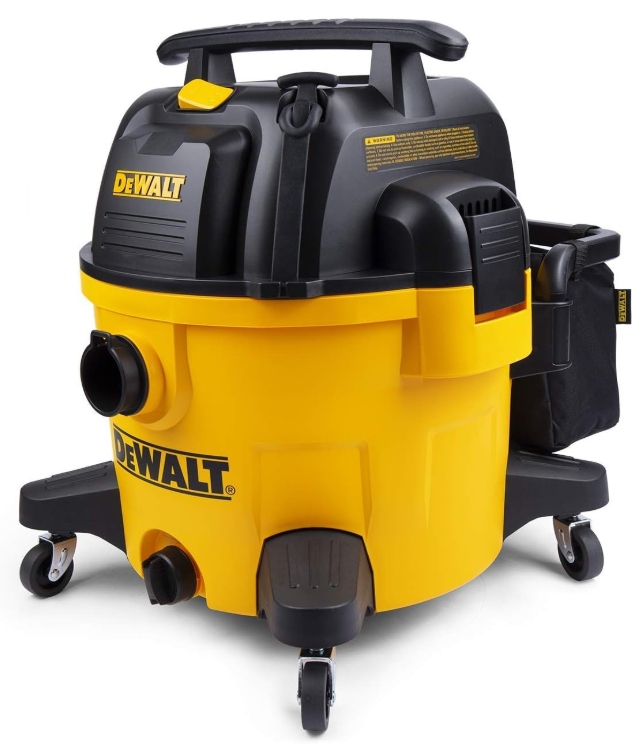
Thirty-four litres is the largest tank in this guide, in a heavy duty body with a blower port and a polyurethane-bodied build. It is aimed at trade use rather than occasional garage duty.
Tank size decides how often the job stops, and on a renovation that matters more than suction. Emptying a vacuum full of plaster dust is a ten minute interruption with a mask on, and a third more capacity means measurably fewer of them across a day.
It is physically large and needs somewhere to live, which rules it out of a small apartment garage. On a site or a serious home renovation, the capacity is the reason to buy it.
Pros
- Largest tank here at 34 litres
- Heavy duty build for trade use
- Blower port included
- Fewer interruptions on dusty jobs
Cons
- Large footprint needs dedicated storage
- Overkill for light household use
Key specs: Barrel wet and dry vacuum, 34 litre tank, 1200 watts, blower port, heavy duty construction.
CHECK ON AMAZON3. Akitas W8S 2000W 30L with Power Take-Off Socket – Best for Power Tools
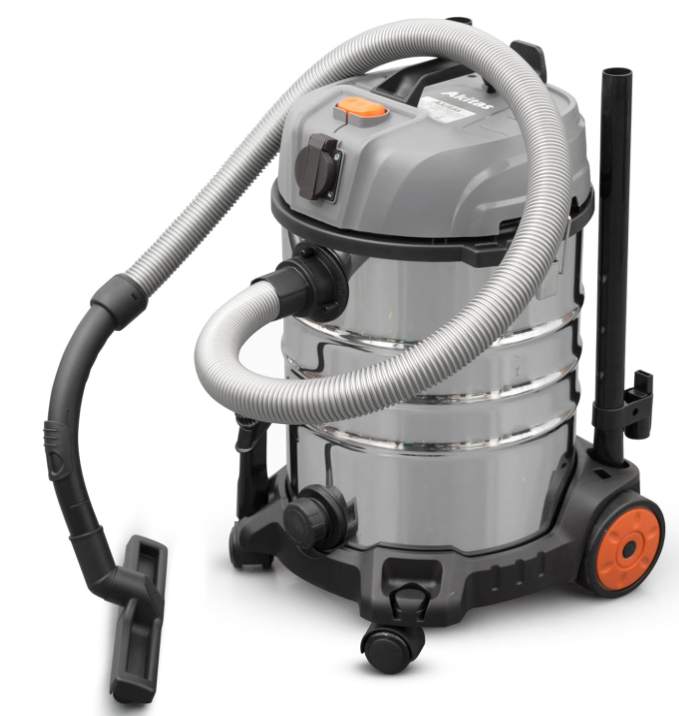
Two thousand watts and a 30 litre tank, with an extra power socket on the housing that a tool plugs into directly. The vacuum starts and stops with the tool.
Dust extraction only happens reliably when nobody has to remember it. Wiring the vacuum to the tool’s own trigger means a mitre saw or sander pulls its own dust from the first cut, rather than after somebody notices the bench disappearing under it.
Two thousand watts through a domestic circuit alongside a power tool is worth checking against the breaker. For a workshop where dust control is the point rather than an afterthought, the socket does something no accessory can.
Pros
- Power take-off socket syncs vacuum to the tool
- 2000 watts of suction
- Thirty litre bagless tank
- Dust extraction happens automatically
Cons
- Combined load worth checking against your circuit
- Larger and louder than domestic machines
Key specs: Barrel wet and dry vacuum, 2000 watts, 30 litre tank, power take-off socket, cyclonic bagless, blower function.
CHECK ON AMAZON4. Akitas W8 2000W 30L Cyclonic Wet and Dry Vacuum – Best Cyclonic Separation
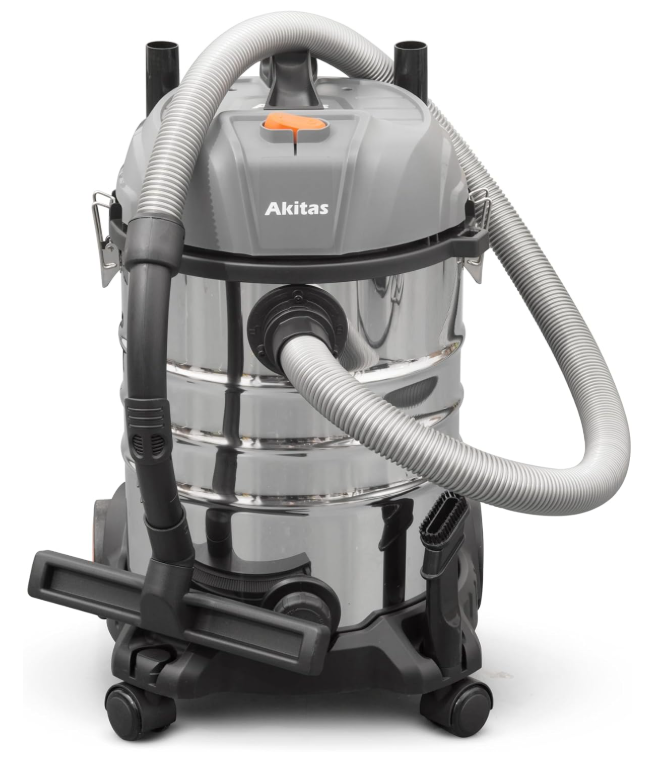
The same 2000 watt motor and 30 litre tank as the model above, without the tool socket, using cyclonic separation ahead of the filter. A blower function is included.
Fine dust is what kills shop vacuum performance, because plaster and concrete dust blind a filter within minutes and suction collapses long before the tank is full. Spinning that material out before it reaches the filter is what keeps a machine working through a full bag of rubble.
Without the tool socket it needs switching on manually like any other vacuum. Where the work is renovation dust rather than sawdust from a fixed tool, the separation stage matters more than the socket would.
Pros
- Cyclonic stage keeps fine dust off the filter
- Maintains suction through dusty work
- 2000 watts and 30 litre capacity
- Blower function included
Cons
- No power take-off socket
- Only limited stock at the time of writing
Key specs: Barrel wet and dry vacuum, 2000 watts, 30 litre tank, cyclonic separation, bagless, blower function.
CHECK ON AMAZON5. Bosch 1200W Wet and Dry Vacuum with Foldable Handle – Best Compact Storage
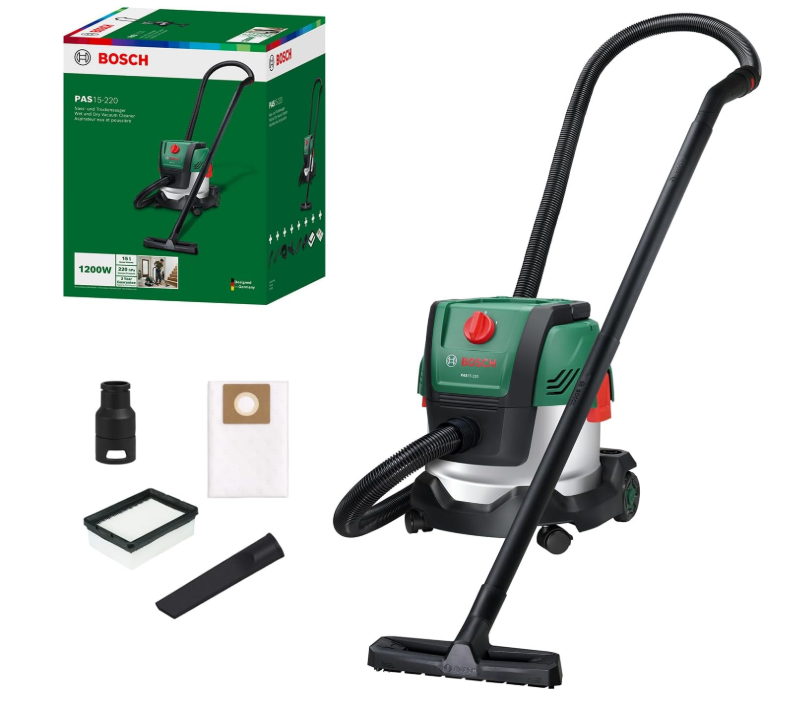
Fifteen litres and 1200 watts in a body whose handle folds flat against the tank. Accessories store on board rather than in a separate box.
Shop vacuums are bought for occasional jobs and then stored for months, which makes stored footprint a more relevant specification than tank size for most households. A folding handle and onboard tool storage decide whether the machine fits on a shelf or takes a corner of the floor permanently.
Fifteen litres will need emptying on any substantial job. In a single-car garage or a small shed where floor space is already spoken for, that is a fair exchange.
Pros
- Handle folds flat for storage
- Onboard accessory storage
- Established brand with available spares
- Fits a shelf rather than the floor
Cons
- Fifteen litres fills quickly on big jobs
- Lower power than the 2000 watt machines
Key specs: Barrel wet and dry vacuum, 1200 watts, 15 litre tank, foldable handle, onboard accessory storage, blower function.
CHECK ON AMAZON6. Bosch 1000W Wet and Dry Workshop Vacuum – Best Everyday Workshop Unit
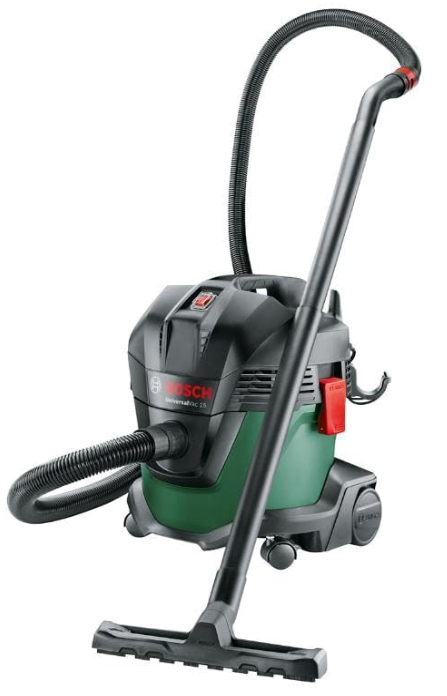
One thousand watts and a 15 litre tank, with a blower function and a high suction rating for the power drawn. It is the longest-established model in this guide.
A machine that has been on sale for years has one advantage nothing new can match: filters, hoses and nozzles are still stocked. A shop vacuum is usually retired because a consumable became unobtainable rather than because the motor failed.
One thousand watts is the lowest figure here and it will feel it against wet debris. For a household using a shop vacuum a few times a month for years, parts availability outlives peak suction.
Pros
- Long-established model with available consumables
- Efficient suction for the power drawn
- Blower function included
- Simple, serviceable design
Cons
- Lowest wattage in this guide
- Fifteen litre tank limits bigger jobs
Key specs: Barrel wet and dry vacuum, 1000 watts, 15 litre tank, blower function, workshop accessories.
CHECK ON AMAZON7. Shop-Vac 1400W 20L with Stainless Steel Tank – Best Tank Durability
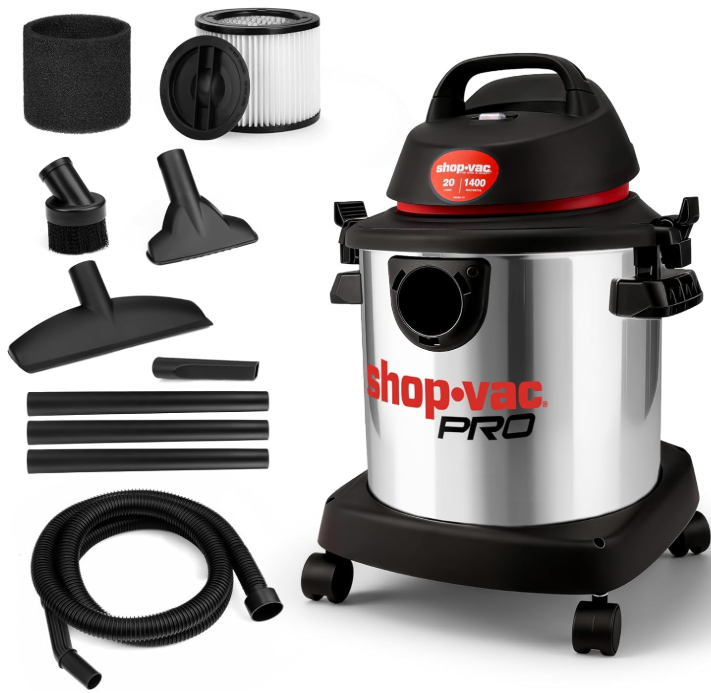
A stainless steel tank rather than moulded plastic, holding 20 litres, driven by a 1400 watt motor in a three-in-one configuration.
Tank material matters specifically because of the wet half of the job. Water left standing in a plastic drum grows a smell that never fully leaves, while stainless rinses clean and dries without holding it, which is the difference between a machine that gets used on spills and one that gets avoided after the first time.
Stainless adds weight and cost against an equivalent plastic unit. For anyone whose main use is water, from a flooded laundry to a pool surround, it is the sensible tank to own.
Pros
- Stainless tank rinses clean after wet use
- Does not retain odours like plastic
- 1400 watts through a 20 litre body
- Three-in-one vacuum, blower and wet pickup
Cons
- Heavier than an equivalent plastic unit
- Costs more for the same capacity
Key specs: Barrel wet and dry vacuum, 1400 watts, 20 litre stainless steel tank, three-in-one operation, filter and hose included.
CHECK ON AMAZON8. Bosch Cordless Wet and Dry Vacuum with Inflator – Best Cordless Option
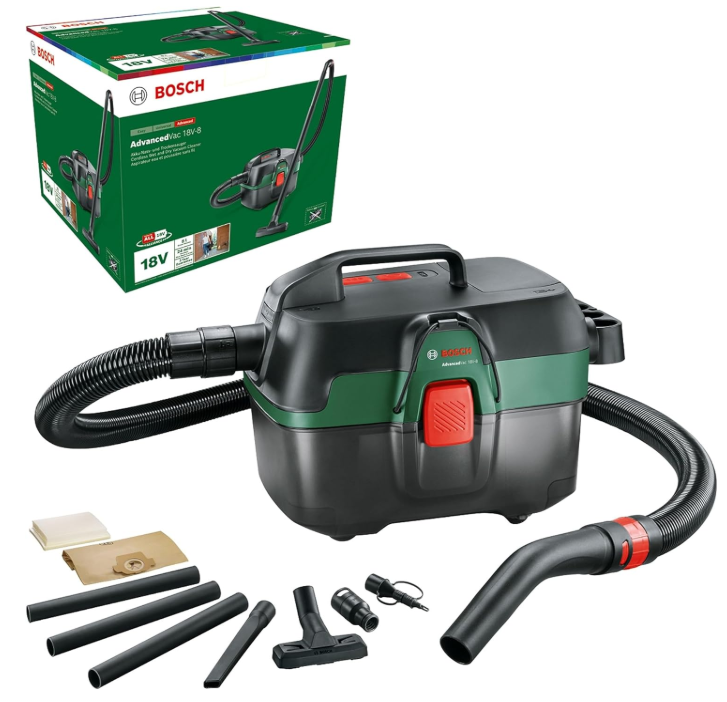
The only cordless machine in this guide, running on a battery platform rather than mains power, and doubling as an inflator. The battery is not supplied with the unit.
Wet and dry work often happens where power does not reach: a car in a driveway, a boat on a trailer, a shed without a circuit. Every corded machine on this list needs an extension lead to get there, and a wet job with a lead trailing through water is a situation worth avoiding.
Run time is bounded by the battery and capacity is small next to the 30 litre barrels. Buyers already invested in the same battery platform get a genuinely useful tool; everyone else pays for a battery and charger on top.
Pros
- No mains lead needed for wet work
- Doubles as an inflator
- Useful away from power points
- Fits an existing battery platform
Cons
- Battery and charger not included
- Small capacity next to the corded barrels
Key specs: Cordless wet and dry vacuum, battery platform powered, inflator function, compact tank, battery sold separately.
CHECK ON AMAZON9. Unimac 20L 1400W Wet and Dry Vacuum with Blower – Best Value Pick
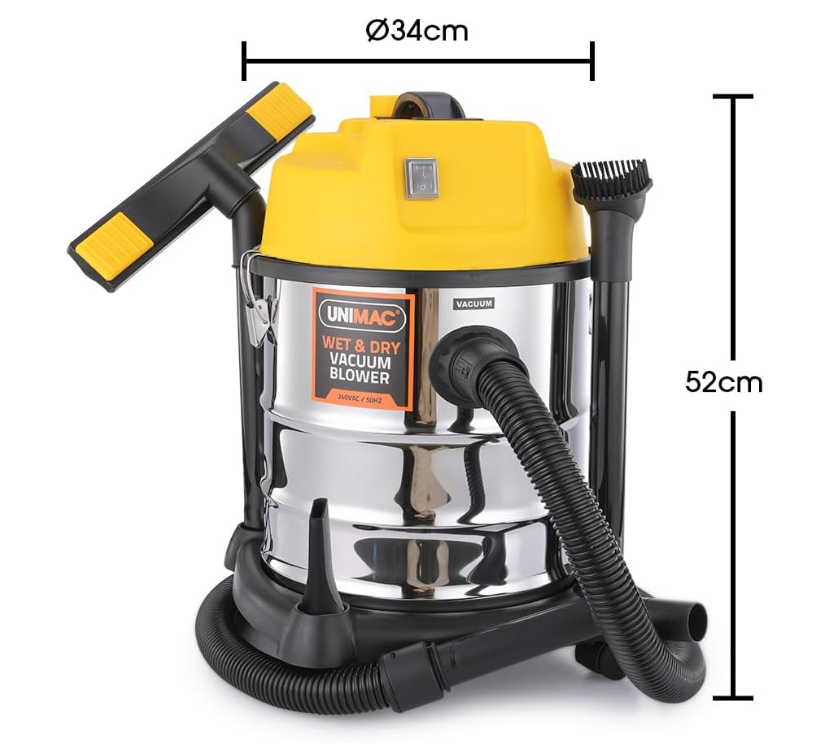
Twenty litres in a stainless tank with 1400 watts and a blower function, at a lower price than the branded machines with the same specification.
The specification list here matches units costing considerably more, which is the usual pattern when a name is not being paid for. What that trades away is not usually the motor but the consumables pipeline, so filters and hoses are worth checking availability on before committing.
Stock is limited at the time of writing and spares support is unproven. On paper it delivers the same tank, power and blower as the mid-priced machines above.
Pros
- Stainless tank and blower at a lower price
- 1400 watts and 20 litre capacity
- Matches dearer machines on specification
- Suits vehicles and workshops
Cons
- Consumables availability unproven
- Limited stock at the time of writing
Key specs: Barrel wet and dry vacuum, 1400 watts, 20 litre stainless steel tank, blower function, vehicle and workshop tools.
CHECK ON AMAZON10. Spector 1200W 20L Wet and Dry Shop Vacuum – Best Budget Pick
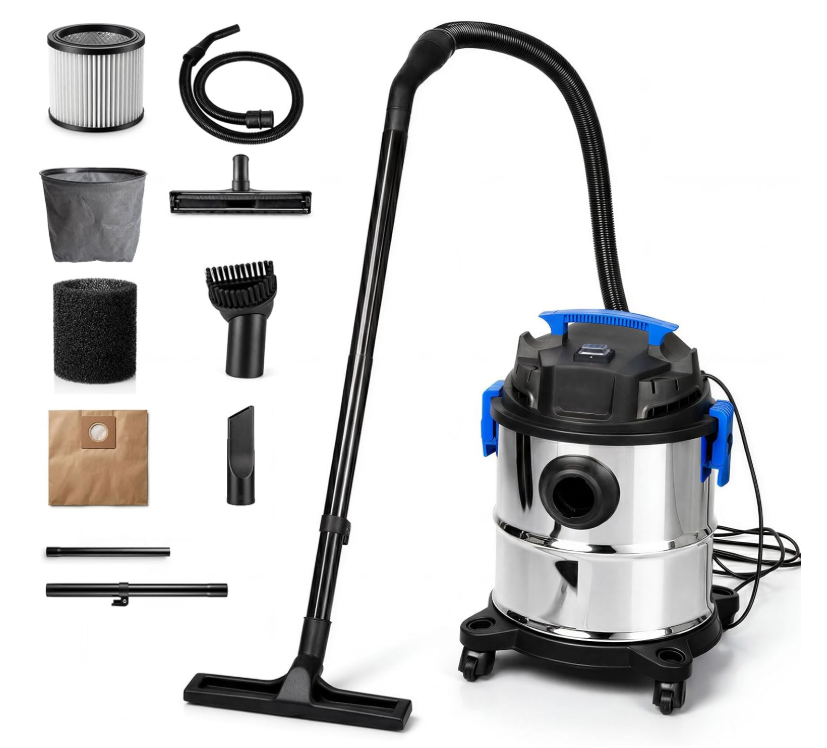
A rust-resistant metal tank holding 20 litres, driven at 1200 watts in a three-in-one shop vacuum layout. It occupies the lowest position on the range in this guide.
For a household using a shop vacuum three or four times a year, on a flooded laundry or after a small renovation, the difference between 1200 and 2000 watts is a few extra minutes rather than a different outcome. Buying capability that sits idle for eleven months is the more common mistake.
It will feel slow on a sustained job and the accessories are basic. As the cheapest way to have a wet-capable vacuum in the house before it is needed, that is the point.
Pros
- Lowest position on the range here
- Rust-resistant metal tank
- Twenty litre capacity
- Adequate for occasional household jobs
Cons
- Slow on sustained work
- Basic accessory set
Key specs: Barrel wet and dry vacuum, 1200 watts, 20 litre rust-resistant metal tank, three-in-one operation.
CHECK ON AMAZONHow to Choose the Best Wet and Dry Vacuum in Australia
Size the tank to the interruption, not the debris. A 15 litre drum is fine for a car interior and miserable on a renovation, because the cost of a small tank is measured in stoppages rather than in performance. Work out how much rubble or water the job produces and buy the size above it.
Check for cyclonic separation if you deal with fine dust. Plaster, concrete and sanding dust blind a filter within minutes and suction collapses long before the tank fills. A cyclonic stage spins that material out first, which is what keeps a machine working through a full drum of it.
Prefer a metal tank if water is the main job. Standing water in a plastic drum leaves a smell that never entirely goes, while stainless rinses out and dries clean. Anyone buying primarily for spills, flooded laundries or pool surrounds should treat the tank material as a specification rather than a finish.
Look for a power take-off socket if you use fixed tools. Wiring the vacuum to a saw or sander means extraction starts with the tool and stops with it, so it happens on the first cut rather than after somebody notices the mess. Check the combined load against your circuit before running a 2000 watt vacuum alongside a power tool.
Confirm the blower function is genuine. A real blower port moves enough air to clear a driveway or sawdust off a bench, while some machines simply reverse a hose fitting to little effect. It is the feature that turns a shop vacuum into the tool you reach for outdoors.
Find out whether filters and hoses are stocked. These machines are usually retired because a consumable became unobtainable, not because the motor failed, so a long-established model with available parts often outlives a cheaper one with better numbers. Australian Consumer Law guarantees apply in addition to the manufacturer warranty on every unit here.
Frequently Asked Questions
Can I use a normal vacuum to pick up water?
No. Liquid drawn through a dry vacuum reaches the motor and destroys it, and the damage is excluded from warranty cover. Wet and dry machines use a sealed path and a float shut-off that stops suction before water reaches the motor.
Do I need to change the filter for wet pickup?
Usually yes. Most machines use a foam or sponge filter for liquids and a pleated cartridge for dust, and running a dry cartridge filter while picking up water will clog and often ruin it. Check the manual before the first wet job.
What size wet and dry vacuum do I need?
For a car and occasional spills, 15 to 20 litres is enough. For renovations, workshops or regular trade use, 30 litres or more reduces how often the job stops for emptying, which matters more than raw suction on dusty work.
What does cyclonic separation actually do?
It spins heavier dust out of the airflow before it reaches the filter. This matters most with fine material like plaster or concrete dust, which otherwise blinds a filter within minutes and collapses suction long before the tank is full.
Can a wet and dry vacuum be used indoors on carpet?
It can, but it is not designed for it. These machines lack the motorised brush roll that lifts grit from pile, so a household vacuum will clean carpet better. Use a shop vacuum indoors for spills, rubble and post-renovation cleanup.
How do I stop my wet and dry vacuum smelling?
Empty and rinse the tank after every wet job and leave it open to dry fully before storing. Water left standing in a plastic drum is the usual cause, which is why stainless and metal tanks are worth the extra cost for regular wet use.
Verdict
Capacity and dust handling decide this, not wattage. For a household wanting one machine to cover a garage, a car and outdoor clearing, the Advwin Wet Dry Vacuum Cleaner with Handheld Blower does all three without extra accessories. Renovation work points instead to the Akitas W8 2000W 30L Cyclonic Wet and Dry Vacuum, whose separation stage keeps suction alive through plaster dust that would blind a plain filter in minutes, and anyone whose real problem is water rather than debris should take the Shop-Vac with the stainless tank, because a plastic drum that has held standing water never quite stops smelling of it.