A baby bottle is a feeding vessel with a shaped silicone or rubber teat that lets an infant drink expressed breast milk or formula by sucking, and it is the one piece of feeding gear almost every Australian parent ends up buying. The best baby bottles Australia sells all do three things well: they let a baby latch without fighting the teat, they vent swallowed air away from the milk, and they come apart far enough to be cleaned properly. Everything else, including the shape, the colour and the marketing on the box, is secondary.
Four bottle types are sold here. Polypropylene (PP) bottles are the light, cheap, slightly cloudy standard. PPSU bottles cost more and take repeated 180C sterilising without going brittle, though they carry an amber tint from new. Glass bottles are heavier and will not stain or hold smells, and silicone bottles squash flat for travel but cost the most per bottle. Teats split the market a second time: wide-neck teats sit on a broad collar and suit babies moving between breast and bottle, while narrow-neck teats pair with the vented anti-colic systems that reduce swallowed air.
The number that decides most purchases is teat flow rate, not bottle capacity. Choice notes that flow rates are usually specified as slow for 0 to 3 months, medium for 3 to 6 months and fast for over 6 months, and a teat that flows too fast is the single most common reason a baby chokes, gulps or refuses a bottle. Capacity across the ten bottles here runs from 120ml to 330ml. The spec most parents overlook is teat material: Choice found silicone withstands repeated washing, boiling and sterilising, while rubber turns sticky and friable after a while.
This lineup compares ten bottles that are in stock in Australia, from single 120ml glass bottles for a newborn through to a 330ml plastic bottle for a six-month-old on solids, plus two multi-bottle sets for parents building a full rotation from scratch. It covers five brands and four materials. One honest boundary: these are feeding bottles only, so bottle warmers, sterilisers and the baby bags you will cart them around in are dealt with further down.
Quick Picks

Pigeon SofTouch PP 240ml
The cheapest per bottle here, with the same wide teat as the dearer PPSU version. Buy this one in twin packs.
CHECK CURRENT PRICE
Pigeon SofTouch PPSU 240ml
Amber PPSU that takes twice-daily boiling without clouding, on the top-rated teat in the SofTouch line.
CHECK CURRENT PRICE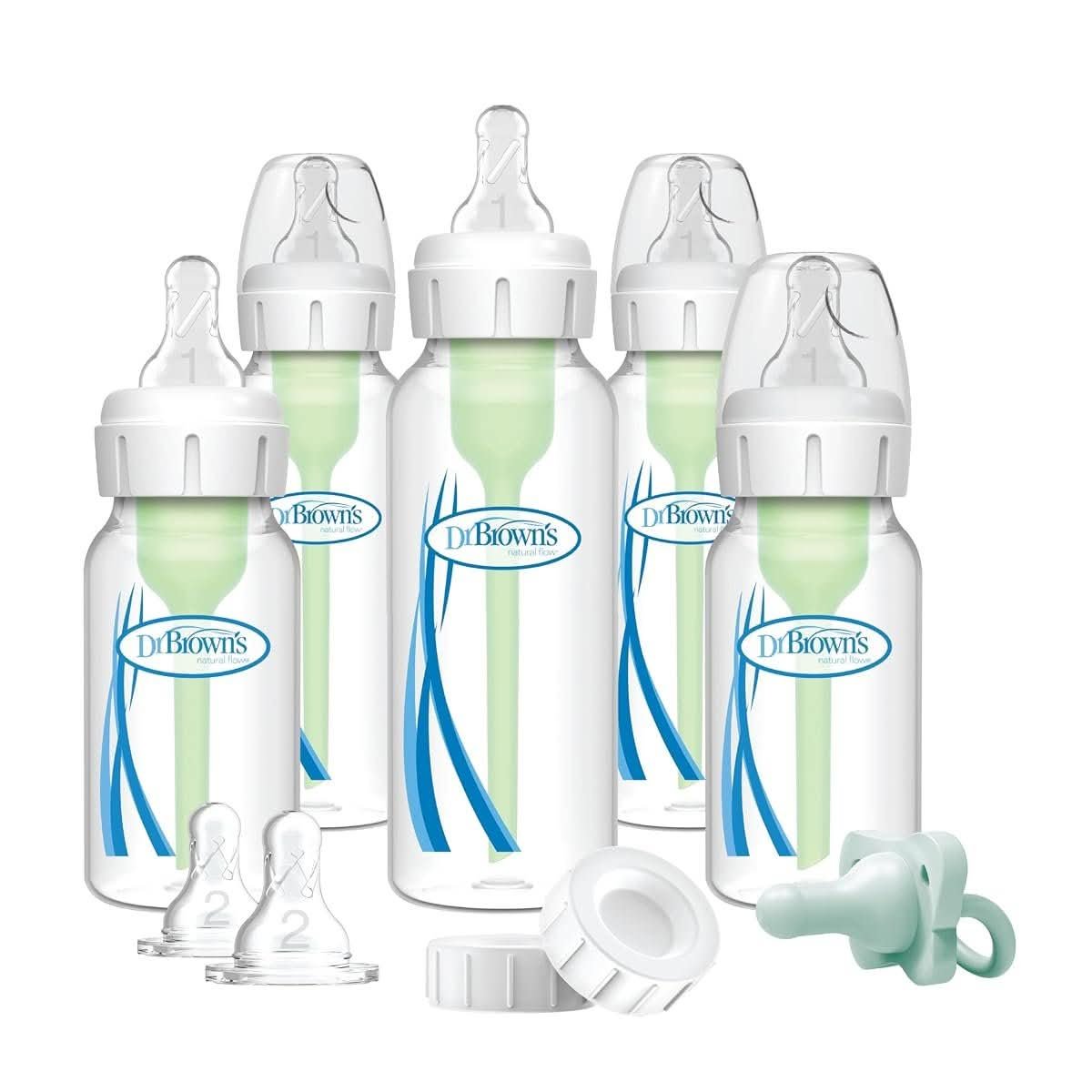
Dr. Brown’s Natural Flow Options+ Newborn Set
Five bottles, seven teats and two sizes in one box, which covers a full rotation from day one.
CHECK ON AMAZONBest Baby Bottles Australia Compared
| Product | Link | Type | Best For | Key Spec |
|---|---|---|---|---|
| Pigeon SofTouch PPSU 240ml | Check price | PPSU, wide neck | Combination feeding | 240ml, twin pack, 3m+ M teat |
| Pigeon SofTouch PP 240ml | Check price | Polypropylene, wide neck | Everyday value | 240ml, twin pack, 3m+ M teat |
| Pigeon SofTouch PP 160ml | Check price | Polypropylene, wide neck | Newborn feeds | 160ml, single, SS teat |
| Pigeon SofTouch PP 330ml | Check price | Polypropylene, wide neck | Older babies | 330ml, single, L teat |
| Philips Avent Natural Response 260ml | Check price | Polypropylene, wide neck | Breastfed babies | 260ml, 2-pack, Flow 3 teat |
| Dr. Brown’s Natural Flow Options+ Newborn Set | Check price | Polypropylene, narrow neck | Starting from scratch | Multi-bottle set, Level 1 teats |
| Dr. Brown’s Options+ Glass 120ml | Check price | Borosilicate glass, narrow neck | Reflux and wind | 120ml, 2-pack, Level 1 teat |
| Tommee Tippee Natural Start Glass 150ml | Check price | Glass, wide neck | Sterilising without a unit | 150ml, 0m+, slow flow teat |
| NUK for Nature 260ml | Check price | Recycled polypropylene | Checking feed temperature | 260ml, medium teat, temp indicator |
| Philips Avent Anti-Colic 260ml | Check price | Polypropylene, narrow neck | Building a full set | 260ml, 3-pack, AirFree vent |
How We Picked
We swept every Australian retailer with, plus the major marketplaces and the brands’ own Australian stores, and read each baby catalogue end to end instead of skimming the front page. That came to a few thousand product listings, of which roughly forty were actual infant feeding bottles as opposed to warmers, sterilisers, teats sold on their own or drink bottles filed in the wrong category.
From there we filtered on three things: in stock in Australia, not an overseas import with a multi-week delivery estimate, and a different bottle rather than the same moulding under a second label. Where two listings turned out to be one product we kept one. We then cross-checked what we had against Choice on materials and teat flow, and against verified buyer feedback on ProductReview, whose baby bottle category carries 621 reviews and a very clear pattern of complaints.
1. Pigeon SofTouch PPSU 240ml – Best for Switching Between Breast and Bottle
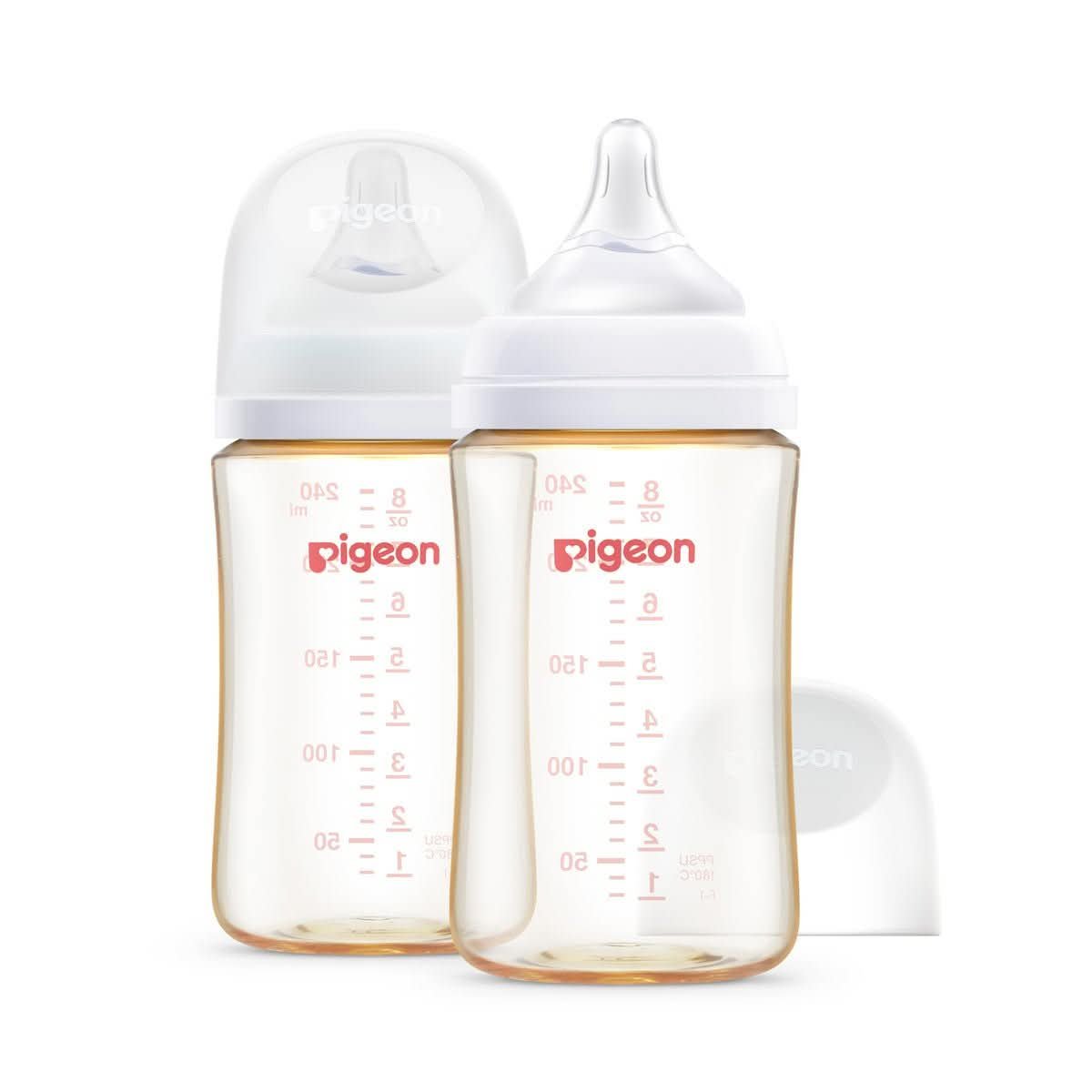
PPSU is the reason this one costs what it does. The plastic takes 180C sterilising cycle after cycle without clouding or going brittle, which is why the bottle carries an amber tint straight out of the box. First-time buyers regularly mistake that colour for staining and try to scrub it out. You cannot, and you do not need to.
The teat is the actual selling point. It is wide, gently sloped and soft enough to squash between two fingers, and it sits on a broad collar that asks a baby to open wide the way a breast does. Buyers on ProductReview rate the PPSU version of this bottle at the top of the SofTouch line, and the pattern in the feedback is parents moving a baby between breast and bottle without a fight. If you are expressing and your partner handles one feed a day, this is the bottle that makes that handover boring.
Two catches. The twin pack ships with the medium teat for three months and up, so a newborn needs slow-flow teats bought separately, and the wide collar will not stand up in some narrow-neck steriliser baskets. This sits at the premium end of the Pigeon range here, and if you sterilise by boiling twice a day it is the pick that still looks new in month six.
Pros
- Amber PPSU shrugs off repeated 180C sterilising without clouding
- Wide, soft teat that babies moving between breast and bottle accept readily
- Twin pack, so one wash cycle covers two feeds
- Top-rated bottle in the SofTouch line on ProductReview
Cons
- The amber tint looks like old milk staining even on a spotless bottle, and no amount of scrubbing changes it
- Ships with the 3m+ medium teat only, so newborn feeding means buying slow-flow teats on top
- The wide collar will not sit upright in narrow-neck steriliser baskets
- Dearer per bottle than the near-identical PP version directly below it
Key specs: 240ml, twin pack, PPSU, wide neck, medium (M) teat for 3m+, BPA and BPS free, 180C sterilising rated.
CHECK CURRENT PRICE2. Pigeon SofTouch PP 240ml – Best Value Twin Pack
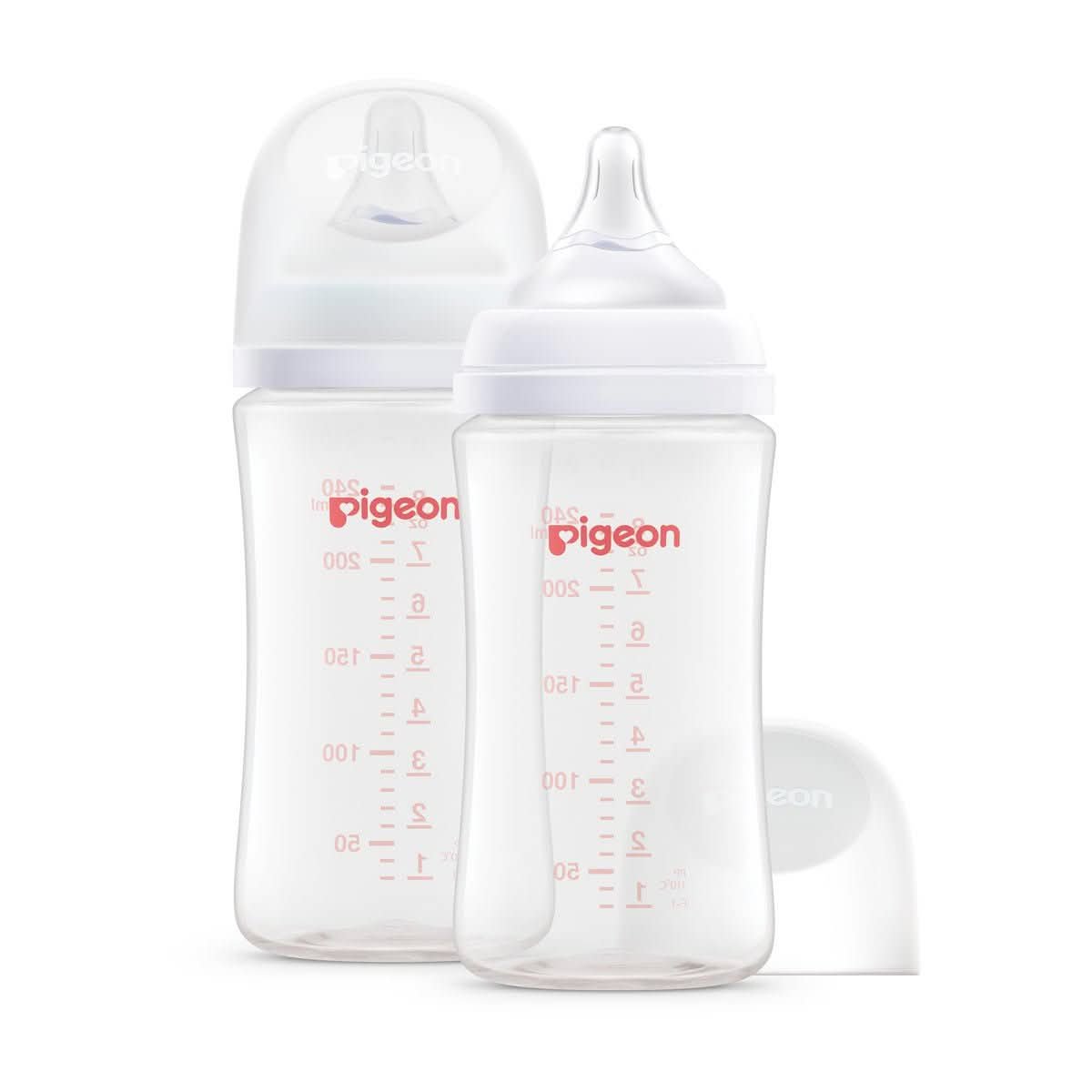
Same bottle shape, same wide teat, same twin pack as the PPSU above, in ordinary polypropylene for noticeably less. That is the whole pitch. PP is lighter in the hand, it goes slightly cloudy after a few months of hot cycles, and it will not take the same punishment at high temperatures. For a bottle that is going to be replaced inside a year anyway, most parents will not notice the difference.
Where it pays off is quantity. This works out the cheapest per bottle of anything here, which matters because you need six of them, not two. Teats are the running cost either way: they are sold separately in packs of two and want replacing every couple of months once the silicone softens or the flow hole widens, and that bill is identical across the whole SofTouch range. Buy this, buy spare slow-flow teats, and put the savings toward a steriliser.
Pros
- Cheapest per bottle in this lineup
- Identical teat and collar design to the dearer PPSU version above
- Lighter than PPSU or glass, easier for a baby starting to hold the bottle
- Twin pack keeps the per-bottle cost down when you need six
Cons
- Goes visibly cloudy after a few months of hot sterilising cycles
- Not rated for the repeated 180C cycles the PPSU version handles
- Comes with the 3m+ medium teat, so newborns need separate slow-flow teats
- Hard water in Adelaide or Perth leaves a chalky film on PP that never fully scrubs off
Key specs: 240ml, twin pack, polypropylene, wide neck, medium (M) teat for 3m+, BPA and BPS free.
CHECK CURRENT PRICE3. Pigeon SofTouch PP 160ml – Best for Newborns
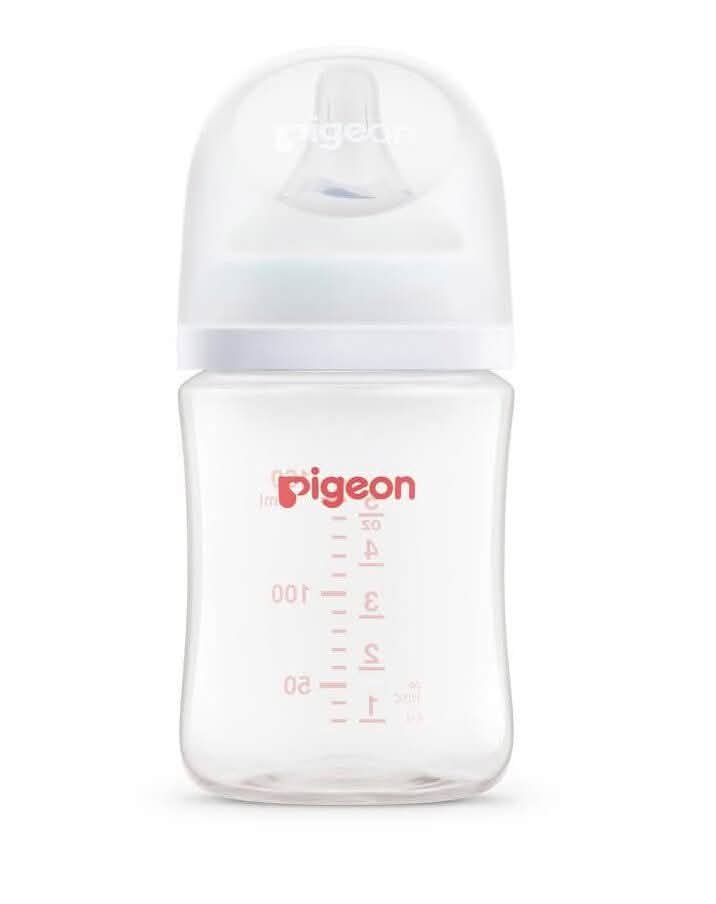
A newborn takes 40 to 60ml a feed. Handing that baby a 240ml bottle means holding a mostly empty column of plastic at an awkward angle every three hours, which is why the 160ml version exists. It is the same wide SofTouch teat and the same moulding as the two bottles above, scaled down (it holds about as much as a takeaway flat white), and it ships with the SS teat that a baby from zero months actually needs.
The markings run to 150ml in 50ml steps, which is enough precision for made-up formula and easy to read at 3am with one eye open. It is the right first bottle to test with: buy one, see whether your baby takes the teat, then commit to twin packs of the bigger size. That sequence saves more money than any discount.
The obvious limit is that it is outgrown. Somewhere around four months your baby will drain it and still be hungry, and you will be back buying 240ml bottles. It also comes as a single, so building a rotation of six means six separate purchases. Feeding through a Brisbane summer, when bottles need sterilising more often and milk spoils faster on the bench? Buy more of these than you think you need.
Pros
- Correctly sized for newborn feeds of 40 to 60ml
- Ships with the slow SS teat a baby from zero months needs, unlike the twin packs above
- Same wide SofTouch teat design, so stepping up to 240ml later changes nothing for the baby
- Cheap enough to buy one as a test before committing to a full set
Cons
- Outgrown at roughly four months, so it is a short-life purchase by design
- Sold as a single bottle, so a full rotation of six is six separate buys
- Volume markings only step in 50ml increments, which is coarse for small top-up feeds
- The narrow 160ml body is fiddly to get a bottle brush into properly
Key specs: 160ml, single bottle, polypropylene, wide neck, slow (SS) teat for 0m+, BPA and BPS free.
CHECK CURRENT PRICE4. Pigeon SofTouch PP 330ml – Best for Bigger Feeds
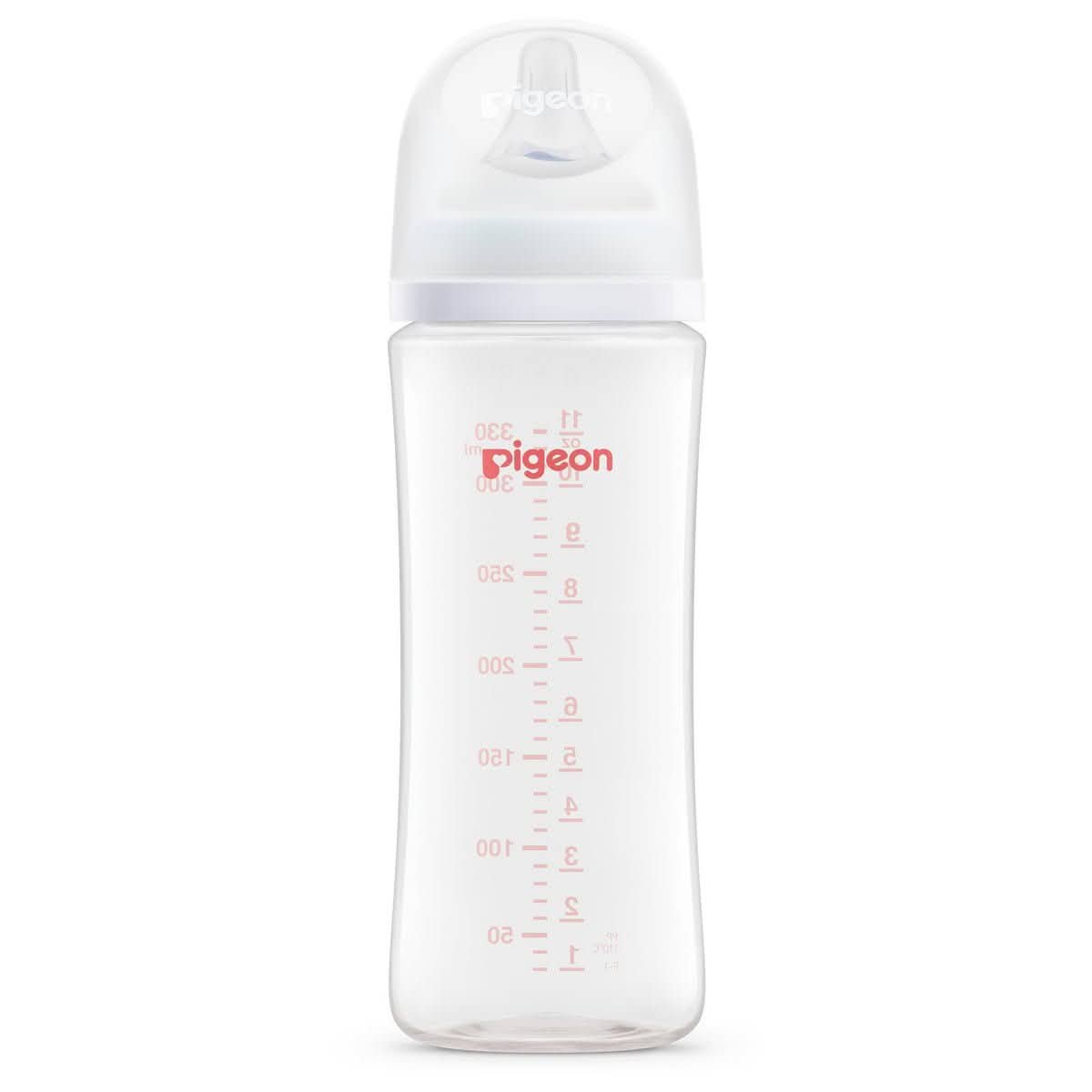
This is the one pick we nearly cut, and it is worth explaining why it survived. A 330ml baby bottle sounds like a solution to a problem most parents do not have, because by the time a baby drinks 330ml in one sitting they are usually on solids, strapped into a high chair and heading for a sippy cup. Buy it at the wrong moment and it sits in the cupboard.
At the right moment it is the only bottle here that works. A hungry six-month-old on a formula-heavy routine will empty a 240ml bottle and scream for the rest, and topping up means making a second feed and washing a second bottle. The 330ml holds a full feed in one go, with markings running to 330 so you are not guessing.
It ships with the L teat for six months and up, which is the fast flow a bigger baby wants and completely wrong for a newborn. That is worth stating plainly, because the bottle looks identical to the 160ml three places up and the teat is the only real difference. Check the letter on the packet, not the shape of the bottle.
Practical warning: it is tall (with the hood on, taller than a 600ml water bottle). Compact steam sterilisers and the insulated pocket on most nappy bags are cut for a 240ml bottle, and a 330ml bottle either will not stand up or will not fit at all. Measure the basket in whatever you already own before buying this one.
Pros
- Holds a full feed for a hungry six-month-old without a top-up bottle
- Ships with the fast L teat that an older baby needs
- Markings run the full 330ml, so made-up formula does not need estimating
- Same wide SofTouch teat family, so no transition for a baby already on Pigeon
Cons
- Too tall for compact steam sterilisers and most insulated nappy-bag pockets
- The L teat flows far too fast for a newborn, and the bottle looks identical to the 160ml version
- Useless until roughly six months, so it is easy to buy months too early
- Sold as a single, and a baby drinking 330ml feeds often needs several
Key specs: 330ml, single bottle, polypropylene, wide neck, fast (L) teat for 6m+, BPA and BPS free.
CHECK CURRENT PRICE5. Philips Avent Natural Response 260ml – Best for a Natural Latch
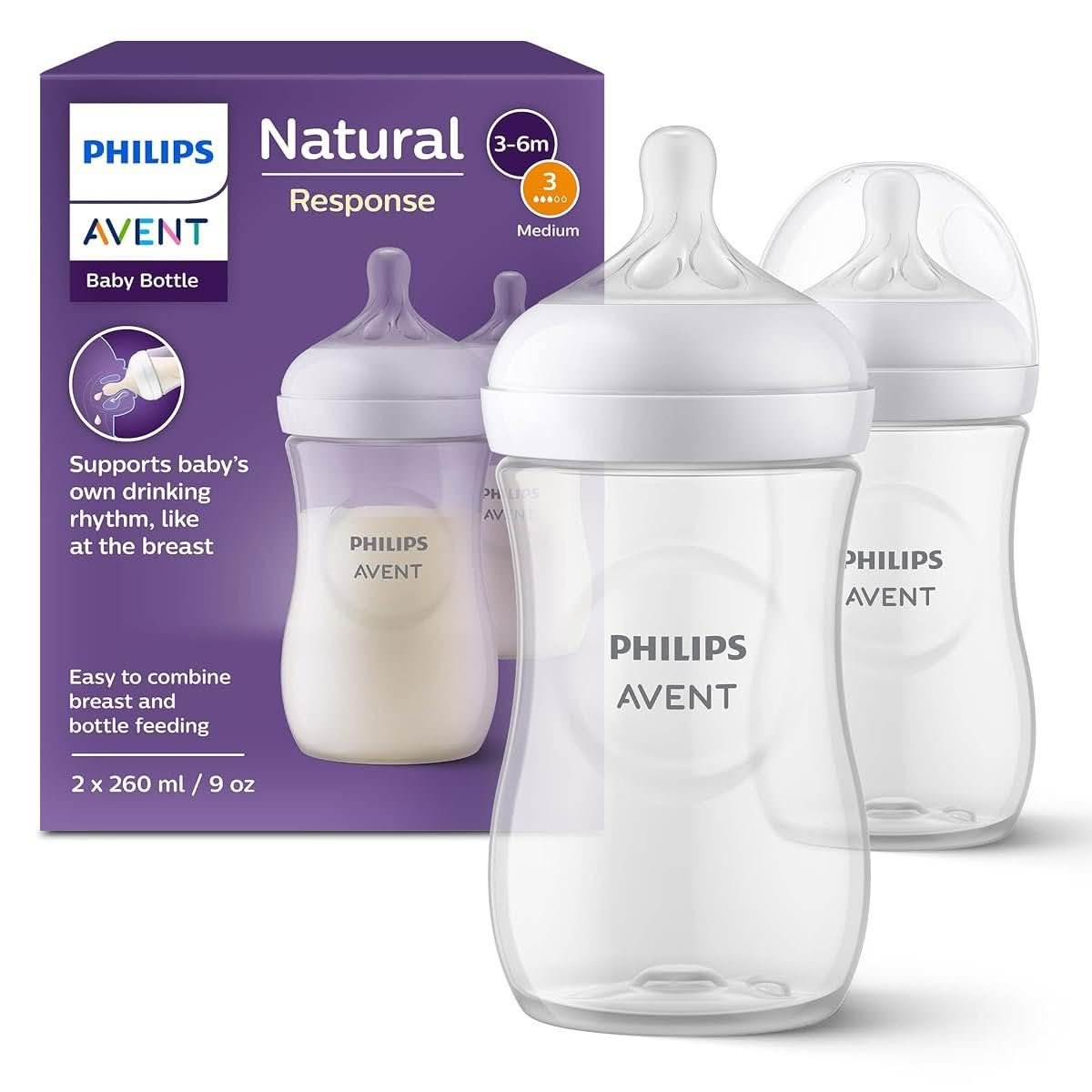
Read the name on the box carefully, because Philips Avent sells two similar-sounding ranges and Australian buyers rate them very differently. On ProductReview the older Avent Natural line sits down at 2.8 out of 5, while the Natural Response range that replaced it sits at the top of the category. This is the Natural Response. The difference is the teat, which has a small valve that only releases milk when the baby actively sucks.
That valve is the reason it belongs in a lineup aimed at breastfed babies. A conventional teat drips whenever the bottle tips, so a baby learns that milk arrives without effort. This one stops when the baby stops. The practical effect is a feed that paces itself, and it is the closest thing on this list to the Pigeon SofTouch teat two entries up in terms of what it asks the baby to do.
Philips is midway through a packaging change, moving from naming the flow to numbering it, so two different-looking packs of the same product are on shelves at once. Ignore the artwork and read the age range. The teat supplied here is the medium, flow 3, for three to six months.
Pros
- Teat valve holds milk until the baby sucks, so the feed paces itself
- The Natural Response range is rated at the top of the baby bottle category by Australian buyers
- Wide teat shape works for babies moving between breast and bottle
- Two-pack, so it covers two feeds per wash
Cons
- Easy to buy the wrong thing: the older Avent Natural range looks similar and rates 2.8 out of 5 on ProductReview
- Mid-transition packaging means the same product ships in two different-looking boxes with different flow labels
- The valve adds a moving part in the teat that can stick if milk film dries in it
- Supplied teat is flow 3 for 3m+, so it is the wrong starting point for a newborn
Key specs: 260ml, 2-pack, polypropylene, wide neck, medium flow 3 teat for 3-6m, BPA free.
CHECK ON AMAZON6. Dr. Brown’s Natural Flow Options+ Newborn Set – Best Newborn Starter Set

Everything a parent starting from zero needs, in one box: three 250ml bottles, two 120ml bottles, five slow teats, two faster ones for later, a soother and two travel caps. That lands you at Choice’s six-to-eight bottle figure in a single purchase, which is the reason to consider a set at all. Bought as singles, the same collection costs meaningfully more.
The bottles use the Dr. Brown’s internal vent, a green tube that runs down the middle of the bottle and carries air to the back so it never bubbles through the milk. For a baby who arches, squirms and pulls off the bottle mid-feed with wind, it works. The two bottle sizes matter too, because the 120ml ones are correctly scaled for the first couple of months and the 250ml ones take over after.
The cost is washing up. Every feed is five separate pieces including that vent tube, and with five bottles in rotation you are looking at twenty-five components a day. Fiddly assembly is one of the most common complaints across the whole category on ProductReview, and a vented bottle is where it bites hardest. There is also a soother in the box you may not want.
Pros
- Reaches Choice’s six-to-eight bottle recommendation in one purchase
- Two bottle sizes, so it covers newborn feeds and the step up at three months
- Internal vent routes air past the milk, which helps a windy or refluxy baby
- Cheaper per bottle than assembling the same collection from singles
Cons
- Five pieces per feed including the vent tube, so a day of feeds leaves 25 components in the sink
- The vent insert is small, easy to lose down the plughole and easy to reassemble wrong
- Narrow-neck bottles are harder to fill from a jug and harder to get a brush into
- Includes a soother and travel caps you may have no use for
Key specs: Set of 5 bottles (3 x 250ml, 2 x 120ml), 5 x Level 1 teats, 2 x Level 2 teats, soother, 2 travel caps. Polypropylene, narrow neck, internal vent, BPA free.
CHECK ON AMAZON7. Dr. Brown’s Options+ Glass 120ml – Best Anti-Colic Vent System
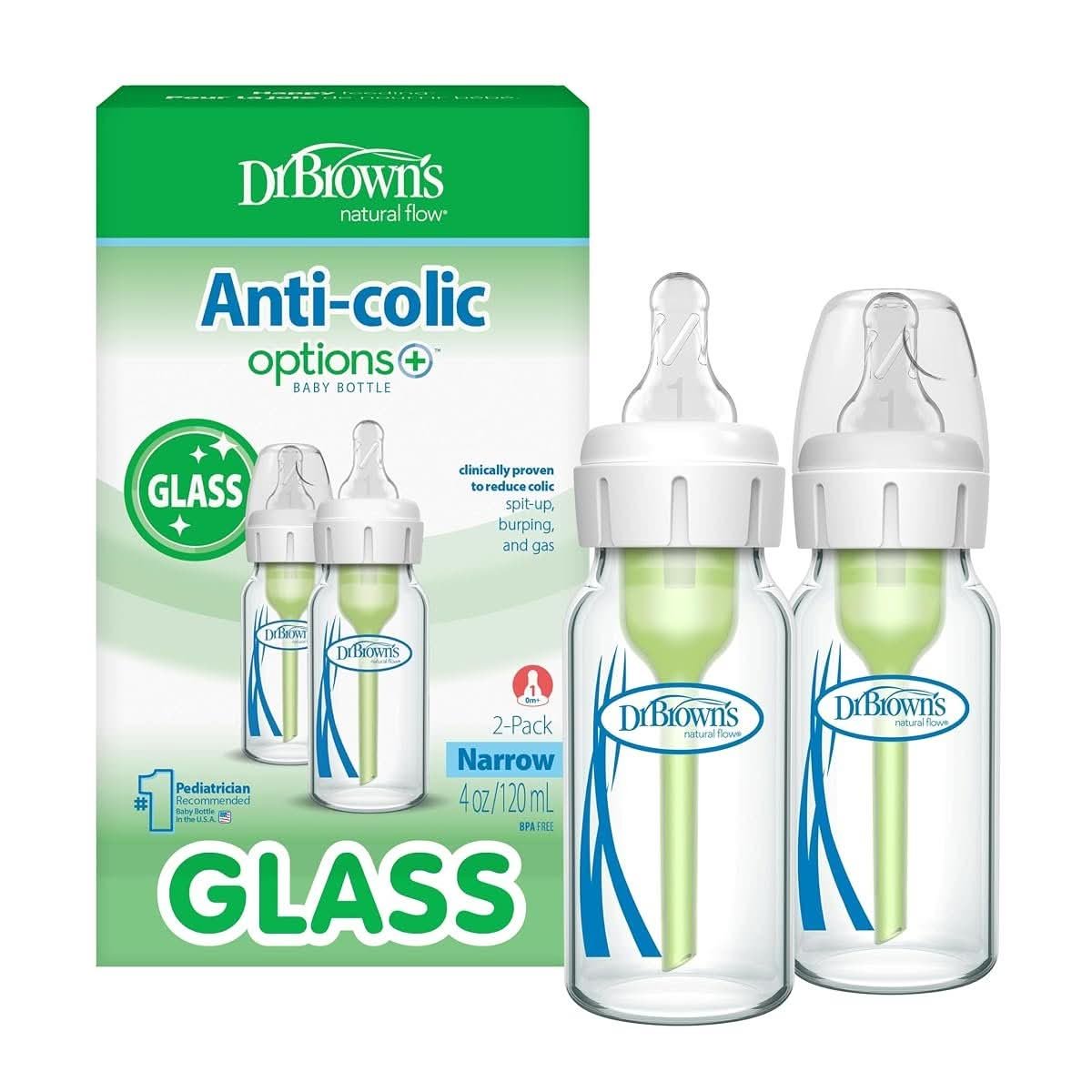
The same vent system as the set above, in borosilicate glass and at 120ml. Glass changes the calculation in ways worth knowing about: Choice calls it more hard-wearing and hygienic than plastic, but heavier and more of a danger if it breaks. It will not cloud, will not stain and will not hold the smell of formula that has sat too long, which is the failure mode every plastic bottle eventually hits.
At 120ml this is a newborn bottle, and the pairing of glass with a vented teat is aimed squarely at a small baby with reflux. The glass also means you can see the vent working, which sounds trivial until you are trying to work out whether you assembled it correctly at 4am.
Weight is the trade-off you feel immediately. A full glass 120ml bottle is heavier than a full plastic 240ml one, and a baby will not be holding it themselves for a long while. Glass cracking and chipping is a recurring theme in the category feedback on ProductReview, usually from a knock against a tap or a tiled floor. Keep a couple of plastic bottles for the pram and the park.
Pros
- Glass will not cloud, stain or hold formula smells the way plastic does
- Same internal vent as the Dr. Brown’s set above, in a newborn-appropriate 120ml size
- You can see whether the vent is assembled correctly through the bottle wall
- Two-pack, and glass survives hard water far better than PP
Cons
- A full 120ml glass bottle outweighs a full 240ml plastic one, which tells in a long feed
- Glass chips and cracks against taps and tiled floors, a recurring complaint in this category on ProductReview
- 120ml is outgrown within a few months
- Still a five-piece wash including the vent tube
Key specs: 120ml, 2-pack, borosilicate glass, narrow neck, Level 1 slow teat, internal vent, BPA free.
CHECK ON AMAZON8. Tommee Tippee Natural Start Glass 150ml – Best Self-Sterilising Glass Bottle

The pitch here is a glass bottle you can sterilise without owning a steriliser: fill the supplied cap with water, microwave it, done. For a family in a rental with no bench space, or anyone who does not want another appliance, that is a real convenience. The teat is wide and soft with an anti-colic valve in the base, and Tommee Tippee markets it hard at babies switching between breast and bottle.
Be careful which Tommee Tippee glass bottle you end up with, though. The older Closer to Nature glass line sits at 1.3 out of 5 on ProductReview, one of the worst-rated listings in the category, with glass cracking the recurring theme. This is the newer Natural Start range and it reviews far better, but the sample is small and the underlying material is the same. Worth a look if the self-sterilising trick solves a real problem for you. Otherwise the Dr. Brown’s glass bottle above is the safer glass buy.
Pros
- Self-sterilises in the microwave using its own cap, no separate unit needed
- Wide, soft teat with an anti-colic valve, aimed at combination feeding
- Glass body resists staining and holds no smells
- 150ml suits a newborn through the first few months
Cons
- Tommee Tippee’s older glass line rates 1.3 out of 5 on ProductReview with glass cracking the common complaint
- Sold as a single bottle, so a full rotation is an expensive series of purchases
- The microwave sterilising routine needs the cap filled to a precise level or the cycle is wasted
- Reviews for the newer range rest on a much smaller sample than the established brands here
Key specs: 150ml, single bottle, glass, wide neck, slow flow teat for 0m+, anti-colic valve, self-sterilising cap.
CHECK ON AMAZON9. NUK for Nature 260ml – Best Temperature Control Indicator
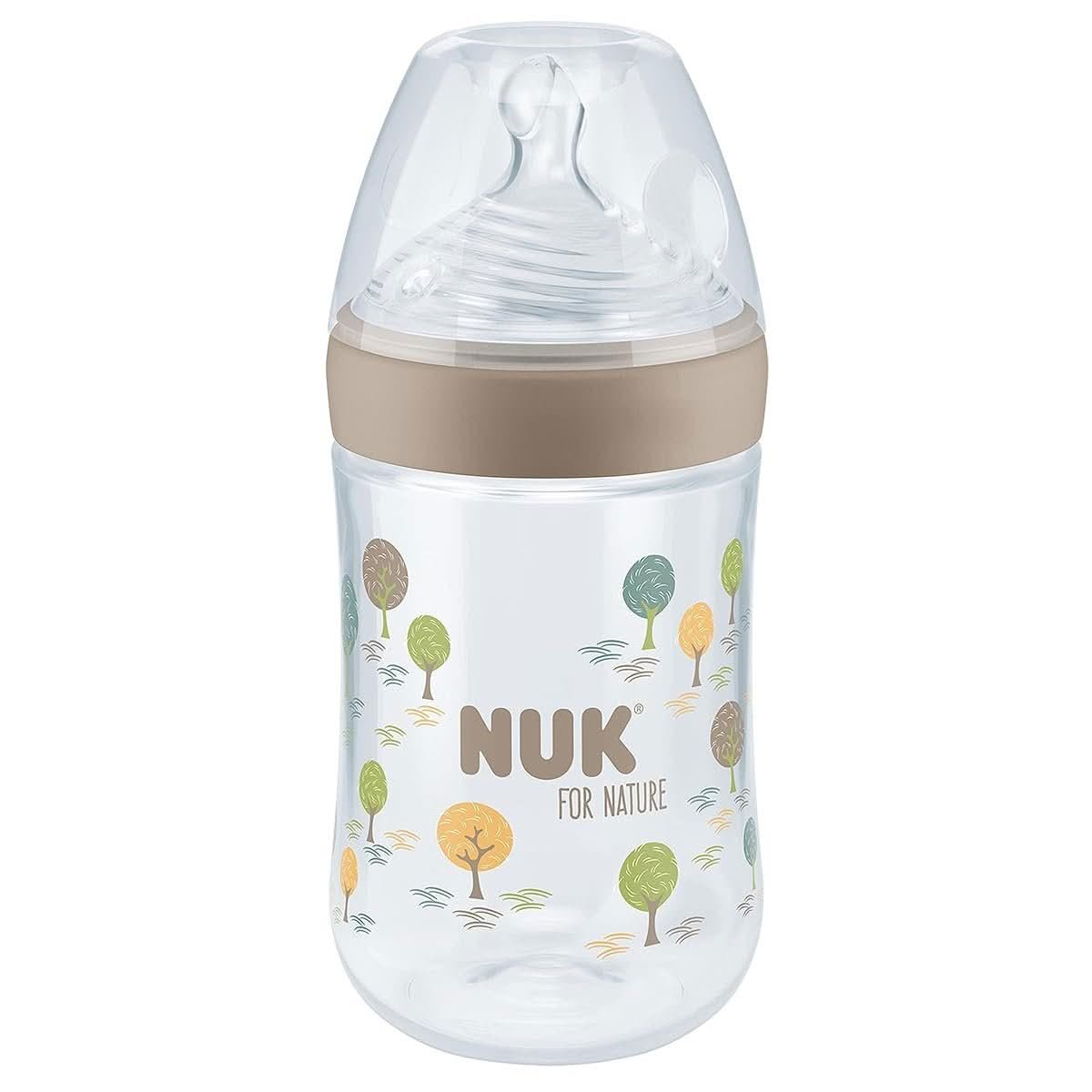
The band around the middle changes colour when the milk inside is too hot. On a Melbourne winter morning, when a bottle out of the fridge has been sitting in a jug of boiled water and you cannot tell by touch through the plastic, that is a genuine convenience. It is not a thermometer and it will not give you a number, but it will stop you offering a feed that is too warm.
The rest of the bottle is a competent wide-neck design with a silicone teat full of small openings, which NUK claims mimics the way milk comes from a breast. The body is made from certified recycled and bio-based plastic, and the packaging follows suit. If that matters to your household it is one of the few bottles here making a specific, certified claim instead of a vague one.
Two things wear on it. The temperature indicator is printed on, and printed indicators fade with repeated sterilising, so treat it as a feature with a shelf life shorter than the bottle. The printed leaf pattern also makes it harder to spot milk film left inside after a wash, which is the opposite of what you want. Hold it up to a window before you fill it.
Pros
- Colour-changing band flags milk that is too hot to offer
- Silicone teat with multiple small openings, shaped for babies moving from the breast
- Made from certified recycled and bio-based plastic, a specific claim rather than a vague one
- 260ml covers feeds from roughly three months onward
Cons
- The printed temperature indicator fades with repeated sterilising, so the feature outlives the bottle
- The printed leaf pattern hides milk residue left inside after washing
- Supplied with a medium teat, so it is not a newborn starting point
- Single bottle at a mid-range price, so building a set gets expensive
Key specs: 260ml, single bottle, recycled and bio-based polypropylene, wide neck, medium silicone teat, temperature control indicator, BPA free.
CHECK ON AMAZON10. Philips Avent Anti-Colic 260ml – Best Three-Pack for Full-Time Bottle Feeding
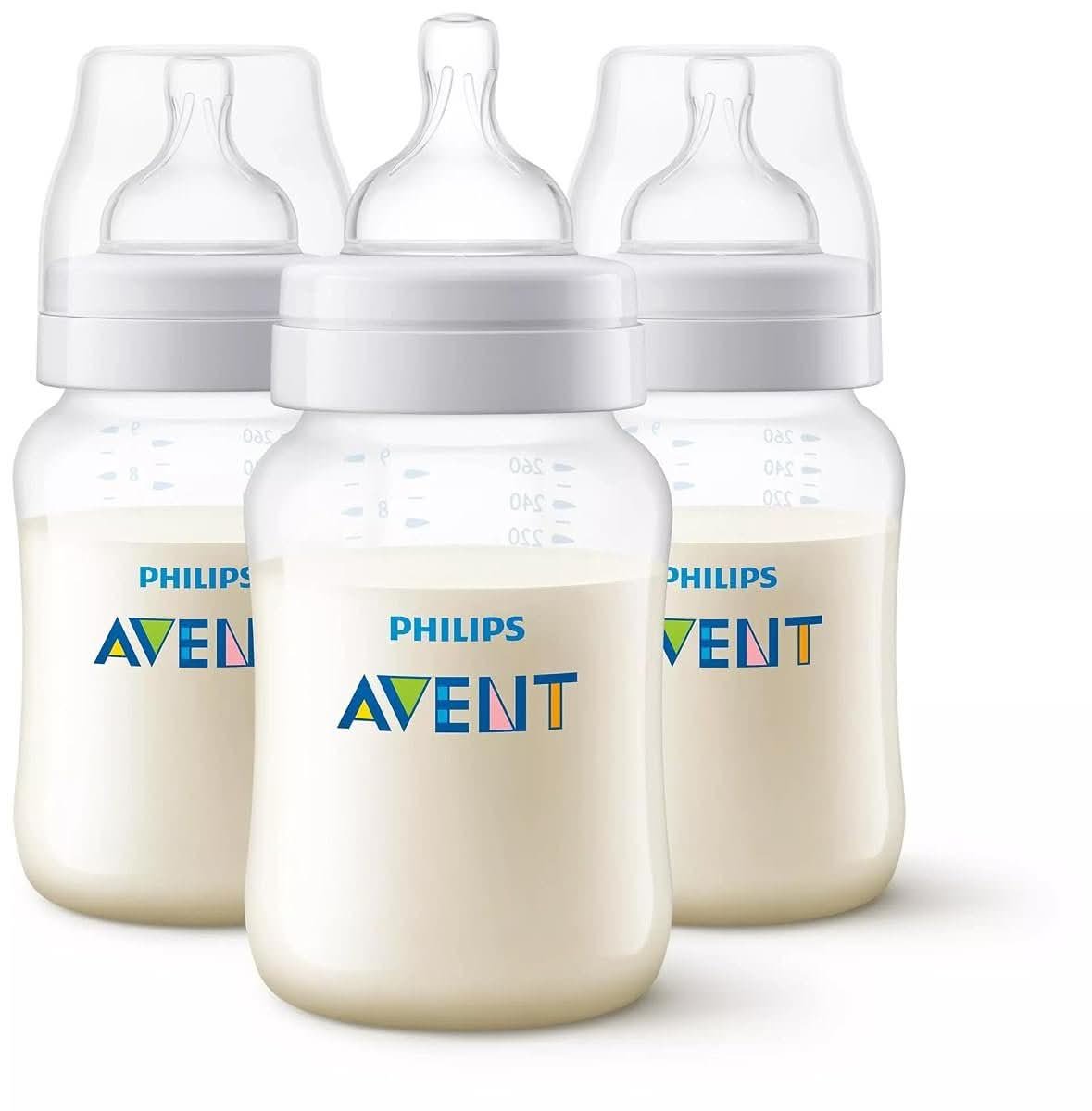
Three 260ml bottles in one box, which is the practical way to buy this. Choice puts a full-time bottle-fed baby at six to eight bottles, so two of these packs plus a couple of smaller newborn bottles gets you a complete rotation without paying single-bottle prices six times over. It is a step up in price from the singles above, with a step up in what you actually get.
The Anti-Colic range uses an AirFree vent, a small insert in the teat collar that keeps the teat full of milk instead of air even when the bottle is held level. That is a different approach to the Dr. Brown’s tube four entries up: fewer parts, less thorough. For a baby with mild wind it does the job, and it is easier to wash than a full vent tube.
These are narrow-neck bottles, which is the compromise. Filling one from a jug of made-up formula without slopping it takes a steady hand, and getting a brush into the shoulder is harder than on any wide-neck bottle here. The upside is that they stand up in every steriliser basket, including the compact ones that will not take the 330ml Pigeon.
Pros
- Three-pack gets you most of the way to a full rotation in one purchase
- AirFree vent is a single small insert, far quicker to wash than a full vent tube
- Narrow neck fits every steriliser basket, including compact units
- Cheaper per bottle than the single bottles further up this list
Cons
- Narrow neck makes filling from a jug messy and cleaning the shoulder awkward
- The AirFree insert is another small part to lose, and the bottle vents poorly without it
- 260ml is too big for a newborn’s 40 to 60ml feeds
- Fewest Australian buyer reviews of the three Philips Avent and Dr. Brown’s options here
Key specs: 260ml, 3-pack, polypropylene, narrow neck, AirFree vent insert, BPA free.
CHECK ON AMAZONHow to Choose a Baby Bottle
Buy for the teat, then the bottle. Babies reject teats, not bottles. A slow flow teat for a newborn, medium from around three months, fast after six: that sequence matters more than which brand is on the collar. Get it wrong and you will see the symptoms quickly, because a baby on too fast a teat gulps, dribbles down both cheeks and pulls off the bottle to breathe. Buy one bottle, prove the teat works, then buy the rest.
Work out how many you actually need. Choice puts it at six to eight bottles if you are exclusively bottle feeding, and two or three if you are mostly breastfeeding and expressing occasionally. Six bottles. Minimum. That number is why the twin packs and the multi-bottle sets in this lineup work out cheaper per bottle than buying singles, and why a parent who buys two premium bottles usually ends up back for more within a fortnight.
Match the material to your water and your sterilising routine. If you are in Adelaide or Perth on hard water, plastic bottles pick up a chalky mineral film that looks like residue and never quite scrubs off, so glass or PPSU holds its looks far longer. If you sterilise by boiling several times a day, PPSU takes it without clouding. Chuck a glass bottle on a tiled laundry floor once, though, and you will understand why most parents keep at least a couple of plastic ones in the rotation.
Count the parts before you buy. A vented anti-colic bottle can have five pieces per feed: bottle, collar, teat, vent insert and cap. Multiply that by six bottles a day and you have thirty-odd components in the sink. Buyers on ProductReview flag fiddly assembly and hard-to-open lids as a recurring complaint across the category, right behind leaking. Vented bottles genuinely help a windy baby, but go in knowing the washing-up load doubles.
Check the bottle fits the gear you already own. Wide-neck bottles will not stand up in some narrow-neck steriliser baskets, and a 330ml bottle is too tall for a few compact units altogether. The same goes for the insulated pocket in most nappy bags, which is usually cut for a 240ml bottle and not much more. Measure before you commit to a size.
Do not pay for a feature your baby will not use. Temperature indicators, self-sterilising tricks and bio-based plastics are all real features, and all of them are irrelevant if the teat flow is wrong. Got a newborn who feeds every three hours and a steriliser already on the bench? Buy the cheapest well-made slow-flow bottle in a twin pack, see how your baby takes it, and spend the difference on more of the same.
You’ll Also Want
A bottle brush with a teat spike is the one accessory you cannot improvise. A regular dish brush will not reach the shoulder of a wide-neck bottle where milk film collects, and the little teat spike clears the flow hole that otherwise blocks solid. Replace it every few months once the bristles splay.
A steriliser earns its bench space if you are washing six bottles a day. Electric steam units run roughly eight to twelve minutes a cycle and draw a few hundred watts, so at 30 to 35 cents per kilowatt hour on most Australian plans you are looking at cents a cycle. The cheaper route is a stockpot: the Raising Children Network rates boiling as the most reliable method at five minutes.
A bottle warmer matters more in a Melbourne winter than a Darwin one. Milk straight from the fridge on a cold morning takes a while to come up in a jug of hot water, and a warmer does it in a few minutes without hot spots. Skip it if you feed at room temperature.
An insulated bottle bag keeps a made-up feed drinkable for a few hours in the car, which is the difference between a manageable outing and a screaming return trip. Most nappy-bag pockets already do this, so check what you own before buying a separate one.
A drying rack sounds like a luxury until you have thirty components draining on a tea towel. Look for one with pegs long enough to take a wide-neck collar, and a tray you can actually tip out.
Frequently Asked Questions
How many baby bottles do you need?
Choice recommends six to eight bottles for a baby who is exclusively bottle fed, and two or three if you are mainly breastfeeding and expressing occasionally. Six is the practical floor for full-time bottle feeding, because it covers a full day of feeds without forcing a wash-up between every one. Buy two of your chosen bottle first, confirm your baby accepts the teat, then buy the rest in twin packs or a multi-bottle set.
Are glass or plastic baby bottles better?
Choice describes glass as a more hard-wearing and hygienic choice than plastic, but notes it is heavier and more dangerous if it breaks. Glass will not stain, cloud or hold the smell of old formula, which matters on hard water in cities like Adelaide and Perth. Plastic is lighter for a baby learning to hold a bottle and safer on tiled floors. Most Australian parents end up running a mix of both.
When can you stop sterilising baby bottles?
The Raising Children Network advises sterilising bottle-feeding equipment until your baby is 12 months old, because an infant immune system cannot fight off some infections an adult shrugs at. It rates boiling as the simplest and most reliable method, at five minutes. After 12 months, hot soapy water and thorough drying is generally enough. Silicone teats tolerate that repeated boiling; Choice notes rubber teats turn sticky and friable with time, so replace any that feel tacky.
What teat flow rate does a newborn need?
A newborn needs the slowest teat the range offers, which Choice describes as slow flow for zero to three months, stepping to medium from three to six months and fast after six. Flow that is too quick makes a baby gulp, dribble and pull away from the bottle to breathe. Some brands number their teats instead of naming the flow, so check the age range printed on the packet, not the number.
Are baby bottles sold in Australia BPA free?
Yes, in practice. Choice reports that Australian retailers including Aldi, Woolworths, Coles, Target, Kmart and Big W have phased out baby bottles containing BPA and now sell only BPA-free products. Every bottle in this lineup is BPA free. If you have been handed older bottles secondhand, check the base for a recycling code and replace anything you cannot identify, since teats and plastics degrade with repeated heat cycles anyway.
Will bottle feeding cause nipple confusion?
The bottles marketed for combination feeding use a wide, gently sloped teat that asks a baby to open wide and use a similar sucking motion to the breast, which reduces the problem rather than removing it. A slow flow teat matters more than the shape, because a fast bottle teaches a baby that milk arrives with less effort. If you are combining, introduce the bottle with the slowest teat available and keep breastfeeding sessions going.
Verdict
For most Australian parents the Pigeon SofTouch PP 240ml twin pack is the sensible starting buy: two wide-neck bottles at the cheapest per-bottle price here, with the same teat design as the dearer PPSU version above it. Step up to the Pigeon SofTouch PPSU 240ml if you sterilise by boiling several times a day and want bottles that will not cloud by month four. Parents starting from nothing should look hard at the Dr. Brown’s Natural Flow Options+ newborn set instead, because five bottles, seven teats and two travel caps in one box gets you to Choice’s six-to-eight bottle figure in a single purchase, and the vented teats suit a baby who struggles with wind.