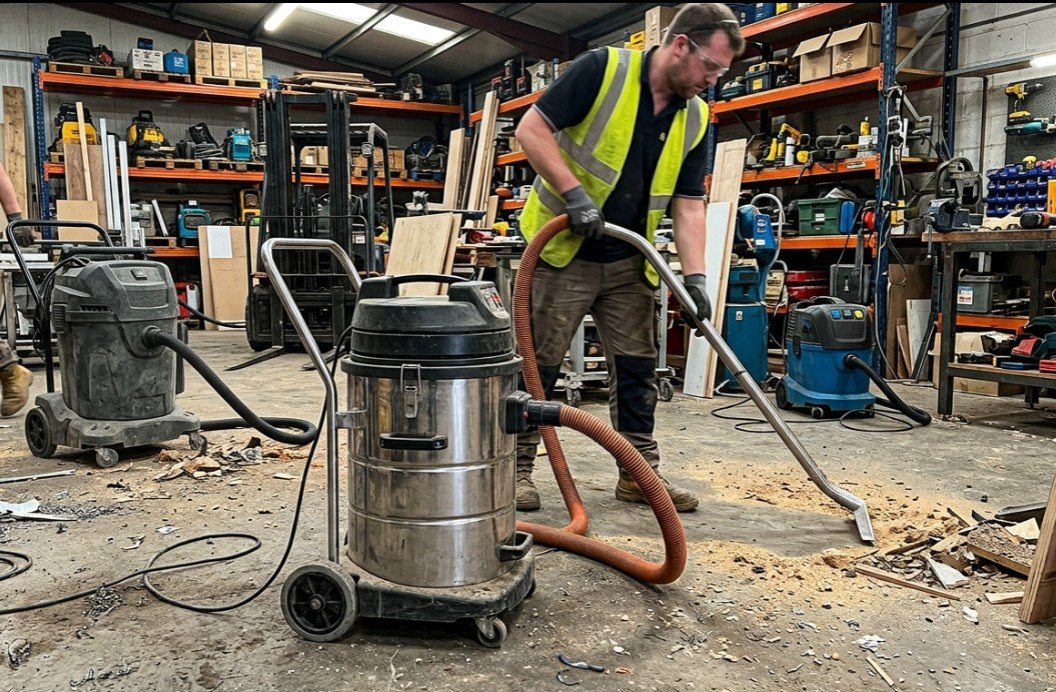
An industrial vacuum cleaner is a high-capacity wet and dry machine built to pick up water, fine dust and heavy debris that would destroy a household vacuum. The best industrial vacuum cleaners in Australia pair a drum of 15 to 100 litres with a motor between 1000W and 2400W, a stainless steel or polyurethane tank, and a blower function for clearing driveways and gutters.
Four types cover almost every job. Wet and dry drum vacuums are the general-purpose workshop standard. Dust extractors connect straight to a power tool and capture silica or timber dust at the source. Cordless workshop vacuums run off a tool battery platform for site work with no lead. Commercial canister vacuums handle dry-only cleaning across large floor areas.
Suction is the number that decides most of this, and it is quoted in kilopascals. Workshop machines generally land between 16 kPa and 20 kPa, roughly double the 8 kPa a typical household barrel vacuum produces. Capacity carries equal weight: a 30 litre drum (about 6.6 imperial gallons) absorbs a burst pipe, while a 15 litre unit fills before the job is finished.
This guide compares six machines on drum capacity, motor power, suction, tank material and whether the unit doubles as a blower or a tool-triggered dust extractor.
Quick Picks
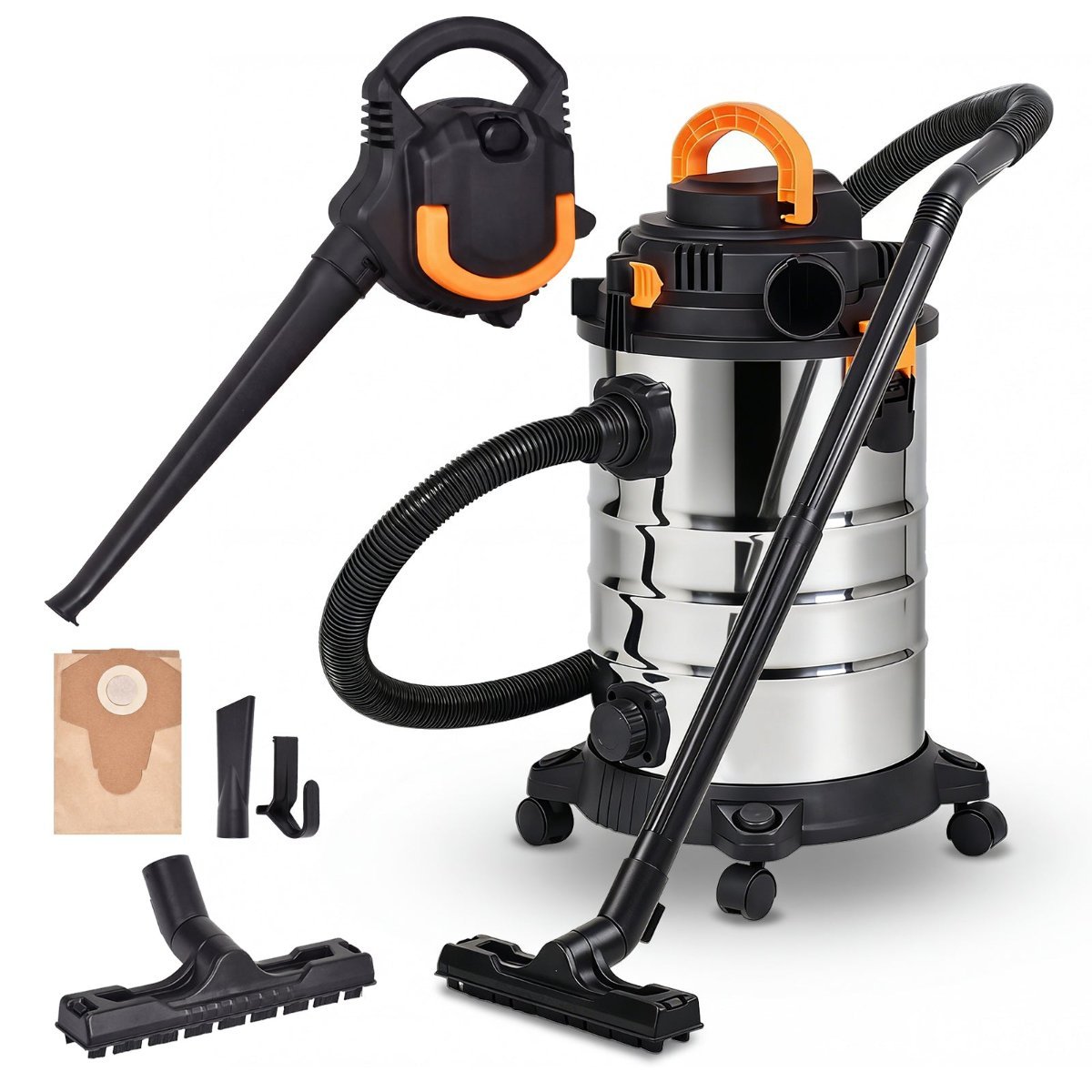
Advwin Industrial Wet and Dry Vacuum
A 30 litre stainless drum, 17 kPa of suction and a detachable blower that genuinely replaces a garden unit.
CHECK CURRENT PRICEBest Industrial Vacuum Cleaners in Australia Compared
| Product | Link | Type | Best For | Key Spec |
|---|---|---|---|---|
| Advwin Industrial Wet and Dry Vacuum | Check price | Wet and dry drum | Workshops and driveways | 30L, 1200W, 17 kPa |
| Akitas Cyclonic Wet and Dry Vacuum | Check price | Cyclonic bagless | Heavy debris | 30L, 2000W, cyclonic |
| DeWALT Heavy Duty Wet and Dry Vacuum | Check price | Wet and dry drum | Job sites | 34L, 1200W, blower port |
| Unimac Dual Motor Wet and Dry Vacuum | Check price | Dual motor drum | Large volume clean-ups | 100L, 2400W, dual motor |
| Bosch Wet and Dry Vacuum and Blower | Check price | Compact wet and dry | Small garages | 15L, 1000W, cartridge filter |
| Ryobi Stainless Steel Workshop Vacuum | Check price | Workshop wet and dry | Home garages | 20L, stainless steel drum |
1. Advwin Industrial Wet and Dry Vacuum – Best for Workshops and Driveways
A stainless steel drum holds 30 litres, and the body measures 33.5cm by 35cm at the base with a height of 53cm. The accessory kit stores on the unit itself, so the three extension tubes, floor nozzle and crevice tool stay with the machine rather than scattering across a bench. A 5 metre cable reaches across a double garage without an extension lead.
The 1200W motor pulls 17 kPa, enough to lift standing water and wet sawdust in a single pass. Switching to blower mode redirects that airflow at 80 to 85 miles per hour, which clears leaves off a driveway faster than most dedicated garden blowers. A sponge filter handles wet pickup and a paper bag takes dry debris.
There is no L-class or HEPA filtration rating here, so fine silica from concrete cutting is not a job for this machine. For a home workshop dealing mostly with sawdust, spills and yard debris, the four-in-one design covers more ground than a single-purpose vacuum.
Pros
- 30 litre stainless steel drum
- 17 kPa suction from a 1200W motor
- Detachable blower reaches 80 to 85 mph
- Accessory kit stores on board
- 5 metre cable
Cons
- No rated filtration class for fine dust
- Sponge filter needs drying between wet jobs
Key specs: 1200W motor, 30L stainless steel drum, 17 kPa suction, detachable blower, 1.5m flexible hose, 5m cable
CHECK CURRENT PRICE2. Akitas Cyclonic Wet and Dry Vacuum – Best for Heavy Debris
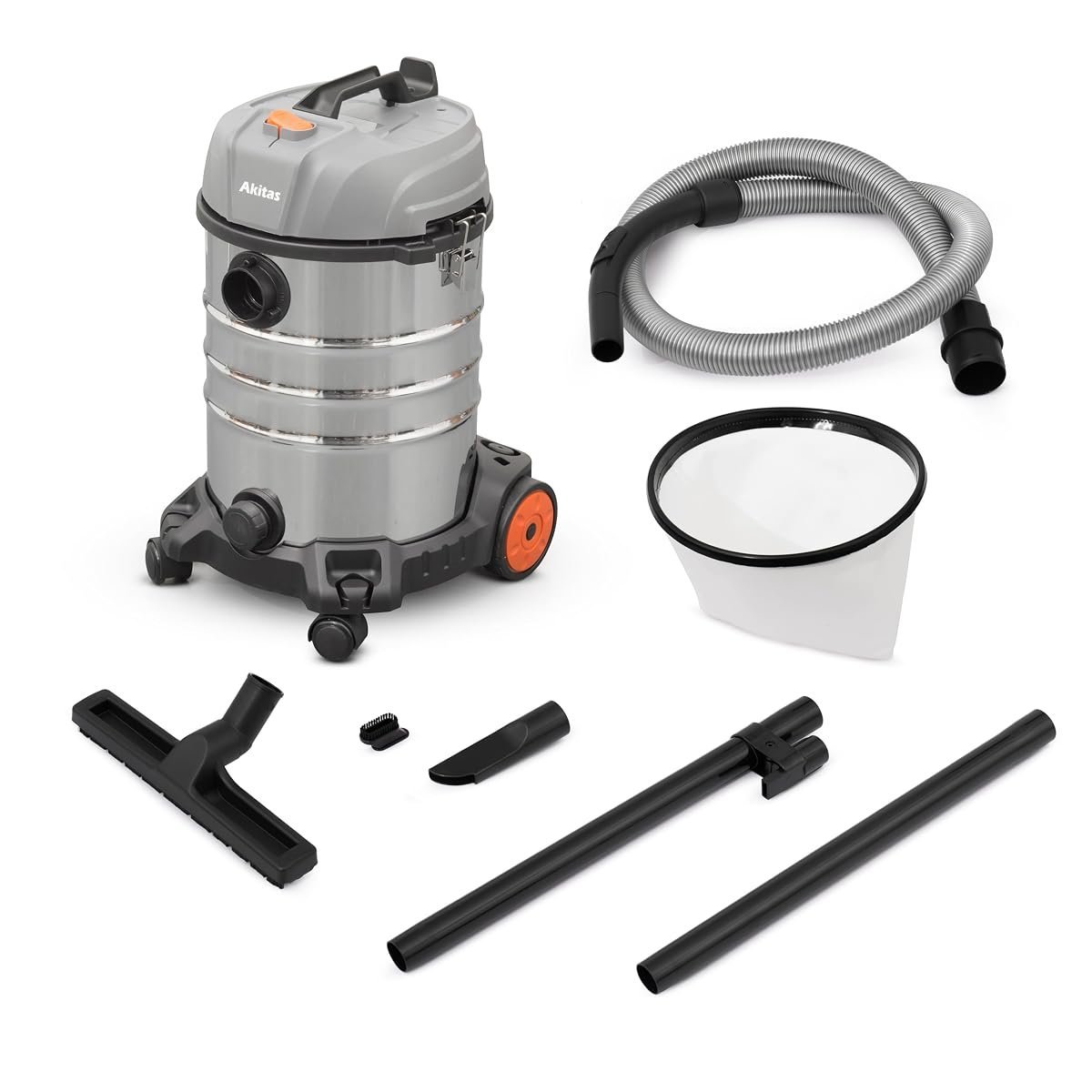
Two thousand watts is the highest motor rating in this guide, and it drives a cyclonic bagless system that spins heavier debris out of the airstream before it reaches the filter. The drum is stainless steel at 30 litres. Bagless operation removes the consumable entirely, which matters when one renovation clean-up would fill several paper bags.
Cyclonic separation holds suction steadier through a long job than a bag-fed machine, where airflow drops away as the bag loads. It takes rubble, wet plaster slurry and leaf litter without fading halfway through. Reversing the airflow turns it into a blower for gutters and workshop corners.
At 2000W it draws more current than the smaller units here, so sharing a circuit with other power tools can trip a breaker in older homes. Where the work is heavy and continuous rather than occasional, the extra power over the rest of this field earns its keep.
Pros
- 2000W motor, the strongest here
- Cyclonic separation keeps suction steady
- No bags to buy or replace
- 30 litre stainless steel drum
- Blower function included
Cons
- High current draw can trip older circuits
- Heavier to move than a 15 litre unit
Key specs: 2000W motor, 30L stainless steel drum, cyclonic bagless separation, blower function
CHECK ON AMAZON3. DeWALT Heavy Duty Wet and Dry Vacuum – Best for Job Sites
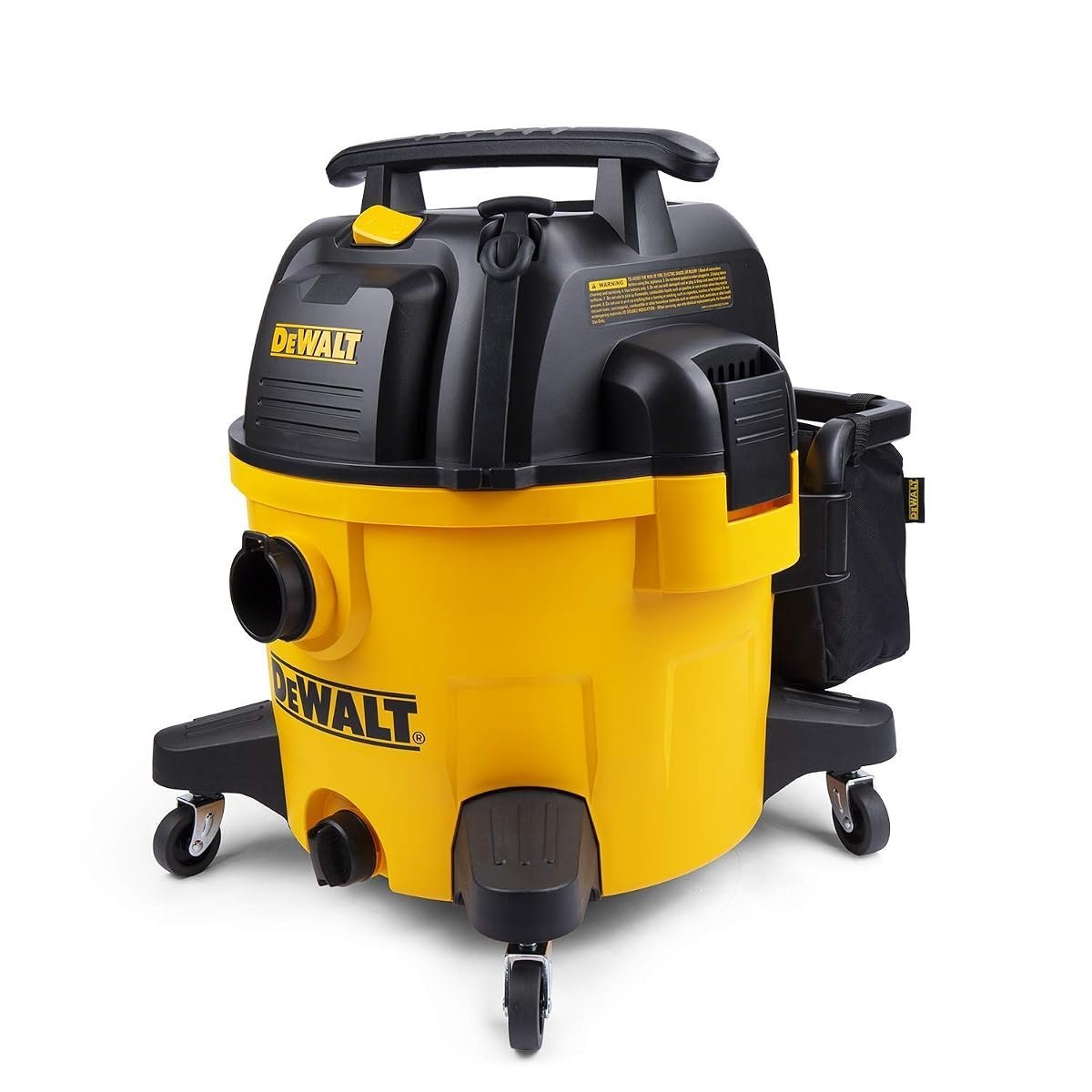
The tank here is polyurethane rather than steel, which takes a knock on a job site without denting or rusting. It holds 34 litres. Heavy-duty rubberised wheels and four metal casters let it roll over rough ground and site debris instead of snagging on it.
A 1200W motor covers wet and dry pickup, and a dedicated blower port on the housing converts it for clearing a work area at the end of the day. The whole build is aimed at daily transport in and out of a ute, where a moulded plastic drum would eventually split.
Polyurethane is lighter than stainless but it scuffs, so it will look worn long before it stops working. Tradespeople moving between sites will get more from this than someone whose vacuum lives in one corner of a garage.
Pros
- 34 litre polyurethane tank resists impact
- Heavy-duty rubberised wheels and metal casters
- Dedicated blower port
- Built for repeated site transport
Cons
- Tank scuffs and marks easily
- No fine dust filtration class
Key specs: 1200W motor, 34L polyurethane tank, blower port, rubberised wheels with four metal casters
CHECK ON AMAZON4. Unimac Dual Motor Wet and Dry Vacuum – Best for Large Volume Clean-Ups
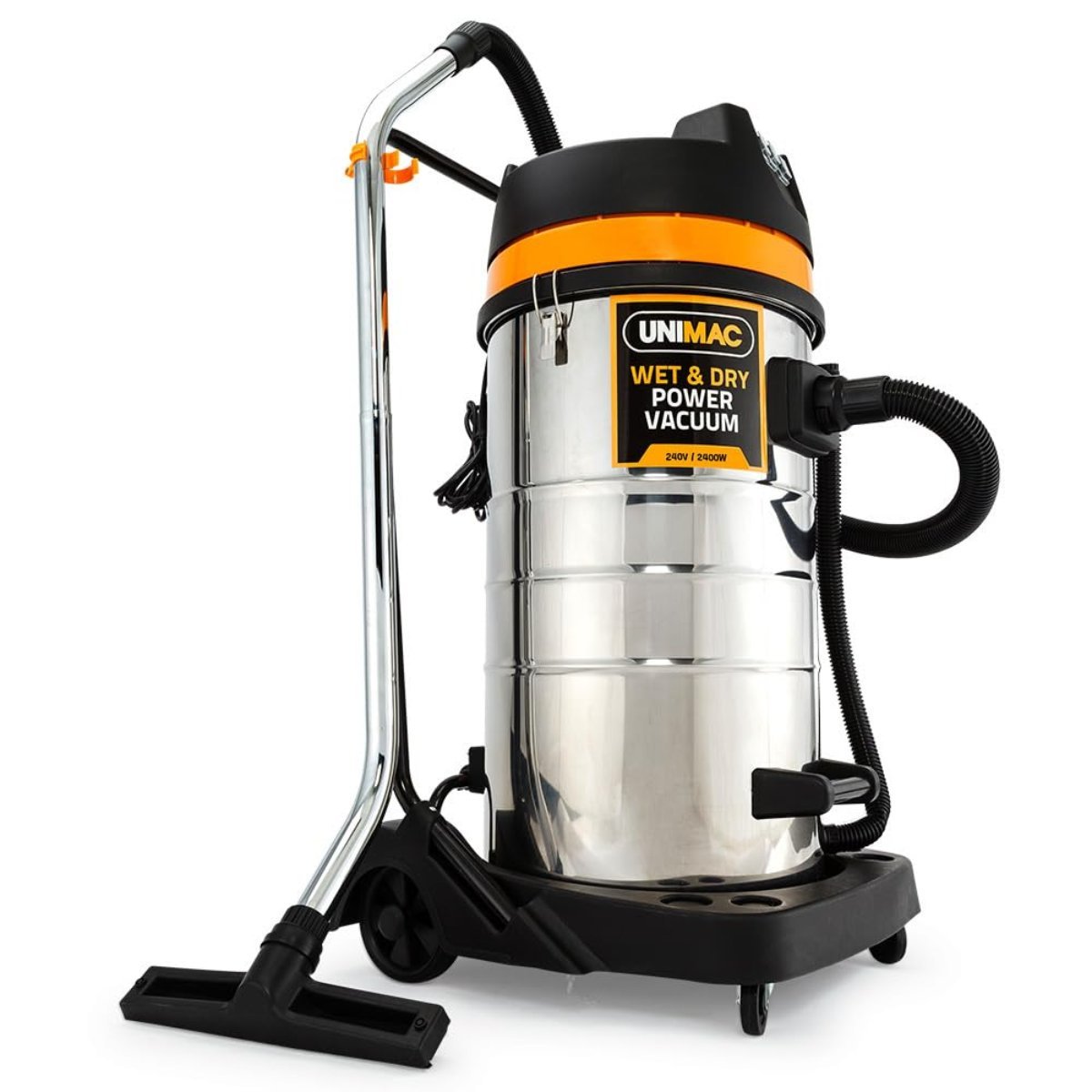
Capacity is the whole argument for this one: 100 litres of 410-grade stainless steel, fed by two copper motors in a dual-stage arrangement drawing 2400W between them. It still runs off a standard 10 amp plug rather than needing a special outlet installed.
Capacity at this scale changes how a job runs. A flooded laundry or a full shed strip-out finishes in one pass instead of stopping to empty a drum every twenty minutes. The dual-motor setup holds suction across the full tank rather than tapering off as it fills.
It is a large machine to store and awkward to carry up stairs, which puts it in a fixed workshop, a farm shed or a cleaning business rather than a suburban garage. Where the volume is genuinely there, nothing smaller keeps up.
Pros
- 100 litre capacity, the largest here
- 410-grade stainless steel tank
- Dual copper motors totalling 2400W
- Runs on a standard 10 amp plug
- Full accessory set included
Cons
- Large footprint to store
- Awkward to move between levels
Key specs: 2400W dual-stage copper motors, 100L 410-grade stainless steel tank, standard 10A plug, accessory set
CHECK ON AMAZON5. Bosch Wet and Dry Vacuum and Blower – Best Compact Pick
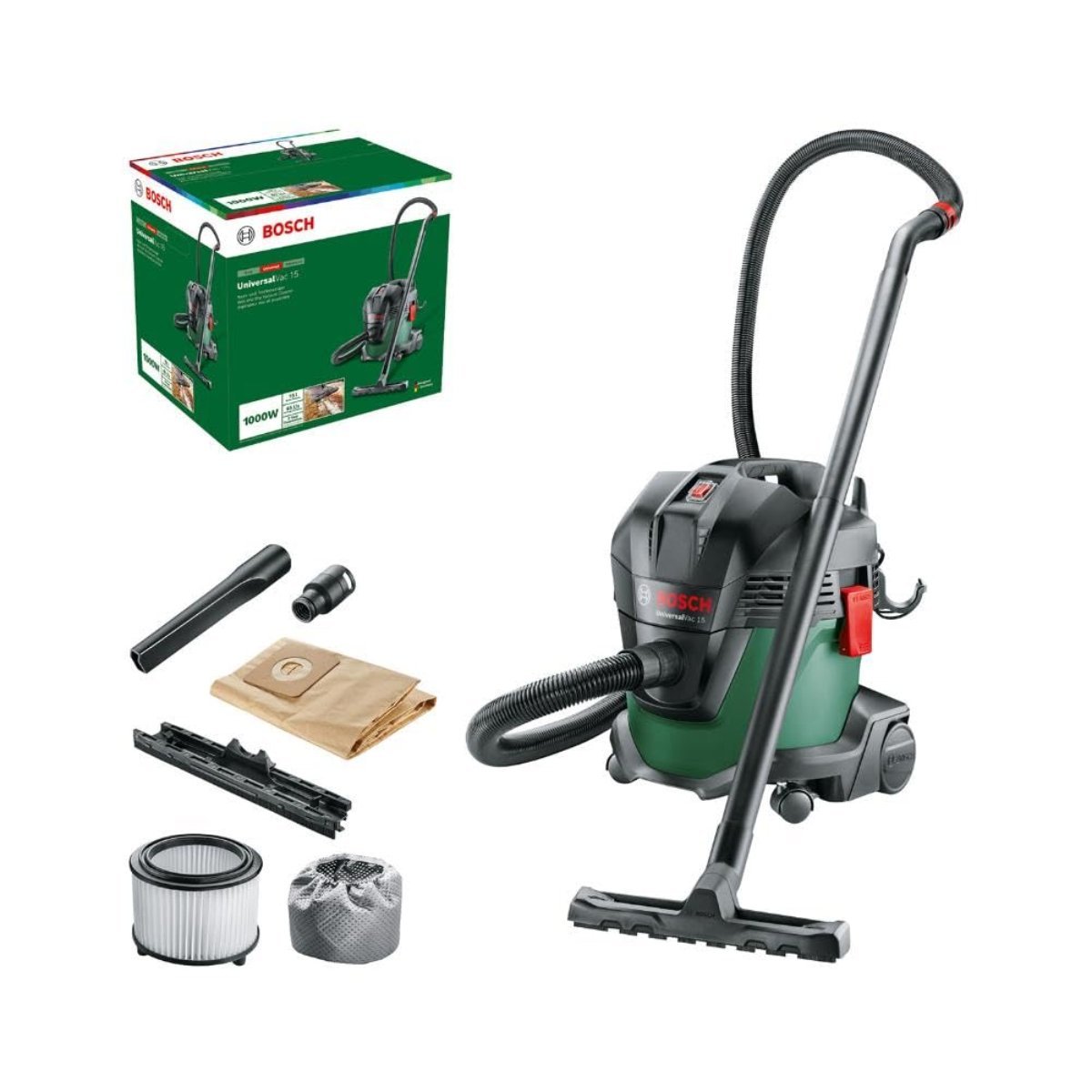
Bosch has aimed this at people short on space. At 15 litres and 1000W it is the smallest mains-powered unit here, built around a cartridge filter that handles wet and dry pickup without being swapped between the two modes.
Removing the filter change removes the step people most often skip, and a filter left in for the wrong mode is what kills a wet and dry vacuum early. Suction is adequate for garage floors, car interiors and workshop benches. The blower function clears clippings and dust off paved areas.
A 15 litre drum fills quickly on a renovation, so this is not the machine for stripping out a room. In a single-car garage or a car detailing setup where storage decides everything, the compact body is worth the smaller capacity.
Pros
- Compact 15 litre body stores easily
- Cartridge filter needs no swapping between wet and dry
- Blower function included
- Lightest mains unit in this guide
Cons
- 15 litres fills fast on big jobs
- Lower suction than the 2000W machines
Key specs: 1000W motor, 15L capacity, built-in wet and dry cartridge filter, blower function
CHECK ON AMAZON6. Ryobi Stainless Steel Workshop Vacuum – Best for Home Garages
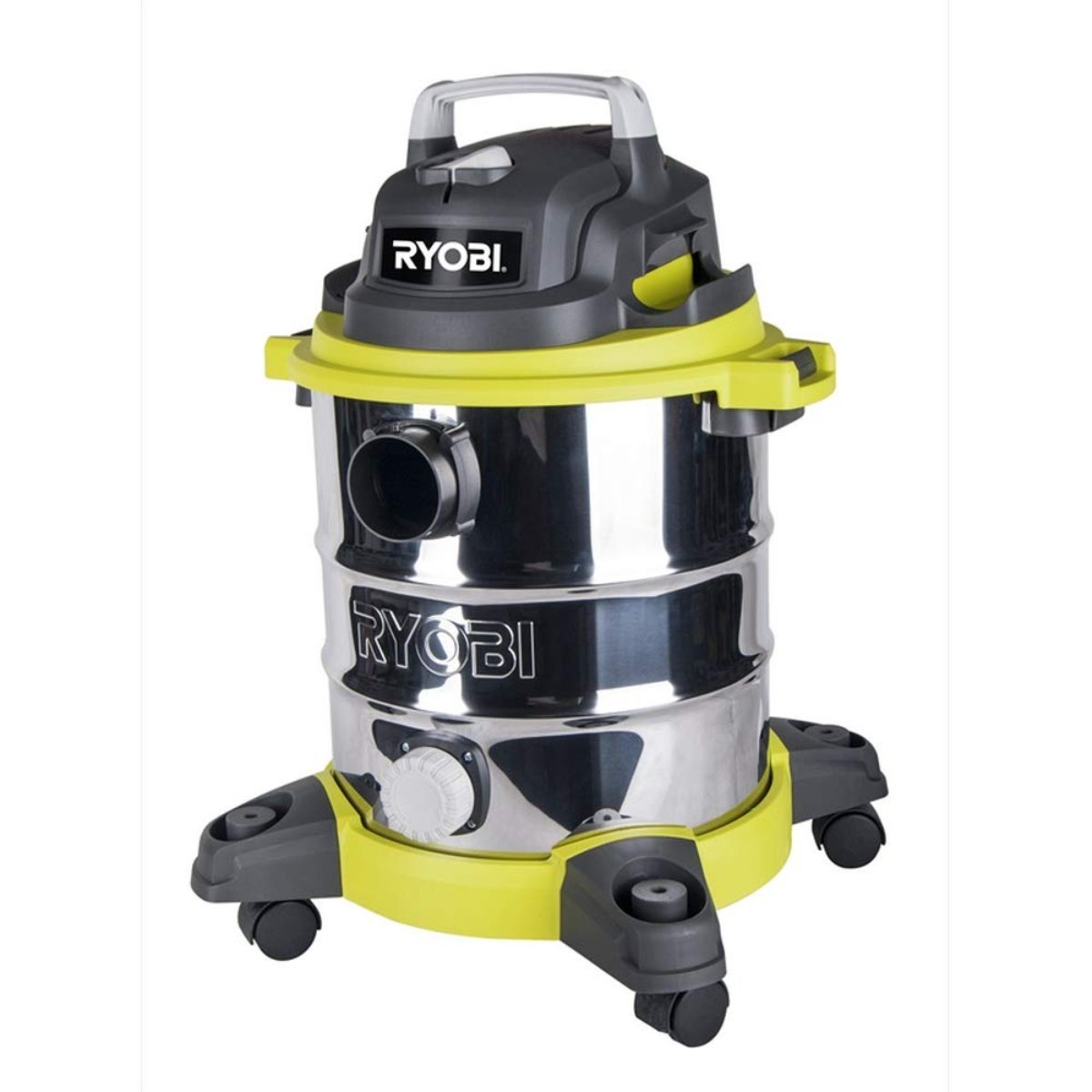
Ryobi keeps this one simple. A 20 litre stainless steel drum, wet and dry pickup, and not much else to go wrong. Stainless resists the rust that finishes off painted steel drums once water has sat in them a few times.
It covers the ordinary run of garage work: sawdust after a weekend project, water from a failed washing machine hose, leaves blown in through an open roller door. Twenty litres gets through most of those without an emptying stop, and the drum wipes out cleanly afterwards.
It sits mid-field on capacity and carries no rated filtration class, so fine dust work still needs a dedicated extractor. The size and the stainless drum make sense for a homeowner; a trade user cutting masonry daily should look at the extractor class above it.
Pros
- 20 litre stainless steel drum resists rust
- Sensible middle capacity for a garage
- Simple build with little to fail
- Wipes out cleanly after wet pickup
Cons
- No rated filtration class
- Fewer extras than the larger machines
Key specs: 20L stainless steel drum, wet and dry pickup, workshop vacuum
CHECK ON AMAZONHow to Choose an Industrial Vacuum Cleaner
Match drum capacity to the job, not to the budget. Fifteen litres suits a single-car garage and car interiors. Thirty litres covers most home workshops and renovation clean-ups. Anything above 60 litres belongs in a fixed workshop, a farm shed or a commercial cleaning run, where the time saved not emptying the drum outweighs the space it occupies.
Suction is measured in kilopascals and the figure is comparable across brands. Workshop machines generally sit between 16 kPa and 20 kPa. Wattage on its own tells you less, because motor efficiency varies: a 1200W unit pulling 17 kPa will outperform a poorly designed 1600W one.
Check the filtration class if you cut concrete, masonry or engineered stone. L-class and M-class ratings describe how much fine dust a machine may pass back into the air. Respirable crystalline silica from concrete and stone is regulated on Australian work sites, and a general-purpose vacuum with a sponge or cartridge filter is not a substitute for a rated extractor.
Decide whether the blower function is worth anything to you. Most units here reverse airflow to clear driveways, gutters and workshop corners. If a garden blower already lives in the shed it adds nothing. If one does not, it removes a second purchase and a second thing to find room for.
Tank material decides how the machine ages. Stainless steel resists the rust that follows repeated wet pickup and holds its shape. Polyurethane absorbs impact without denting, which suits daily site transport, though it scuffs. Painted steel is cheapest and the first to corrode once water has sat in it.
A workshop vacuum does not replace household cleaning. These machines are loud, heavy and built for debris rather than for daily floors. Most homes still want a stick vacuum for quick passes and a robot vacuum handling the maintenance in between.
Frequently Asked Questions
What is the difference between an industrial vacuum cleaner and a household one?
An industrial vacuum handles water as well as dry debris, uses a drum of 15 litres or more, and runs a motor built for continuous duty. A household vacuum will short or burn out if it picks up liquid, and its dust container is usually under 2 litres.
Can an industrial vacuum cleaner pick up water?
Wet and dry models can. They use a float valve that cuts suction once the drum fills, plus either a sponge filter or a cartridge rated for moisture. Dry-only commercial vacuums cannot, and running water through one will damage the motor.
How much suction do I need for a workshop vacuum?
Between 16 kPa and 20 kPa covers sawdust, spills, rubble and leaf litter. Below 15 kPa you will notice heavier debris being left behind. Compare kilopascals rather than watts, since wattage does not account for how efficiently the motor moves air.
Do I need an L-class or M-class dust extractor?
You do if you cut, grind or drill concrete, brick or engineered stone. Those materials release respirable crystalline silica, which is regulated on Australian work sites. For timber dust, general debris and liquid, a standard wet and dry vacuum is adequate.
How often should the filter be cleaned?
Rinse or tap out the filter after every wet job and every few dry ones. A clogged filter is the most common reason a machine seems to have lost suction. Let a washed filter dry completely before dry pickup, or the dust will cake onto it.
Can I connect a power tool to an industrial vacuum?
Models with a power take-off socket can. The vacuum starts automatically when the tool does and keeps running briefly afterwards to clear the hose. Without that socket you can still fit a hose adaptor, but you will be switching the vacuum on and off by hand.
Verdict
The Advwin covers the widest spread of jobs, pairing a 30 litre stainless drum with a blower strong enough to retire a separate garden unit. If the volume runs past what a 30 litre drum can keep up with, the Unimac is the only machine here that will not need emptying mid-job. For a garage where storage space settles every argument, the Bosch is the one that will actually get put away rather than left in the way.