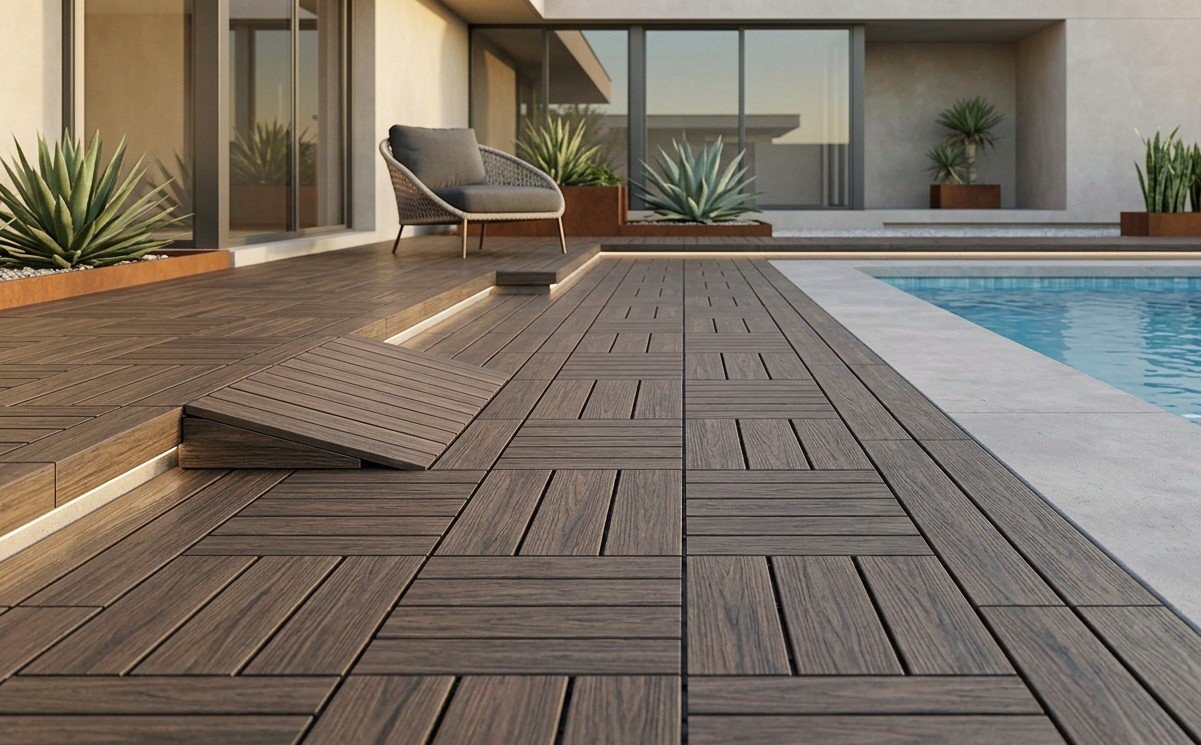
Bare concrete, ageing timber boards and cracked pavers are what decking tiles are built to cover: modular squares that click together over an existing hard surface without glue, screws or a full deck rebuild. The best decking tiles in Australia come in three main materials, wood-plastic composite, solid hardwood and moulded plastic, and which one suits a given space depends more on budget and finish than on how the tile locks together.
Wood-plastic composite (WPC) tiles blend recycled plastic with wood fibre, giving a timber look without the oiling or sanding solid wood needs. Hardwood tiles, usually acacia, are the real thing: heavier, better looking underfoot, but they do need occasional oil to keep their colour. Moulded plastic tiles are the cheapest and lightest option, built from high-density polypropylene rather than any wood content, and they are the most water and stain resistant of the three.
Thickness is the number worth checking before ordering: most tiles sold in Australia run 18mm to 22mm (0.7 to 0.9 inches) thick, and anything thinner tends to flex underfoot on an uneven base. Coverage per pack, load rating and whether the tiles are rated for full sun are the other three details that separate a patio upgrade that lasts from one that fades or cracks within a season.
A small balcony and a full backyard patio call for different things from a tile, and the six options below split roughly in half: two composite, two solid hardwood, and two plastic builds at very different price points. If you are decking out a new outdoor area from scratch, our outdoor furniture guide covers what typically goes on top once the flooring is down.
Best Decking Tiles Australia Compared
| Product | Link | Type | Best For | Key Spec |
|---|---|---|---|---|
| VICTORY RELAX Acacia Hardwood | Check price | Hardwood | Natural hardwood | 9 tiles, acacia, 30x30cm |
| Lauft WPC Composite Tiles | Check price | Composite | Composite build | 10 tiles, WPC, A1 fire-resistant |
| Heitiff WPC Mahogany Tiles | Check price | Composite | Warm timber tone | 9 tiles, WPC, mahogany |
| vidaXL Acacia Hardwood | Check price | Hardwood | European-style build | 10 tiles, acacia, 30x30cm |
| VEVOR 10-Pack Plastic Tiles | Check price | Plastic | Budget pick | 10 tiles, PP plastic, 440 lbs |
| VEVOR 54-Pack Plastic Tiles | Check price | Plastic | Large areas | 54 tiles, PP plastic, 440 lbs |
1. VICTORY RELAX Acacia Hardwood Deck Tiles – Best Natural Hardwood
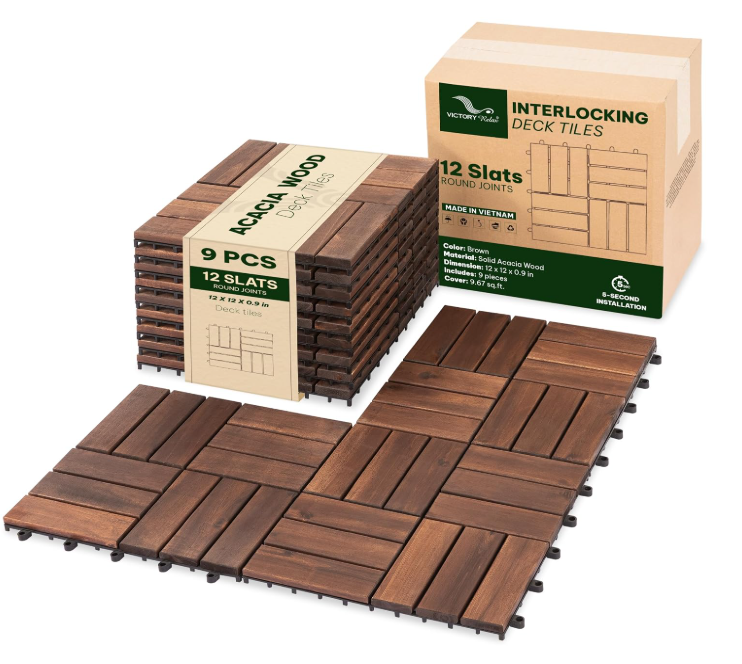
Real acacia hardwood, not a wood-look composite, is what sits underfoot here, cut into 12 slats per tile with round interlocking joints on all four sides. Amazon’s Choice badge and 210 reviews at a 4.6 average make it the most reviewed tile in this list by a wide margin.
Solid timber needs more upkeep than composite or plastic: an annual oil treatment keeps the brown colour from greying out in full sun, though skipping it will not cause structural problems, just a faded look. Each pack of 9 tiles covers roughly 9 square feet at 30x30cm per tile.
Anyone who wants a genuine timber deck feel rather than a synthetic finish gets that here, at the cost of a maintenance routine the composite and plastic options do not need. A shaded balcony that will not see direct sun most of the year is the one setting where the composite options below make more sense instead.
Pros
- Real acacia hardwood, not a composite imitation
- By far the most-reviewed tile in this list, 210 ratings at 4.6 stars
- Round interlocking joints on all four sides
Cons
- Needs periodic oiling to hold its colour in full sun
- Heavier than the plastic options, more effort to reposition
Key specs: 9 tiles per pack, 30x30cm, acacia hardwood, round interlocking joints
CHECK ON AMAZON2. Lauft WPC Composite Deck Tiles – Best Composite Build
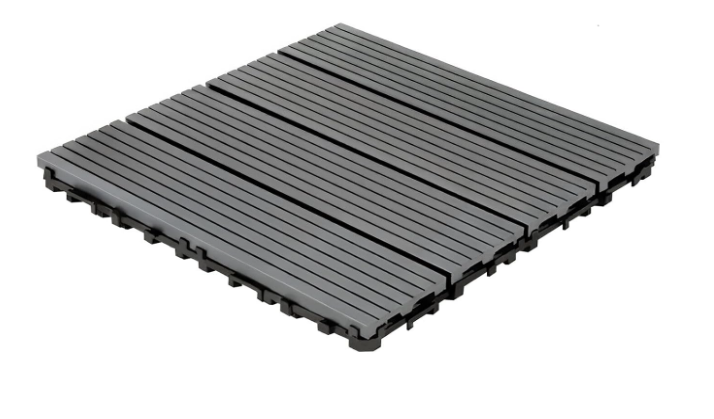
A wood-plastic composite blend rather than solid timber or plain plastic is the build here, with a 4-slat grey finish and an A1 fire-resistance rating that none of the other tiles on this list carry.
At 0.4cm listed thickness, the spec sheet is thinner than most of the acacia options, and the interlocking system is the same tool-free snap design used across this category. As a newer listing it does not carry the review history the VICTORY RELAX tile has, which is worth weighing against the fire-resistance certification.
The fire rating is the specific reason to pick this over the Heitiff composite below, particularly close to an outdoor kitchen, fire pit or barbecue area. Anyone wanting a longer review track record before buying should look at the VICTORY RELAX hardwood or the VEVOR plastic tiles instead, both of which have more customer feedback behind them.
Pros
- A1 fire-resistance rating, the only tile here with one
- Genuine wood-plastic composite build
- Anti-slip textured surface
Cons
- No review history yet as a newer listing
- Listed thickness is on the thinner side of this category
Key specs: 10 tiles per pack, 30x30cm, wood-plastic composite, A1 fire-resistant
CHECK ON AMAZON3. Heitiff WPC Mahogany Deck Tiles – Best Composite for Warm Tones
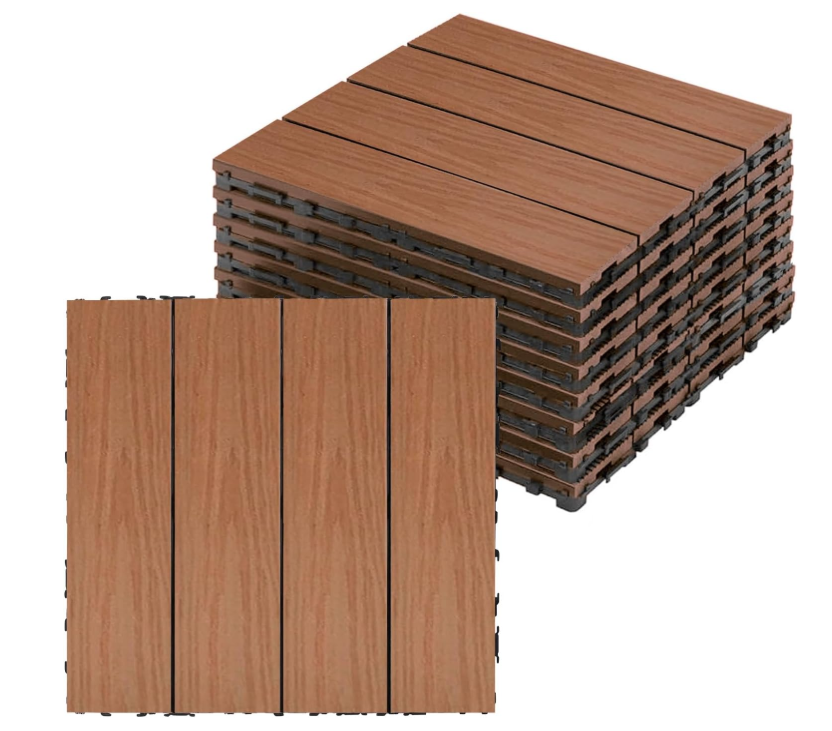
A second wood-plastic composite option, this one finished in a warmer mahogany tone rather than the Lauft’s grey, with the same four-slat grooved surface designed for water runoff.
It is also available in a light coffee colourway and an 18-tile pack size through the same listing, so the pack size and finish can be matched to the exact area being covered rather than settling for whatever a single fixed size offers. Reviews are limited so far at 4.6 stars from 3 ratings, a smaller sample than the VICTORY RELAX tile above.
Choosing between this and the Lauft composite above comes down to colour and whether the A1 fire rating matters for where it is going. A courtyard away from any fire pit or barbecue does not need that certification, and the warmer mahogany tone here suits a timber-look aesthetic better than the Lauft’s grey.
Pros
- Warmer mahogany wood-plastic composite finish
- Available in two colours and two pack sizes through the one listing
- Grooved surface for water drainage
Cons
- Small review sample so far
- No fire-resistance certification, unlike the Lauft composite above
Key specs: 9 tiles per pack (18-pack available), 30x30cm, wood-plastic composite, mahogany
CHECK ON AMAZON4. vidaXL Acacia Hardwood Deck Tiles – Best European-Style Build
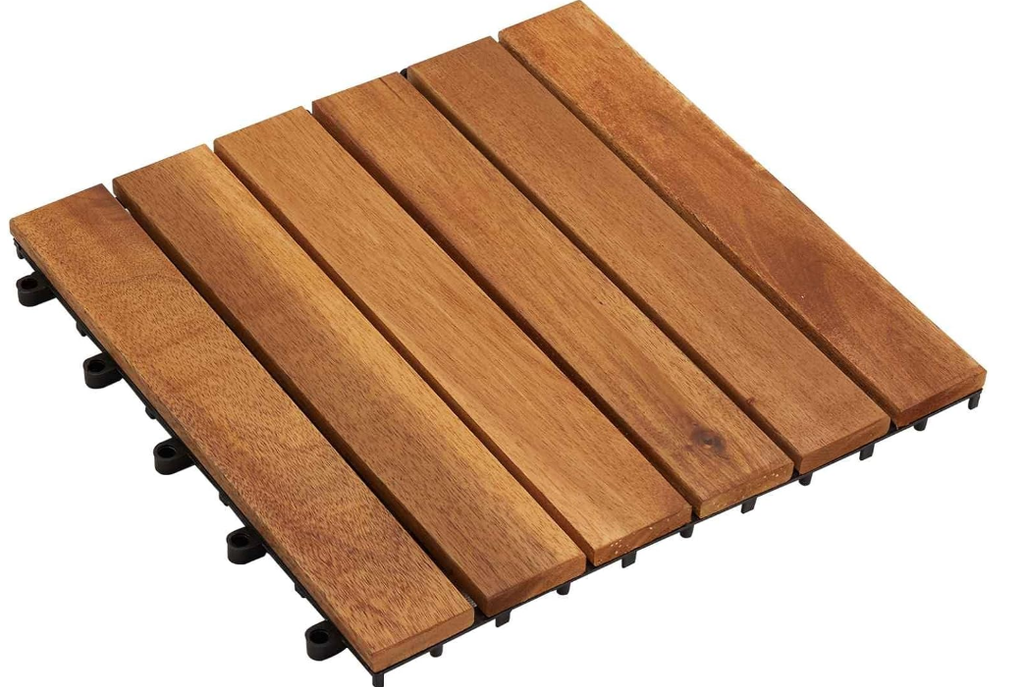
vidaXL brings a European home-goods catalogue approach to this list: solid acacia hardwood again, but in a 10-tile pack rather than 9, and priced a little above the VICTORY RELAX equivalent.
Specs track closely with the other acacia option on this list, brown-toned hardwood cut to 30x30cm tiles with an interlocking edge system. The main practical difference is pack count and the vidaXL brand’s broader furniture and homewares range, useful if matching an existing vidaXL outdoor setting.
There is no strong technical reason to pick this over the VICTORY RELAX hardwood unless brand matching or the extra tile in the pack matters to the specific area being covered. Someone tiling a slightly larger space who wants to avoid buying a part-second-pack gets more practical value from the extra tile here than from the marginally cheaper price on the VICTORY RELAX listing.
Pros
- 10 tiles per pack, one more than the other acacia option here
- Matches vidaXL’s broader outdoor furniture range
- Solid acacia hardwood construction
Cons
- Priced above the equivalent VICTORY RELAX hardwood tile
- Limited review history compared to VICTORY RELAX
Key specs: 10 tiles per pack, 30x30cm, acacia hardwood
CHECK ON AMAZON5. VEVOR 10-Pack Interlocking Plastic Deck Tiles – Best Budget Pick
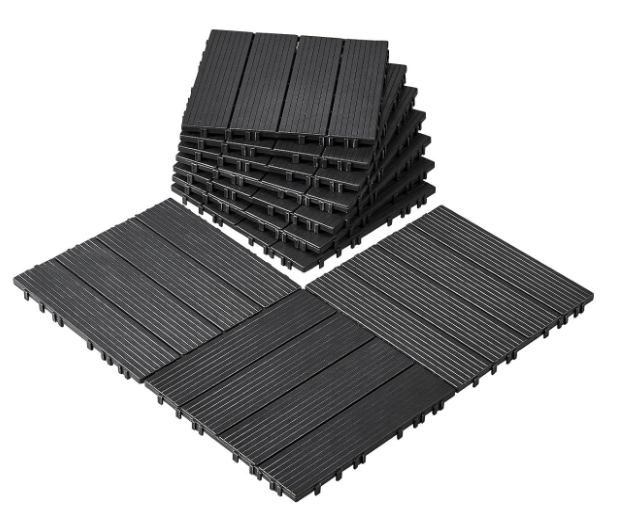
High-density polypropylene rather than any wood content is what this is built from, which makes it the most water and stain resistant tile on this list, and the cheapest per-tile of the smaller pack sizes here.
VEVOR rates the load capacity at 440 lbs across the tile’s 0.8-inch thickness, with a cross-patterned backing for impact resistance and a slip-resistant surface texture. Ten tiles cover 10 square feet, and the plastic construction means no oiling, staining or sealing at any point.
This is the practical pick for a rental balcony, a shed floor or anywhere the deck-timber look matters less than cost and low maintenance. Anyone wanting the appearance of real timber underfoot should look to the acacia or composite options above instead, since plastic reads as plastic up close regardless of the woodgrain texture moulded into the surface.
Pros
- Lowest price per tile among the smaller packs on this list
- 440 lbs load rating with impact-resistant backing
- Zero maintenance, fully waterproof plastic build
Cons
- Does not look or feel like timber up close
- Smallest coverage per pack among the plastic options here
Key specs: 10 tiles per pack, 30x30cm, PP plastic, 440 lbs load rating
CHECK ON AMAZON6. VEVOR 54-Pack Interlocking Plastic Deck Tiles – Best for Large Areas
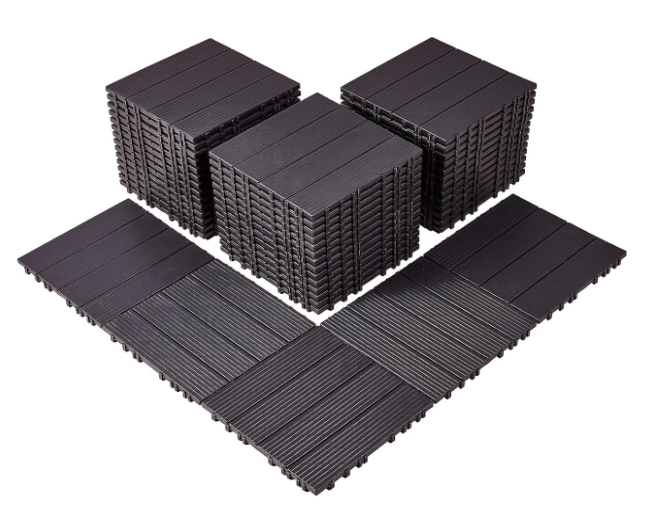
The same PP plastic build as the 10-pack above, scaled up to 54 tiles for 54 square feet of coverage in one order, enough for a full-size patio or double garage floor without ordering multiple smaller packs.
It carries the strongest review count of any tile on this list at 160 ratings averaging 4.3 stars, a useful data point given the larger single purchase involved. The same 440 lbs load rating and cross-patterned backing from the smaller VEVOR pack applies here.
Buying in this size only makes sense once the area is actually measured, since 54 tiles is a large commitment compared to the 9 or 10 tile packs elsewhere on this list. For anything under roughly 30 square feet, the smaller VEVOR pack or one of the composite options above is the more sensible starting point.
Pros
- Largest single-order coverage on this list at 54 square feet
- Strongest review count here, 160 ratings at 4.3 stars
- Same load rating and backing as the smaller VEVOR pack
Cons
- Large minimum commitment if the space does not need 54 tiles
- Same plastic look and feel as the smaller VEVOR pack
Key specs: 54 tiles per pack, 30x30cm, PP plastic, 440 lbs load rating
CHECK ON AMAZONHow to Choose Decking Tiles
Material decides both the look and the maintenance routine. Wood-plastic composite splits the difference: a timber-look surface that does not need oiling. Solid acacia hardwood looks and feels the most authentic but needs an annual oil treatment to hold its colour. Moulded plastic is the lowest-maintenance and cheapest option, at the cost of an obviously synthetic surface up close.
Thickness and load rating matter more once outdoor furniture, a barbecue or foot traffic from a family is involved. Most tiles in this category run 18mm to 22mm thick, and the load ratings published by brands like VEVOR, around 440 lbs per tile, give a rough guide to how much weight a tile can take without flexing or cracking.
Coverage and pack size should be measured against the actual area before ordering, since buying a fixed pack size that undershoots the space means a second order in a different batch that may not match in colour exactly. Nine or ten-tile packs suit a small balcony or entryway, while anything over 30 square feet is better served by a bulk pack like the 54-tile VEVOR option.
The interlocking system is largely standardised across brands: tiles click together edge to edge without tools, and most can be cut down with a hand saw to fit around a post, drain or irregular edge. Check whether edge or corner trim pieces are sold separately for the specific tile, since an exposed raw edge on a composite or plastic tile looks unfinished compared to hardwood, which can be left square-cut.
Sun and weather exposure affects composite and hardwood more than plastic. A north-facing deck in full Queensland or WA sun will fade a hardwood tile faster than a shaded southern balcony, and composite tiles vary in UV resistance by brand, so a lighter colour that will not show fading as obviously is worth considering for a high-sun position.
Cleaning and maintenance is mostly a hose-and-broom job across all three materials, though a build-up of grime in the grooved drainage channels benefits from an occasional pressure wash rather than scrubbing by hand. Keep the nozzle on a wide fan setting rather than a narrow jet on composite or plastic tiles, since a concentrated jet can strip the surface texture. Our pressure washer guide covers the settings and nozzle types that suit outdoor flooring specifically.
Frequently Asked Questions
What is the difference between composite and hardwood decking tiles?
Composite tiles blend recycled plastic with wood fibre for a timber look that does not need oiling or sanding, while hardwood tiles are solid timber, usually acacia, that need periodic oil treatment to keep their colour but feel and look the most authentic underfoot.
How thick should decking tiles be?
Most decking tiles sold in Australia run 18mm to 22mm thick. Thinner tiles are more likely to flex on an uneven base, so a level or near-level sub-surface matters more with a thinner tile than a thicker one.
Can decking tiles go over concrete?
Yes, decking tiles are designed to click together over an existing hard, reasonably level surface such as concrete, pavers or an old timber deck, without any glue or fixings into the base.
Do plastic decking tiles get hot in summer?
Dark-coloured plastic and composite tiles absorb more heat than light colours and can get noticeably warm underfoot in direct summer sun, similar to dark pavers. A lighter grey or natural timber tone stays cooler than a dark brown or black finish in the same position.
How many decking tiles do I need per square metre?
A standard 30x30cm tile covers 0.09 square metres, so roughly 11 tiles cover one square metre before allowing for cuts around edges. Buying a small additional margin, around 5 to 10 percent extra, covers wastage from cutting tiles to fit borders.
Are decking tiles a permanent installation?
No, that is the main advantage over a built deck. Tiles sit loose, interlocked with each other rather than fixed to the ground, so they can be lifted, moved or reconfigured, which also makes them suitable for rental properties where permanent structures are not an option.
Verdict
Anyone wanting a genuine timber feel without an oiling routine is best served by the Lauft or Heitiff composite tiles, and the Lauft’s A1 fire rating makes it the safer of the two near a barbecue or fire pit. For a real hardwood surface, the VICTORY RELAX acacia tile carries far more customer reviews than any other option here and needs only an annual oil treatment to stay looking its best. Covering a full-size patio rather than a balcony is the one case where the 54-tile VEVOR plastic pack earns its place, at a lower cost per square foot than composite or hardwood at the same scale.