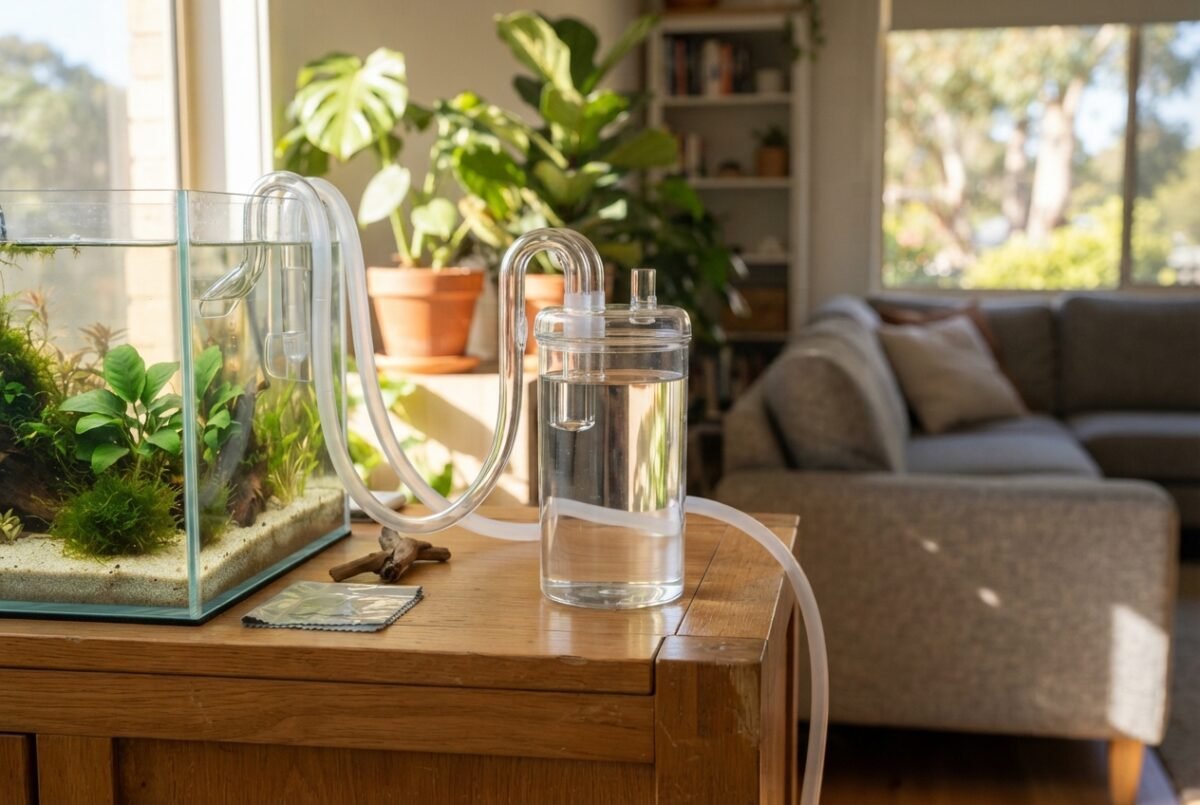
An aquarium filter is the equipment that keeps fish tank water safe to live in, pulling water through media that traps solid waste, hosts the bacteria that break down ammonia, and returns clean water to the tank in a continuous cycle. Skip one, or run an undersized one, and ammonia and nitrite from fish waste and uneaten food build up fast enough to poison a tank within days. The best aquarium filter Australia fish keepers rely on does three jobs at once: it strains out visible debris, it grows enough bacteria to process waste chemically, and it keeps water moving without blasting fish that prefer calmer flow.
Three main types cover almost every tank sold here. Internal filters sit underwater on suction cups and suit small to medium setups where a bulky external unit would look out of place. External canister filters sit below or beside the tank and push water through several stacked media baskets, giving bigger tanks the surface area they need for mechanical, biological and chemical filtration in one box. Hang-on-back (HOB) filters clip to the rear glass and split the difference, dropping into a tank with no plumbing at all. A fourth feature, UV sterilisation, is not a filter type by itself but bolts onto a canister unit to knock over free-floating algae and pathogens that media alone cannot catch.
The number that separates one filter from the next is flow rate in litres per hour, matched against the tank’s actual volume rather than its footprint. Manufacturers generally recommend turning over a whole tank four to six times an hour, so a 200 litre tank wants a filter rated somewhere between 800 and 1200 litres per hour once head height and media resistance eat into the rated figure. The picks below range from a 400 litre per hour internal unit for a 90 litre tank up to a 3,500 litre per hour canister built for tanks up to 1500 litres. The spec most buyers skip past is noise and vibration from the pump itself, since a filter that hums through a bedroom wall gets switched off within a week, and a filter nobody runs isn’t filtering anything.
This lineup runs from a budget internal sponge filter through mid-range external canisters to a premium high-flow unit built for large show tanks, covering freshwater and saltwater setups alike. One honest boundary: these are filtration units only, so heaters, lighting, and the gravel vacuum you will want on water-change day are covered separately in the accessories section below.
Quick Picks
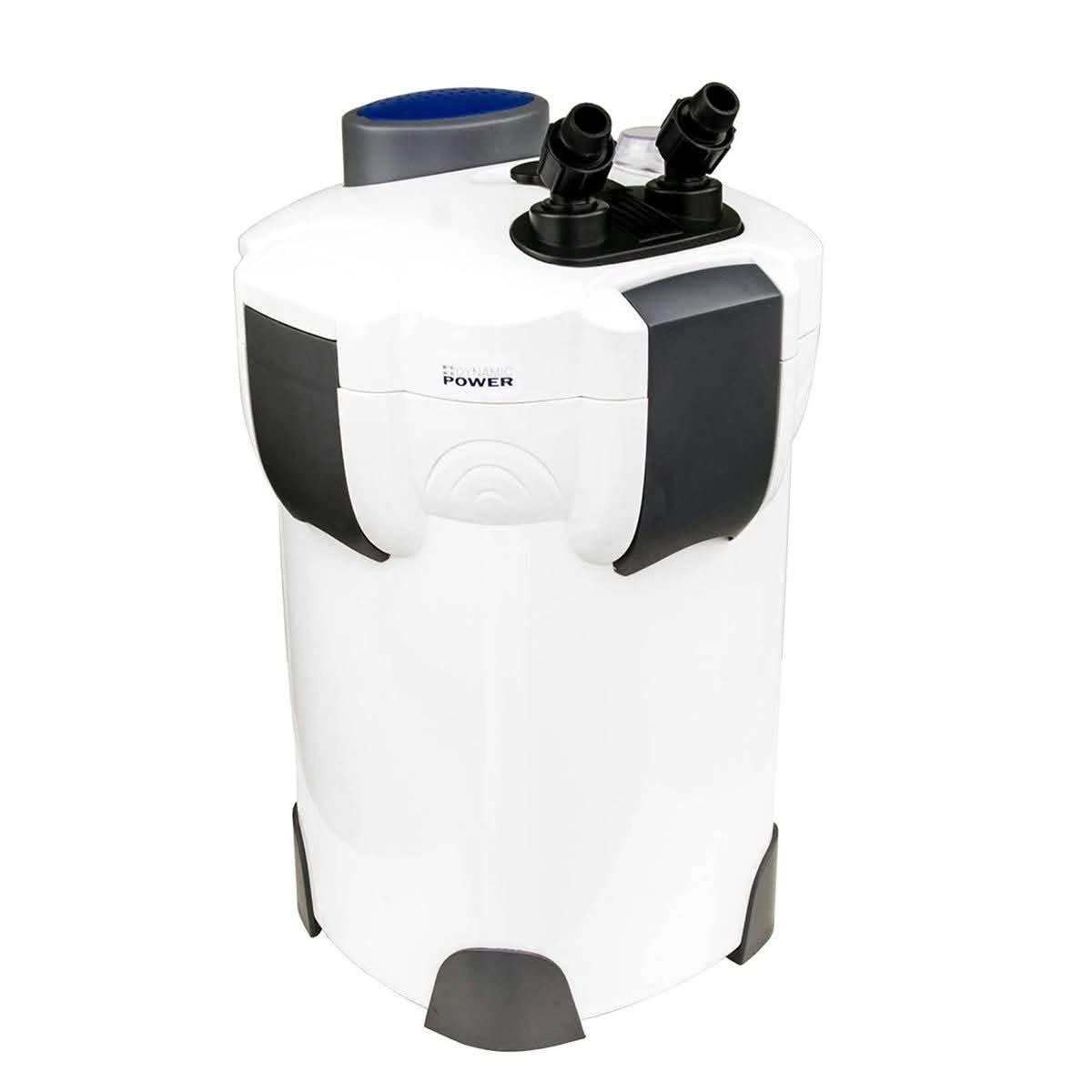
Dynamic Power UV Light External Canister Filter 2000L/H
Bolts on a 9W UV steriliser that knocks over green water, built for tanks up to 500 litres.
CHECK CURRENT PRICE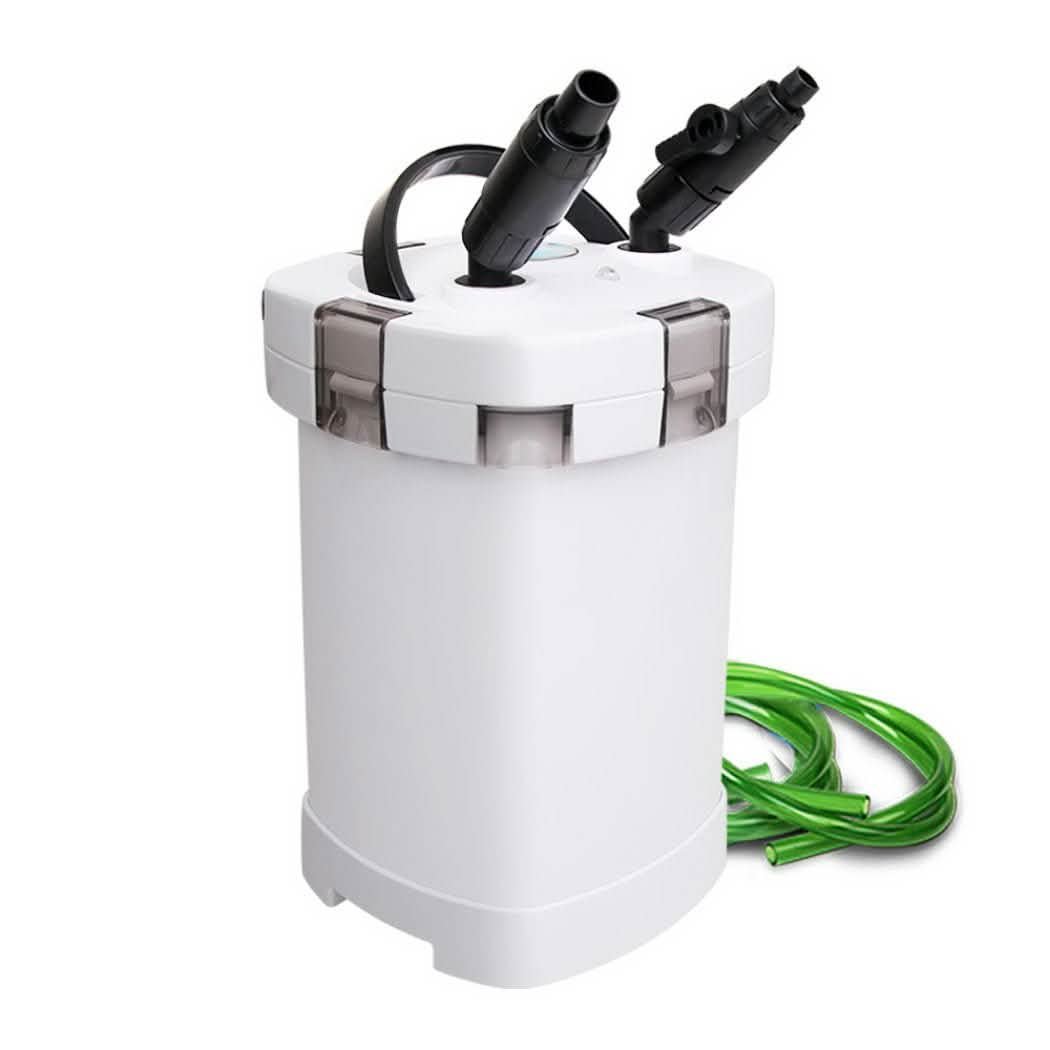
Giantz External Canister Filter 1250L/H
Four stackable media baskets and a leak-proof cap lock on a mid-size canister that suits tanks up to 250 litres.
CHECK CURRENT PRICE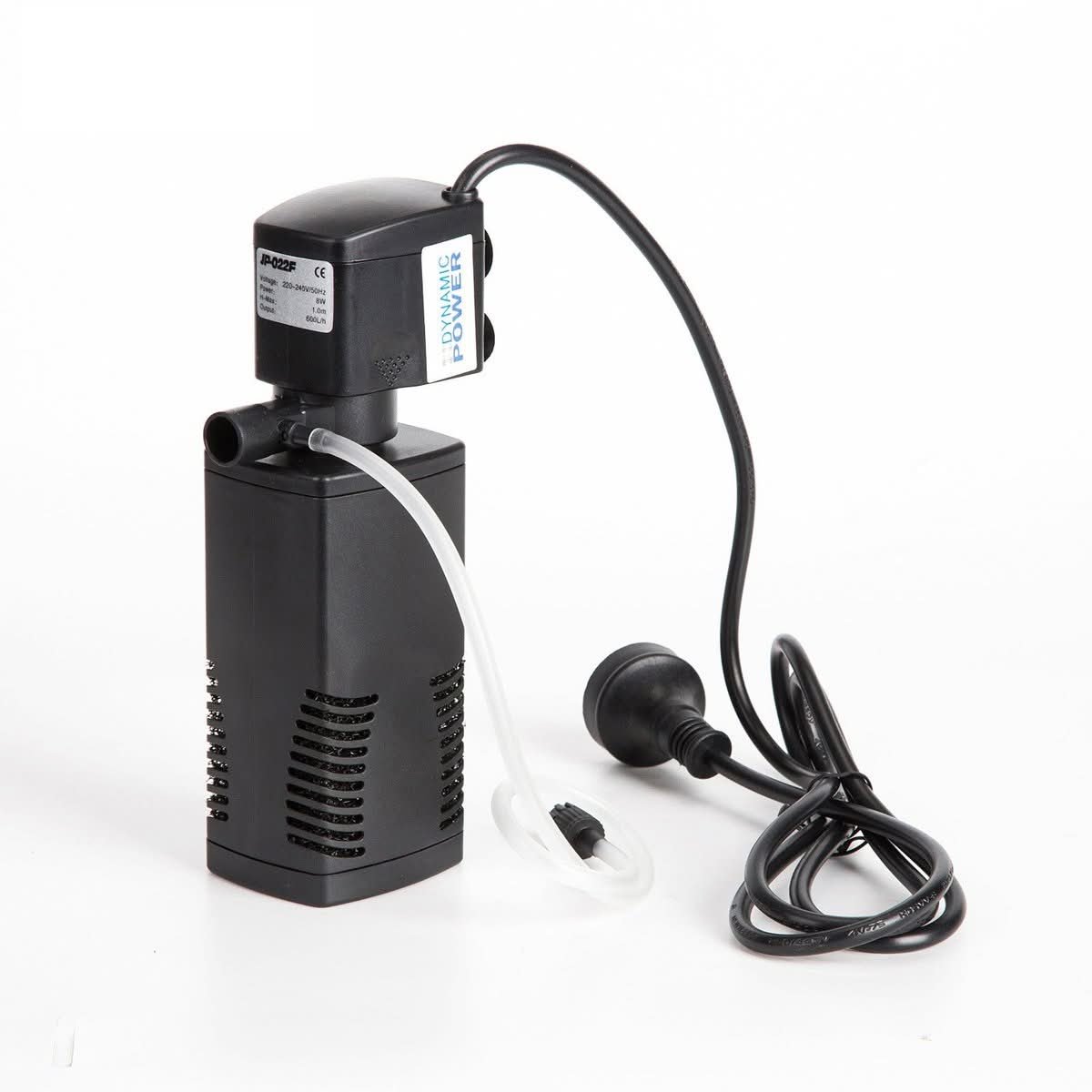
Dynamic Power Submersible Filter 600L/H
Filters, circulates and aerates in one compact unit that suction-cups straight into a nano tank.
CHECK CURRENT PRICEBest Aquarium Filter Australia Compared
| Product | Link | Type | Best For | Key Spec |
|---|---|---|---|---|
| Dynamic Power UV Light External Canister Filter 2000L/H | Check price | External canister with UV | Algae control | 2000L/H, 500L tanks |
| Giantz External Canister Filter 1250L/H | Check price | External canister | Mid-size tanks | 1250L/H, 250L tanks |
| Dynamic Power External Canister Filter 400L/H | Check price | External canister | Small tanks | 400L/H, 90L tanks |
| Dynamic Power Submersible Filter 600L/H | Check price | Internal/submersible | Nano tanks | 600L/H, 50L tanks |
| Fluval FX6 High Performance Canister Filter | Check price | External canister | Large show tanks | 3500L/H, 1500L tanks |
| Boyu EFU-45 Canister Filter with UV | Check price | External canister with UV | Large community tanks | 1100L/H, 450-650L tanks |
| SunSun HW-703B External Canister Filter with UV | Check price | External canister with UV | Green water control | 1400L/H, 350L tanks |
| Aqua One AquaBac 100 Internal Filter | Check price | Internal filter | Compact tanks | 450L/H, 100L tanks |
| Aqua One 100 Clearview Hang-On Filter | Check price | Hang-on-back | Budget upgrades | 180L/H, small tanks |
How We Picked
We swept the aquarium filtration ranges at Australia’s main dropship and pet-gear retailers, then checked Amazon AU where the category ran thin, reading full specifications instead of titles alone to avoid pond pumps and decorative tank kits being mistaken for filters. That covered several dozen listings, of which nine survived as in-stock aquarium filters spanning internal, hang-on-back and external canister designs.
From there we filtered on three things: confirmed AU stock, a flow rate matched to a real tank size instead of an inflated headline figure, and no duplicate product resold under a second storefront. We checked tank-sizing advice against RSPCA NSW and the NSW Department of Primary Industries, and leaned on Amazon AU verified-buyer patterns where a filter has a long review history.
1. Dynamic Power UV Light External Canister Filter 2000L/H – Best for Algae Control
This is the biggest canister in the lineup that is still built for a household aquarium, not a pond, rated to 2000 litres an hour across four stacked media baskets loaded with bio balls, ceramic noodles and activated carbon. A 9W UV lamp sits inline before the outlet, and that is the actual point of paying more here: it sterilises free-floating algae spores and pathogens that mechanical media never touches. The PVC housing is chunky (about the footprint of a large shoebox) and the water flow shut-off tap means you can pull the lid without a bucket standing by.
Brisbane and Cairns tanks fight algae blooms nearly year-round, since humidity barely drops even through winter and warm ambient temperatures keep algae spores active. That is exactly the climate this filter earns its keep in, running the UV lamp continuously instead of dosing it only now and then. Rated for tanks up to 500 litres, it will comfortably handle a large community tank set up in anything from a new-estate townhouse to an older weatherboard, or a modest saltwater setup, and the 4-basket design means you can swap media combinations as your tank matures instead of locking you into one configuration.
At 55W plus the UV lamp’s own draw, this runs warmer and costs more to operate than the smaller canisters below it, roughly the premium end of this guide on running cost as well as upfront outlay. The trade-off is a filter that still needs its media replaced on a schedule: expect to swap carbon every four to six weeks and rinse, never replace, the biological media at water changes, or you reset the bacteria colony that actually does the filtering. Buy this if algae control matters more than a light power bill; the compact 400 litre per hour unit further down this list suits a smaller, calmer setup instead.
Pros
- 9W UV steriliser knocks over algae and free-floating pathogens continuously
- Four swappable media baskets with bio balls, ceramic noodles and carbon included
- Water flow shut-off tap makes lid removal mess-free
- Rated to 500 litres, enough headroom for a large community tank
Cons
- The case runs noticeably warm to the touch near the UV chamber after a few hours, more than the spec sheet suggests
- Carbon needs replacing every four to six weeks or it stops adsorbing and becomes just another hiding spot for waste
- At 29 x 29 x 48.5cm it eats more cabinet space under the tank than the flow-rate spec alone suggests
Key specs: 2000L/H, 55W plus 9W UV, up to 500L tanks, 4 media baskets, freshwater and saltwater, full media kit included.
CHECK CURRENT PRICE2. Giantz External Canister Filter 1250L/H – Best Value Canister Filter
Roughly half the price of the UV canister above and half its flow rate too, the Giantz unit is the filter most mid-size community tanks actually need. It suits freshwater and saltwater tanks up to 250 litres, running at just 14W thanks to a filter and pump kept separate instead of combined into one housing. The four-tier stackable basket design is flexible: use every level for one style of media, or split it across mechanical, biological and chemical stages depending on what your tank needs.
Setup takes maybe ten minutes without tools, and the tight cap lock is the detail that actually matters day to day: no drips, no re-seating the lid every time you bump the hose. Buyers moving from an internal filter to their first external canister consistently mention this as one of the easier units to prime, since the hose sizes, 1.2cm and 1.5cm, fit standard aquarium tubing without adapters.
Filter media is not included, so budget for bio balls, ceramic noodles and carbon separately on top of the unit itself, unlike the UV filter above which ships with a full kit. That is the one real gap between the two. For a tank in the 150 to 250 litre range without an algae problem to solve, this is the sensible pick over the pricier UV unit.
Pros
- Four-tier stackable basket design suits mixing mechanical, biological and chemical media
- Tight cap lock stops leaks and speeds up lid removal at water-change time
- Low 14W draw keeps running cost down for a canister this size
- Straightforward setup with standard-size tubing, no adapters needed
Cons
- Filter media is not included, so budget for a separate buy before the tank is actually filtering anything on day one
- The stock hose length is short for a tank sitting in a cabinet set back from the wall, so measure before assuming it reaches
- The four stacked baskets need to sit dead level or the lid will not seal properly, which takes a couple of goes to get right the first time
Key specs: 1250L/H, 14W, up to 250L tanks, 4-stage stackable basket, freshwater and saltwater, media sold separately.
CHECK CURRENT PRICE3. Dynamic Power External Canister Filter 400L/H – Best for Small Tanks
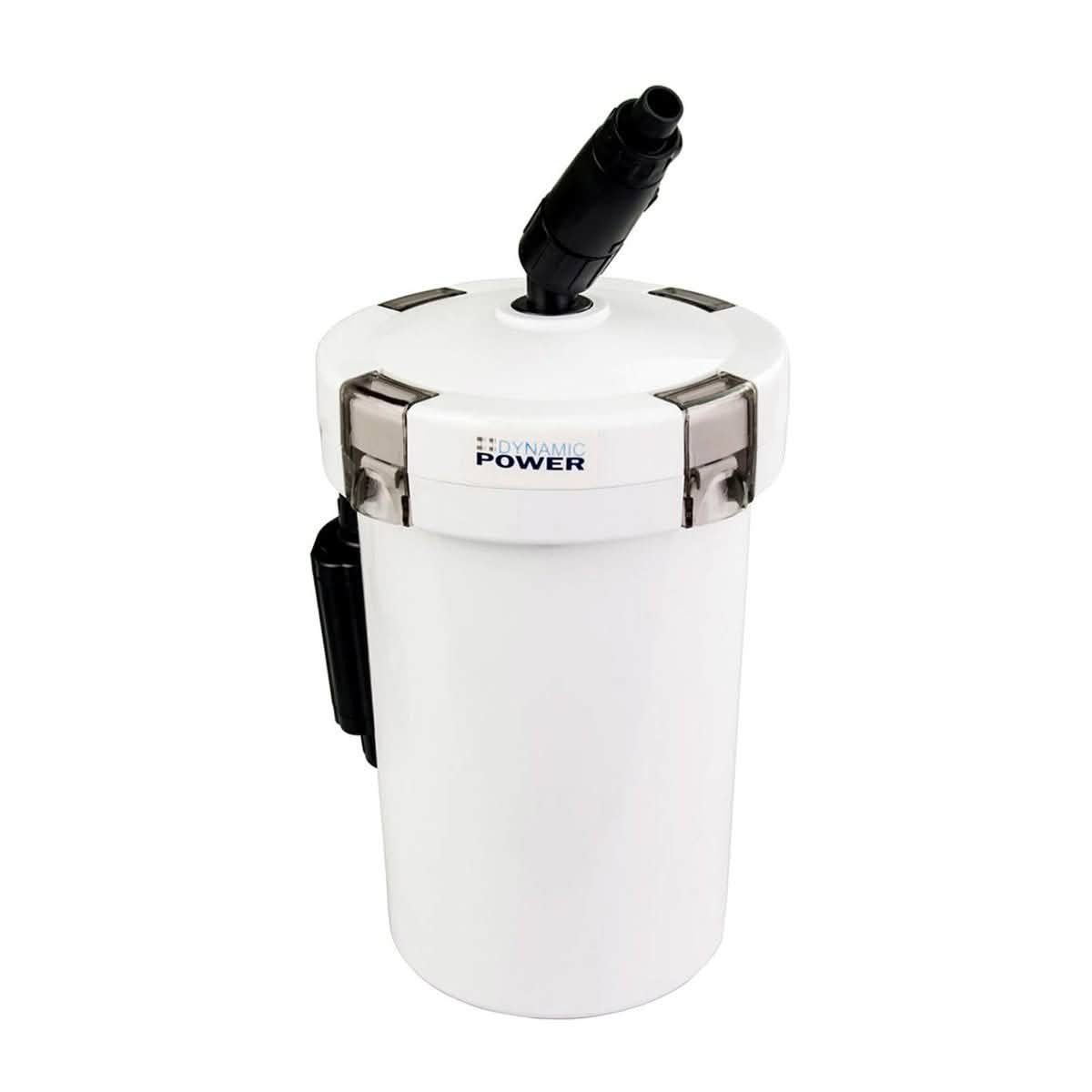
Scaled down for tanks up to 90 litres, this pulls 400 litres an hour on just 6W, running quiet enough to sit in a living room without becoming background noise. It ships with four filter sponges instead of a full media kit, so setup is fast: sponges in, hoses connected, done. Suits a 60 to 90 litre tank, a common size for a first serious freshwater setup in a share house or a first apartment.
The compact 16 x 16 x 33cm footprint tucks behind almost any stand, and the water flow shut-off tap doubles as flow control if your fish prefer gentler current. Sponge-only media is the trade-off: it handles mechanical and some biological filtration well, but you will want to add carbon or ceramic noodles yourself if water clarity or odour becomes an issue. This is the one we would point a first-time fishkeeper toward over the internal units further down this list, since an external canister forgives more overfeeding mistakes than a small internal box does.
Pros
- Quiet enough to run in a living room without becoming background noise
- Compact 16 x 16 x 33cm footprint fits behind almost any stand
- Low 6W draw keeps running cost negligible
- Water flow shut-off tap doubles as a crude flow control
Cons
- Ships with sponges only, so carbon and ceramic noodles are a separate buy if chemical filtration matters to you
- The short 1.3m tubing runs out fast if the tank sits higher than a standard stand
- Sponges need rinsing in old tank water every couple of weeks or they clog and flow drops noticeably
Key specs: 400L/H, 6W, up to 90L tanks, 4 filter sponges included, freshwater and saltwater.
CHECK CURRENT PRICE4. Dynamic Power Submersible Filter 600L/H – Best Budget Pick
A renter setting up a first 40 to 50 litre tank in a share house rarely wants tubing, a separate pump and an external canister bolted to the stand. This is the answer: filtration, water circulation and aeration in one unit small enough to suction-cup inside the tank itself (about the size of a soft-drink can). No external plumbing, no cabinet space taken, nothing to explain to a landlord doing an inspection.
The built-in biochemical sponge handles mechanical and biological filtration and is easy to pull out and rinse, and the included air tube adds a bit of surface agitation that a still 40 litre tank often needs. Works in freshwater, saltwater and even a garden pond feature, it is the cheapest useful filter in this guide by a decent margin, sitting well under half the price of the small external canister above it.
The trade-off is capacity: 600 litres an hour tops out at 50 litre tanks, and pushing it onto anything bigger leaves the water looking clean while ammonia quietly climbs, since there simply is not enough media volume to process the bioload. Fine as the only filter on a nano tank or as backup circulation in a larger one. Not a filter to stretch past its stated size.
Pros
- Filters, circulates and aerates in one compact unit with no external plumbing
- Suction-cups straight into the tank, ready in a couple of minutes
- Cheapest useful filter of the nine here by a decent margin
- Built-in sponge is simple to pull and rinse without tools
Cons
- Tops out at 50 litres, and pushing it onto a bigger tank lets ammonia climb even while the water looks clear
- The suction cups lose grip on glass after a few months and need replacing or the unit can drift loose
- No spray bar included, so surface agitation is limited to whatever the air tube manages alone
Key specs: 600L/H, 8W, up to 50L tanks, 3-in-1 filtration/circulation/aeration, ABS housing, suction-cup mount.
CHECK CURRENT PRICE5. Fluval FX6 High Performance Canister Filter – Best for Serious Fishkeepers
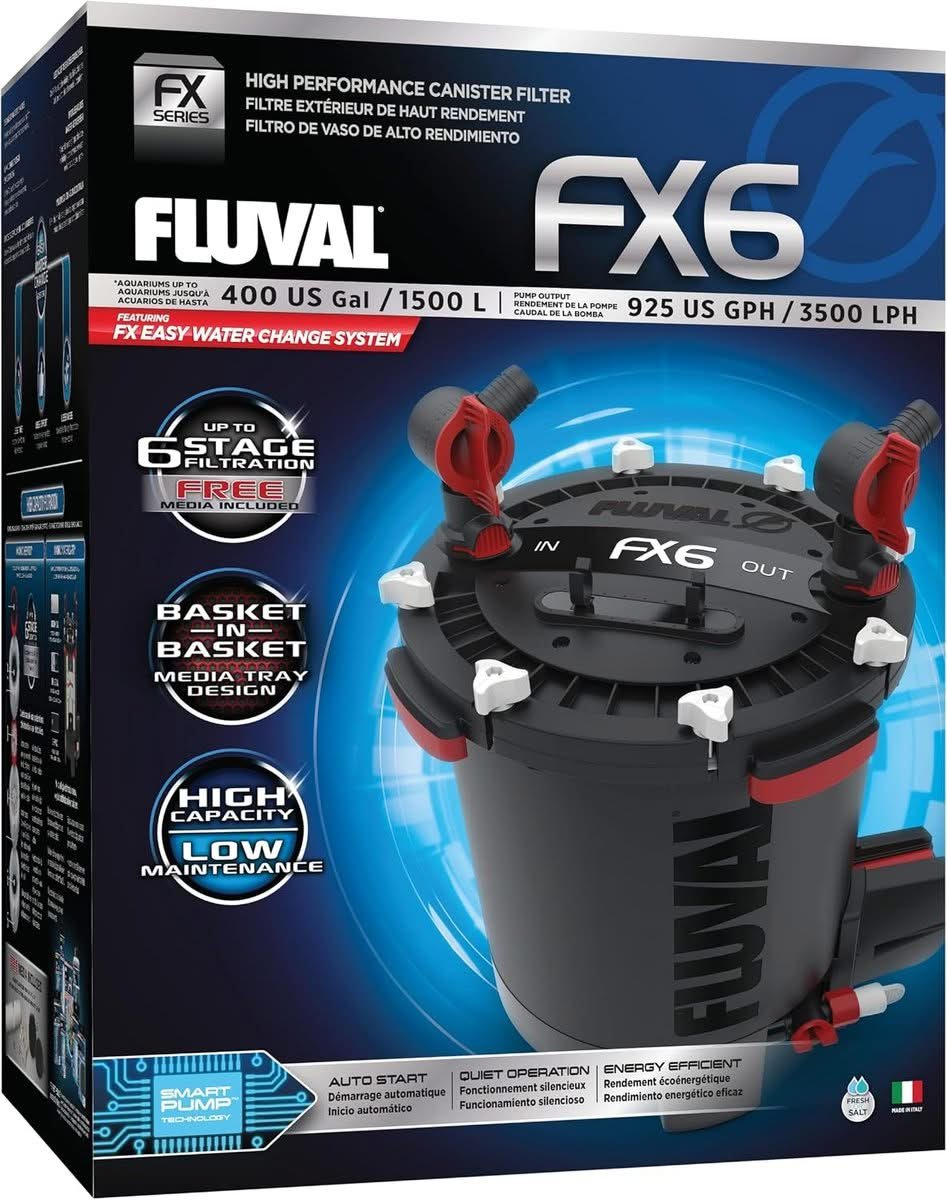
This is the only unit in the lineup built for a large tank, rated to 3,500 litres an hour and sized for aquariums up to 1500 litres. Fluval’s Smart Pump technology self-primes, just add water and plug in, and auto-evacuates trapped air every 12 hours, which sounds like a gimmick until you have owned a canister that airlocks and stops pumping without warning.
The media baskets are stackable and hold 5.9 litres of media between them, more than three times the capacity of the mid-range canisters above, which is the real reason serious fishkeepers pay this much for one filter. Output plumbing is designed for water changes without lifting a bucket: attach hosing to the output and the pump does the draining for you, a time-saver on a tank too big to siphon by hand.
Nearly 15,000 buyers rating this at 4.6 stars is not a coincidence in this category. Well, ratings get gamed elsewhere, but a review base this size and this consistent is hard to fake. It is one of the most reviewed canister filters sold in Australia, and the complaints that do surface are almost all about the price, not performance. That consistency matters more than any single spec, since a filter this expensive needs to still be working in five years, not five months.
This is not a filter for a 200 litre tank, and buying it for one wastes most of what you are paying for. It earns its keep on a large show tank, a heavily stocked community setup, or anyone running multiple smaller tanks off one oversized canister via a manifold. If your tank is under 400 litres, the Boyu or SunSun canisters below do the job for a fraction of the outlay.
Pros
- Rated to 3,500L/H and built for tanks up to 1500 litres, more headroom than anything else here
- Self-priming Smart Pump auto-evacuates air every 12 hours without manual intervention
- 5.9 litre media capacity across stackable baskets, well beyond the mid-range canisters above
- Nearly 15,000 ratings at 4.6 stars, an unusually deep review history for this category
Cons
- The premium end of this guide by a wide margin, and overkill for anything smaller than a large tank
- At 53 x 40 x 40cm it needs real cabinet space (closer to a small esky than a typical canister)
- Priming and hose runs take real setup time the first time, more fiddly than the smaller units above despite the self-priming pump
Key specs: 3500L/H, up to 1500L tanks, 5.9L media capacity, self-priming Smart Pump, dims 53 x 40 x 40cm.
CHECK ON AMAZON6. Boyu EFU-45 Canister Filter with UV – Best for Large Community Tanks
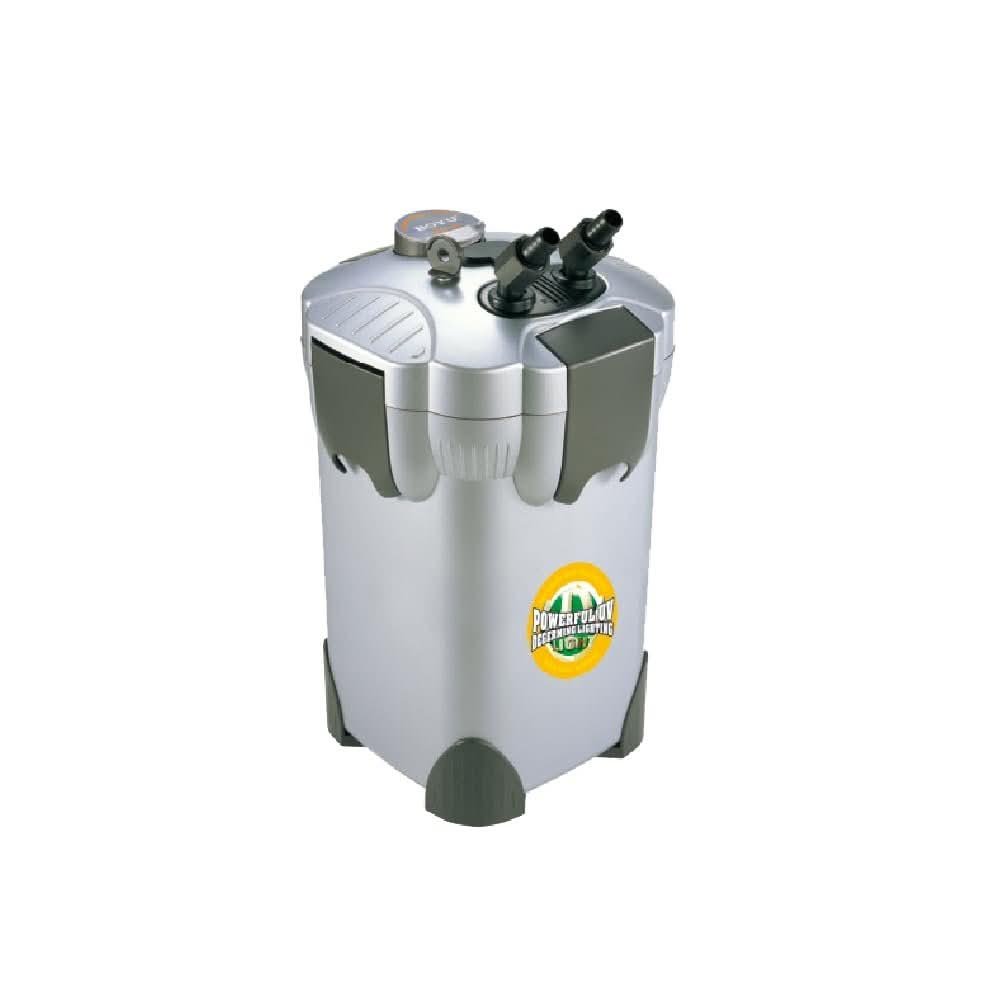
This is the one pick on this list we nearly cut. Stock ran to a single unit left at the time of writing, which is not the kind of thing you want to read before committing to a filter at the premium end of this guide. It stayed on the list because nothing else in this price range covers a 450 to 650 litre tank with a built-in UV stage, and that combination is hard to find elsewhere.
The integrated valve control puts the inlet and outlet in one block rather than two separate taps, which sounds minor until you are the one doing maintenance every few weeks with wet hands. The UV steriliser runs off its own switch, so you can run mechanical and biological filtration without the UV stage during fishless cycling, then switch it on once the tank is stocked and green water turns from a risk into a near certainty.
Comes fitted with an AU 2-pin plug, no adapter needed, and the pump is quiet enough by reputation to sit in a living room. Suits a well-stocked 450 to 650 litre community tank where algae control matters as much as mechanical filtration. If stock has run out by the time you are reading this, the SunSun canister below covers a smaller tank with the same UV feature at a lower outlay.
Pros
- Covers a large 450 to 650 litre tank with a built-in UV stage, an unusual combination at this price
- Integrated valve control simplifies maintenance compared with separate inlet and outlet taps
- UV steriliser runs off its own switch, useful for skipping it during fishless cycling
- AU 2-pin plug fitted standard, no adapter required
Cons
- Stock has been thin in our checks, so availability is the real risk here, not the filter itself
- No media kit included at this price point, unlike the UV canister at the top of this list
- Being a newer listing, it does not yet have the review depth to confirm long-term reliability
Key specs: 1100L/H, up to 450-650L tanks, UV steriliser with separate switch, integrated valve control, AU plug.
CHECK ON AMAZON7. SunSun HW-703B External Canister Filter with UV – Best for Green Water Control
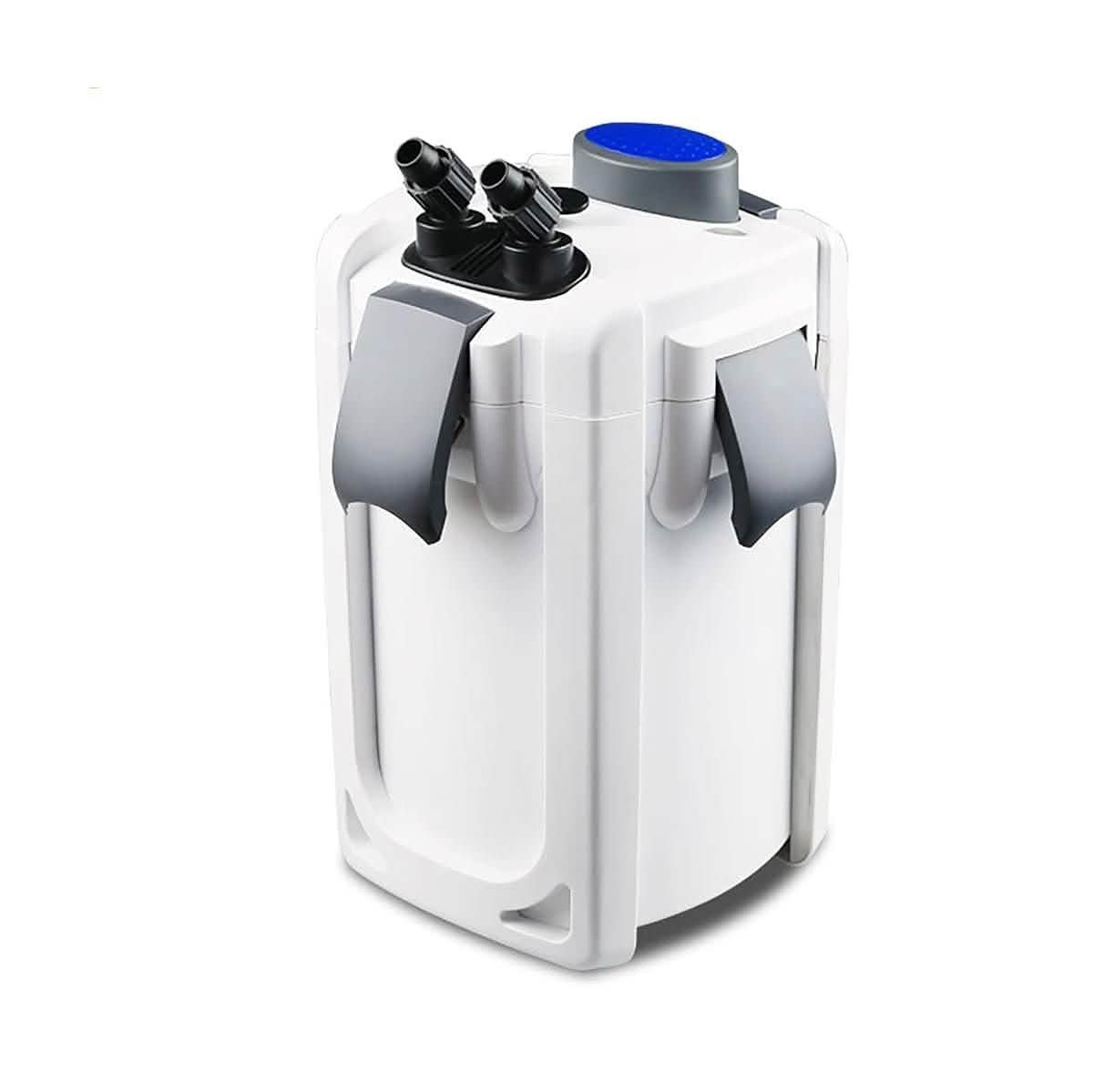
SunSun is one of the more established names in imported aquarium gear, and the HW-703B brings a 9W UV stage to a mid-size 1400 litre an hour canister rated for tanks up to 350 litres. At 30W total draw it sits comfortably between the small canisters and the premium units above on running cost, and the canister ships with a full set of tubing at 16mm and 22mm diameter, so hose replacement down the track is not a hunt for an obscure size.
The UV lamp runs off its own switch, same as the Boyu above, which means you are not stuck sterilising water you do not need to during the first weeks of a new tank cycling in. A 2.0m maximum head height gives some flexibility on cabinet placement, and the unit comes fitted with an Australian 3-pin plug, skipping the two-pin-to-three-pin adapter some imports need.
This sits in the mid-range for this category in Australia, a step up in price from the compact canisters early in this list but a step down from the Fluval further up, with a comparable UV feature set to the pricier Boyu. Fair pick for a 250 to 350 litre freshwater or saltwater tank where green water is a recurring problem, not an occasional one.
Pros
- 9W UV stage on a mid-size canister at a lower outlay than the premium units above
- Full set of standard-diameter tubing included, no hunting for obscure hose sizes later
- UV lamp runs off its own switch, skippable during a fishless cycle
- Australian 3-pin plug fitted, no adapter required
Cons
- 350 litre ceiling means it will not stretch to a large community tank the way the Boyu or Fluval will
- The plastic fittings feel lighter-duty than the Fluval’s, though the price gap explains most of that
- Setup instructions are translated roughly in places, so the first build benefits from checking a video instead of relying on the printed steps alone
Key specs: 1400L/H, 30W, 9W UV, up to 350L tanks, H-max 2.0m, AU 3-pin plug.
CHECK ON AMAZON8. Aqua One AquaBac 100 Internal Filter – Best Compact Internal Filter
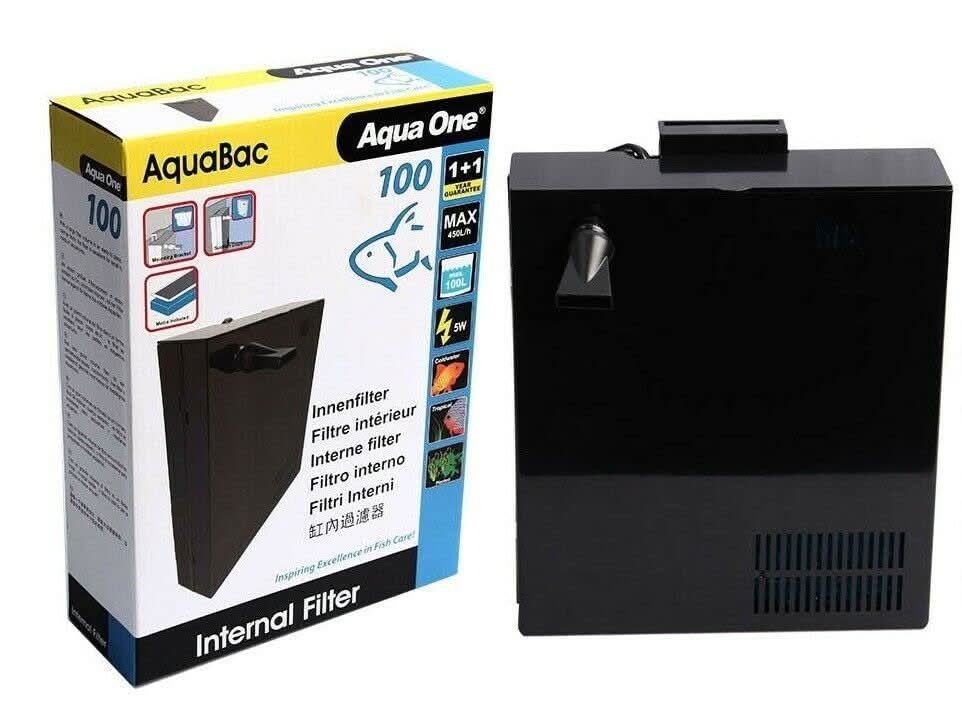
No plumbing, no cabinet space, and a fraction of the setup time of anything external on this list: the trade-off is a hard ceiling of 100 litres and 450 litres an hour of flow. That is the honest limitation before anything else about this filter. It suits a compact tank instead of one it would be stretched to cover.
Aqua One is a long-running Australian aquarium brand, and the AquaBac line is its entry-level internal filter, sitting underwater on suction cups with a sponge-based mechanical and biological stage. It is quiet by reputation and simple enough that a first-time owner can rinse the sponge in old tank water and have it running again within minutes.
This suits a 60 to 100 litre tank, a betta or small community setup, or a quarantine tank kept ready for a sick fish without needing a second canister plumbed in. Compared with the Dynamic Power 400 litre canister earlier in this list, it trades a little flow rate for zero setup time, which matters more for a second or third tank than a main display.
Pros
- Suction-cups straight into the tank with zero external plumbing
- Sponge is simple to rinse and reseat within minutes
- Well suited to a dedicated quarantine or hospital tank kept on standby
- From an established Australian aquarium brand with a long local track record
Cons
- Hard ceiling of 100 litres, and there is no bigger model in the same line to step up to
- Suction cups can lose grip in a warmer tank over time, the same weak point as the submersible unit earlier in this list
- Intake can pull in smaller fish fry if you keep a breeding tank, so a sponge pre-filter is worth adding
Key specs: 450L/H, up to 100L tanks, internal sponge filter, suction-cup mount.
CHECK ON AMAZON9. Aqua One 100 Clearview Hang-On Filter – Best Hang-On Filter
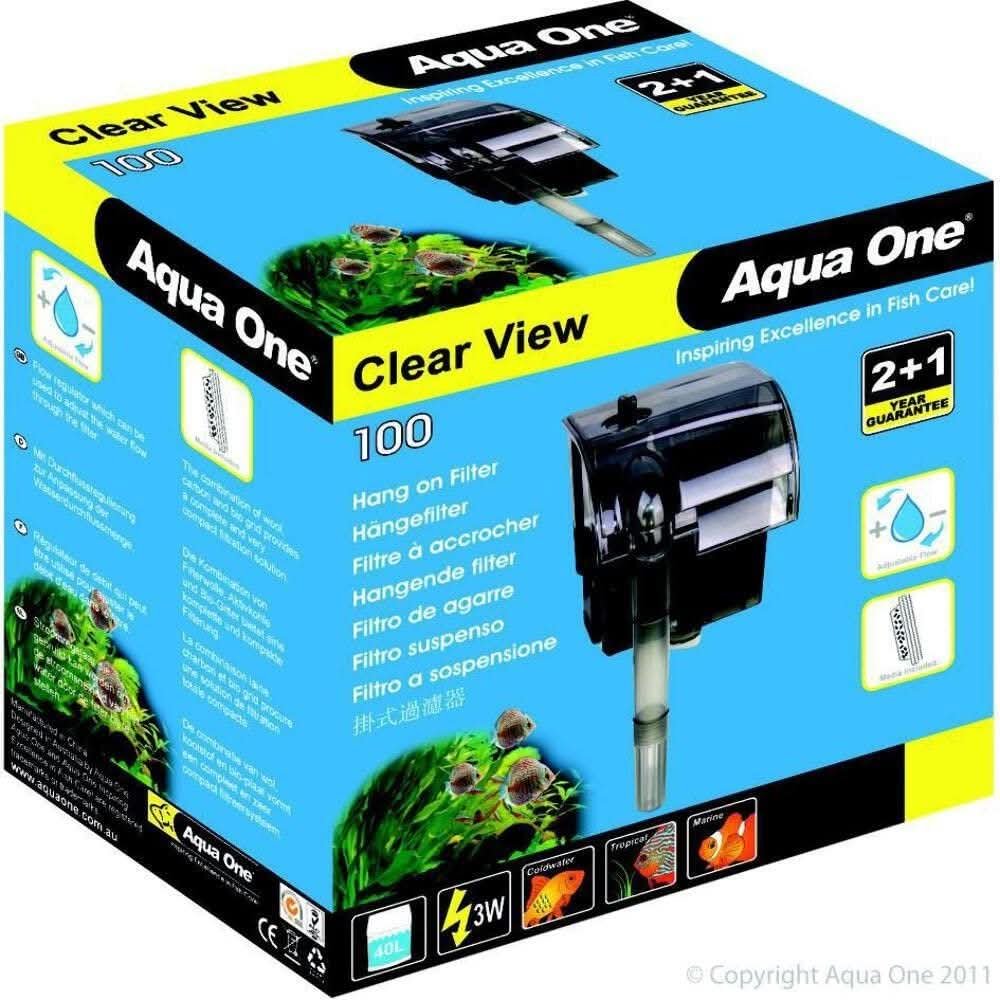
The cheapest way into a hang-on-back filter among these nine picks, clipping straight onto the rear glass with no suction cups and no cabinet plumbing. Rated at 180 litres an hour, it suits a small tank in the 40 to 60 litre range, or as a second filter running alongside an internal unit for extra flow. The carbon cartridge is the consumable here and wants replacing every six to eight weeks, a running cost worth factoring in before comparing this against the internal units above on price alone.
Setup is a two-minute job: clip it on, fill the chamber, plug in. It draws less power than the smallest canister on this list and takes up no cabinet space at all, which matters in a small apartment where every centimetre under the stand is already earning its keep. Not a filter for anything past about 60 litres, and the plastic clip does show wear if it is constantly removed for tank maintenance, but as a second filter or a starter unit on a first small tank it does the job without fuss.
Pros
- Cheapest entry point into a hang-on-back filter of the nine here
- Clips on in about two minutes with no plumbing or suction cups
- Useful as a second filter for extra flow on a tank that already has one
- Draws less power than the smallest canister here
Cons
- Replacement carbon cartridges are a running cost every six to eight weeks, not a one-off cost
- The plastic clip shows wear if it is removed and reseated often during tank maintenance
- Not rated past about 60 litres, so it is easy to outgrow within a year of setting up a first tank
Key specs: 180L/H, small tanks to 60L, replaceable carbon cartridge, hang-on-back mount.
CHECK ON AMAZONHow to Choose an Aquarium Filter
Match flow rate to your actual tank volume, not its footprint. Aim for four to six times the tank’s volume in litres per hour once you allow for head height and media resistance cutting into the rated figure. A 200 litre tank wants roughly 800 to 1200 litres an hour of rated flow, not the bare 200. Undersize this and ammonia climbs quietly while the water still looks clear.
Pick the filter type that suits your tank size and your patience for maintenance. Internal filters and hang-on-back units suit smaller tanks and near-zero setup time. External canisters handle bigger tanks and more media volume but want proper plumbing and a cabinet underneath. RSPCA NSW‘s advice on tank setup is blunt on this point: the larger the tank and filter, the better it is for your fish, so buying the smallest filter that technically fits the spec sheet is usually a mistake.
Factor in where you live before assuming any filter will just work. A Melbourne winter drops tank temperature enough to slow the nitrifying bacteria colony living in your filter media, so a tank running cooler over winter needs a slightly gentler feeding schedule while that colony catches up. Perth’s bore water runs harder than most eastern capitals, and that mineral load cakes onto media and impeller housings faster, so budget for more frequent cleaning if you are on bore supply.
Treat your tap water before it goes anywhere near the tank. The NSW Department of Primary Industries recommends replacing about a third of your aquarium’s water at least once a month, and warns that tap water can contain chemicals that harm fish unless it is appropriately treated first. A water conditioner is cheap insurance against a water change that does more harm than good.
Decide whether UV sterilisation earns its keep in your situation. It adds running cost and a bulb that needs replacing roughly once a year, but it is useful if your tank sits somewhere that gets a lot of natural light or if green water has been a recurring problem. Skip it on a shaded tank with no history of algae blooms; that expense buys you nothing there.
Budget for consumables, not just the unit itself. Carbon, sponges and UV bulbs are all running costs on top of the upfront price, and a filter that looks cheap on the shelf can end up costing more over a year than a pricier unit with a longer media-replacement cycle. Got a tank that is forever cloudy no matter what you do? Check the media schedule before blaming the filter itself.
You’ll Also Want
Every canister and UV filter in this guide eats through filter media over time, and a pre-mixed bag of ceramic rings, bio balls and activated carbon covers mechanical, biological and chemical filtration in one bag without hunting down each type separately.
A gravel vacuum turns the monthly water change the NSW Department of Primary Industries recommends into a five-minute job instead of a fight with a bucket and a jug, pulling waste out of the substrate at the same time it drains old water, the same basic tool Bunnings sells off the shelf near the pond gear.
An air pump adds surface agitation and oxygen exchange that a densely stocked or heavily planted tank can fall short on, especially useful alongside an internal filter that does not already push much surface movement.
A water conditioner treats tap water before it goes anywhere near the tank, neutralising chlorine and chloramine so a water change does not stress or poison the fish it is meant to help.
Frequently Asked Questions
How often should I clean an aquarium filter?
Rinse mechanical media like sponges every two to four weeks in a bucket of old tank water, never tap water, since chlorine kills the beneficial bacteria living in the media. Replace carbon every four to six weeks once it stops adsorbing odours and discolouration. Never fully replace biological media, ceramic noodles or bio balls, all at once, since that resets your tank’s nitrogen cycle and risks an ammonia spike.
What size aquarium filter do I need?
Match rated flow to four to six times your tank’s volume in litres per hour, then round up, not down, once head height and media resistance are factored in. A 100 litre tank wants roughly 400 to 600 litres an hour of rated flow. Internal and hang-on-back filters generally suit tanks under 100 litres, while external canisters handle larger volumes and heavier stocking.
Do I need a UV steriliser on my aquarium filter?
A UV steriliser is not essential for every tank, but it earns its keep on a tank exposed to natural light or one with a recurring green water problem, since it sterilises free-floating algae spores that mechanical and biological media never touch. It adds running cost and a bulb that needs replacing roughly once a year, so a shaded tank with no algae history can usually skip it.
How long can an aquarium filter run without power before fish are at risk?
Beneficial bacteria in filter media can start dying off within a few hours without oxygenated water moving through them, and a longer outage risks an ammonia spike once the filter restarts and disturbed waste re-enters the water column. During a blackout, manually agitate the water surface if possible and avoid feeding until power and filtration are both back and stable.
Can I use an aquarium filter in both fresh and saltwater tanks?
Most of the canister and internal filters covered here are rated for both freshwater and saltwater use, since the filtration mechanism itself does not care about salinity. What does matter is using media and housing materials that will not corrode in saltwater, and rinsing thoroughly if you ever move the same unit between a freshwater and a marine setup.
Why does my new aquarium filter make the water cloudy?
New-tank cloudiness is usually a bacterial bloom as the filter’s biological colony establishes itself, and it typically clears within a week or two on its own without extra cleaning. Resist the urge to over-clean or replace media during this period, since that resets the very bacteria colony trying to establish. A UV steriliser can speed up clearing algae-related cloudiness specifically, but not a bacterial bloom.
Verdict
For most Australian tanks in the 150 to 300 litre range, the Giantz external canister is the sensible starting buy, a four-stage canister at a mid-range outlay that does not lock you into a media kit you may not need. Step up to the Dynamic Power UV canister if algae or green water is a recurring fight, especially in a Brisbane or Cairns household where humidity keeps it warm year-round. Anyone running a large show tank should look past the mid-range picks entirely and go straight to the Fluval FX6, since its media capacity and self-priming pump are built for a scale nothing else in this lineup covers.