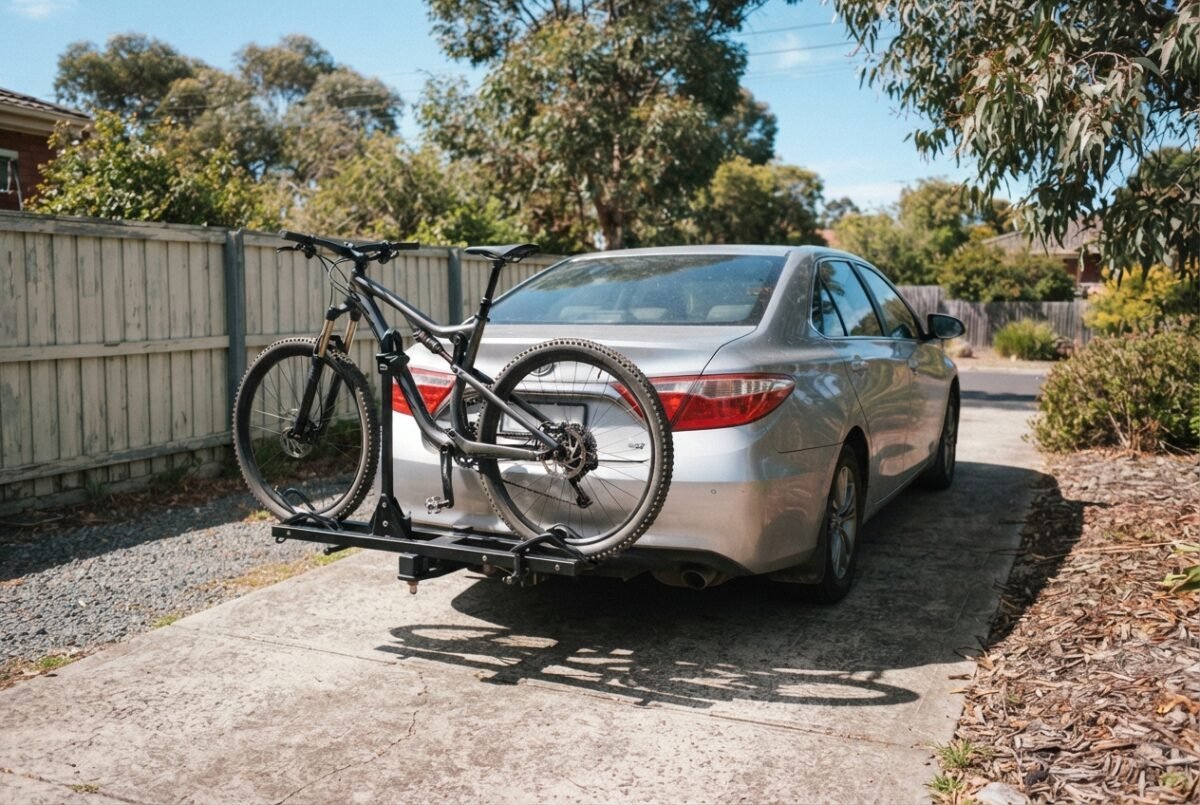
Fit a bike rack that hangs over your rear number plate and you have created a genuine, fineable road offence in every Australian state, not a minor styling issue: an obscured plate needs an official auxiliary plate ordered through your state transport authority, with fines reaching $514 plus demerit points in NSW and up to $2,500 in South Australia. A bike rack for a car is a carrier built to transport one or more bicycles on a vehicle without putting them inside the cabin or boot, mounted to a hitch receiver, a roof rail, a boot lid, or the vehicle’s own spare wheel.
Four distinct mount types cover almost every car in Australia: **hitch-mount racks** that plug into a 2-inch tow receiver and carry the most weight with the least fuss; **roof-mount racks** that clamp to roof bars or rails and keep the tailgate free; **trunk or boot-mount racks** that strap directly to a boot lid with no towbar or roof rails needed; and **spare-tyre-mount racks**, a properly Australian-relevant option for the 4WDs and utes common here that carry their spare wheel externally on the rear door.
The number that actually matters on a hitch rack is tow ball weight, and it catches people out constantly: your towbar’s rated ball weight is a combined figure covering the rack itself plus every bike loaded onto it, not a per-bike allowance, and Australian Design Rule 62 requires that rating to be stamped directly onto the tow ball. A roof or trunk rack has no towbar to worry about, but still carries its own stated bike-count and per-bike weight limit that is easy to exceed with two e-bikes instead of two standard road bikes.
This comparison runs from a budget hitch rack sourced through Australian retail partners through to a premium roof-mount and tray-style hitch rack sourced on the open marketplace, covering entry-level 4-bike carriers through to dedicated e-bike and spare-tyre mounts.
Quick Picks

Giantz 4 Bicycle Hitch Rack
A folding 4-bike hitch carrier at the cheapest price point in this whole comparison.
CHECK CURRENT PRICE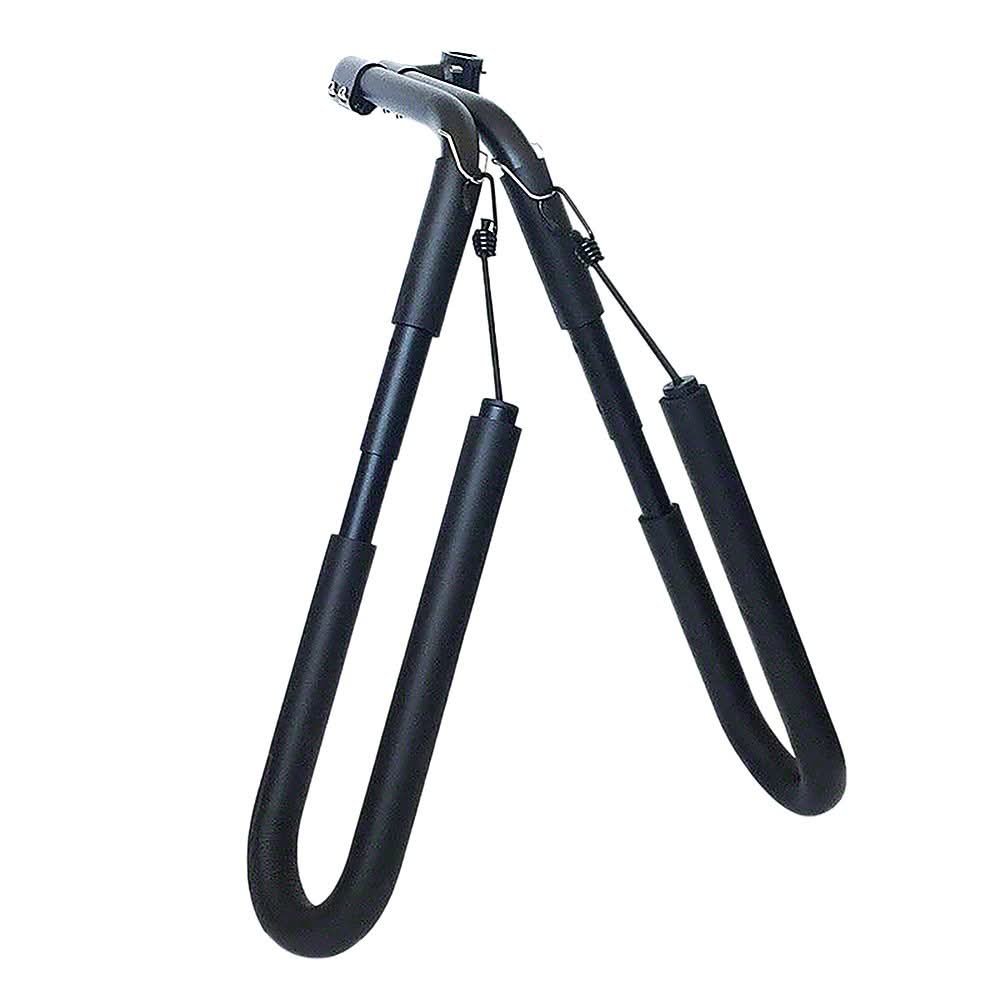
Adjustable Surf and Bike Roof Rack
One roof clamp that swaps between a surfboard, a skimboard and a bike frame.
CHECK CURRENT PRICEThe Best Bike Racks for Cars in Australia Compared
| Product | Link | Type | Best For | Key Spec |
|---|---|---|---|---|
| Giantz 4 Bicycle Hitch Rack | Check price | Giantz | Best Budget 4-Bike Hitch Rack | 2 inch hitch receiver |
| Adjustable Surf and Bike Roof Rack | Check price | Unbranded | Best Roof-Mount Rack for Beach Gear | Roof bar clamp mount |
| Heavy-Duty 2 E-Bike Hitch Rack | Check price | Unbranded | Best Heavy-Duty Rack for E-Bikes | 2 inch hitch receiver |
| 2 E-Bike Hitch Rack with Lock | Check price | Unbranded | Best with Integrated Lock | 2 inch hitch receiver |
| Thule ProRide Roof Rack | Check price | Thule | Best Premium Roof-Mount Rack | Frame clamp mount |
| Allen Sports Deluxe 2-Bike Trunk Rack | Check price | Allen Sports | Best Trunk-Mount Rack | Boot lid strap mount |
| SAN HIMA Spare Tyre Bike Rack | Check price | SAN HIMA | Best for a Rear-Mounted Spare Wheel | Spare tyre clamp mount |
| Allen Sports S302 Spare Tyre Carrier | Check price | Allen Sports | Best Alternative Spare-Tyre Mount | Spare tyre mount |
| Yakima TwoTimer Hitch Rack | Check price | Yakima | Best Premium Tray-Style Hitch Rack | 2 inch hitch receiver |
1. Giantz 4 Bicycle Hitch Rack – Best Budget 4-Bike Hitch Rack
Four bike capacity for less than a hundred dollars is a properly rare combination. Cheap. Folds flat. Does the one job asked of it. The design means the whole rack tilts out of the way of the boot without unloading a single bike first, useful the moment you need to grab something from the back with a full load already strapped on. It plugs into a standard 2-inch hitch receiver, the same fitting most Australian towbars already use.
Buyers on the open marketplace flag the arms as noticeably wobblier fully loaded with four bikes than with two, so anyone regularly carrying a full load should still check strap tension at a servo stop on a longer trip, the same kind of budget hitch rack you would find hanging on the wall at Bunnings or Kmart. It is not going to match a premium tray-style rack for stability, but for occasional weekend use at this price it does the job asked of it.
Pros
- Four bike capacity at the cheapest price point in this comparison
- Folds down without needing bikes removed first, so the boot stays accessible
- Fits a standard 2-inch hitch receiver already common on Australian towbars
Cons
- Noticeably wobblier fully loaded with four bikes than with two, worth a mid-trip strap check
- No integrated lock, so a separate cable lock is worth adding for servo stops
Key specs: 2 inch hitch receiver, 4 bike capacity, folding arms, steel construction
CHECK CURRENT PRICE2. Adjustable Surf and Bike Roof Rack – Best Roof-Mount Rack for Beach Gear
A Sydney or Perth weekend that starts with a surf and finishes with a bike trail does not usually justify two separate roof accessories, and this one adjusts between board and bike mounting in a few minutes instead of needing a full swap of hardware. It clamps directly to an existing roof bar setup, so there is no towbar or hitch receiver required at all, useful for a hatchback or wagon without one fitted.
The trade-off for that flexibility is capacity: this is a single-bike mount, not a four-bike hitch rack, and lifting a bike onto roof height is a properly different physical task to sliding it onto a low hitch tray, worth considering if a knee or shoulder makes overhead lifting awkward.
Pros
- Swaps between a surfboard, skimboard or bike mount without separate accessories
- No towbar or hitch receiver needed, clamps straight to existing roof bars
- Cheapest roof-mount option in this comparison
Cons
- Single-bike capacity only, not built for a family loading multiple bikes at once
- Lifting a bike to roof height is a real physical ask compared with a low hitch tray
Key specs: Roof bar clamp mount, adjustable for surfboard/skimboard/bicycle, single bike capacity
CHECK CURRENT PRICE3. Heavy-Duty 2 E-Bike Hitch Rack – Best Heavy-Duty Rack for E-Bikes
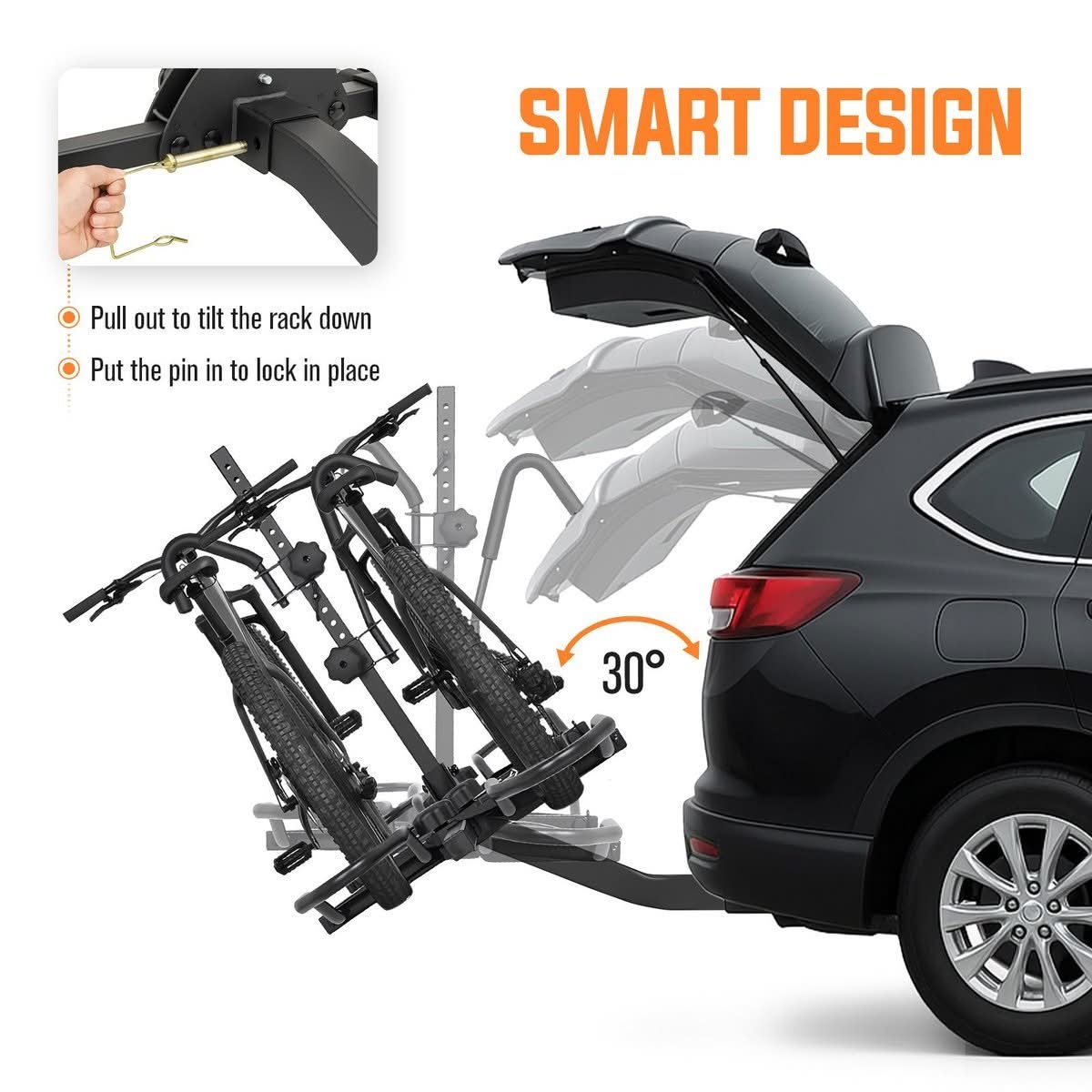
A road bike weighs somewhere around 8-10kg, but an e-bike with its battery and motor commonly sits at 25kg or more, and loading two of them onto a rack rated for standard bikes will quietly overload it well before it looks obviously wrong. This platform is rated to 73kg combined, comfortably covering two heavier e-bikes rather than assuming everyone is hauling a lightweight carbon road bike.
The platform-style tray supports the bike by its wheels instead of clamping the frame, which matters for an e-bike frame that often has an oddly shaped downtube housing the battery, not built to take a frame-clamp’s pressure the way a standard diamond frame is. It still folds down for boot access and fits the same 2-inch receiver as the budget rack above.
Pros
- 73kg combined rating comfortably covers two e-bikes, not just two standard road bikes
- Wheel-tray support avoids clamping an e-bike’s battery-housing downtube
- Folds down for boot access without unloading bikes first
Cons
- Two bike capacity only, a step down from the budget rack’s four bikes above
- Sits at a higher price point than the basic hitch rack for the extra load rating
Key specs: 2 inch hitch receiver, 73kg combined rating, wheel-tray support, foldable, 2 bike capacity
CHECK CURRENT PRICE4. 2 E-Bike Hitch Rack with Lock – Best with Integrated Lock
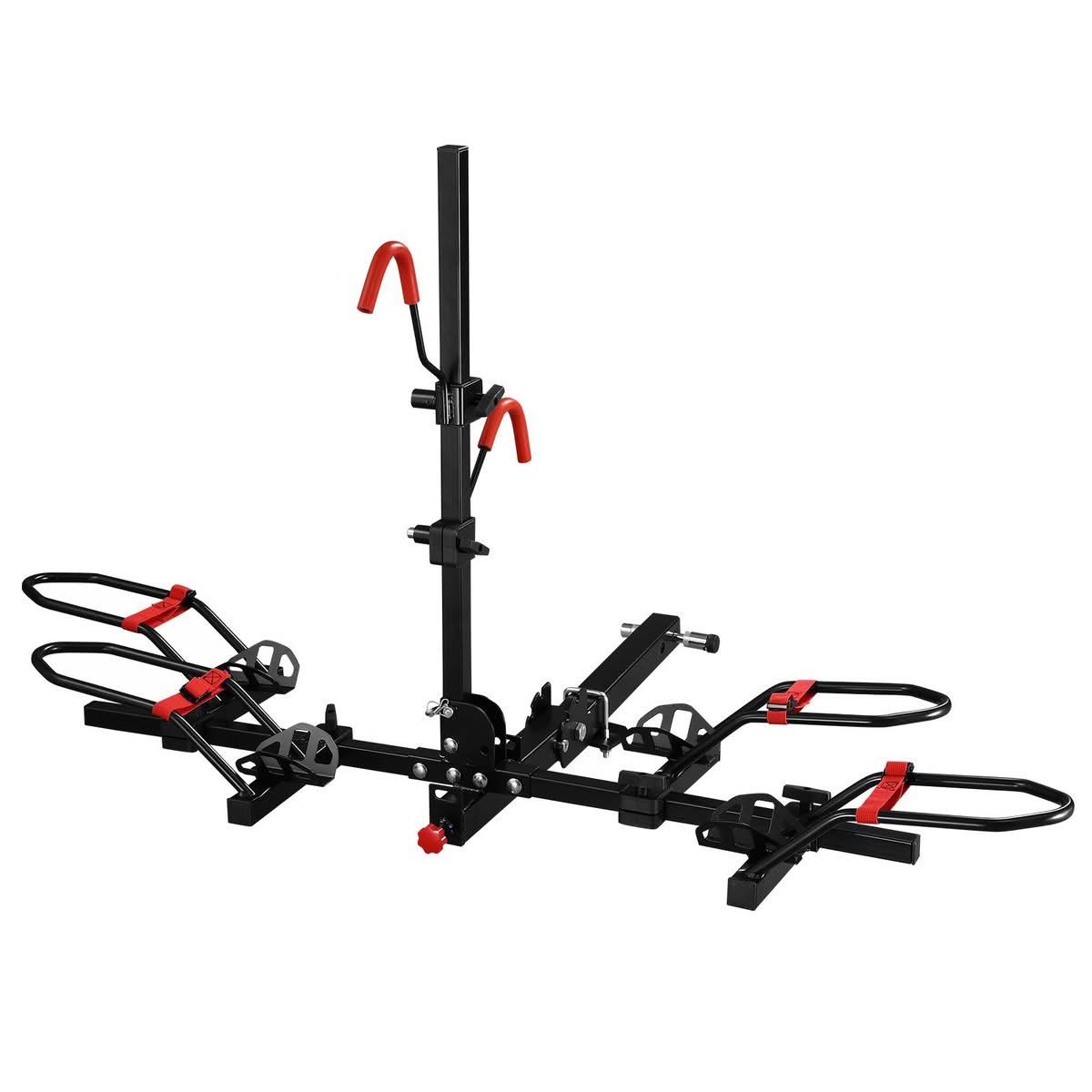
Most hitch racks only give you a strap or cable to lock a bike to the tray. This one adds a second lock securing the whole rack to the hitch receiver itself, so nobody can simply unbolt the entire carrier and walk off with two bikes still attached, a real theft vector for a hitch rack left on overnight at a caravan park or hotel car park through a Queensland wet season or Adelaide’s dry heat alike.
The tilt-away feature drops the loaded rack down and away from the boot on a hinge, instead of needing the whole thing unbolted, so checking on gear or grabbing a bag mid-trip does not mean unloading two bikes first. Reviewers on the open marketplace note the tilt mechanism needs a firm push to release cleanly once fully loaded, not quite as smooth as it looks in the product photos.
Pros
- A second lock secures the whole rack to the hitch, not just bikes to the rack
- Tilt-away hinge gives boot access without unloading bikes first
- Rated for e-bike weight, same as the basic hitch rack above
Cons
- The tilt mechanism needs a firm push to release cleanly once fully loaded
- Costs more than the basic hitch rack above for the added lock and tilt hardware
Key specs: 2 inch hitch receiver, integrated rack lock, tilt-away access, foldable, 2 bike capacity
CHECK CURRENT PRICE5. Thule ProRide Roof Rack – Best Premium Roof-Mount Rack
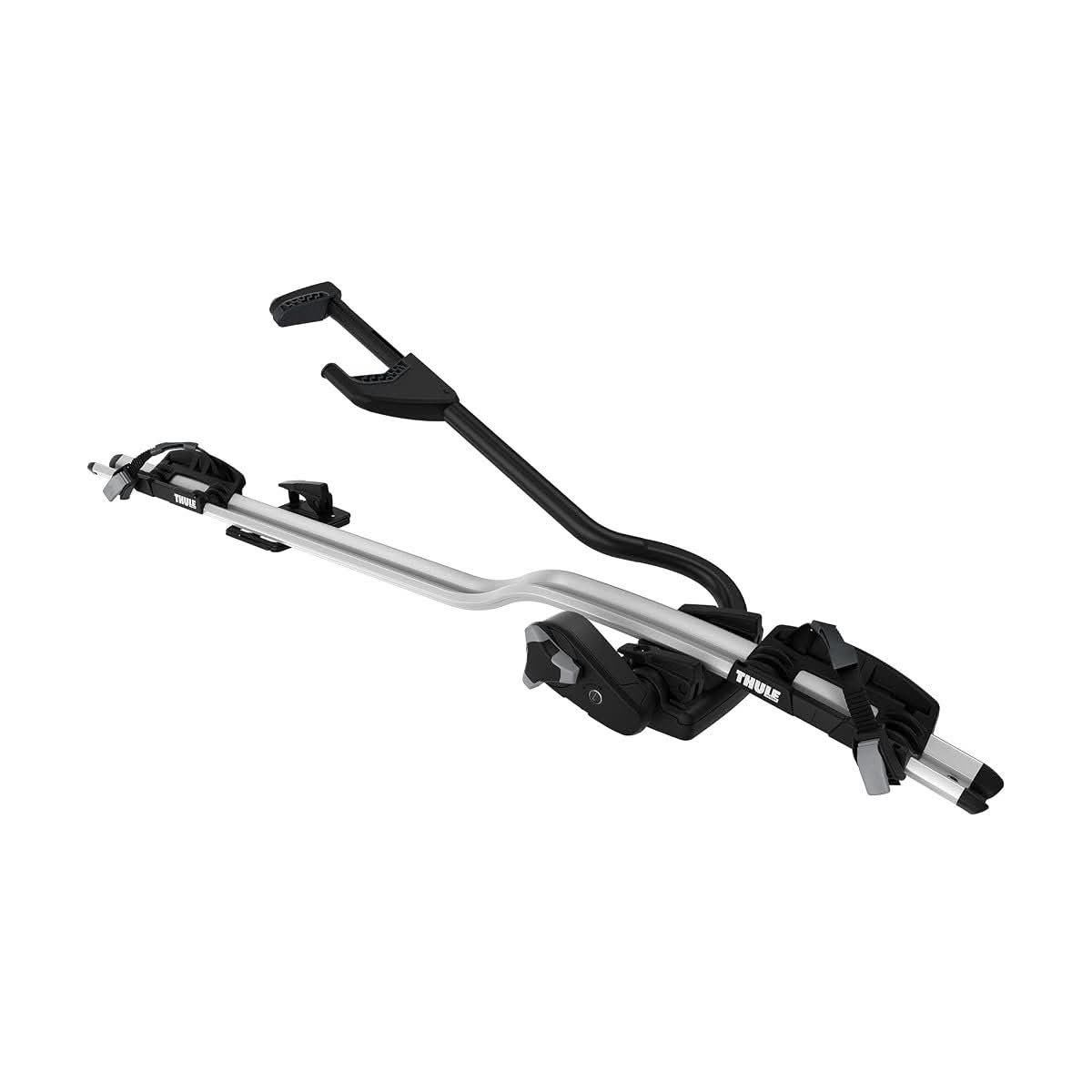
Thule sits at the top of almost every bike shop’s recommendation list for a real reason: the ProRide’s frame clamp adjusts to fit anything from a kid’s bike to a full-suspension mountain bike without a separate adaptor kit, and the wheel straps keep everything stable at highway speed without the rocking a cheaper clamp can develop over a long drive. It leaves the boot and rear number plate completely untouched, so no auxiliary plate is ever needed.
The trade-off is the same one every roof rack shares: lifting a loaded bike overhead onto the roof bars is real, repeated effort, and this sits at the most expensive price point in this entire comparison.
Pros
- Frame clamp adjusts to fit a properly wide range of bike shapes and sizes
- Leaves the rear plate and lights untouched, no auxiliary plate ever needed
Cons
- Most expensive rack in this comparison by a clear margin
- Lifting a bike to roof height on every use is real, repeated physical effort
Key specs: Frame clamp mount, roof bar fitting, single bike capacity, wheel straps included
CHECK ON AMAZON6. Allen Sports Deluxe 2-Bike Trunk Rack – Best Trunk-Mount Rack
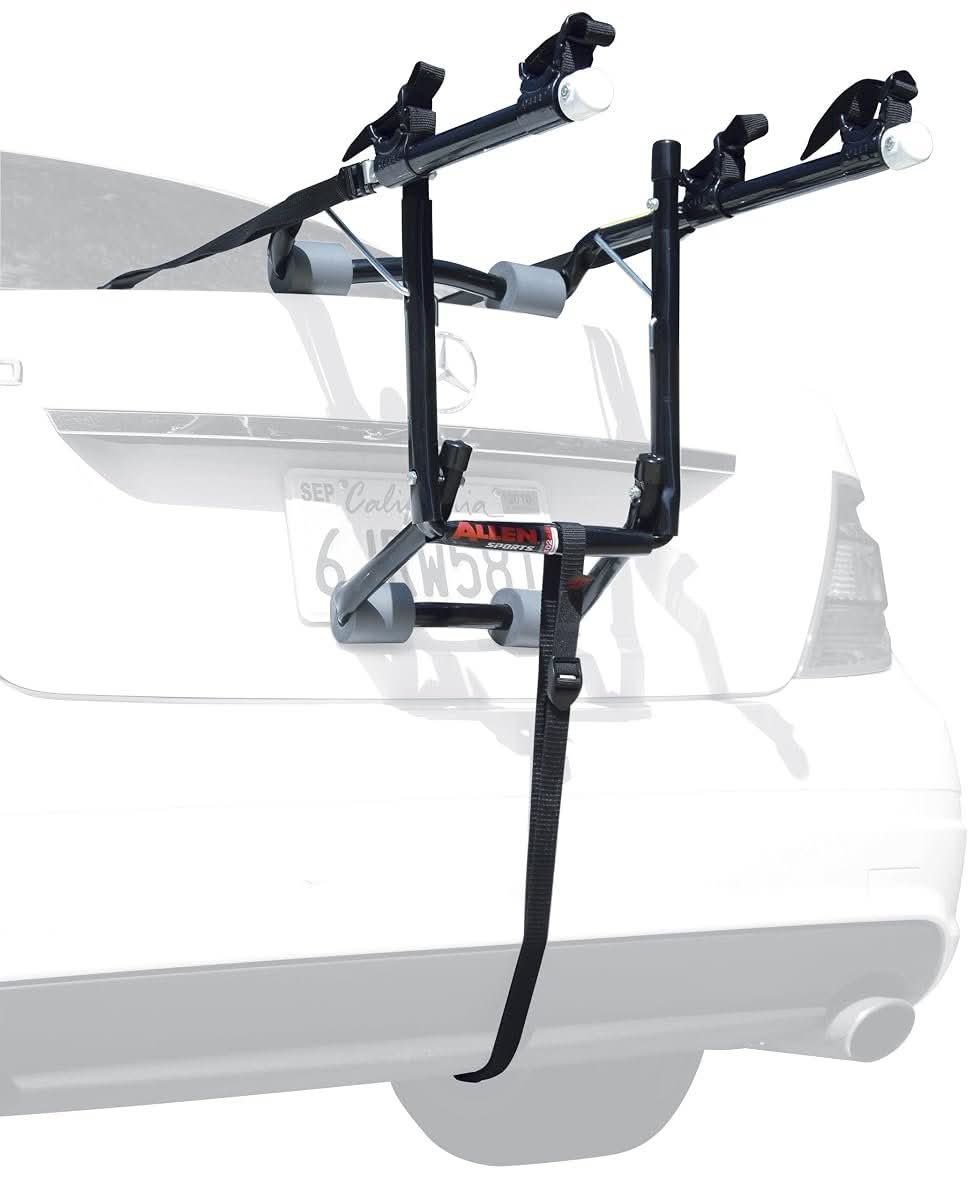
For anyone driving a hatchback with no towbar fitted and no roof rails to clamp onto, this straps directly across the boot lid on adjustable webbing and folds flat for storage in a cupboard when it is not in use. Set-up actually takes a few minutes the first time and gets faster once the strap positions are marked.
Since it covers the boot lid, drivers still need to check that both the number plate and brake lights remain visible once bikes are loaded, adding an auxiliary plate or light bar if either gets blocked.
Pros
- No towbar or roof rails needed, straps directly to a boot lid
- Folds flat for storage when not in use
Cons
- Can obscure the number plate or brake lights depending on the vehicle, check both once loaded
- Strap-based fit is less rigid at highway speed than a hitch or roof mount
Key specs: Boot lid strap mount, 2 bike capacity, folds flat, no towbar or roof rails required
CHECK ON AMAZON7. SAN HIMA Spare Tyre Bike Rack – Best for a Rear-Mounted Spare Wheel

A 4WD or wagon with its spare wheel bolted to the rear door has no clean spot for a hitch or trunk rack, and this clamps directly around that existing spare tyre instead, adjustable to fit a range of wheel diameters rather than one fixed size. Two tightening straps keep it snug against the tyre itself, and the whole thing adds nothing to the vehicle’s actual footprint beyond what the spare already takes up.
It carries a modest 34kg rating across two bikes, so this is built for standard road or hybrid bikes (about the weight of a full esky, not a loaded e-bike), not a pair of heavier e-bikes. This is a real Australian-specific niche: a car style barely sold in markets without the same rural-distance driving culture that makes an externally mounted spare common in the first place.
Pros
- Mounts directly to an existing rear-door spare wheel, no towbar or roof rails needed
- Adjustable to fit a range of spare tyre diameters, not one fixed size
- Adds nothing to the vehicle’s footprint beyond the spare wheel already there
Cons
- 34kg combined rating suits standard bikes, not a pair of heavier e-bikes
- Only fits vehicles with an externally mounted rear spare in the first place
Key specs: Spare tyre clamp mount, 2 bike capacity, 34kg load rating, adjustable tyre diameter fit
CHECK ON AMAZON8. Allen Sports S302 Spare Tyre Carrier – Best Alternative Spare-Tyre Mount
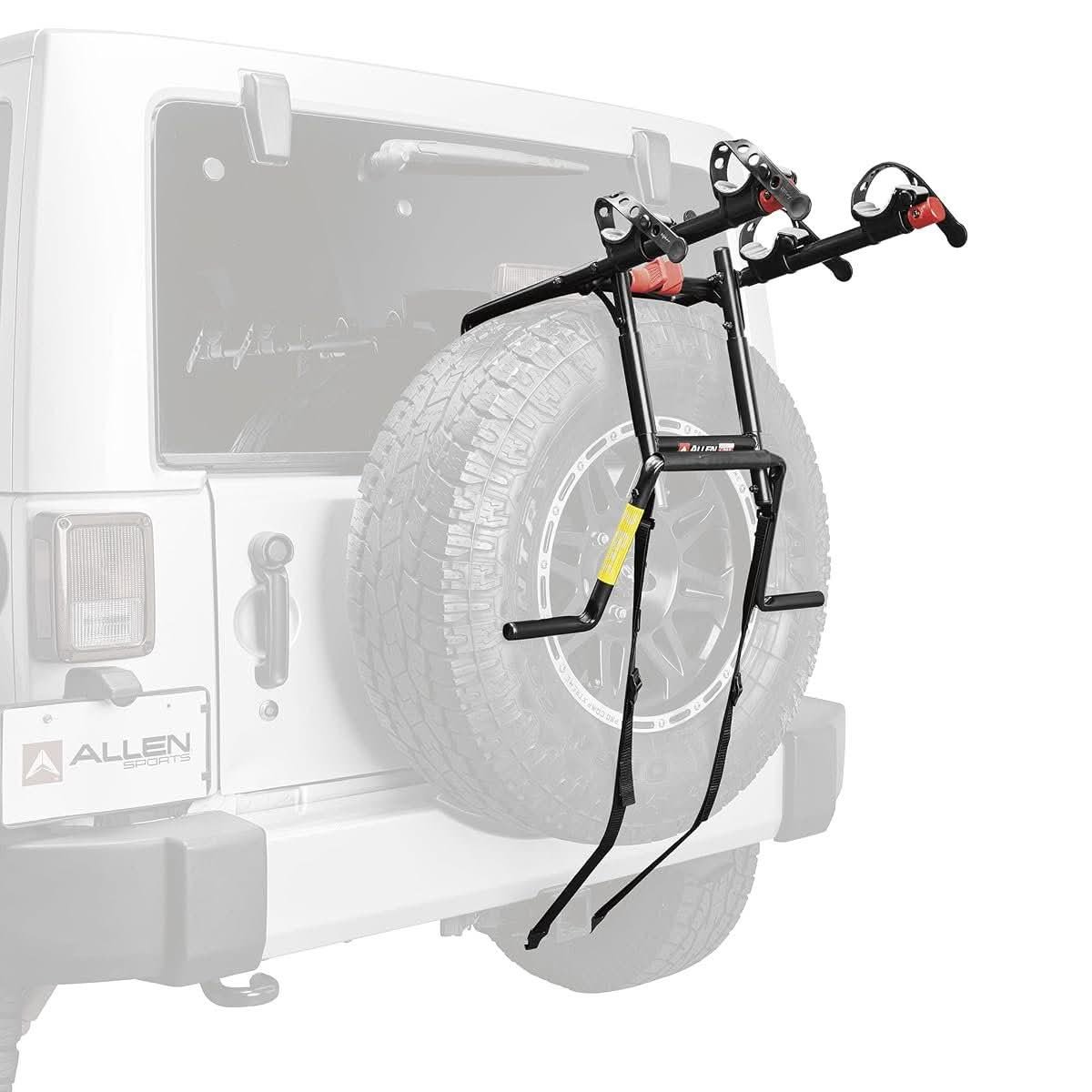
Where the SAN HIMA rack above suits a straightforward budget fit, this Allen Sports option is worth checking when a particular spare-wheel size or vehicle shape does not suit the first pick, since spare-tyre mounts are noticeably fussier about exact fit than a hitch or roof rack.
Setup still means working around the vehicle’s own spare wheel instead of a purpose-built receiver, so expect a bit more trial and error tightening the mount than a hitch rack that simply slots into a standard 2-inch receiver.
Pros
- A proven, well-reviewed second option for spare-tyre mounting
- Useful when a vehicle’s spare-wheel shape or size does not suit the SAN HIMA fit above
- Established brand with a long track record in this specific niche
Cons
- Fussier setup than a hitch rack, since it has to clamp around an existing spare wheel
- Only 2 left in stock at the time of this comparison, worth checking availability before committing
Key specs: Spare tyre mount, 2 bike capacity, adjustable clamp fit
CHECK ON AMAZON9. Yakima TwoTimer Hitch Rack – Best Premium Tray-Style Hitch Rack
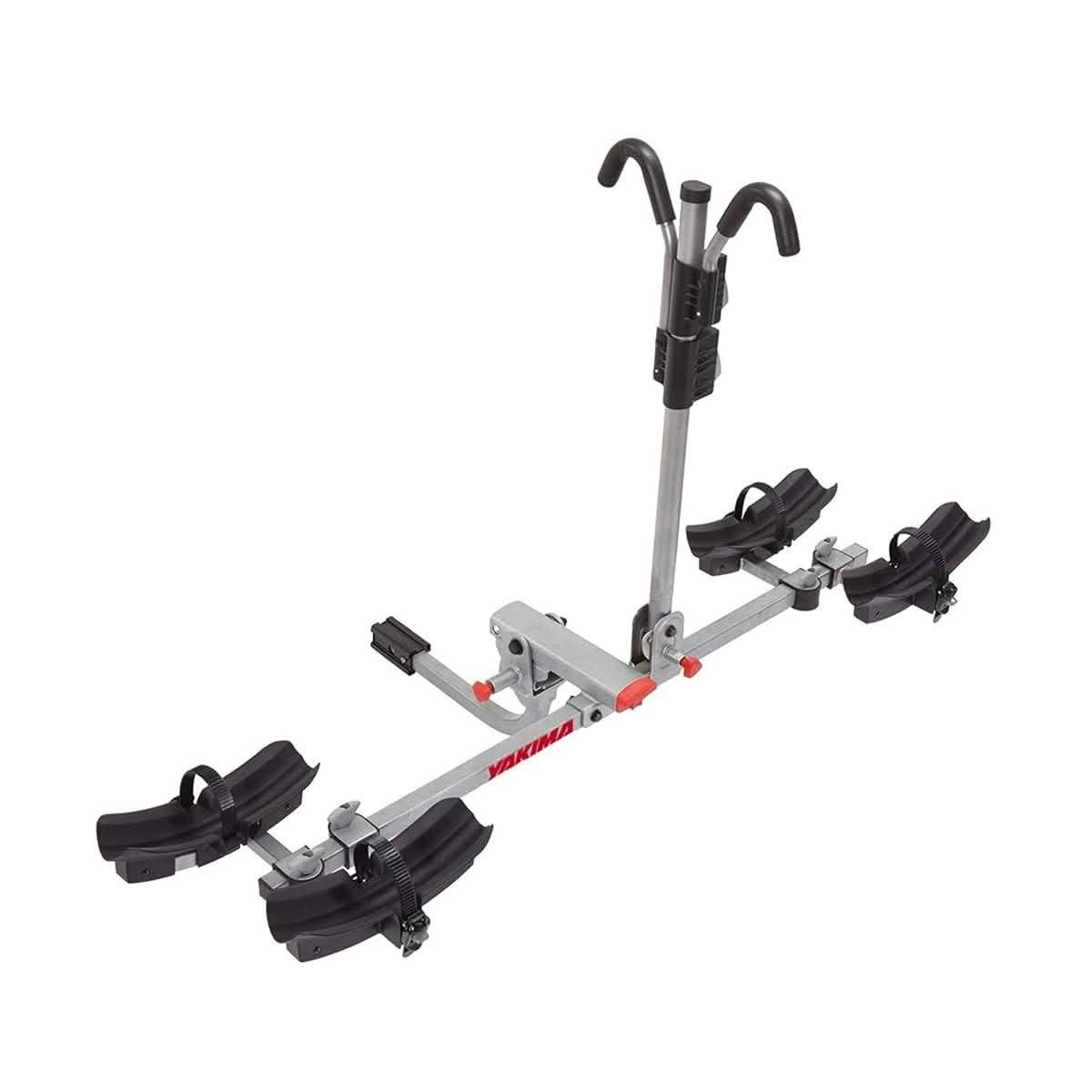
Where the budget hitch racks earlier in this list use folding steel arms, the TwoTimer uses individual wheel trays per bike, a sturdier, less rattly mount at highway speed that also makes loading faster since each bike simply rolls into its own tray rather than needing a frame clamp positioned just right. It fits the same 2-inch receiver as every hitch rack in this comparison.
Yakima and Thule are the two brands most Australian roof-and-hitch rack fitters reach for first, and this sits at a properly premium price point that reflects it. Anyone deciding between the two brands is really choosing between Thule’s roof-first reputation and Yakima’s tray-hitch design, not picking a lesser alternative either way.
Pros
- Individual wheel trays per bike load faster and sit more solidly than folding steel arms
- Fits the same standard 2-inch hitch receiver as every other hitch rack here
- One of the two most trusted rack brands Australian fitters recommend
Cons
- Premium price point, a clear step up from the budget hitch racks earlier in this list
- No independent rating data was available to verify against at the time of this comparison
Key specs: 2 inch hitch receiver, tray-style mount, 2 bike capacity
CHECK ON AMAZONHow to Choose a Bike Rack for Your Car in Australia
Check your rear number plate and lights before you drive anywhere. If a loaded rack covers the plate, brake lights or indicators, Australian road rules require an official auxiliary plate ordered through your state transport authority and, if needed, an extra light bar, not a handwritten sign taped on. Fines reach $514 plus demerit points in NSW and up to $2,500 in South Australia, so this is worth ten minutes of checking before the first trip, not an afterthought.
Match the rack’s weight rating to your actual bikes, not an average bike. An e-bike commonly weighs 25kg or more against a standard road bike’s 8-10kg, and a tow ball’s rated capacity covers the rack plus every bike combined, not per bike. Two e-bikes on a rack rated for two standard bikes is a real overload risk, not a rounding error.
Pick the mount type your car can actually take. No towbar fitted rules out a hitch rack outright, no roof rails or bars rules out most roof mounts, and only a 4WD or wagon with an externally mounted spare wheel can use a spare-tyre rack at all. Confirm what is actually bolted to your car before comparing prices.
Weigh roof height against your own back and shoulders. Ever tried lifting a loaded mountain bike onto a roof rack after a full day on the trail, arms already tired? A roof rack keeps the boot and towbar completely free, but lifting a loaded bike overhead on every single use adds up, especially with a heavier e-bike or a second and third bike to load one after another. A hitch or trunk rack keeps the lift low and close to the body instead.
A locking rack is worth it the moment bikes travel unattended. Leaving a loaded hitch rack outside a hotel or caravan park overnight is a real theft risk, and a rack that only locks the bikes to the tray still lets someone unbolt the whole assembly. Look for a rack that also locks to the hitch receiver itself if bikes will ever sit unattended.
Confirm your rack works with your other transport plans. Anyone who also tows a trailer or caravan needs to check hitch clearance before assuming a rack and a tow ball coexist happily, and riders coming off a fat tyre electric bike specifically should double check both the rack’s weight rating and its wheel-tray width, since a properly wide tyre does not always sit cleanly in a standard hitch rack’s wheel cradle.
You’ll Also Want
A rack keeps bikes on the car, but a proper combination cable lock is what actually stops one walking off a hitch or roof mount at a servo stop.
A set of extra retractable ratchet tie-down straps is worth carrying alongside any rack for a longer trip, as backup security beyond the rack’s own built-in straps.
An official auxiliary number plate is ordered directly through your own state or territory road authority, not a marketplace listing, so budget that as a separate small cost the moment a rack covers your existing plate.
Riders adding an e-bike to a rack rated for standard bikes should double check the model’s actual kerb weight before assuming any rack fits it safely, since a battery and motor add real weight a standard rack rating does not account for.
Frequently Asked Questions
Is it illegal to drive with a bike rack covering my number plate in Australia?
Not on its own, but you must then fit an official auxiliary plate ordered through your state or territory road authority, matching your registered plate’s characters and illuminated at night. Homemade or handwritten plates are illegal everywhere in Australia. Fines for an obscured, non-compliant plate reach $514 plus demerit points in NSW and as much as $2,500 in South Australia, so check this before your first trip with a loaded rack.
What is tow ball weight and why does it matter for a bike rack?
Tow ball weight is the total static downward force your towbar is rated to carry on the ball, stamped directly on the ball itself under Australian Design Rule 62. It covers the rack’s own weight plus every bike loaded onto it combined, not a per-bike allowance, so two e-bikes on a rack rated for standard road bikes can actually exceed a towbar’s rating even though it looks like a normal, modest load.
Can I fit a hitch bike rack without a towbar already installed?
No, a hitch rack needs a genuine 2-inch tow receiver already fitted to the vehicle, which usually means having a towbar professionally installed first if one is not already there. Drivers without a towbar and without roof rails are generally better served by a boot or trunk-mount rack, which straps directly to the vehicle with no permanent hardware needed at all.
Do I need a special rack for an e-bike?
Not always, but it is worth checking specifically instead of assuming any rack will do. An e-bike’s extra 15-20kg of battery and motor weight, plus its differently shaped frame around the battery housing, can exceed a standard rack’s rating or sit awkwardly in a frame clamp built for a lighter, more conventional diamond frame. A wheel-tray platform rack rated for the combined e-bike weight avoids both problems.
Is a roof rack or a hitch rack better for carrying bikes in Australia?
A hitch rack generally wins on ease of loading, since it sits low and close to the ground instead of needing bikes lifted overhead, and it usually carries more total weight. A roof rack’s real advantage is leaving the boot and towbar completely free, useful for anyone also towing a trailer or caravan, or simply without a towbar fitted at all. Neither is objectively better, the right choice depends on what else the vehicle needs to do.
How many bikes can I actually fit on a hitch rack in Australia?
Most hitch racks sold here carry two to four bikes, but the real limit is the combined tow ball weight rating on your specific towbar, not the rack’s marketed capacity. A rack marketed for four bikes can still overload a towbar rated for a lower ball weight if the bikes themselves are heavy, so check your own vehicle’s stamped towbar rating against the rack and bikes combined before assuming the marketed number applies to you.
Verdict
A hatchback with no towbar, a 4WD with a rear-mounted spare, and a wagon hauling two e-bikes each need a properly different rack, which is why this list runs nine deep instead of naming one universal winner. Most Australian households with a towbar already fitted get the easiest all-round result from the Giantz 4-bike hitch rack at the top of this list. Anyone carrying e-bikes specifically should skip straight to one of the 73kg-rated hitch options instead of a standard rack, and a 4WD owner with an externally mounted spare wheel is far better served by the SAN HIMA spare-tyre mount than trying to force a hitch rack onto a vehicle that was never built for one.