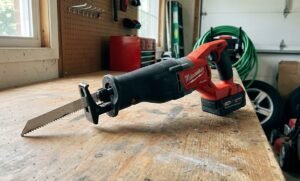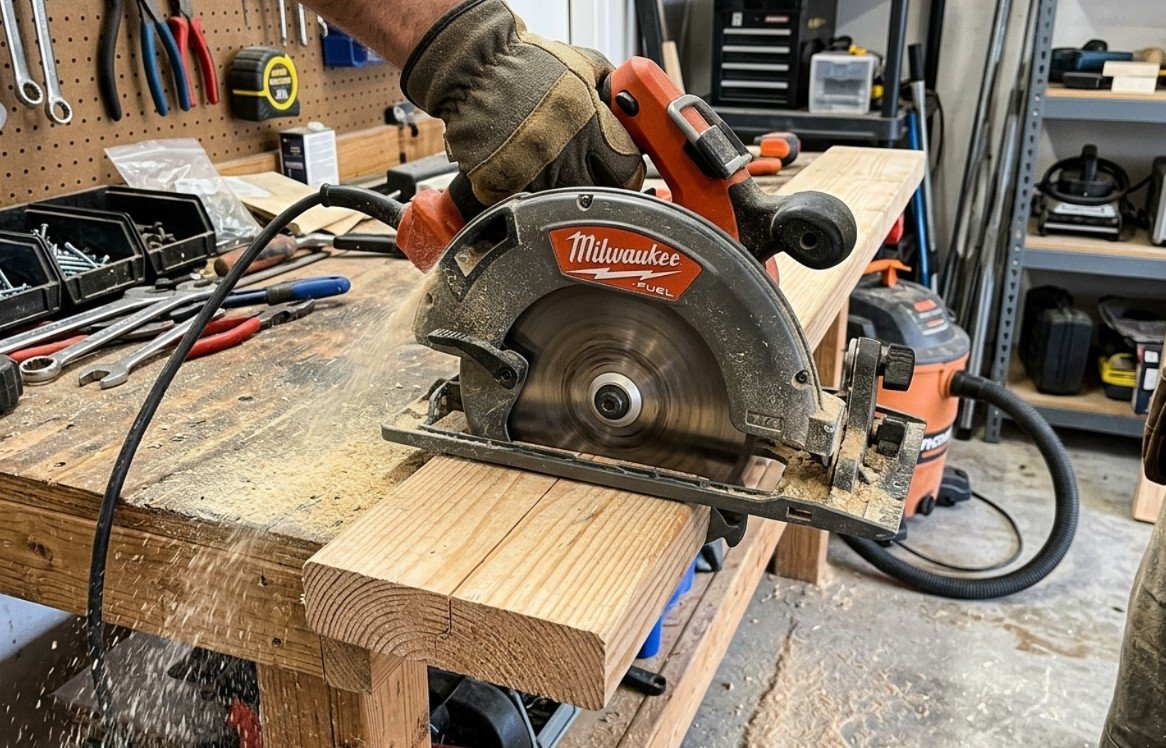
A circular saw is a handheld power saw with a toothed rotating blade, used for straight cuts through timber, sheet material and framing stock. The best circular saws in Australia pair a blade between 136mm and 184mm with a bevel adjustment to at least 45 degrees, a flat machined base plate, and either a brushless motor or a battery platform you already own.
Three things separate them. Blade diameter sets cutting depth, running from around 51mm on a compact saw to 65mm on the largest here. Brushless motors hold blade speed as the timber loads up, where a brushed motor bogs and burns. Base plate construction decides accuracy, because a pressed steel shoe flexes under hand pressure and the blade follows it off the line.
Cutting depth is the specification that decides what is possible. Standard Australian framing stock is 90mm, decking is around 19mm to 22mm, and sheet ply runs 12mm to 18mm. A saw cutting 51mm handles sheet goods and decking but cannot clear a stud in one pass, while 65mm gets through nearly everything a home build throws up.
This guide compares nine saws on blade size and cutting depth, motor type, bevel range, base plate quality and which battery platform each one commits you to.
Best Circular Saws in Australia Compared
| Product | Link | Type | Best For | Key Spec |
|---|---|---|---|---|
| Makita LXT Brushless 165mm Circular Saw | Check price | Brushless 18V | All-round cordless use | 165mm blade, 50 degree bevel |
| Black and Decker 20V Cordless Circular Saw | Check price | Brushed 20V | Light DIY | 5.5 inch blade, variable speed |
| Makita LXT 136mm Circular Saw | Check price | Brushed 18V | Confined work | 136mm blade, 51mm depth, LED |
| Ryobi One Plus Cordless Circular Saw | Check price | Brushed 18V | Households on ONE+ | 5.5 inch, 4,700 RPM |
| Makita LXT 6.5 Inch Cordless Circular Saw | Check price | Brushed 18V | Framing and ripping | 3,700 RPM, 2.25 inch cut |
| Einhell Power X-Change 165mm Circular Saw | Check price | Brushed 18V | Occasional DIY | 165mm, tool-free adjustment |
| Bosch Professional 12V Circular Saw | Check price | Brushed 12V | One-handed work | 12V, compact body |
| DeWalt 18V XR Brushless 184mm Circular Saw | Check price | Brushless 18V | Thick stock | 184mm blade, 65mm depth |
| Einhell Power X-Change 150mm Circular Saw | Check price | Brushed 18V | Light cutting with extraction | 150mm, LED, dust port |
1. Makita LXT Brushless 165mm Circular Saw – Best Brushless
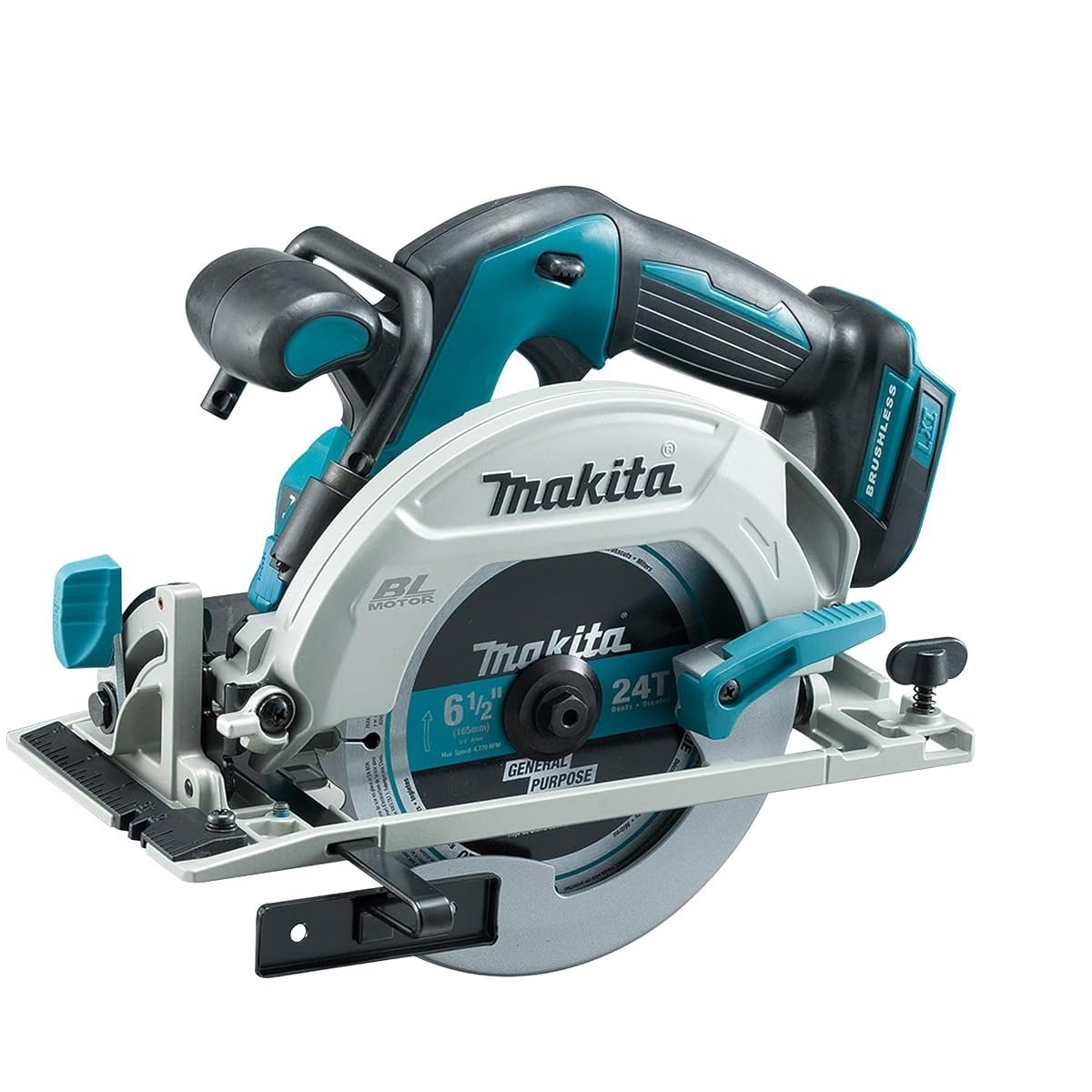
A 165mm blade on a brushless 18V motor, with bevel adjustment running to 50 degrees rather than the usual 45. It ships as a bare skin on the Makita LXT platform.
Fifty degrees is more useful than the extra five suggests. Standard saws stop at 45, which covers a mitre but not the compound angles that come up in roofing and rafter work, and hitting that ceiling means finishing the cut by hand. The brushless motor holds blade speed as the material loads up, which is what stops a cordless saw bogging halfway through a rip in wet timber.
It is the most expensive skin in this guide and needs LXT batteries that are not included. For anyone already on Makita 18V who wants one saw to handle framing, sheet goods and bevels, it is the one to buy.
Pros
- Bevel adjustment to 50 degrees
- Brushless motor holds speed under load
- 165mm blade suits framing and sheet goods
- Battery charge indicators on the tool
- Shares the widely held 18V LXT platform
Cons
- Highest priced skin here
- No battery or charger included
Key specs: 18V LXT brushless, 165mm blade, bevel adjustment to 50 degrees, battery charge indicators, skin only
CHECK ON AMAZON2. Black and Decker 20V Cordless Circular Saw – Best Budget Pick
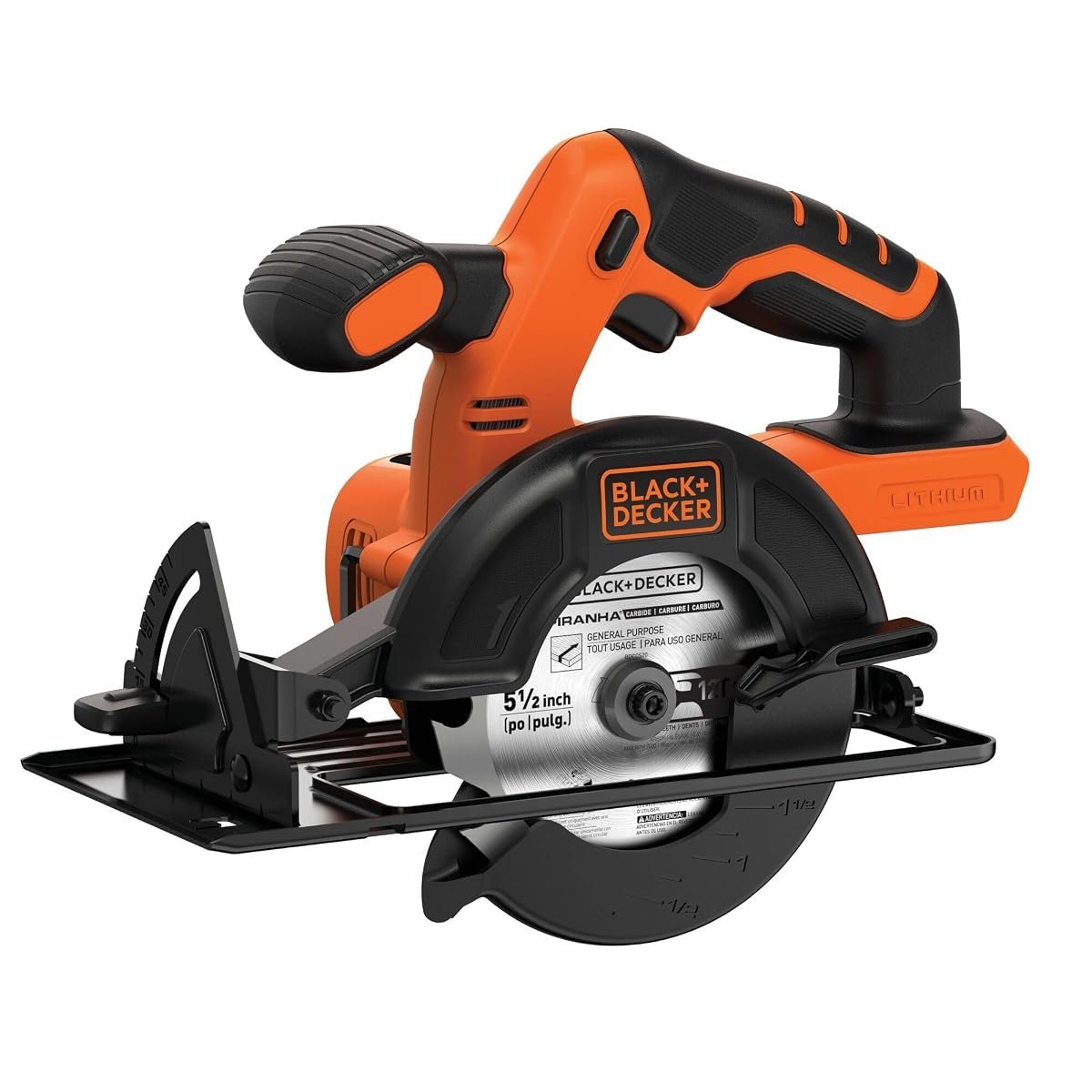
A 5.5 inch blade and a variable-speed trigger at the lowest price in this guide, sold as a bare tool on the Black and Decker 20V system.
Smaller blades cut shallower but they also make the saw lighter and easier to control one-handed, which matters more than depth for someone cutting a shelf to length. Variable speed is unusual at this price and gives some control starting a cut, where a single-speed budget saw tends to grab and kick the workpiece.
A 5.5 inch blade will not cut through 90mm framing timber in one pass, so this is not a saw for structural work. For breaking down sheet goods and general household cutting, it does the job for the least outlay.
Pros
- Lowest price in this guide
- Variable-speed trigger for controlled starts
- Light and manageable one-handed
- Shares Black and Decker 20V batteries
Cons
- 5.5 inch blade will not cut 90mm framing
- Brushed motor, lower sustained output
Key specs: 20V cordless, 5.5 inch blade, variable-speed trigger, bare tool
CHECK ON AMAZON3. Makita LXT 136mm Circular Saw – Best Compact
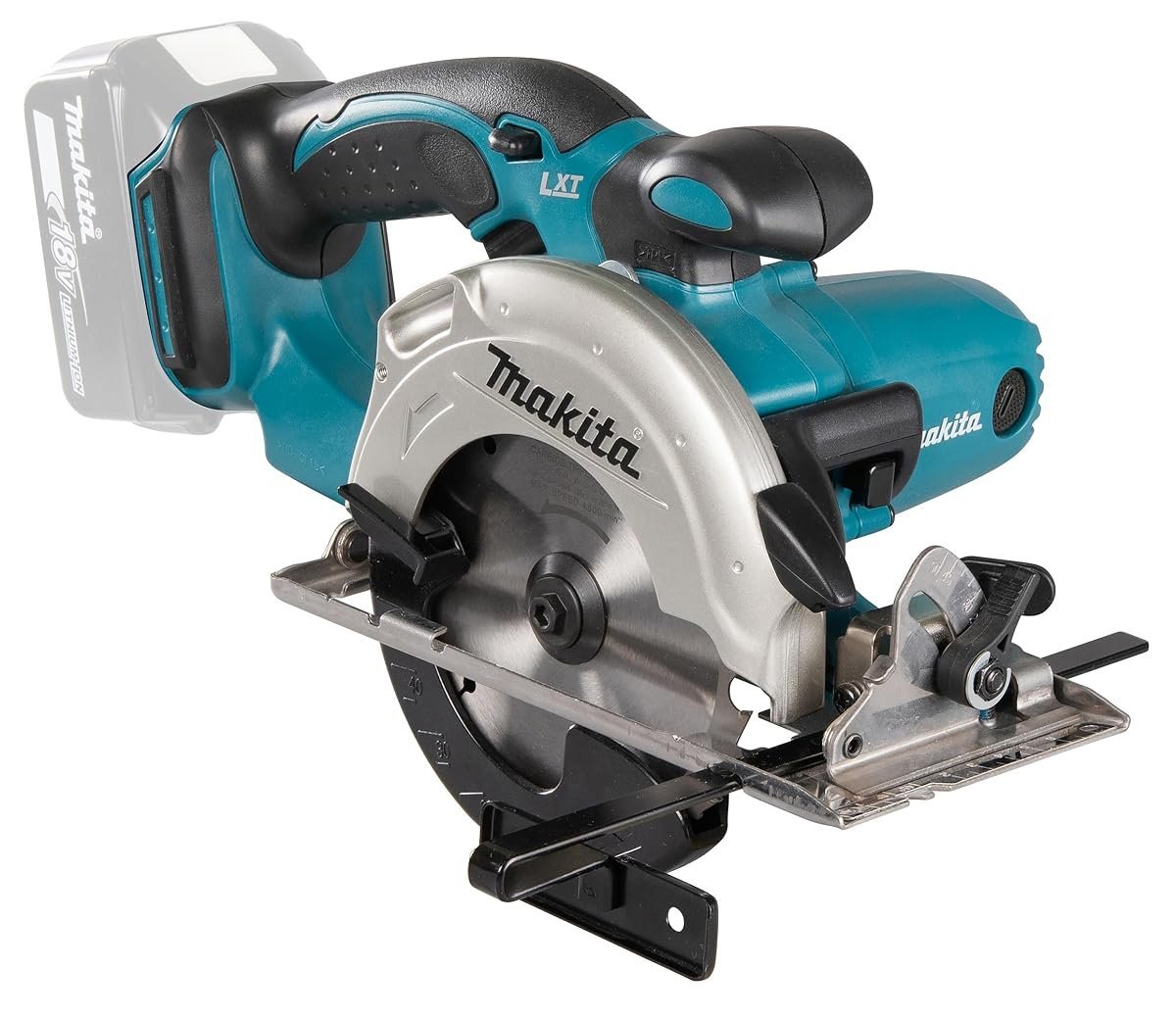
One hundred and thirty-six millimetres of blade gives 51mm of cut at 90 degrees and 35mm at 45, in the smallest body of any Makita here. An LED job light picks out the cut line.
Depth of 51mm covers standard sheet material, decking boards and 45mm stock, which is the great majority of cuts a home workshop makes. Dropping to a smaller blade takes real weight off the tool, and a lighter saw is easier to hold square through a long rip. The LED matters when working in a subfloor or a roof space where the pencil line disappears in shadow.
Fifty-one millimetres rules out cutting through framing timber in a single pass. Where the work is sheet goods and lighter stock in awkward positions, the reduced size is worth more than depth that never gets used.
Pros
- Compact and light for confined spaces
- 51mm cutting depth at 90 degrees
- LED job light on the cut line
- Easier to hold square than a full-size saw
- Shares 18V LXT batteries
Cons
- 51mm depth will not clear framing timber
- Brushed rather than brushless
Key specs: 18V LXT, 136mm blade, 51mm depth at 90 degrees and 35mm at 45, LED job light, skin only
CHECK ON AMAZON4. Ryobi One Plus Cordless Circular Saw – Best for ONE Plus Owners
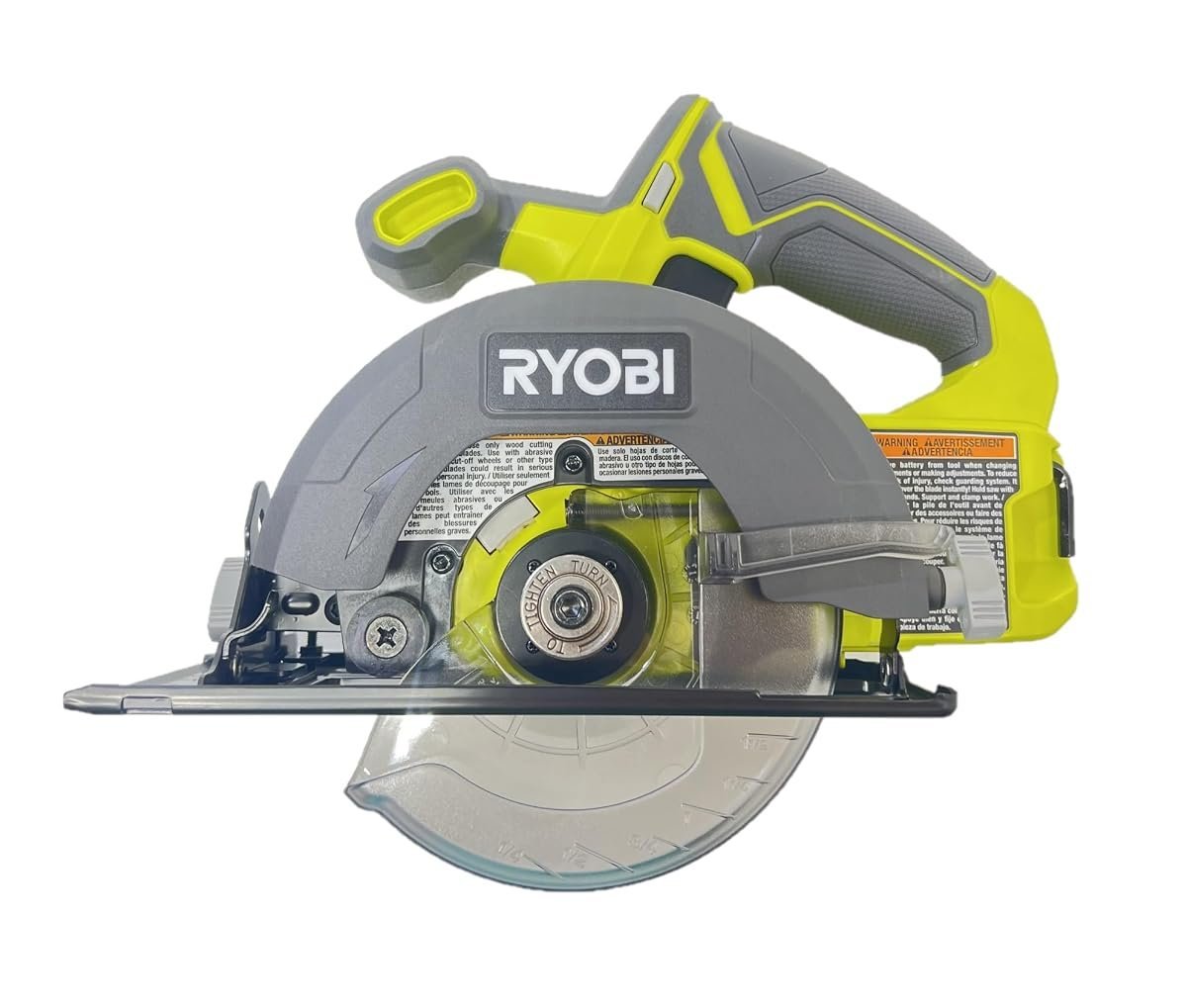
Forty-seven hundred RPM through a 5.5 inch blade, with a transparent lower guard and rubber overmoulded grips. It runs on the Ryobi ONE+ battery already sitting in a great many Australian sheds.
A clear blade guard is a small change that solves a real annoyance. On a standard opaque guard the blade disappears exactly when you need to line it up with the mark, so people either guess or crouch to see underneath. Seeing through it means the cut starts where intended. The overmoulded grip holds when hands are sweaty or gloved.
Output sits below the brushless saws and it will slow through dense hardwood. For a household already holding ONE+ batteries across mowers, drills and blowers, adding a saw for the price of a bare tool is hard to beat.
Pros
- Transparent lower guard shows the cut line
- 4,700 RPM through a 5.5 inch blade
- Rubber overmoulded grip
- Shares the very common ONE+ battery system
Cons
- Slows through dense hardwood
- Brushed motor limits sustained cutting
Key specs: 18V ONE+ cordless, 5.5 inch blade, 4,700 RPM, transparent lower guard, bare tool
CHECK ON AMAZON5. Makita LXT 6.5 Inch Cordless Circular Saw – Best for LXT Owners
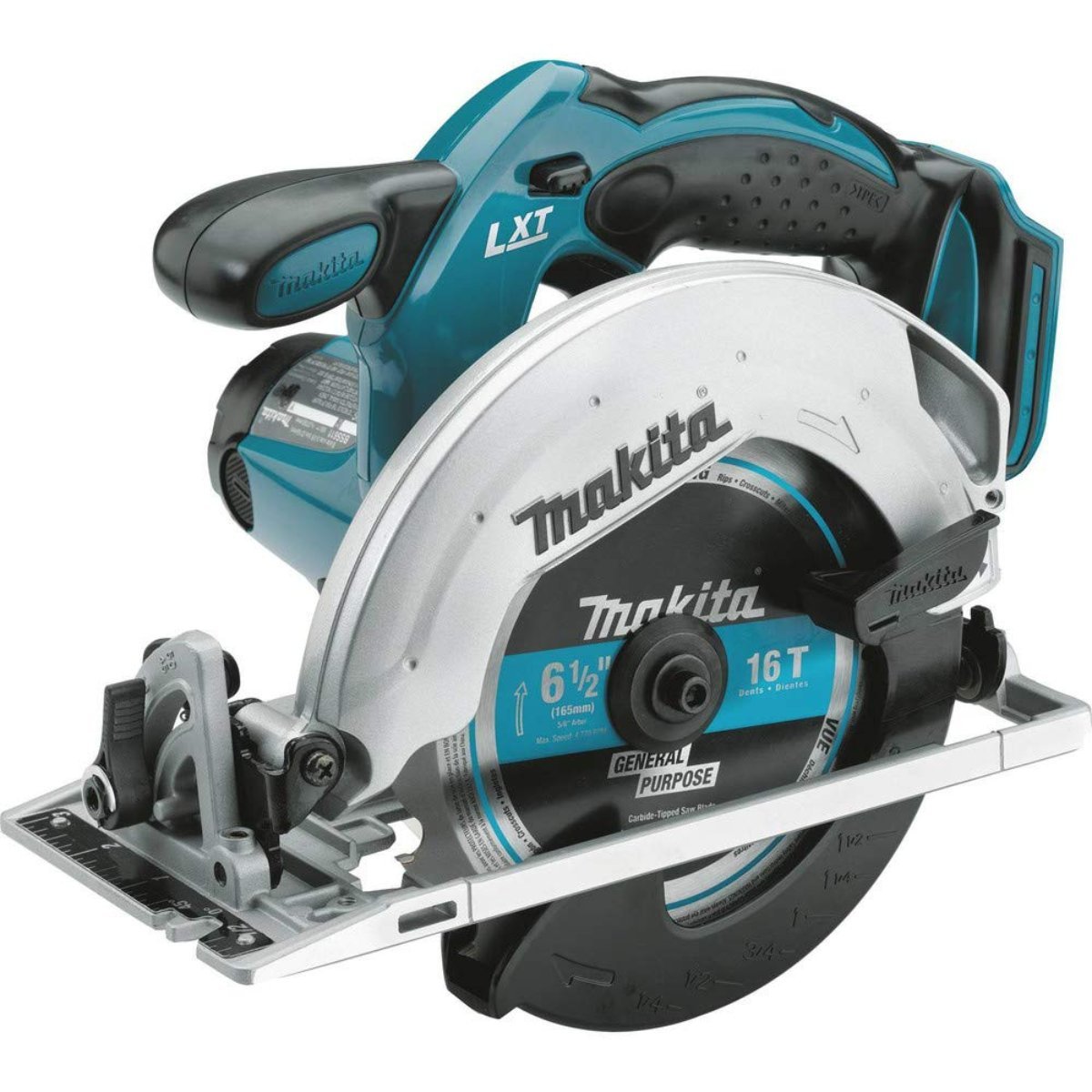
Three thousand seven hundred RPM and a maximum cut of 2.25 inches, on a heavy gauge precision machined base rather than a pressed one.
Base plate quality decides how accurate a circular saw actually is. A pressed steel base flexes under hand pressure and the blade follows it, which is why cheap saws wander off a straight line no matter how carefully they are guided. A machined base stays flat, so the cut goes where the guide says. The 2.25 inch depth clears 90mm framing in a single pass.
It is a brushed motor, so it will not hold pace with the brushless model at the top of this guide through a long day. Anyone on LXT batteries wanting a saw that cuts framing accurately, without paying brushless prices, should look here.
Pros
- Heavy gauge machined base for accurate cuts
- 2.25 inch maximum depth clears 90mm framing
- 3,700 RPM
- Shares 18V LXT batteries
- Less expensive than the brushless Makita
Cons
- Brushed motor fades over a long day
- Bare tool only
Key specs: 18V LXT cordless, 6.5 inch blade, 3,700 RPM, 2.25 inch maximum cut, machined base plate, tool only
CHECK ON AMAZON6. Einhell Power X-Change 165mm Circular Saw – Best for Occasional Use
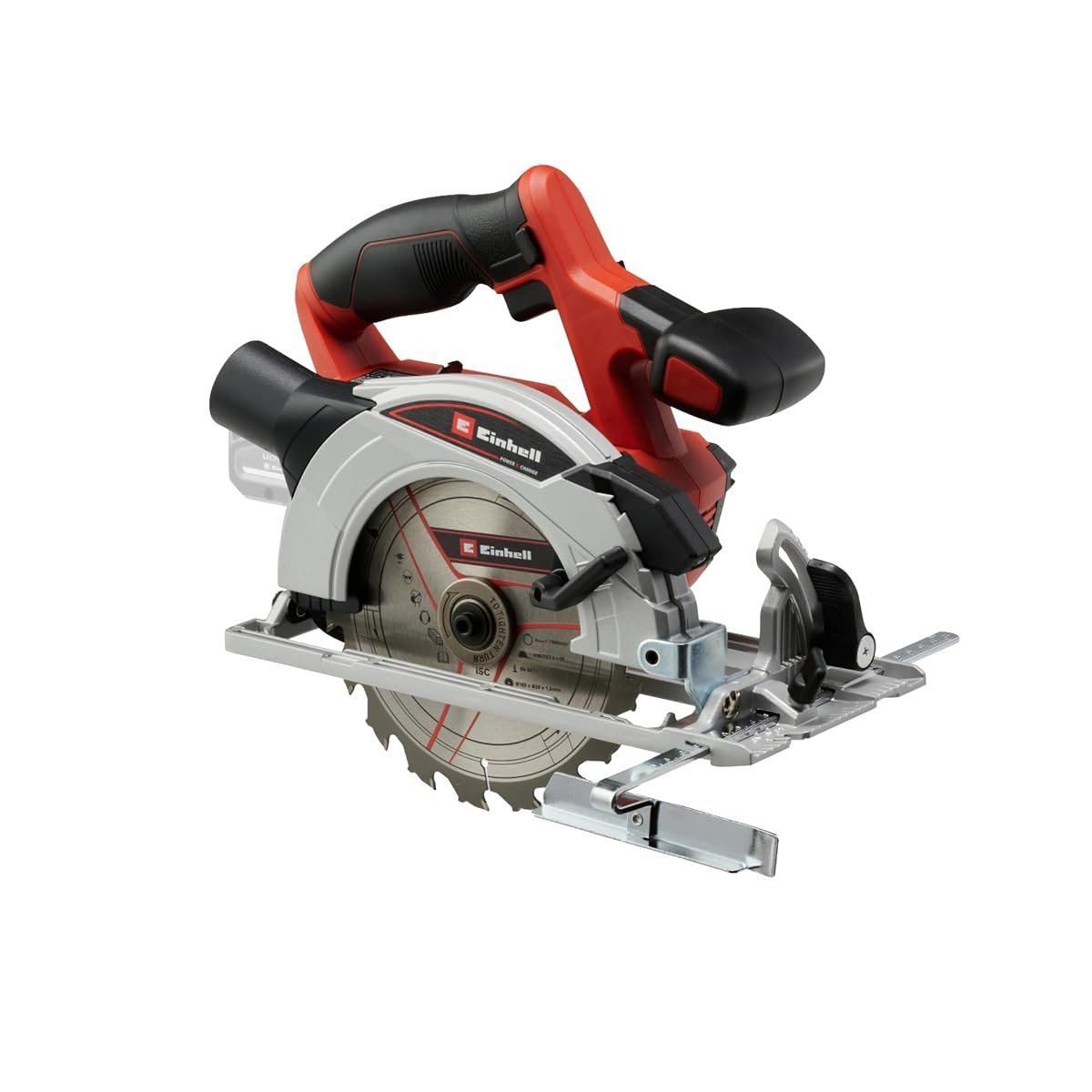
Einhell puts a 165mm blade on this one with tool-free adjustment of both cutting depth and tilt angle, hanging it off the Power X-Change battery system.
Tool-free adjustment sounds like convenience and behaves like accuracy. A saw that needs an allen key to change depth gets left at whatever it was set to last time, and cutting at the wrong depth is how kickback and splintering happen. Being able to set it by hand in seconds means it actually gets set correctly for each cut.
It is not built for daily use and the motor is brushed. For a shed that already runs Power X-Change garden tools, the saw costs the price of a bare unit and covers occasional cutting perfectly well.
Pros
- Tool-free depth and tilt adjustment
- 165mm blade clears framing timber
- Shares the broad Power X-Change battery range
- Inexpensive as a bare tool
Cons
- Not built for daily trade use
- Supplied without battery or charger
Key specs: 18V Power X-Change, 165mm blade, tool-free cutting depth and tilt adjustment, solo tool
CHECK ON AMAZON7. Bosch Professional 12V Circular Saw – Best for Tight Spaces
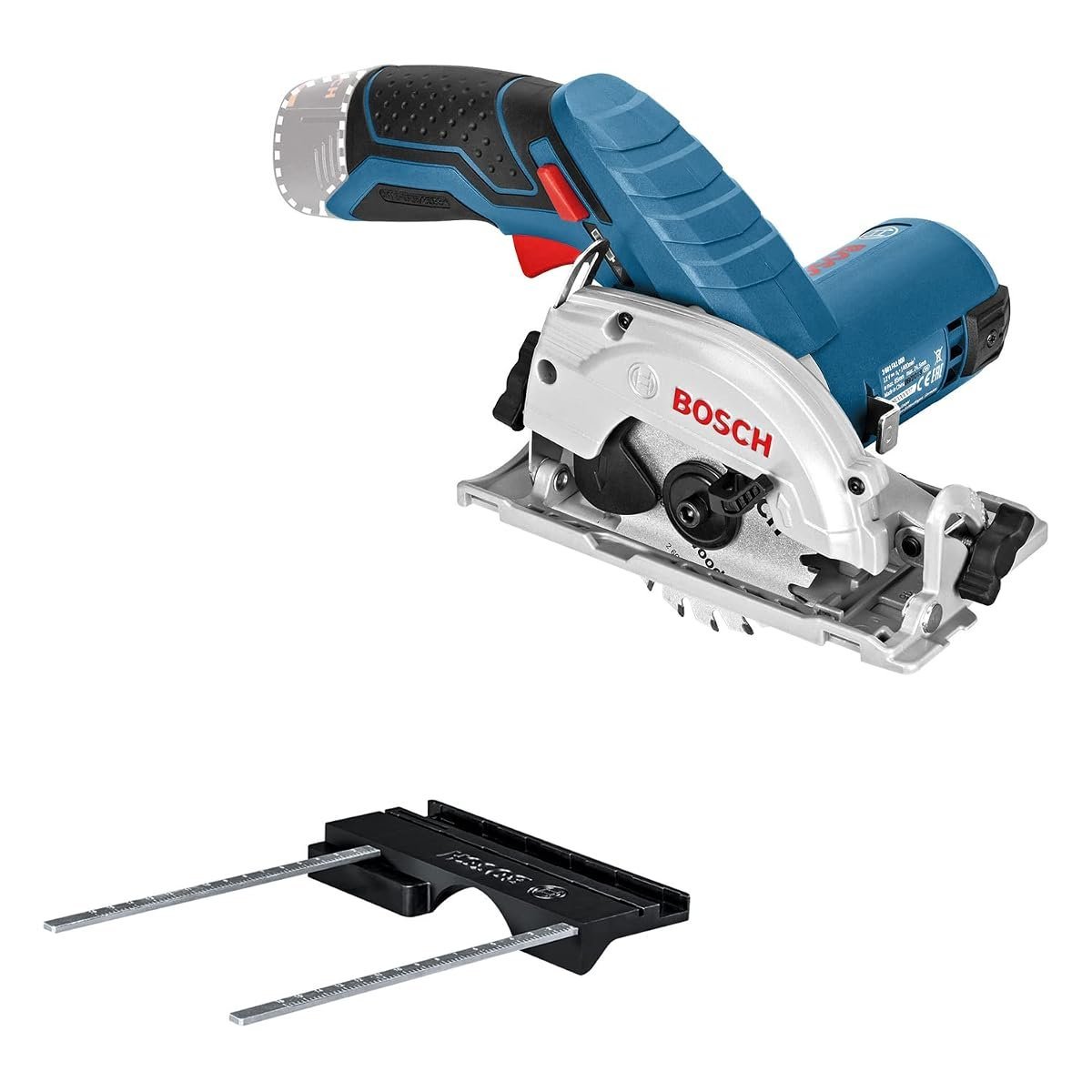
Twelve volts rather than eighteen, in a narrow-handled body Bosch has built around one-handed control and overhead work.
Most circular saw cuts do not need a full-size saw, and a 12V tool weighs roughly half what an 18V one does. Cutting sheet material overhead, trimming architrave in place or working from a ladder is limited by how long you can hold the tool steady rather than by power. The narrow handle circumference is the detail that makes one-handed use realistic.
It has the shallowest cut here and will not touch framing timber. Cabinet installers, shopfitters and anyone cutting thin material in awkward positions will reach for it constantly; a builder framing a wall will not.
Pros
- Very light and compact for one-handed use
- Narrow handle for better control
- Excellent overhead and on a ladder
- Bosch Professional 12V platform
Cons
- Shallowest cutting depth in this guide
- Not suited to framing timber
Key specs: Bosch Professional 12V System, compact body, narrow handle circumference, without battery and charger
CHECK ON AMAZON8. DeWalt 18V XR Brushless 184mm Circular Saw – Best for Deep Cuts
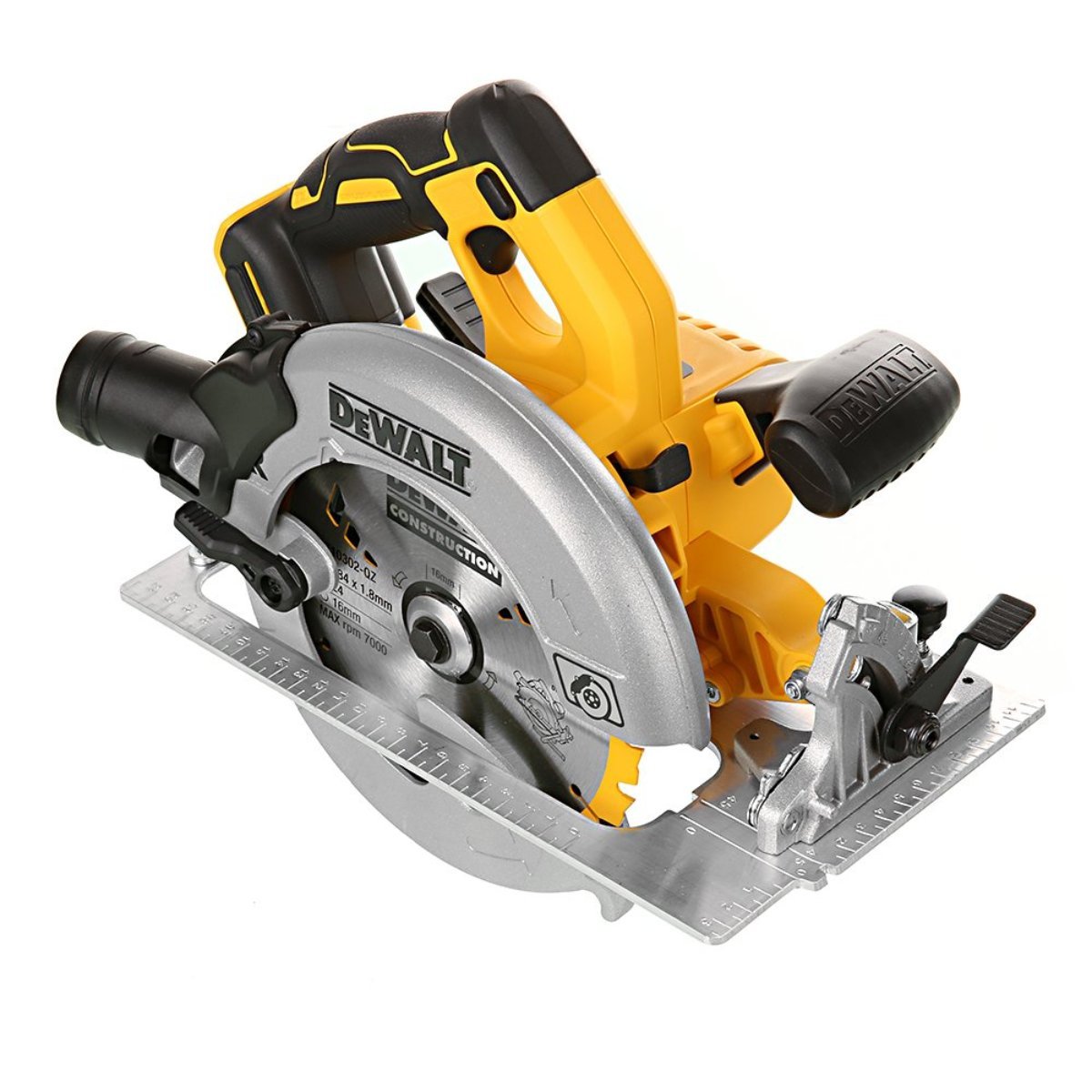
The largest blade in this guide is 184mm, and it buys 65mm of cutting depth with a scale on the shoe for setting it precisely.
Sixty-five millimetres is the number that decides whether a saw can cut a 70mm post in two passes or a 90mm stud in one bevelled cut. Anything shallower means flipping the timber and hoping the cuts meet, which they rarely do squarely. A depth scale rather than an eyeballed slider is what makes repeat cuts at a set depth consistent across a job.
The larger blade makes it the heaviest saw here and blades cost more than 165mm ones. Where the stock is genuinely thick, it is the only saw in this guide that will get through in one pass.
Pros
- 65mm cutting depth, the deepest here
- 184mm blade
- Scale for precise depth setting
- Brushless motor
- Handles ripping, cross-cutting and bevelling
Cons
- Heaviest saw in this guide
- 184mm blades cost more than 165mm
Key specs: 18V XR brushless, 184mm blade, 65mm cutting depth, depth-setting scale, skin only
CHECK ON AMAZON9. Einhell Power X-Change 150mm Circular Saw – Best Lightweight
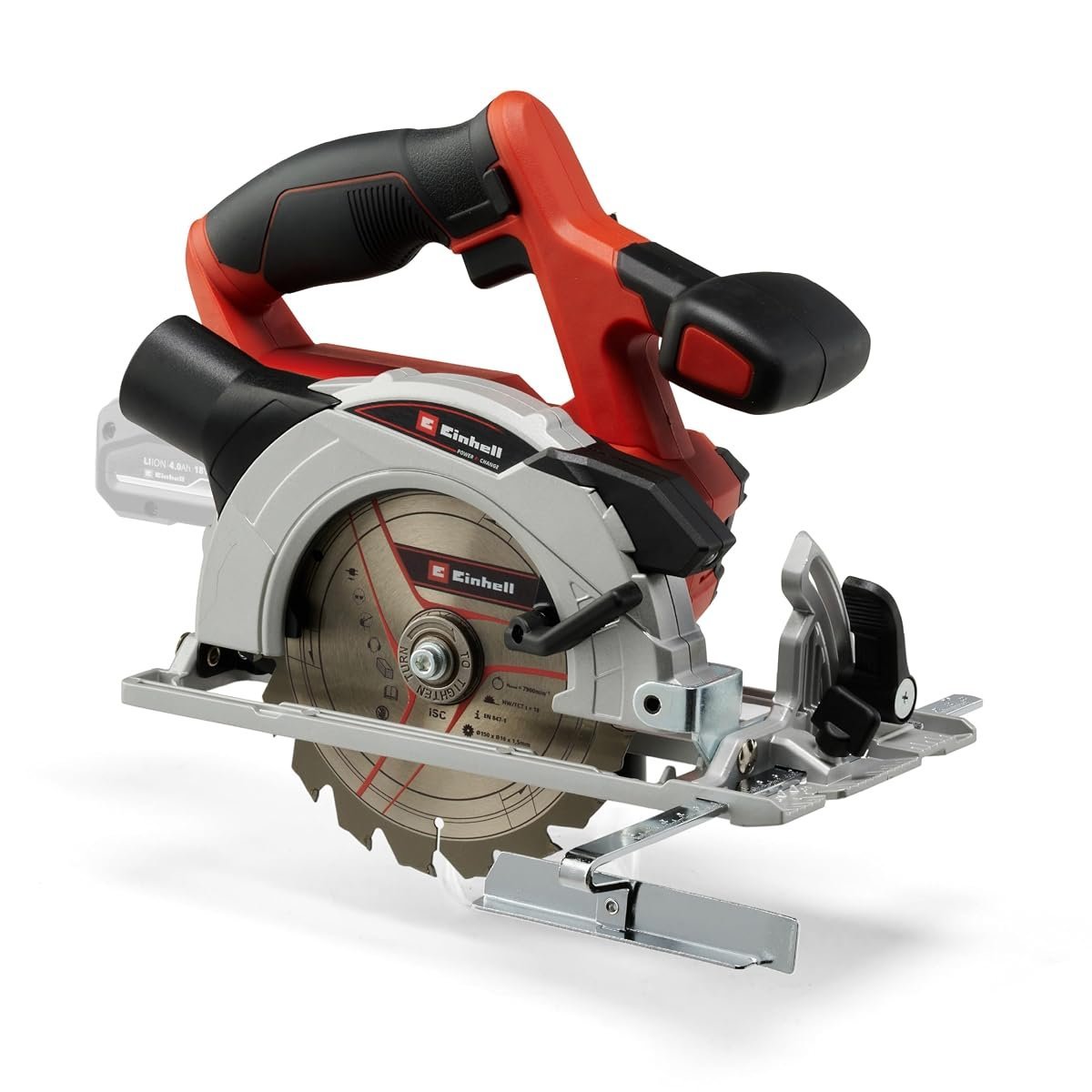
A 150mm blade sits between the compact and full-size saws here, with LED lighting and a dust vacuum attachment built in.
Dust extraction on a circular saw is rarer than it should be. Cutting MDF or treated pine throws a plume straight at your face, and a port that takes a vacuum hose removes most of it at the source rather than leaving it to settle across the workshop. Combined with the LEDs, it means you can actually see the line you are cutting to.
The 150mm blade is a compromise between the 136mm compact and the 165mm full-size saws, so it does neither job perfectly. For someone cutting sheet material indoors who cares about dust, that middle ground plus extraction is the right trade.
Pros
- Dust vacuum attachment captures debris at source
- LED lighting on the cut line
- 150mm blade balances depth and weight
- Tool-free depth and tilt adjustment
- Shares Power X-Change batteries
Cons
- Middle blade size suits neither extreme perfectly
- Brushed motor, occasional use only
Key specs: 18V Power X-Change, 150mm blade, LED lighting, dust vacuum attachment, tool-free adjustment
CHECK ON AMAZONHow to Choose a Circular Saw
Work out your cutting depth from the timber you actually use. Australian framing stock is 90mm, so a saw cutting 51mm will not clear a stud in one pass no matter how you angle it. Decking and sheet ply sit well under that. Buy 165mm or larger if framing is on the list, and a compact 136mm saw if it is sheet goods and trim.
Check the base plate before the motor. A pressed steel shoe flexes when you lean on the saw and the blade tracks with it, which is why a cheap saw wanders off a straight line even against a guide. A heavy gauge or machined base stays flat. This affects cut quality more than a few hundred RPM ever will.
Brushless is worth it if you cut weekly. A brushless motor holds blade speed as the timber loads up, so it powers through a rip in wet hardwood where a brushed saw slows, burns the edge and eventually stalls. For a few cuts a year the difference never shows and the extra outlay does not pay back.
Let the battery platform decide between cordless saws. Circular saws are heavy current draws and will flatten a small battery in a handful of cuts, so plan on 4.0Ah packs or larger and a spare. If there is already an 18V system in the shed, the matching bare skin is nearly always the right buy over a nominally better saw on a new platform.
Check the bevel range if you cut roof or rafter work. Most saws stop at 45 degrees, which covers a standard mitre. Compound angles in roofing need more, and a saw reaching 50 degrees saves finishing those cuts by hand. For flat work it makes no difference at all.
Plan for the dust and the offcuts. A circular saw throws a plume of fine dust, and treated pine and MDF are the ones you least want to breathe. A saw with an extraction port paired with one of the industrial vacuum cleaners in our guide handles most of it, and the blades, guides and spare batteries need somewhere to live, which the tool boxes guide covers.
Frequently Asked Questions
What size circular saw do I need?
For Australian 90mm framing stock you want a 165mm or larger blade, which cuts around 60mm to 65mm deep and clears a stud in one pass. For sheet ply, decking and trim, a 136mm to 150mm saw cuts 45mm to 55mm and is lighter and easier to control.
Is a cordless circular saw as good as a corded one?
Modern brushless cordless saws match corded performance for most work, and the freedom from a lead is worth a great deal on a site. The trade-off is battery drain, since a circular saw draws hard and will empty a small pack in a handful of cuts. Plan on 4.0Ah batteries or larger.
Do I need a brushless circular saw?
If you cut weekly, yes. A brushless motor holds blade speed under load, so it rips through wet hardwood where a brushed saw bogs down and burns the cut. For occasional DIY, a brushed saw costs less and will not be the limiting factor.
Why does my circular saw not cut straight?
Usually a flexing base plate, a blunt or warped blade, or pushing faster than the saw can cut. Check the base is locked at 90 degrees and sits flat, fit a sharp blade with the right tooth count for the material, and let the saw set the pace rather than forcing it.
What causes circular saw kickback?
The blade binding in the cut and driving the saw back at the operator. Common causes are cutting depth set too deep, the offcut pinching the blade because the workpiece is unsupported, or a blunt blade. Set the depth so the blade clears the material by about a tooth, and support both sides of the cut.
Can a circular saw cut metal or masonry?
With the correct blade, yes, though a dedicated tool is safer and cleaner. Metal-cutting and masonry blades exist for circular saws but generate significant heat, sparks and dust, and not every saw is rated for them. Check the manufacturer guidance before fitting a non-timber blade.
Verdict
Anyone cutting framing regularly should take the brushless Makita, where holding blade speed under load and a 50 degree bevel cover the work a single saw needs to do. If the stock runs thicker than 60mm, the DeWalt is the only saw here that clears it in one pass. And for sheet goods and trim in awkward positions, the compact 136mm Makita is easier to hold square than any full-size saw, which matters more for accuracy than depth nobody uses.