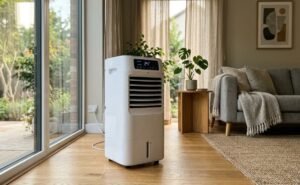
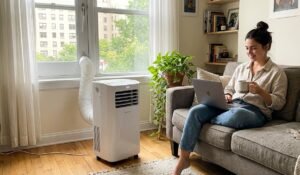
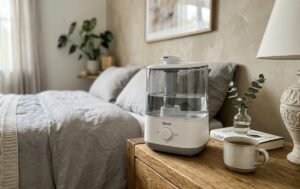
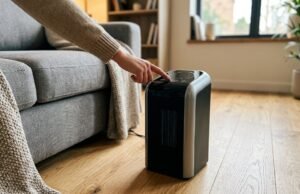
An evaporative cooler lowers air temperature by pulling warm air through a water-soaked pad, so the heat is absorbed as the water evaporates rather than being pumped outside the way a refrigerant air conditioner does. It needs no exhaust hose, no window kit and draws a fraction of the power a split-system uses, which is why choosing the best evaporative cooler in Australia usually comes down to tank size, airflow and how humid the local air already is.
Four form factors turn up across Australian retailers, and floor space decides more than any single spec. Personal coolers sit on a desk and cool one person within arm’s reach. Tower coolers stand narrow and tall for a bedroom or home office. Tank coolers carry six to ten litres for a living area. Large-tank coolers hold twenty litres or more and are built to run through a whole afternoon in a garage, shed or covered patio.
Tank capacity across this guide runs from 800 millilitres, roughly 27 fluid ounces, up to 30 litres, close to 8 gallons, and that one figure predicts how often the appliance interrupts the day more than any other spec. Beyond it, the things worth checking are the number of fan speeds, whether the cooling pad is a single face or wraps around the housing, and whether a remote or a sleep mode is fitted.
Evaporative cooling is a humidity trade, not a universal fix. It works hardest in the dry inland air of Western Australia, South Australia and regional New South Wales and Victoria, where evaporation happens fast, and does far less in the humid coastal stretch of Queensland and the Northern Territory. This guide compares eight evaporative coolers sold in Australia on tank capacity, airflow, noise and power use, and pairs with the portable air conditioner comparison for anyone in a humid climate who needs refrigerant cooling instead.
Quick Picks
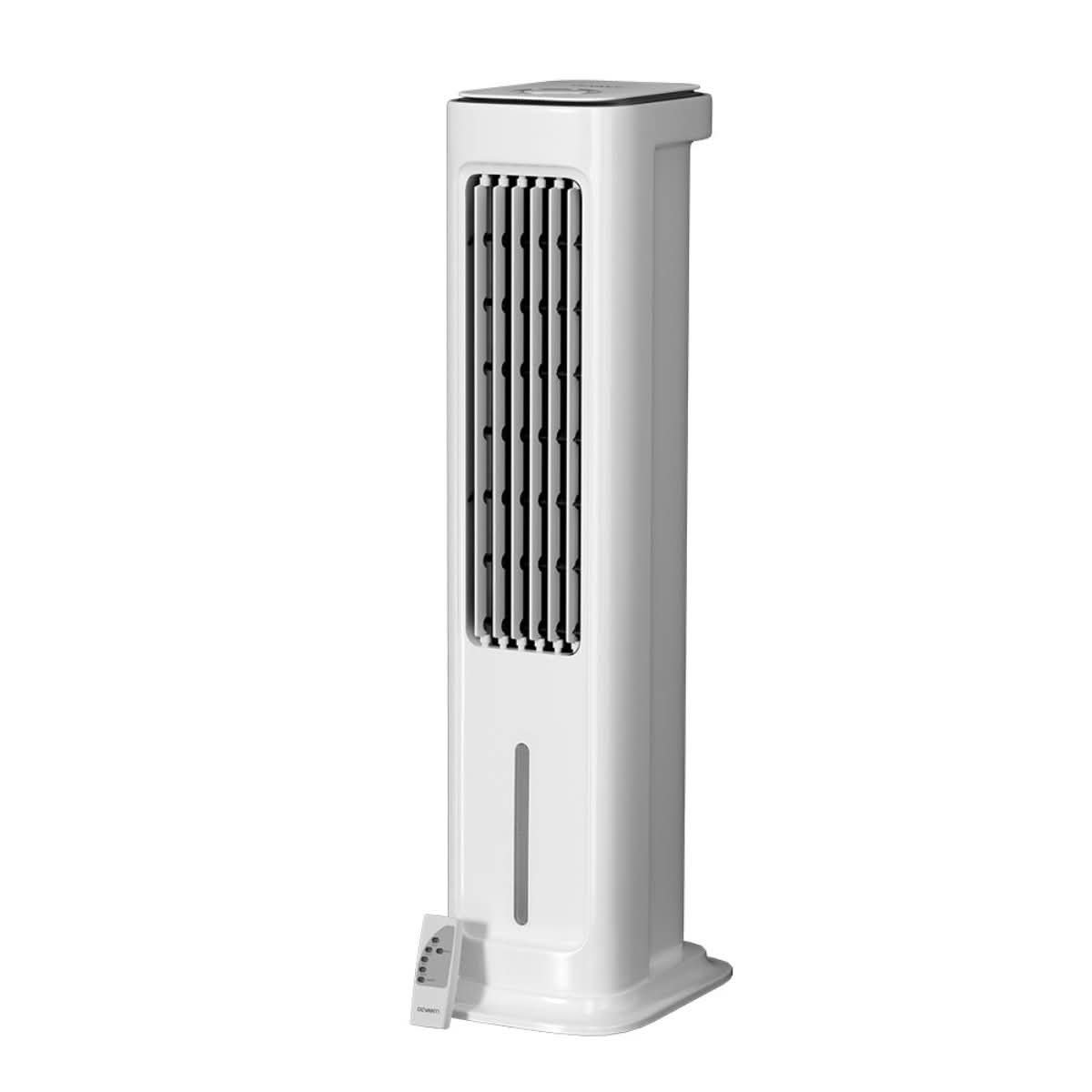
Devanti Tower Evaporative Air Cooler 6L
A slim tower design with a dedicated sleep mode and a 12-hour timer, sized to run through the night beside a bed.
CHECK CURRENT PRICE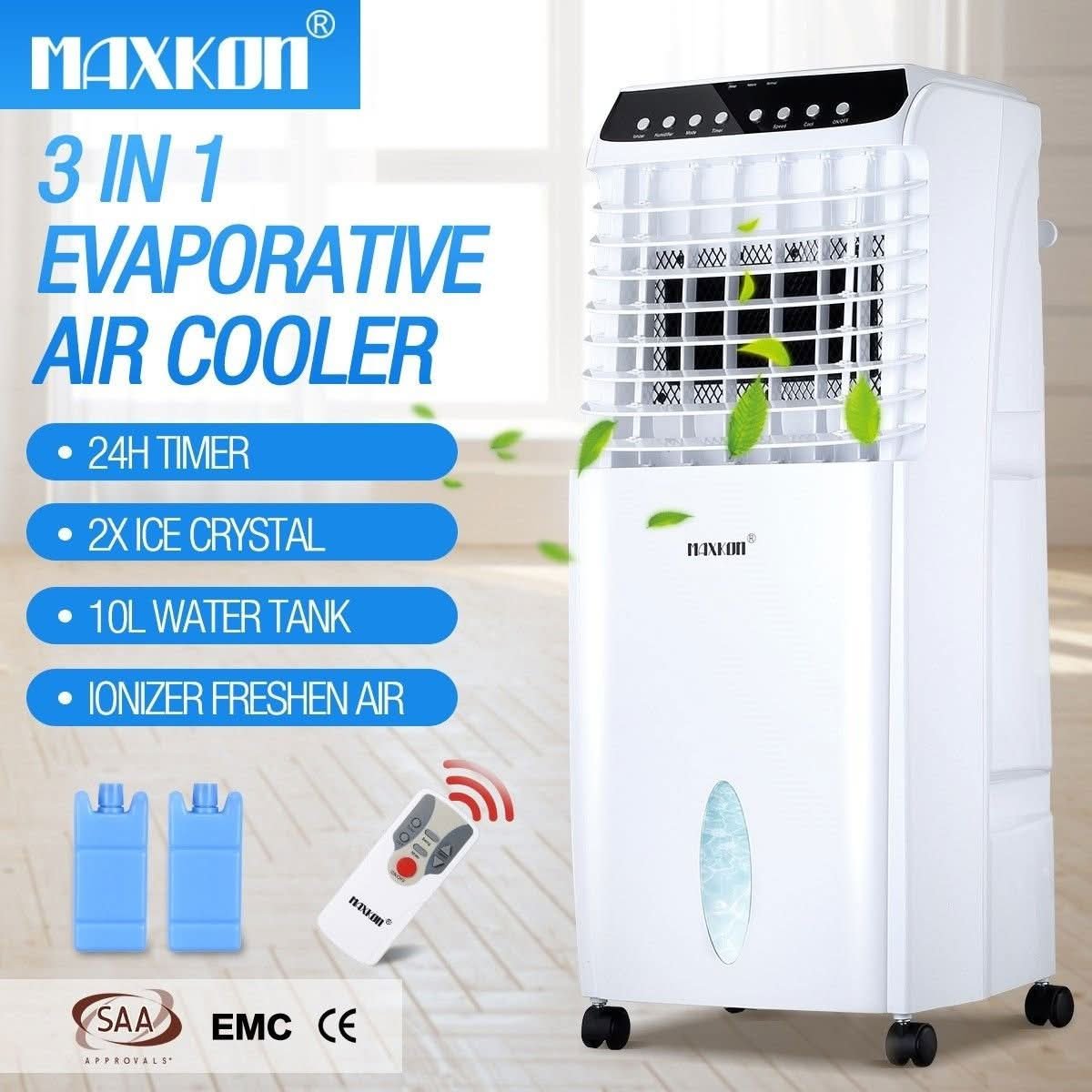
Maxkon 10L Evaporative Air Cooler
The largest tank among the mid-range picks here, built for a lounge room rather than a single desk.
CHECK CURRENT PRICE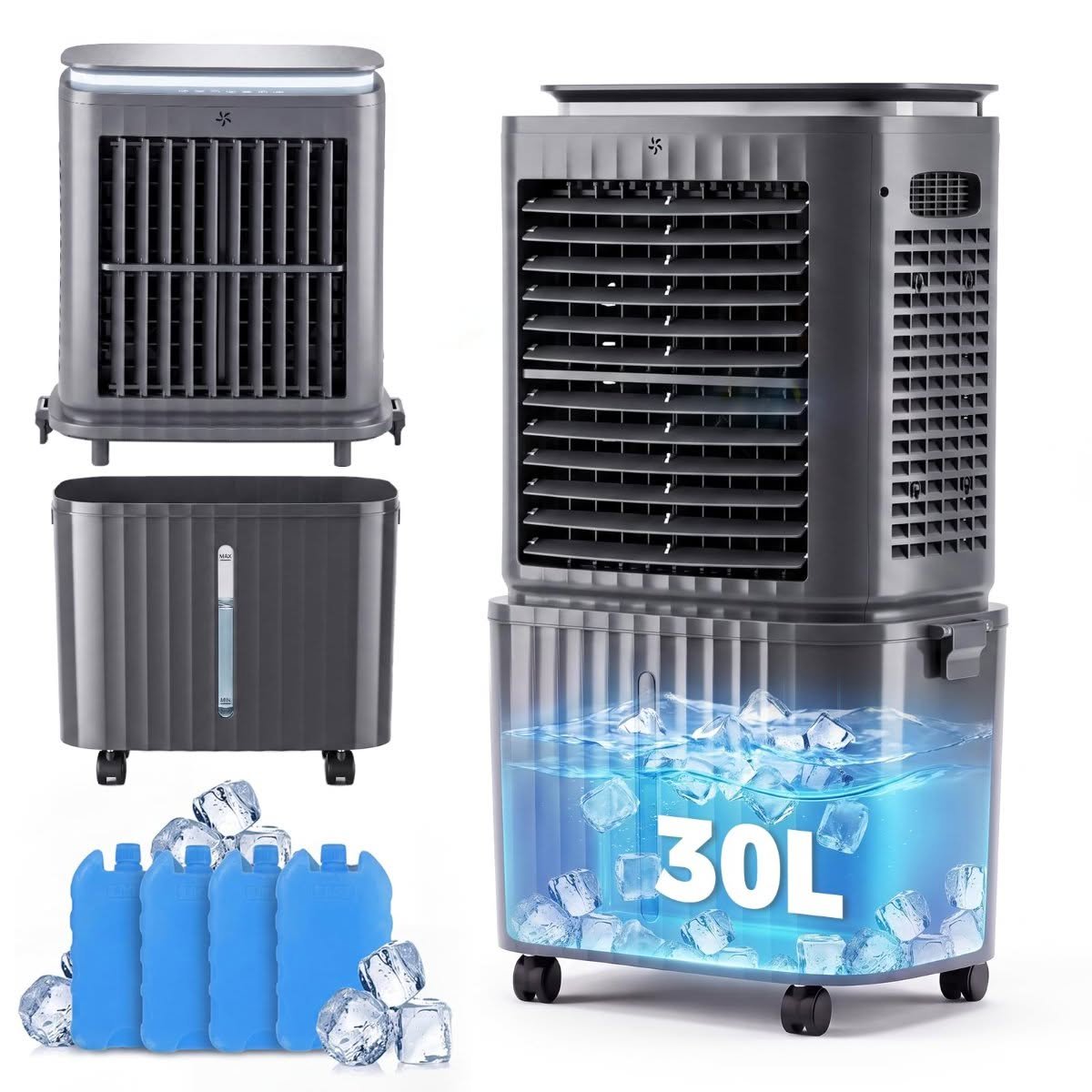
YOPOWER 30L Evaporative Air Cooler
A 30-litre tank rated for up to 24 hours of cooling before it needs a refill.
CHECK ON AMAZONBest Evaporative Cooler Australia Compared
| Product | Link | Type | Best For | Key Spec |
|---|---|---|---|---|
| Devanti Tower Evaporative Air Cooler 6L | Check price | Tower | Bedrooms | 6L tank, ice-crystal pad |
| 8L Evaporative Air Cooler 3-in-1 Portable | Check price | 3-in-1 portable | Multi-mode use | 8L tank, cool / fan / humidify |
| Maxkon 10L Evaporative Air Cooler | Check price | Tank cooler | Living rooms | 10L tank, ionizer |
| Maxkon 6L Evaporative Air Cooler | Check price | Tank cooler | Single rooms | 6L tank, ionizer |
| Mini Portable USB Arctic Air Cooler | Check price | Personal / USB | Desk or bedside | USB or wall plug, LED light |
| YOPOWER 30L Evaporative Air Cooler | Check price | Large-tank | Biggest tank | 30L tank, 3500m3/h airflow |
| Evapolar evaCHILL EV-500 | Check price | Personal | Single desk | 800ml tank, 10W |
| Bonaire Diet 22i Evaporative Air Cooler | Check price | Premium | Established brand | 22L tank, i-Pure treatment |
1. Devanti Tower Evaporative Air Cooler 6L – Best for Bedrooms
This is the narrowest cooler in the guide, standing 86.5cm tall on a 23 by 29cm base, small enough to tuck beside a bedside table without eating into floor space. The water compartment holds 6 litres and sits low in the tower for stability, with a cooling pad rated to hold ice packs for a sharper temperature drop on the hottest nights.
Three fan speeds pair with three preset modes, including a dedicated sleep setting that steps the fan down gradually rather than cutting it in one jump. Oscillation swings the head side to side to spread the airflow across a room rather than aiming it at one spot, and the remote covers every function so the unit does not need to be reached once it is running.
At 60 decibels on its higher speeds it is closer to a running fridge than silent, so light sleepers should plan to run it on the lower two settings overnight and save the top speed for cooling the room down first. The 12-hour timer means it can switch off in the small hours rather than run until sunrise. Anyone in a small bedroom who wants a unit they can control from bed without a phone or an app has the strongest reason to buy this one.
Pros
- 6L tank with ice-crystal cooling pad
- Dedicated sleep mode across 3 speeds
- Remote control for every function
- 0-12 hour timer
- Compact 23 x 29cm footprint
Cons
- 60dB on higher speeds, not whisper-quiet
- No WiFi or app control
- Tank needs manual refilling, no auto-fill hose
Key specs: 6L tank, 65W, 3 speeds / 3 modes, ice-crystal cooling pad, 0-12hr timer, remote control, 86.5 x 29 x 23cm.
CHECK ON AMAZON2. 8L Evaporative Air Cooler 3-in-1 Portable – Best 3-in-1 Design
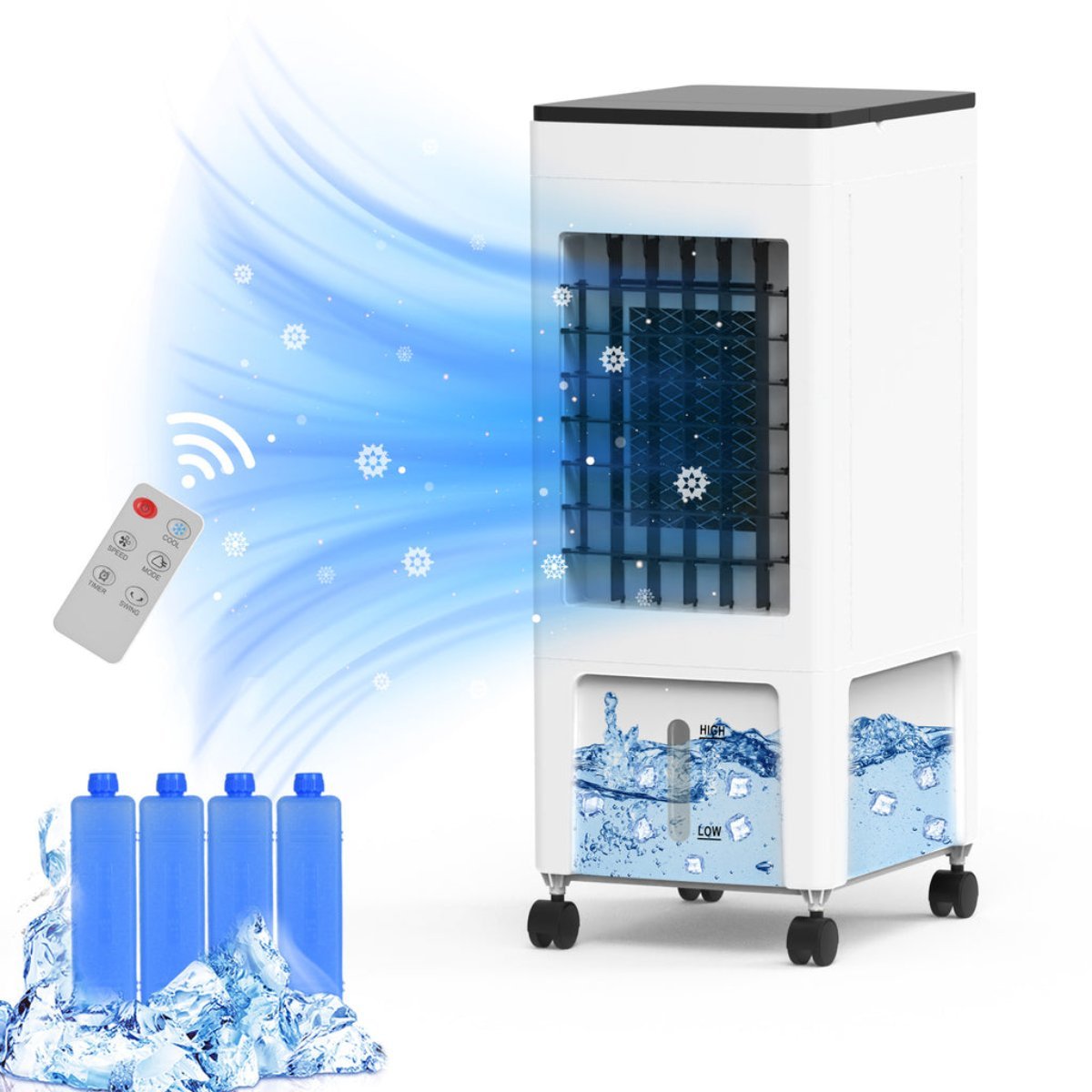
Unlike the tower design above, this unit sits lower and wider, at 61.5cm tall on a similar footprint, and the tank fills from the top without lifting the housing off its base. Four ice-crystal boxes slot into the tank rather than one, which is the detail that actually earns the 3-in-1 label: cooling, fan and humidifying modes all draw on the same reservoir.
The 8-litre capacity is the largest tank on a genuinely portable, sub-70cm unit in this guide, and auto horizontal swing is paired with a manual vertical tilt, so the airflow can be aimed rather than only spread. The timer runs from one to eight hours in one-hour steps, tighter control than the tower’s 12-hour dial, and 55 decibels puts it a touch below that unit on paper.
The trade-off against the tower is footprint: at 24 by 29cm it takes up more floor space for a similar height, which matters in a small room. It suits a living area or a study where the appliance can sit against a wall rather than a bedroom nightstand, and where switching between cooling, plain fan and humidifying without buying three separate appliances is the actual selling point.
Pros
- 8L top-fill tank, the largest on a sub-70cm unit here
- Genuine 3-in-1: cool, fan and humidify modes
- 1-8 hour timer in 1-hour steps
- Auto horizontal swing plus manual tilt
- 4 ice-crystal boxes included
Cons
- Wider footprint than the tower design above
- 55dB is still audible on higher speeds
- No app or voice control
Key specs: 8L top-fill tank, 60W, 3 speeds / 3 modes, 4 ice-crystal boxes, 1-8hr timer, auto swing, 61.5 x 29 x 24cm.
CHECK ON AMAZON3. Maxkon 10L Evaporative Air Cooler – Best for Living Rooms
At 10 litres this carries the largest tank among the mid-capacity picks in this guide, built for a space larger than one bedroom. An ionizer function runs alongside the cooling fan, intended to add a mild negative-ion output to the airflow rather than just moving cooled air.
Remote control operates the unit from across a room, useful given the larger size makes it less of a bedside appliance and more of a fixed floor unit for a living area. The 10-litre reservoir means fewer refills through a long afternoon compared with the smaller units above, with a heavier unit to move once it is full.
The listing does not publish airflow, timer duration or a noise rating, a real gap next to the fully specified units elsewhere in this guide, stated here rather than guessed. A shopper who wants those figures in writing before buying should check directly before ordering. For a living room where tank capacity matters more than a documented decibel figure, it is still the largest confirmed-in-stock option below the Bonaire in this guide.
Pros
- 10L tank, largest of the mid-range picks
- Ionizer function alongside cooling
- Remote control
- Sized for a living room rather than a desk
Cons
- Airflow, timer and noise level not published
- Heavier to move once the tank is full
- No documented sleep mode
Key specs: 10L tank, ionizer function, remote control. Airflow, timer and noise rating not published.
CHECK ON AMAZON4. Maxkon 6L Evaporative Air Cooler – Best Compact Pick
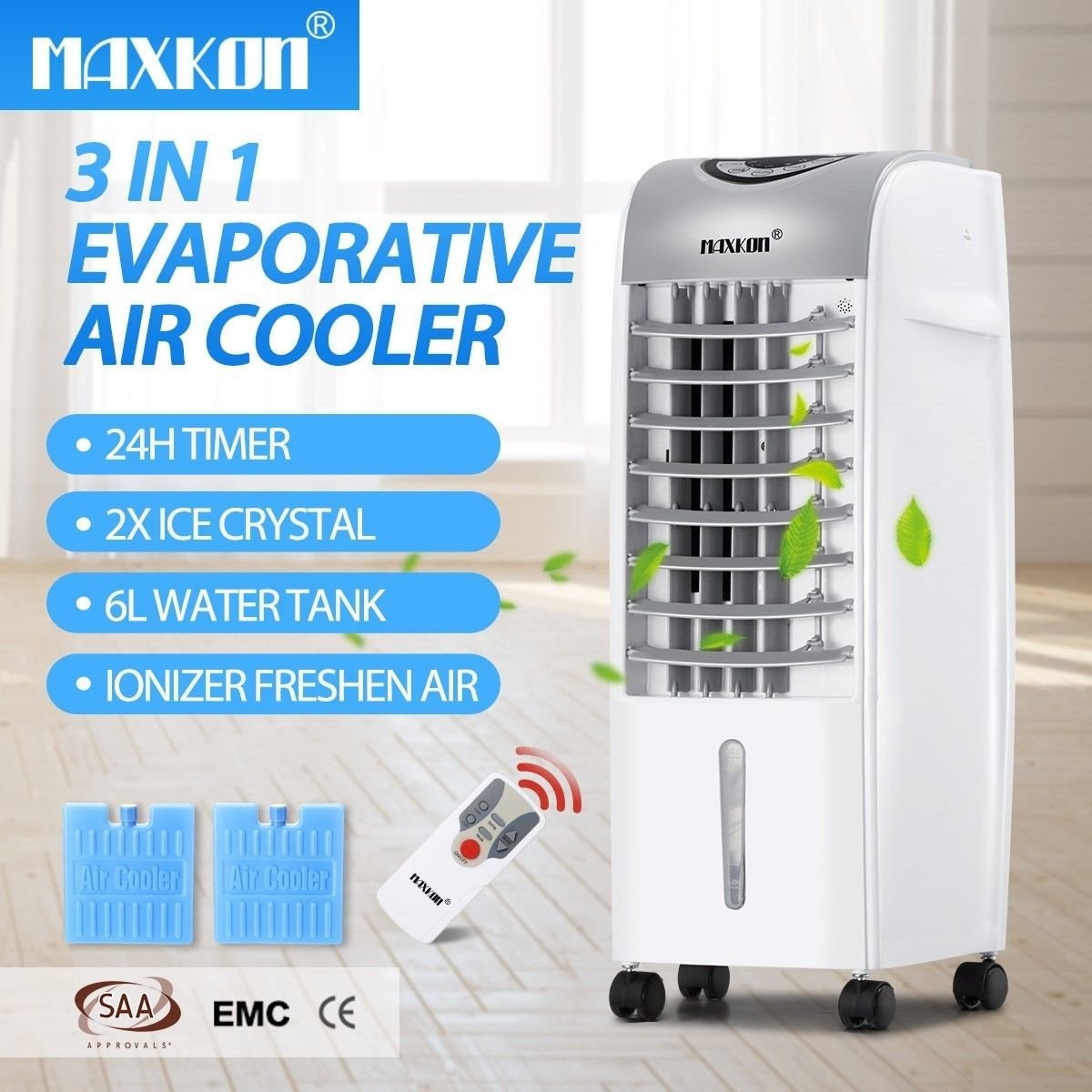
This is the compact sibling of the 10-litre unit above, sharing the same ionizer-and-remote combination in a smaller 6-litre reservoir. The smaller tank means more frequent refills through a hot afternoon, but a lighter unit that is easier to move between rooms.
Remote control and an ionizer function carry over from the larger model, and the reduced tank size is the only meaningfully different published spec. For a single room rather than an open living area, the smaller reservoir is less of a practical downside than it sounds, since less floor area means less air to cool per cycle.
As with the 10-litre version, airflow, timer duration and noise level are not published, so this suits a buyer prioritising a smaller footprint over a fully documented spec sheet. It sits between the tower design and the personal cooler below, for anyone who has ruled out a bedroom-specific tower shape.
Pros
- 6L tank, lighter and easier to move than the 10L option
- Ionizer function and remote control included
- Smaller footprint suits a single room
Cons
- Airflow, timer and noise level not published
- More frequent refills than the 10L or 30L options
- No sleep-specific mode documented
Key specs: 6L tank, ionizer function, remote control. Airflow, timer and noise rating not published.
CHECK ON AMAZON5. Mini Portable USB Arctic Air Cooler – Best Personal Desk Cooler
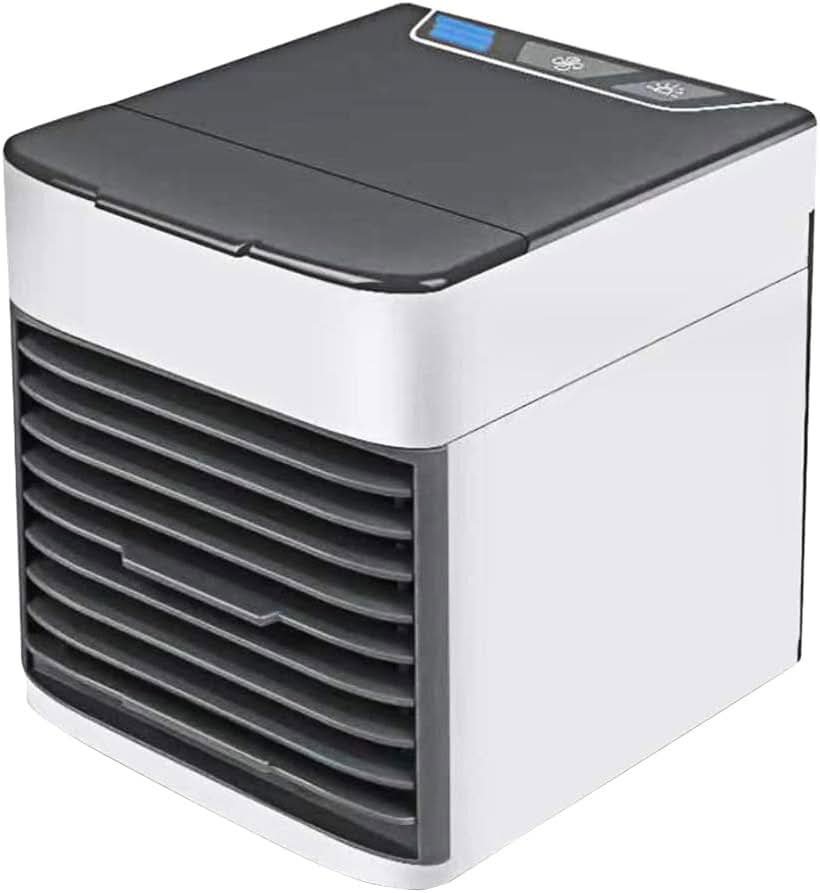
This is a compact personal cooler, closer to a desk accessory than an appliance. You fill the reservoir with water, plug it in, and it cools the air around you rather than the whole room.
Power comes from a USB port or a standard wall outlet, so it runs from a laptop, a power bank or a plug socket. It has a quiet fan and a built-in LED light with seven colours that can cycle or be switched off, which makes it a bedside option as well as a desk one. It is not a substitute for any of the tank-based coolers above and should not be compared with them on airflow or coverage.
The listing gives no tank capacity, airflow or power figures, so treat this as a single-person accessory rather than a documented appliance. It suits a desk, a bedside table or a spot check on a very hot day, not a bedroom or living room that needs sustained cooling.
Pros
- Compact single-person size
- Powers from a USB port or a standard wall outlet
- Seven-colour LED light that can cycle or be switched off
- Light and compact enough for a desk, bedside table or travel
Cons
- Cools only the air close to you
- No tank capacity, airflow or power figures in the listing
- Not a substitute for a tank-based cooler
Key specs: USB or wall-outlet power, quiet fan, 7-colour LED light, personal desk / bedside use. No tank capacity, airflow or power rating published.
CHECK ON AMAZON6. YOPOWER 30L Evaporative Air Cooler – Best Tank Capacity
At 30 litres this holds the biggest tank in the guide, roughly eight gallons, and the listing says it can run up to 24 hours in cooling mode on a single fill. Airflow is quoted at 3500 cubic metres an hour for rooms of about 10 to 50 square metres, with a measured wind speed of 6.5 m/s.
Three modes (normal wind, natural wind and cooling) and three fan speeds sit under a 12-hour timer, and a 60 degree automatic swing spreads the air. Power is quoted at 80W, which at roughly 30 to 35 cents a kilowatt hour is under 3 cents an hour to run. In the dry heat of Perth or Adelaide, where evaporative cooling does its best work, a 30L fill is close to a full day.
Evaporative coolers struggle in humid Brisbane and Darwin summers, and a big tank does not change that. Thirty litres of water weighs 30 kg before the unit itself, so it is a lot to move when full, which makes a drained tank a good habit. The listing gives no noise figure to compare against the quieter models here.
Pros
- 30L removable tank, up to 24 hours in cooling mode
- 3500 cubic metres an hour for 10 to 50 square metres
- Three modes, three speeds and a 12-hour timer
- 80W power draw with 60 degree auto swing
Cons
- Humid weather limits any evaporative cooler
- A full 30L tank is heavy to move
- No noise figure on the listing
Key specs: 30L removable tank, up to 24 hours cooling, 3500m3/h airflow, 6.5m/s measured wind speed, 3 modes, 3 speeds, 12-hour timer, 80W, 60 degree auto swing
CHECK ON AMAZON7. Evapolar evaCHILL EV-500 – Best for Personal Cooling
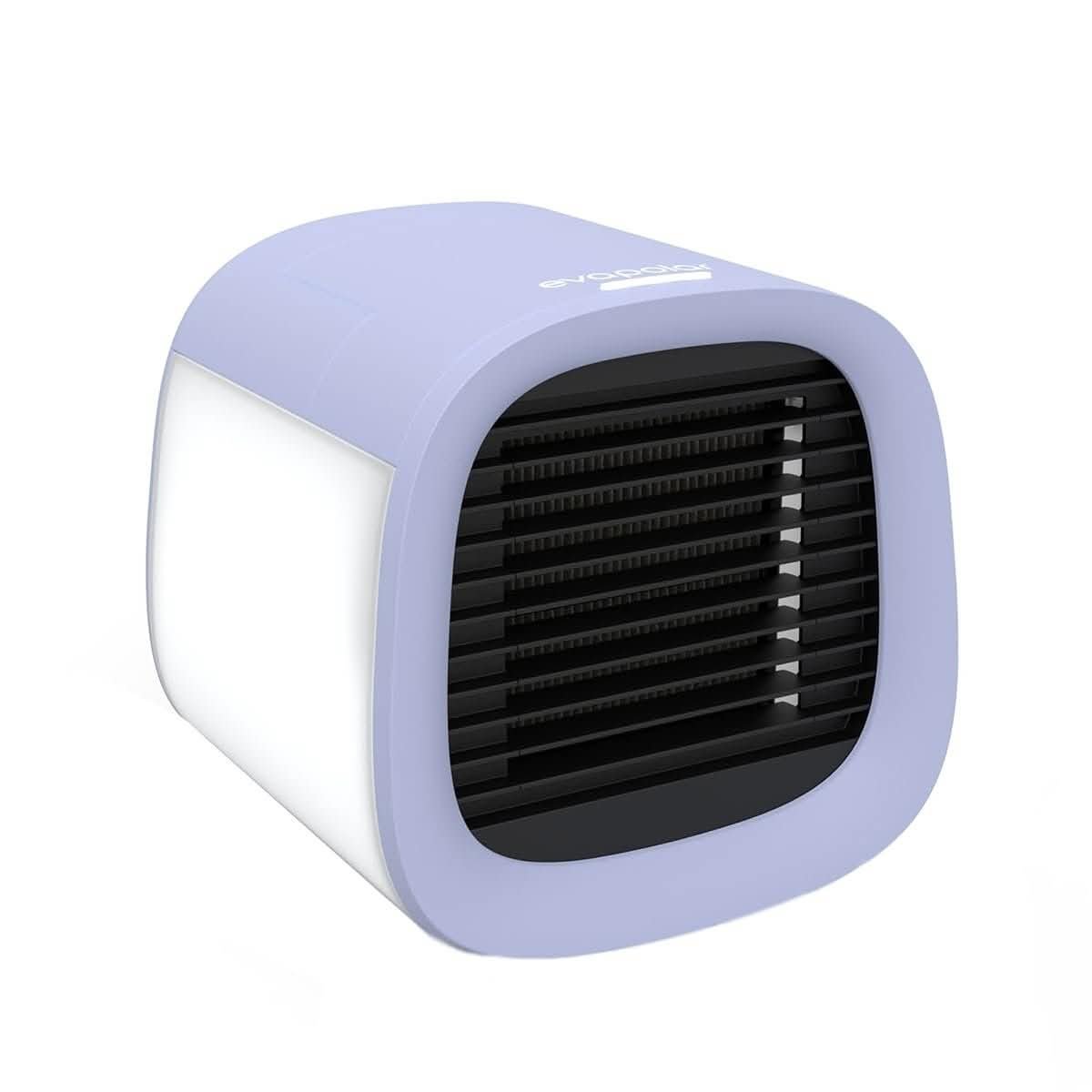
This is a genuinely personal cooler rather than a room appliance, small enough to sit on a desk at 17cm on each side and drawing only 10 watts, a fraction of every tank-based unit above. The 800 millilitre tank is removable for filling at a sink rather than needing a jug carried to the unit.
A basalt-fibre cooling medium replaces the foam or paper pads used in larger coolers, intended to hold more water and resist mould over time, and one button steps through four fan speeds without a remote or app to manage. It is built to cool the air within roughly a metre, not a whole room.
At 10 watts it draws a fraction of the power of any tank cooler here when run continuously, and the small footprint suits a desk, a bedside table in a share house, or a compact apartment where a full-size unit would not fit. It will not touch a living room the way the 30-litre unit above does, and buyers expecting whole-room cooling from it will be disappointed.
Pros
- Only 10W power draw
- 800ml removable tank for easy filling
- Basalt-fibre cooling medium instead of foam
- Compact 17cm cube footprint
Cons
- Cools only a single desk or bedside area, not a room
- No remote control
- Smallest tank in this guide, most frequent refills
Key specs: 800ml removable tank, 10W, 4 fan speeds, basalt-fibre cooling medium, 172 x 170 x 170mm.
CHECK ON AMAZON8. Bonaire Diet 22i Evaporative Air Cooler – Best Established Brand
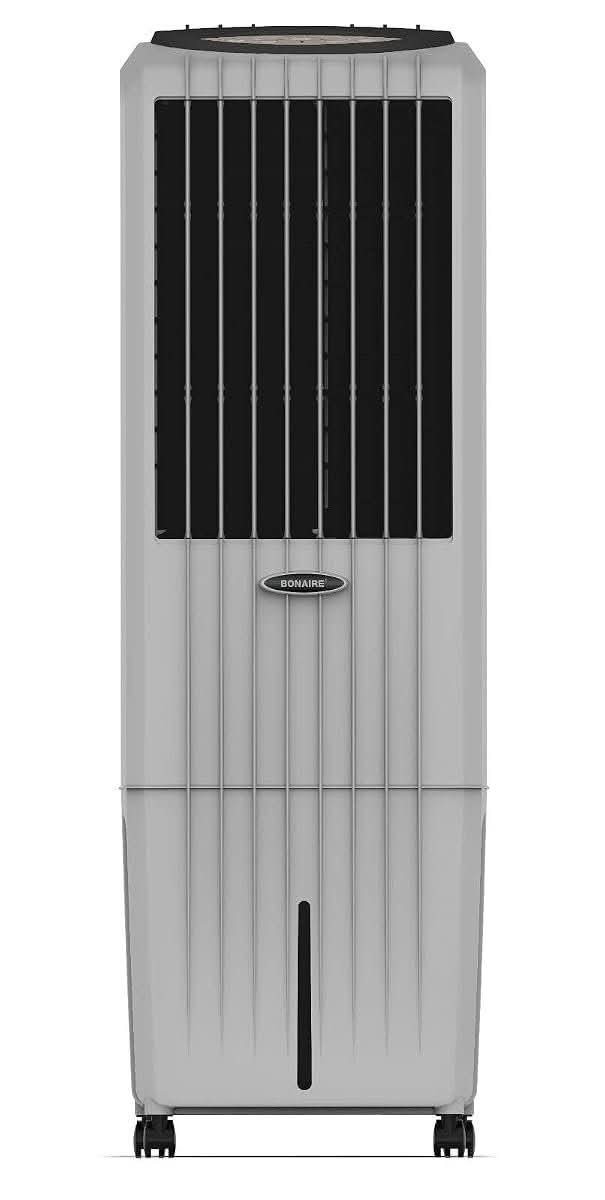
This is the only unit in the guide from an established Australian cooling manufacturer rather than a generic import brand, carrying a 22-litre tank in a floor-standing housing built for a living area or an open-plan room. A honeycomb cooling pad is paired with a dust filter ahead of it, catching some airborne particles before the air passes through.
A branded air-treatment stage sits alongside the cooling function, and an empty-tank alarm sounds before the unit runs dry rather than leaving a buyer to check a sight glass manually. The manufacturer states roughly 80 per cent lower running cost against a refrigerant air conditioner of comparable output, a figure worth treating as a manufacturer claim rather than an independently tested one.
It sits above every other unit in this guide on brand reputation and build rather than on tank size alone, since the 30-litre unit above still holds more water. For a buyer who wants a name they can look up service history and spare parts for, rather than a generic import, this is the pick.
Pros
- From an established Australian cooling brand, not a generic import
- 22L tank with a dust filter ahead of the cooling pad
- Empty-tank alarm
- Claimed running cost around 80 per cent lower than refrigerant air conditioning
Cons
- Smaller tank than the 30-litre unit above despite the higher position
- The 80 per cent saving figure is a manufacturer claim, not independently tested
Key specs: 22L tank, honeycomb cooling pad, dust filter, i-Pure air treatment, empty-tank alarm.
CHECK ON AMAZONHow to Choose an Evaporative Cooler
Tank capacity is the single figure that predicts how often the appliance interrupts an afternoon. Across this guide it runs from 800 millilitres, roughly 27 fluid ounces, up to 30 litres, close to 8 gallons, and the difference between the two ends is measured in refills per day rather than per week.
Climate decides more than the spec sheet does. Evaporative cooling works by pulling heat out of the air as water evaporates from the cooling pad, which happens fastest in dry air and slows as humidity climbs. Inland Western Australia, South Australia and regional New South Wales and Victoria see the most benefit from a unit like this; the humid coastal stretch of Queensland and the Northern Territory see noticeably less.
Airflow is published on some listings and missing from others in this guide, and it is worth asking for before buying when it is absent. The 30-litre unit here rates 3500 cubic metres an hour on its top speed, more than double what a compact desk cooler needs to move to be useful within arm’s reach.
Noise level ranges from a rated 40 decibels on the largest tank here up to 60 decibels on the smallest tower, and a rating on the box is only ever the lowest speed. Run a unit on its top setting in the shop, or read reviews that mention noise specifically, before assuming the printed number applies to normal use.
Power draw separates a genuine appliance from a desk accessory. A personal cooler pulling 10 watts uses a fraction of the power of a tank-based unit when run continuously, which matters if it is left on for a full work day rather than switched on for an hour before bed. Bladeless fans move air without a water tank at all, worth a look for anyone who finds topping up a reservoir every day more hassle than it is worth.
Filter and pad maintenance is the part of ownership that gets skipped. A cooling pad or honeycomb filter that is never rinsed collects mineral deposits from tap water and starts smelling stale within a season, regardless of the unit. Rinsing the pad every few weeks during heavy use, and letting the tank dry out fully over winter, is what keeps a cooler working at the airflow it was rated for.
Frequently Asked Questions
What is the difference between an evaporative cooler and an air conditioner?
An evaporative cooler lowers air temperature by evaporating water from a pad, using far less power and no exhaust hose, while a refrigerant air conditioner actively removes heat and works regardless of humidity. Evaporative units use less power but lose effectiveness as humidity rises.
Does an evaporative cooler work in humid climates?
It works best in dry air and loses effectiveness as humidity rises, which makes it a stronger choice in inland Western Australia, South Australia and regional New South Wales and Victoria than in humid coastal Queensland or the Northern Territory.
How often does an evaporative cooler tank need refilling?
It depends on tank size and how hard the unit is run. The smallest personal cooler in this guide holds 800 millilitres and needs refilling several times a day on continuous use, while the largest 30-litre tank here is rated for up to 24 hours of continuous cooling before it runs dry.
Are evaporative coolers cheaper to run than air conditioners?
Yes. A personal evaporative cooler can draw as little as 10 watts, and even a large tank-based unit typically draws well under 100 watts, against the far higher draw of a refrigerant air conditioner of comparable coverage.
Do evaporative cooler pads need cleaning?
Yes. A cooling pad or honeycomb filter left unrinsed collects mineral deposits from tap water and starts smelling stale within a season. Rinsing it every few weeks during heavy use, and letting the tank dry out over winter, keeps the unit running at its rated airflow.
Can an evaporative cooler cool an entire house?
Not the portable units compared in this guide. Even the largest tank here is built for one room, a garage or a covered patio rather than a whole house; whole-house evaporative cooling uses a separate ducted system installed on the roof.
Verdict
For a bedroom, the Devanti tower’s sleep mode and 12-hour timer make it the easiest to live with overnight. For a living area or garage that needs to run through a full afternoon without a refill, the 30-litre tank holds more water and moves more air than anything else in this guide. And for a single desk or bedside table where a full-size unit would be overkill, the 10-watt personal cooler draws very little power left running all day.