An inflatable tent replaces the metal or fibreglass poles of a conventional tent with sealed air beams that you pump up, so the structure rises in one go instead of being threaded and clipped together. Also sold as air tents or blow-up tents, inflatable tents Australia stocks range from 3-person weekenders to 6-person family cabins. The appeal is pitch time. The catch, which almost no product page mentions, is that air is a consumable: beams need topping up, and a puncture fails differently from a snapped pole.
Three builds are sold here. Air-column cabin tents are the common shape, with vertical inflatable pillars holding up a square, high-walled body. Air-beam tunnel tents use two or three curved beams front to back and are the design serious brands use, because a curve sheds wind better than a corner. Yurt-style air tents run a single inflatable ring with no centre pole, which frees the whole floor. The other division that matters is the beam material: PVC air columns are cheap and repairable, while TPU beams hold pressure longer and cost more.
The number that matters is pitch time, and it is the one figure these tents truly win on: the Vango here quotes 12 minutes against the 30 to 45 a big pole tent takes. But the spec buyers skip is waterproof rating. Choice rates tents on a rain test and says anything under 70 per cent means the tent leaked water to an uncomfortable degree, so a hydrostatic head figure of PU3000mm or better is the floor worth accepting. Capacity across the six here runs from 3 to 6 person.
This lineup compares six air tents in stock in Australia, from a 210cm two-minute pitch up to a 5-person tunnel tent with three bedrooms. One honest boundary, and it shaped the whole post: this is a thin category here. Australia’s main consumer testing body does not cover air tents in its tent guide at all, and most listings are white-label imports sold under half a dozen names. If you want a conventional pole tent instead, our tents guide covers those.
Quick Picks

Weisshorn 6 Person Inflatable Tent
The only one stocked by an Australian retailer, so returns and warranty stay local.
CHECK CURRENT PRICE
Vango AirBeam Odyssey Air 500
Curved AirBeam tunnel, 12-minute pitch, three bedrooms, and a brand with a real track record.
CHECK ON AMAZON
WildFinder Inflatable Tent with Stove Jack
4.3 across 237 ratings, with a roll-back skylight and a stove jack for cold weather.
CHECK ON AMAZONInflatable Tents Australia Compared
| Product | Link | Type | Best For | Key Spec |
|---|---|---|---|---|
| Weisshorn 6 Person Inflatable Tent | Check price | Inflatable pillars | Families and glamping | 6 person, 300cm, PU3000 fabric, pump included |
| WildFinder Inflatable Tent with Stove Jack | Check price | PVC air columns | Winter and shoulder season | Stove jack, PVC skylight, Oxford fabric, hand pump |
| WENZEFZZB Four-Season Inflatable Tent | Check price | 12mm air columns | Wet and windy weather | PU3000mm, 300D Oxford, PVC skylight with curtain |
| Vango AirBeam Odyssey Air 500 | Check price | AirBeam structure | Serious family camping | 5 person, 12 minute pitch, 18.55kg, 3 bedrooms |
| Danchel Outdoor Inflatable Glamping Tent | Check price | Air frame, no centre pole | Two-person comfort | Sealed stove jack, 4 roof vents, UPF50+ coating |
| Fseoot Quick Setup Inflatable Tent | Check price | Air frame | Fast overnight pitches | 3-4 person, 210 x 210cm, 175cm height, 2 minute pitch |
How We Picked
We swept every Australian retailers with, plus the major marketplaces and the brands’ own Australian stores. Exactly one inflatable tent turned up across the retailer accounts. Everything else in those catalogues was a pole tent, a pop-up, a gazebo or a fibreglass-framed bubble dome that the listing described as inflatable and was not. One promising hit turned out to be a car spray booth.
On the marketplace side we parsed 66 listings and found 58 that were actually inflatable tents, then ran a duplicate check on them. Eleven clusters were the same white-label tent relisted two to four times, sometimes with different star ratings on identical products. Only eight freestanding listings had 20 or more ratings. After deduplicating designs and excluding car-attached shelters, six distinct products with a usable evidence base survived, which is why this is a six-product guide and not a ten. We cross-checked against Choice on sizing and rain performance and against ProductReview for Australian owner reports. We do not physically test every tent. Selections are informed by affiliate partnerships, but commission does not override editorial ranking.
1. Weisshorn 6 Person Inflatable Tent – Best Family Inflatable Tent
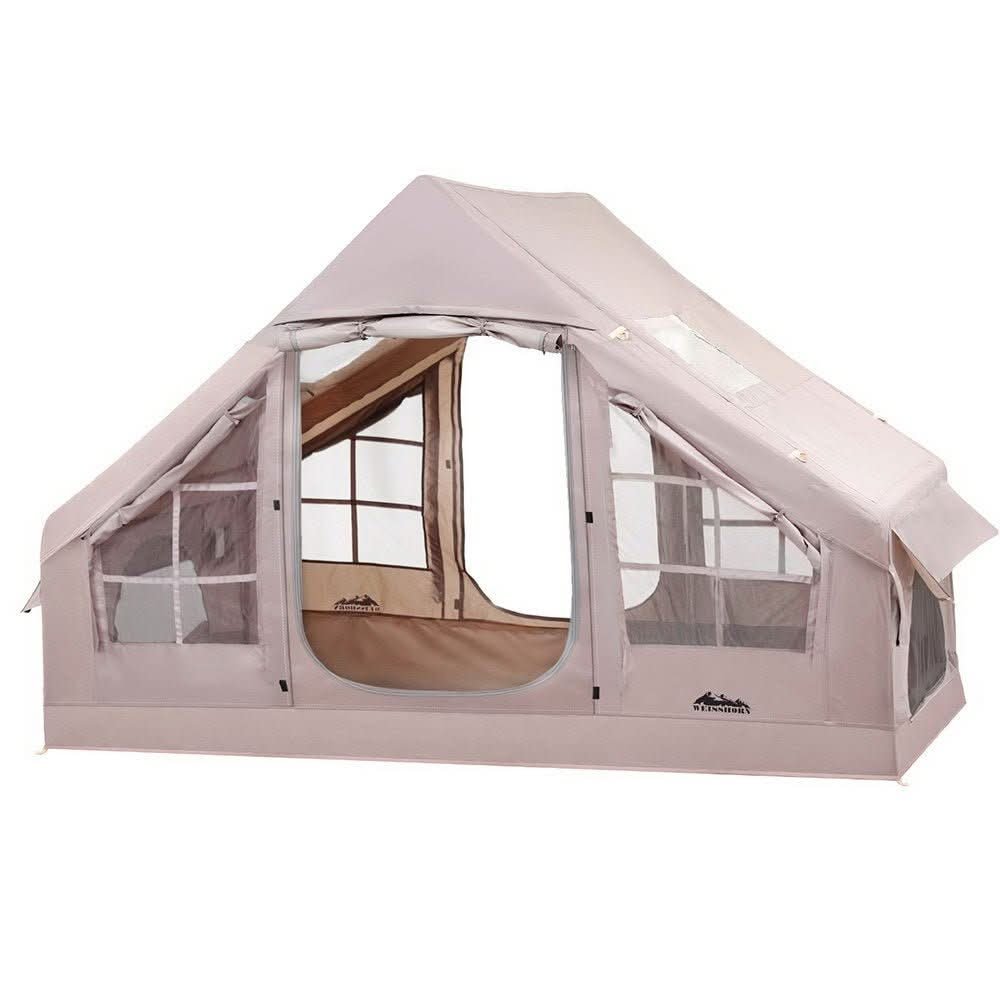
The only inflatable tent here stocked by an Australian retailer instead of a marketplace seller, which matters more than it sounds: returns, warranty and a local phone number all get easier. It is a cabin-shaped 300cm body on inflatable pillars, rated six person, in PU3000 fabric with rollable window and door panels and a pump in the box. It sits in the mid-range for this category in Australia.
Read the six-person rating the way Choice suggests and treat it as comfortable for four, because the pillars take internal width that poles would not. The rollable panels are the feature that earns its place here: in a Queensland summer you want every wall open, and a cabin this tall with the sides rolled up moves air properly. The listing calls it a beach tent, which undersells it. It is a family camping tent that happens to be photographed on sand.
Pros
- Stocked by an Australian retailer, so returns and warranty are local
- PU3000 fabric, at the floor Choice’s rain testing suggests is worth accepting
- Rollable window and door panels open the whole body up in heat
- Pump included, unlike some marketplace listings at this size
Cons
- Sold as a six-person tent, which realistically means four adults with their bags
- The inflatable pillars are vertical, so it catches wind harder than a curved tunnel shape
- Listed as a beach tent, so it is easy to scroll past when you are shopping for camping
- Only one product image exists, which makes it hard to judge the interior before buying
Key specs: 6 person rating, 300cm body, inflatable pillars, PU3000 fabric, rollable panels, pump included.
CHECK CURRENT PRICE2. WildFinder Inflatable Tent with Stove Jack – Best for Cold-Weather Camping
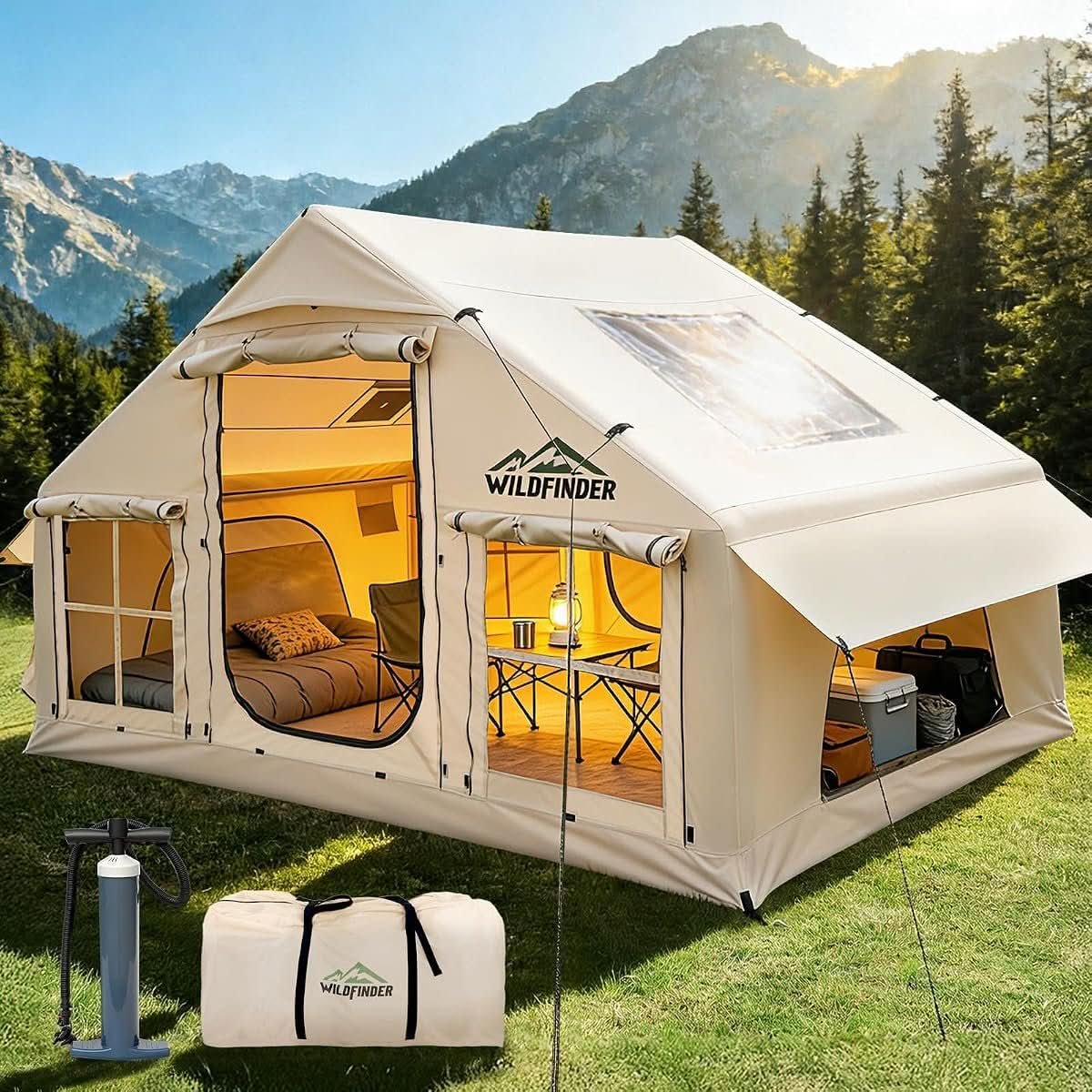
No air tent on the Australian marketplace has been reviewed anywhere near as heavily as this one: 4.3 across 237 ratings, and that evidence base is the main reason it is here. In a category where most listings carry single-figure review counts, 237 owners is the closest thing to a consensus you will find.
The build is PVC air columns under an Oxford body, with a roll-back PVC skylight and a stove jack, which puts it in shoulder-season and cold-weather territory. The skylight is the feature people actually mention: it is a large clear panel with a curtain that unzips and rolls inward, so you get sky at night and shade when the sun comes over the ridge.
The honest detail, and credit to the manufacturer for printing it on their own product images, is a warning to top the air up every 24 hours. That is standard for PVC columns and worth knowing before you buy, not at 3am on night one. Ongoing cost is close to zero beyond a patch kit, but keep the pump inside the tent.
Pros
- 4.3 across 237 ratings, comfortably the strongest evidence base in this category
- Roll-back PVC skylight with an internal curtain, the feature owners single out
- Stove jack makes it usable in real cold, which most air tents here are not
- PVC columns can be patched in the field with a bike repair kit
Cons
- The maker’s own images carry a warning to top up the air every 24 hours
- PVC columns are vertical and square, so a windy site tests the corners
- Every image in the listing is a styled campsite scene or an infographic, so you cannot tell what the bare tent looks like
- Unknown brand with no Australian service presence behind the warranty
Key specs: PVC air columns, Oxford body, roll-back PVC skylight with curtain, stove jack, hand pump.
CHECK ON AMAZON3. WENZEFZZB Four-Season Inflatable Tent – Best Budget Four-Season Pick
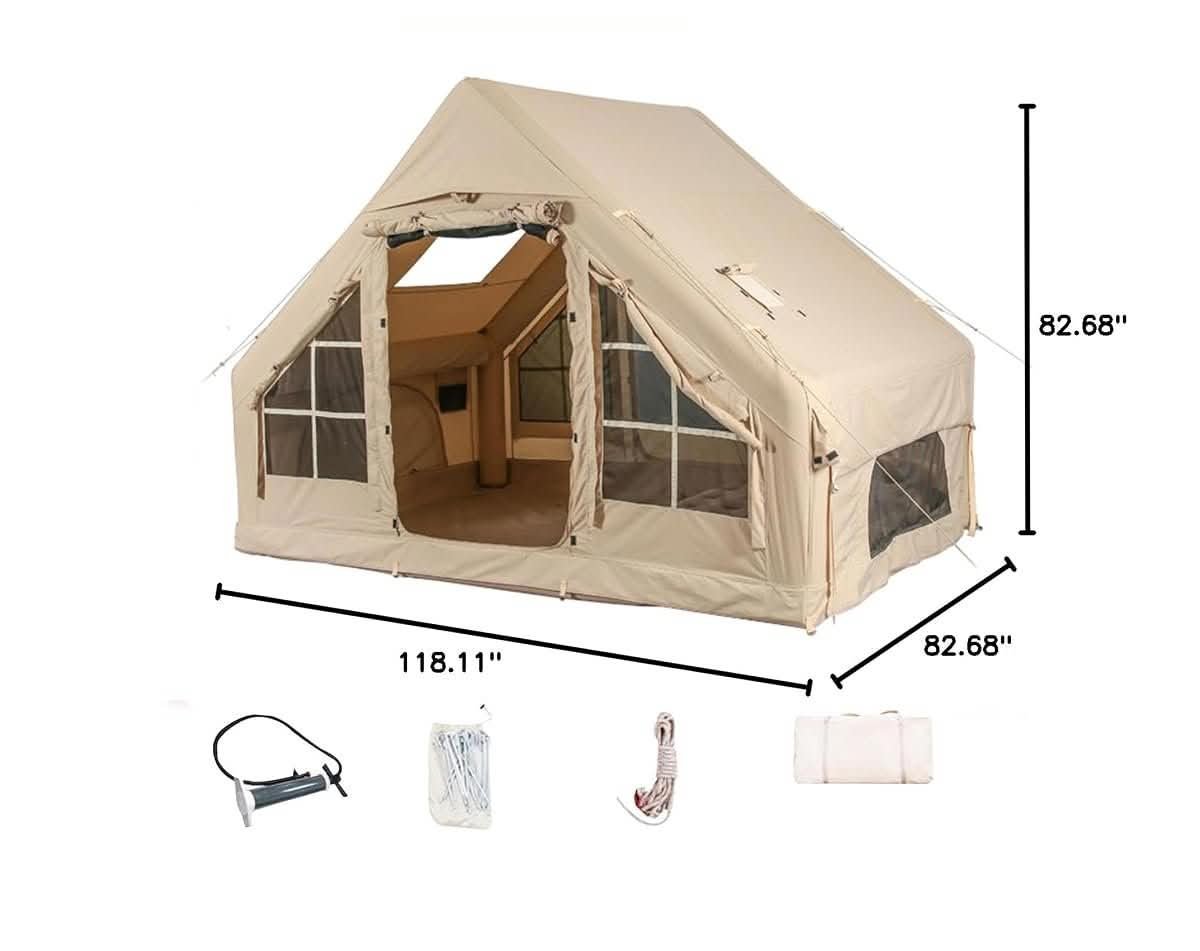
Second only to the tent above on review count, at 4.2 across 222 ratings, and the specs are the clearest of any listing here. Twelve-millimetre air columns in PVC tarpaulin, a PU3000mm rating, 300D Oxford fabric, and a body measuring roughly 300 by 210 by 210 centimetres, at the budget end of the six.
Those published numbers are the reason it sits where it does. Everything about buying in this category is guesswork about specs nobody prints, and this listing prints them. A PU3000mm fly and a 12mm column diameter are both figures you can compare against the next tent, which is more than the cheaper end of the market offers.
It is a double-layer design, which helps in the way that matters here. The gap between fly and inner is what stops condensation running down onto sleeping bags, and on a cold Victorian morning a single-skin air tent will be wet inside whether or not it rained. The trade-off is pack size and weight, both of which go up.
Pros
- 4.2 across 222 ratings, the second strongest evidence base here
- Publishes real specs: PU3000mm, 300D Oxford, 12mm column diameter
- Double-layer construction, which controls condensation better than single skin
- Roughly 300 x 210cm floor, honestly stated in centimetres
Cons
- Double layer means a bigger, heavier pack than the single-skin tents here
- Brand name is a random letter string, which tells you what the support will be like
- 12mm columns are on the slim side for a body this tall
- PVC tarpaulin gets stiff and awkward to fold in cold weather
Key specs: 12mm PVC air columns, PU3000mm, 300D Oxford, double layer, PVC skylight with curtain, roughly 300 x 210 x 210cm.
CHECK ON AMAZON4. Vango AirBeam Odyssey Air 500 – Best Air-Beam Build
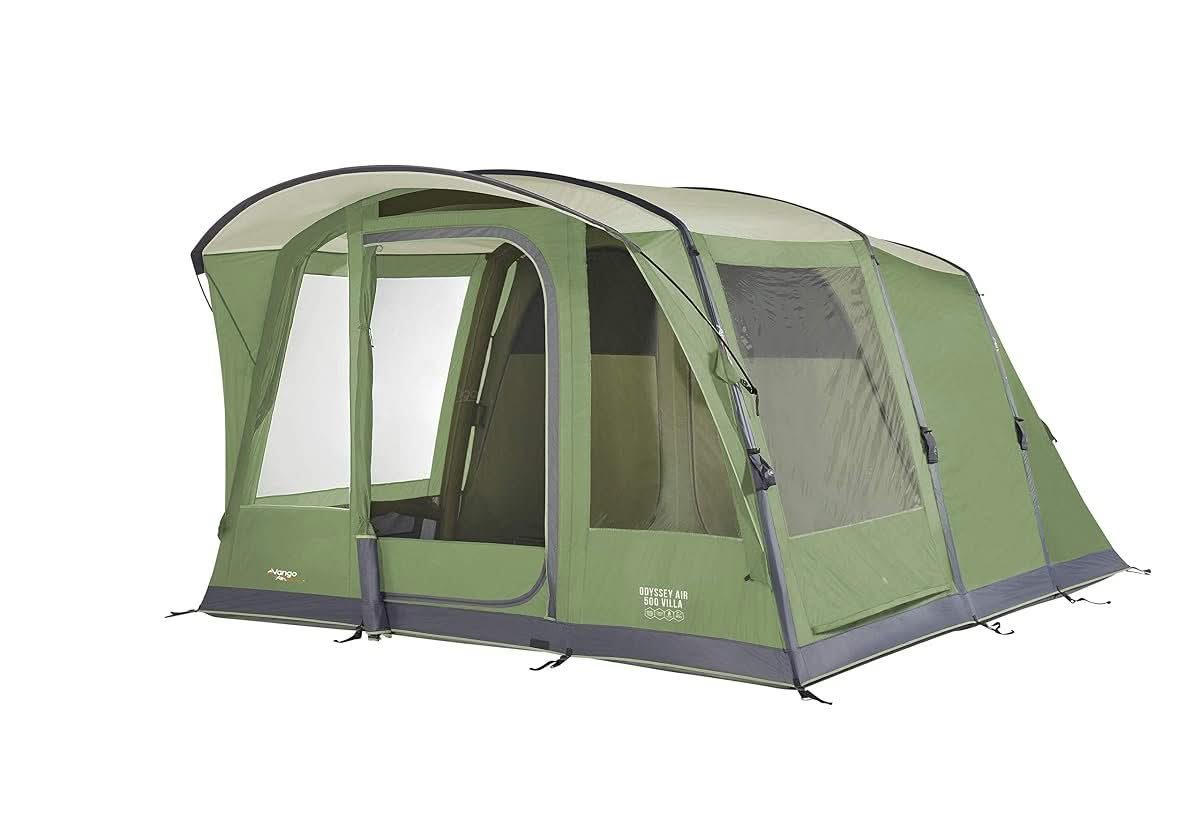
This is the only tent here from a brand with an actual track record in Australia, and it is built to a different standard from everything above it. Vango’s AirBeam system uses curved tunnel beams front to back instead of vertical columns, which is the design choice that separates a real air tent from a cheap one: a curve sheds wind, a corner catches it.
The numbers are specific and published, which is itself unusual here. Twelve minutes to pitch, 18.55kg packed (about the weight of a full esky), 70 by 40 by 37 centimetres in the bag, a 490 by 320 centimetre floor and three bedrooms across a five-person layout. A 180-degree tension band system spreads load across the beams instead of letting one take it.
One documented caution, because it is the specific complaint Australians make about this brand. Owners on ProductReview have criticised Vango for selling models without fly-screen doors and not disclosing it, and one reviewer reported temperature and humidity inside climbing so far within five minutes that they could barely breathe. Check the mesh on the exact model you are ordering. In this country that is not a minor specification.
It is the most expensive tent in this guide by a wide margin, and it is the one worth saving for. Everything else here is a white-label import at a lower price with no service behind it; this is the one you can still get parts for in three years.
Pros
- Curved AirBeam tunnel design sheds wind better than vertical air columns
- 12-minute pitch on a 5-person tent with three bedrooms, all published figures
- The only brand here with an established Australian retail and service presence
- 180-degree tension band spreads load across the beams instead of one
Cons
- Australian owners on ProductReview have criticised Vango models for shipping without fly-screen doors
- 18.55kg packed, the heaviest here, and a 70cm pack length that eats boot space
- The dearest tent in this guide by a wide margin
- Rated 4.1, lower than two unbranded tents above it, which is worth sitting with
Key specs: 5 person, 3 bedrooms, 490 x 320cm floor, 12 minute pitch, 18.55kg, pack 70 x 40 x 37cm, AirBeam tunnel structure.
CHECK ON AMAZON5. Danchel Outdoor Inflatable Glamping Tent – Best Yurt-Style Design
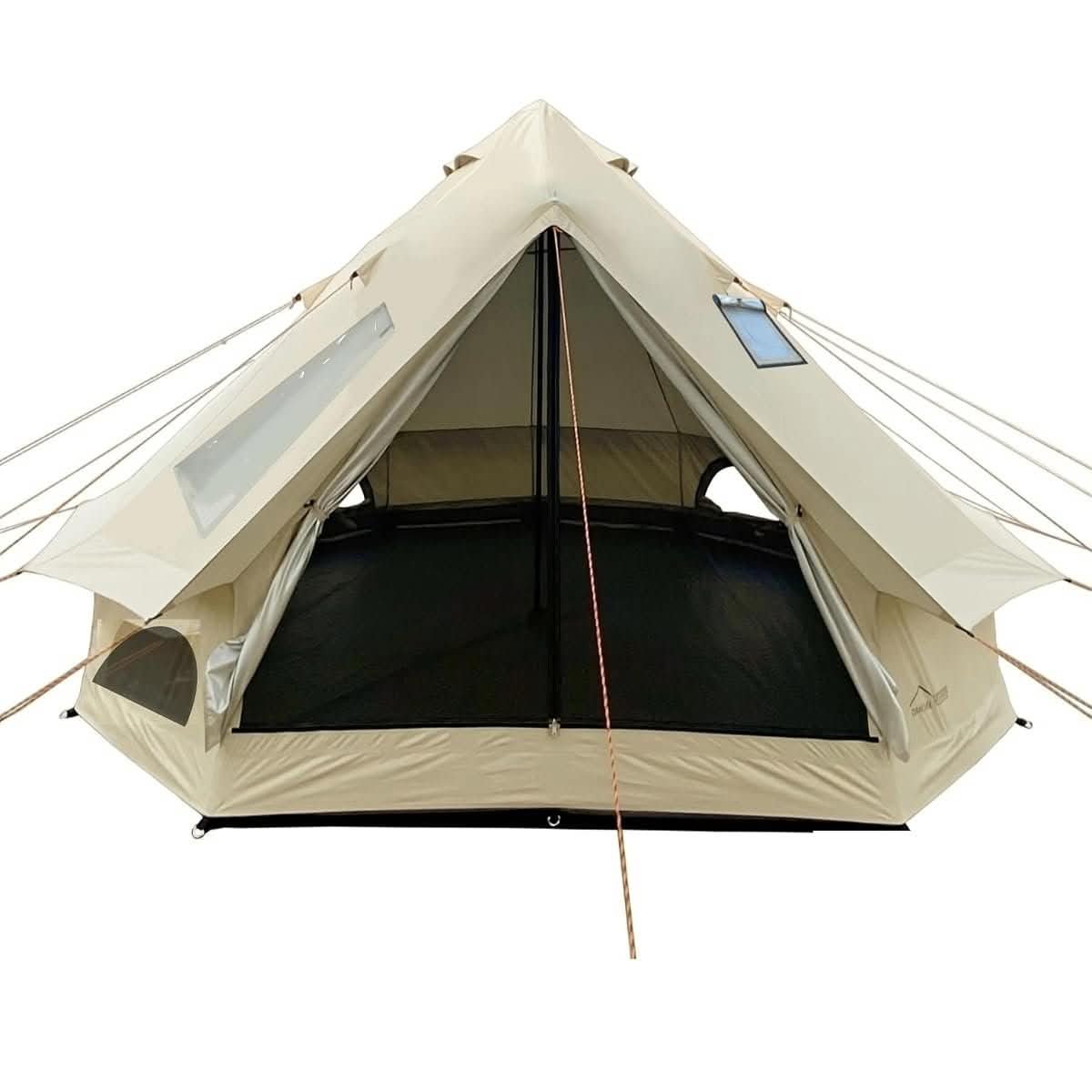
A yurt-shaped air tent with no centre pole, which is a different proposition from the cabins above. Bell tents and yurts normally have a post through the middle of the floor that you walk around for the entire trip. Remove it and a 4-metre circle becomes usable space instead of a doughnut.
The detailing is the most thorough of any tent here. A sealed stove jack, four roof vents, a large PVC skylight, four side mesh windows, an insect-proof door screen, a zippered cable pass-through and a silver sun-proof coating rated UPF50+. That vent count is the number to notice, because four roof vents on a single-skin tent is what makes it survivable in heat.
The catch is the evidence. It holds the highest rating of the six at 4.7, and it holds it across seven ratings, which is not a sample you can lean on. The maker describes it as comfortable for two campers, and that is the honest read of a tent this shape: floor area goes further than a rectangle but the sloping walls cost you at the edges.
Pros
- No centre pole, so the entire floor circle is usable
- Four roof vents plus four mesh side windows, the best ventilation count here
- Sealed stove jack and a zippered cable pass-through, both properly finished
- UPF50+ silver coating on the outer, which matters under Australian sun
Cons
- Only seven ratings behind it, the thinnest evidence base of any pick here
- Sloping yurt walls cut usable height at the edges despite the open floor
- Realistically a two-person tent, whatever the floor diameter suggests
- Single skin, so condensation management depends entirely on those vents being open
Key specs: Yurt shape, no centre pole, sealed stove jack, 4 roof vents, 4 mesh windows, PVC skylight, UPF50+ coating.
CHECK ON AMAZON6. Fseoot Quick Setup Inflatable Tent – Best Two-Minute Setup
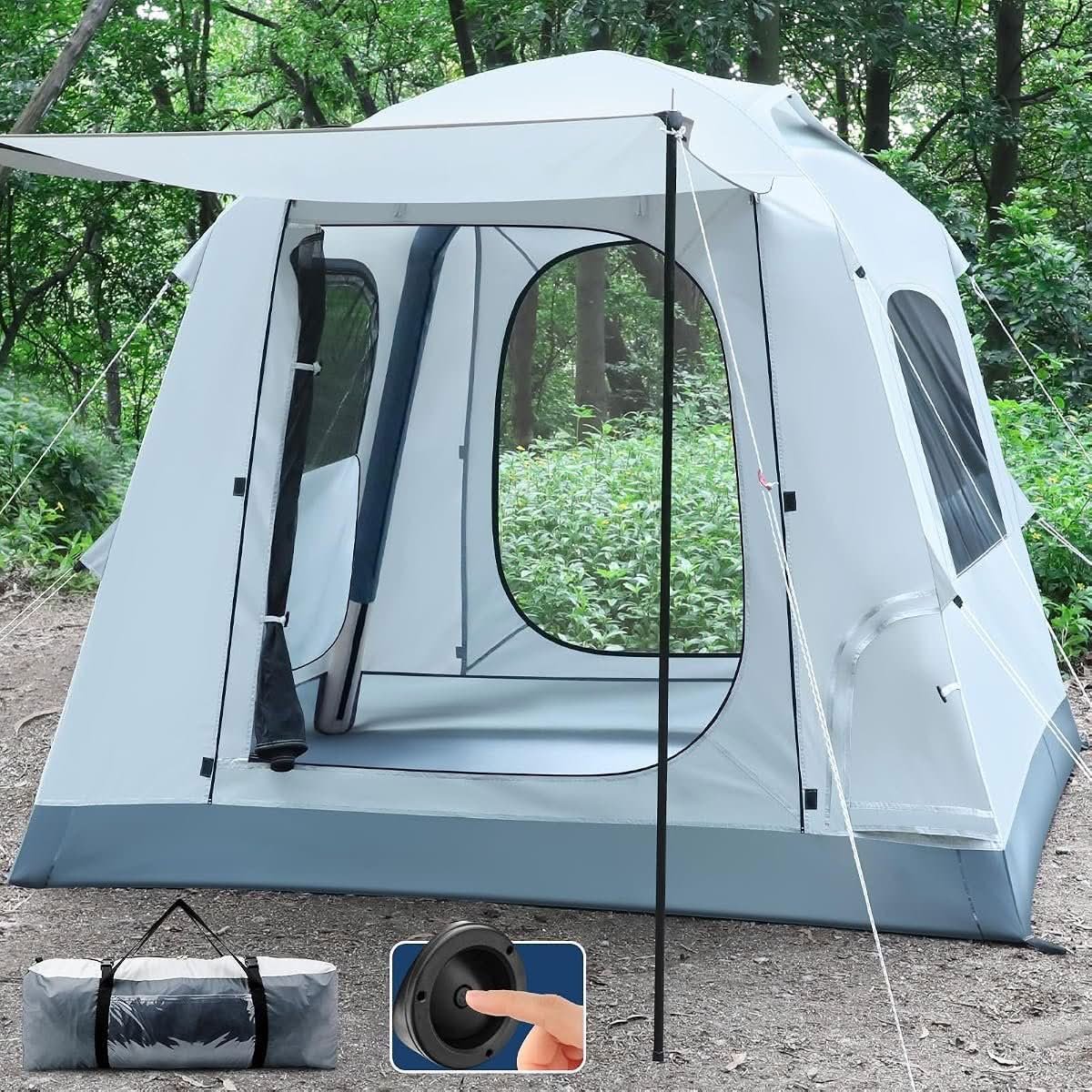
The smallest and fastest tent here, and the one that makes the clearest case for buying inflatable at all. Two minutes, one person, 210 by 210 centimetres of floor (a double mattress and little else) and 175 centimetres of standing height. If the reason you are reading this page is that you are tired of threading poles in the dark after a four-hour drive, this is the shape of the answer.
Sold as three to four person and described by the maker as comfortable for two sleeping, which is the same gap Choice warns about across all tents when it advises sizing up by at least one person. At 175cm of height most adults will stoop slightly. Against the 5-person Vango three places up it is a fraction of the price and a fraction of the tent, and for two people doing overnight trips that is the correct trade.
Pros
- Two-minute pitch by one person, the fastest here
- 175cm standing height in a tent this small
- Rated 4.4, the second highest of the six
- Small enough packed to leave in the boot permanently
Cons
- Sold as 3-4 person but honestly a two-person tent, on the maker’s own description
- 175cm height means most adults stoop instead of standing
- 210 x 210cm floor leaves nowhere for bags once two mattresses are down
- Its only white-background images are spec diagrams, so the real thing is hard to picture
Key specs: 3-4 person rating, 210 x 210cm floor, 175cm height, 2 minute one-person pitch, air frame.
CHECK ON AMAZONHow to Choose an Inflatable Tent
Size up, not across. Choice advises over-accommodating by at least one person, and says a four-person tent is generally great for two. That maths is harsher on air tents, because the inflatable columns eat internal width that poles do not. Read the floor dimensions in centimetres and ignore the person rating on the box.
Treat air as a consumable. One of the tents here carries a warning on its own product images to top up the air every 24 hours. That is normal for PVC columns, which lose pressure as overnight temperatures drop and the air inside contracts. Bring the pump into the tent, not the car. A soft beam at 3am is not a failure, it is Tuesday.
Ventilation beats waterproofing in most of Australia. Choice puts the trade-off plainly: good ventilation matters for Australian weather, but a cool breeze on a hot night costs you water resistance in a downpour. Owners on ProductReview have taken Vango to task over exactly this, reporting models sold without fly-screen doors, and one reviewer found the temperature and humidity climbed so far within five minutes that they could barely breathe. Count the mesh panels before you count the litres.
Check the beam material and whether it is repairable. PVC columns are cheap and can be patched in the field with a bike kit; TPU holds pressure better but a hole is a warranty conversation. Either way, find out whether the beams are individually replaceable or sewn in. A tent whose beams cannot be swapped is a tent with an expiry date.
Pitch time claims assume a calm day and a practised person. Two minutes means two minutes with the pump already attached, the pegs sorted and no wind. Add ten. The real advantage is not the stopwatch, it is that one person can pitch an air tent alone, which a 6-person pole tent generally does not allow.
Buy on verifiable specs, because brand tells you little here. Half the market is unbranded imports and the same tent appears under several seller names at different prices. Got a shortlist? Compare hydrostatic head, floor dimensions in centimetres, beam material and pack weight, and treat everything else on the listing as decoration. Australia’s consumer testing body does not cover this category, so nobody is going to do that comparison for you.
You’ll Also Want
A second pump is the accessory nobody buys until the first one splits. Most of these tents ship with a hand pump, and hand pumps are the cheapest component in the box. A 12V electric pump that runs off the car socket turns a 12-minute pitch into a four-minute one and removes the only sweaty part of the job.
A PVC repair kit costs almost nothing and is the difference between a punctured beam and a ruined trip. A bicycle inner-tube kit works on PVC columns. Buy it before you need it, because you will need it a long way from Bunnings.
A proper footprint or ground sheet matters more under an air tent than a pole tent, because the whole structure sits on its floor with no separate frame taking the load. Sticks and stones under the base are what put holes in floors.
A camping mattress is worth sorting at the same time, since a tall air tent with a clear floor is the one shape where a thick mattress actually fits without fighting a sloped wall. Our camping mattress guide covers the options.
Extra guy ropes and decent pegs earn their keep. Air tents are light for their volume, which is a virtue until the wind picks up. The pegs supplied with budget tents are usually thin steel wire, and they bend in hard ground.
Frequently Asked Questions
Are inflatable tents any good?
For pitch speed and one-person setup, yes. Air beams raise the whole structure in one go, and the Vango in this lineup quotes a 12-minute pitch against 30 to 45 minutes for a comparable pole tent. The trade-offs are real: air beams lose pressure as temperatures drop overnight and need topping up, punctures are possible, and you pay more than for a pole tent of the same floor area. They suit car campers who pitch often, not hikers.
How long does an inflatable tent take to set up?
Between two and fifteen minutes depending on size, and always longer than the label claims. Small 3-person air tents genuinely go up in a few minutes with the pump attached. A 5-person tunnel tent with multiple beams is closer to 12 to 15 minutes once pegs and guy ropes are done. The honest comparison is not against the claim but against a pole tent of the same size, which typically takes two people 30 minutes or more.
Do inflatable tents leak air overnight?
They lose some pressure, and this is normal physics, not a fault. Air contracts as overnight temperatures fall, so beams pumped firm at dusk feel soft by dawn. One tent in this guide carries a manufacturer warning to top the air up every 24 hours. Keep the pump inside the tent and give the beams a few strokes in the morning. A beam that empties in an hour is a puncture, not temperature.
What waterproof rating should an inflatable tent have?
Look for a hydrostatic head of PU3000mm or better on the fly, and treat anything lower as a fair-weather tent. Choice rates tents on a rain test and says a score under 70 per cent means the tent leaked water to an uncomfortable degree, so the rating on the label is a floor, not a promise. Seam sealing and a bathtub-style floor matter as much as the fabric number itself.
Can you repair a punctured air beam?
Usually yes, if the beams are PVC. A standard bicycle inner-tube patch kit will seal a PVC air column in the field, which is why a repair kit belongs in the bag from day one. TPU beams hold pressure better but are harder to patch and often mean a warranty claim. Before buying, check whether individual beams can be unzipped and replaced, because sewn-in beams turn one hole into a dead tent.
How big an inflatable tent do I need?
Size up by at least one person, as Choice advises, and go by floor dimensions in centimetres instead of the person rating. Air tents make this more important than pole tents do, because the inflatable columns take up internal width that thin poles do not. A tent sold as four-person realistically sleeps two adults comfortably with room for bags, which is the same rule of thumb Choice applies to conventional tents.
Verdict
The Vango AirBeam Odyssey Air 500 is the one to buy if the budget reaches it, because it is the only tent here from a brand with a track record in Australia, the tunnel-and-beam shape handles wind better than a square air-column cabin, and 12 minutes to pitch a 5-person tent with three bedrooms is the whole argument for air tents in one number. For families who want the space without the outlay, the Weisshorn 6 Person is the value pick and the only one stocked by an Australian retailer rather than a marketplace seller. If the tent is for two people who camp often and want the floor clear, the Danchel Outdoor yurt-style tent removes the centre pole entirely, though its Australian review base is still very small.