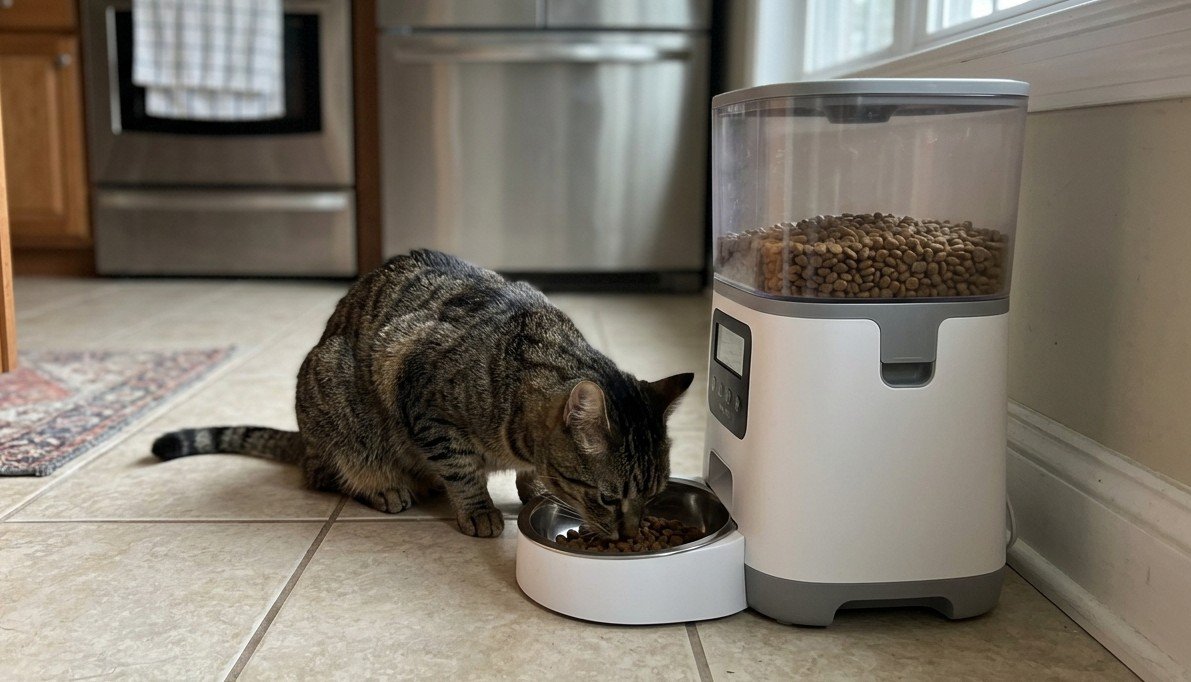
An automatic pet feeder is a timed dispenser that releases measured portions of food to a cat or dog on a schedule, either from a gravity-fed hopper of dry biscuits or from sealed compartments that suit wet food. The best automatic pet feeders in Australia hold between 4 and 9 litres, dispense adjustable portions across multiple meals a day, and keep their schedule running through a power or network dropout.
Four designs cover the category. Hopper feeders hold days of dry food in one reservoir and suit most households. Compartment feeders rotate sealed trays into place, which is the only workable way to automate wet food. Camera feeders add a lens so you can confirm the animal actually ate. RFID feeders open only for the pet wearing the matching tag.
Capacity is the figure that decides how often you refill, and the spread here runs 4 litres to 9 litres. An average adult cat eats roughly 60 grams of dry food a day, so a 4 litre hopper holds around three weeks for one cat but barely five days for a large dog. Battery backup matters just as much, because a feeder that forgets its schedule in a blackout is worse than a full bowl.
This guide compares six feeders on capacity, wet or dry food handling, camera and app features, multi-pet controls and how each one behaves when the power or the WiFi goes out.
Quick Picks
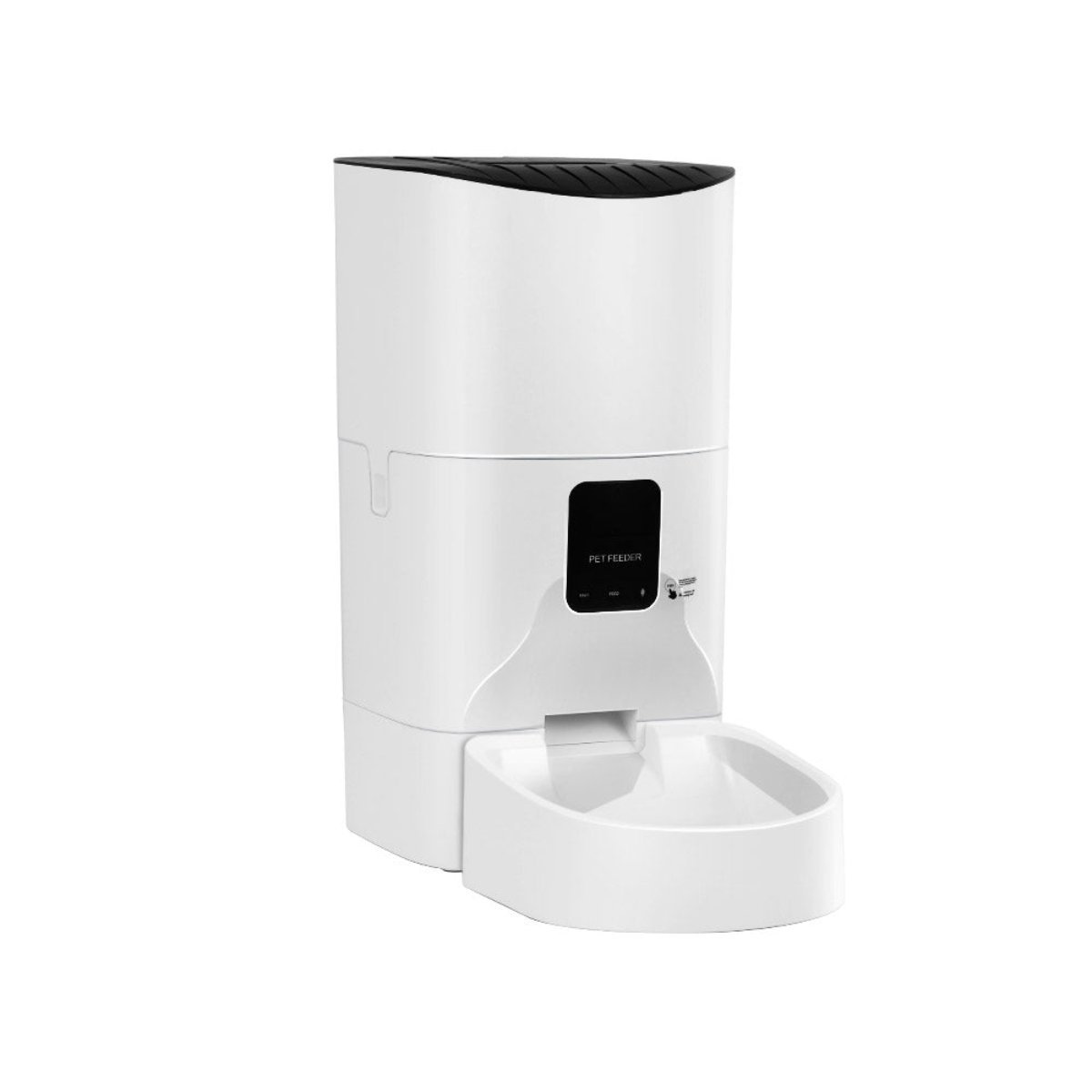
i.Pet 9L WiFi Automatic Pet Feeder
Nine litres of dry food and app scheduling, the largest hopper in this guide.
CHECK CURRENT PRICE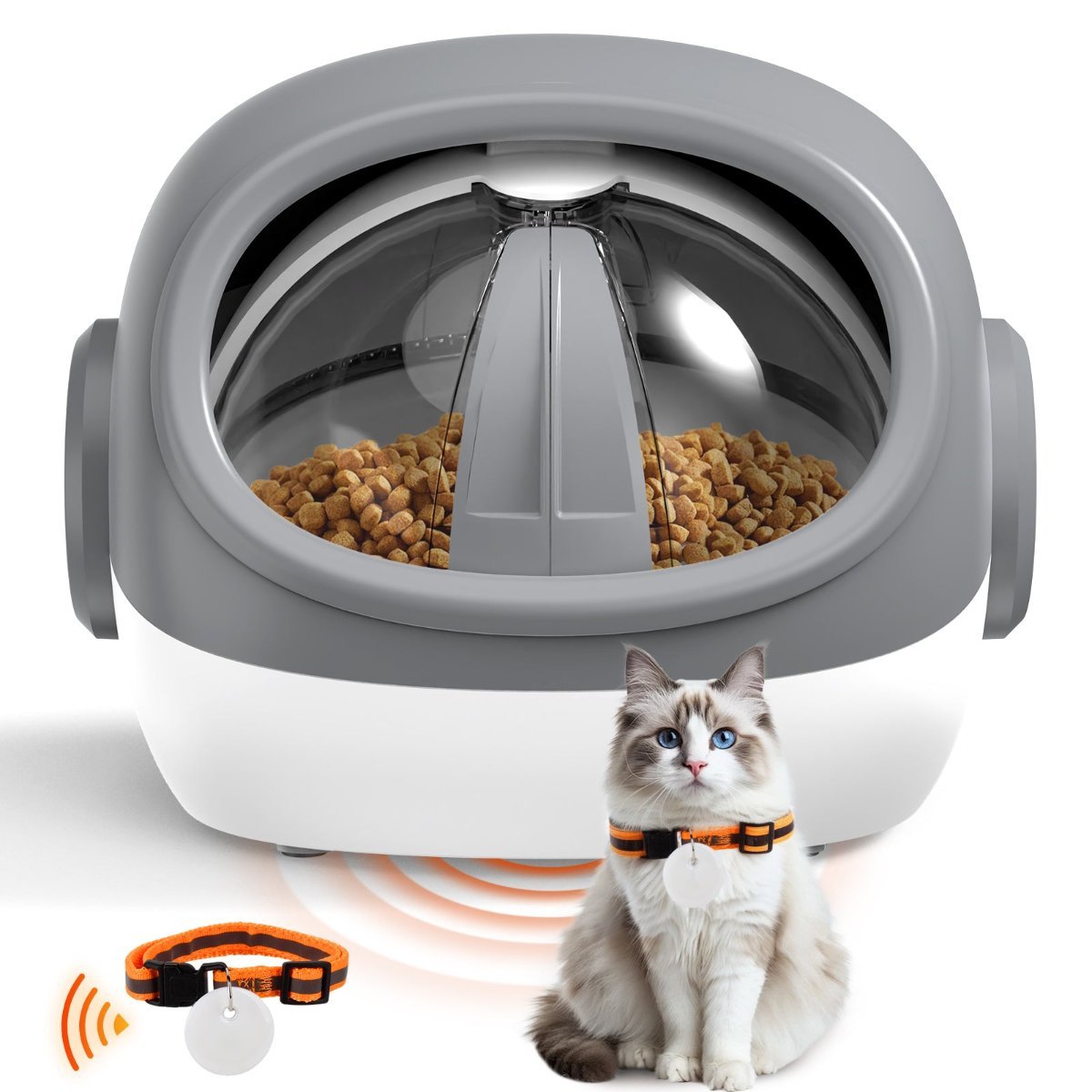
Advwin RFID Automatic Cat Feeder
Opens only for the pet wearing the matching tag, so nobody eats anybody else’s food.
CHECK CURRENT PRICE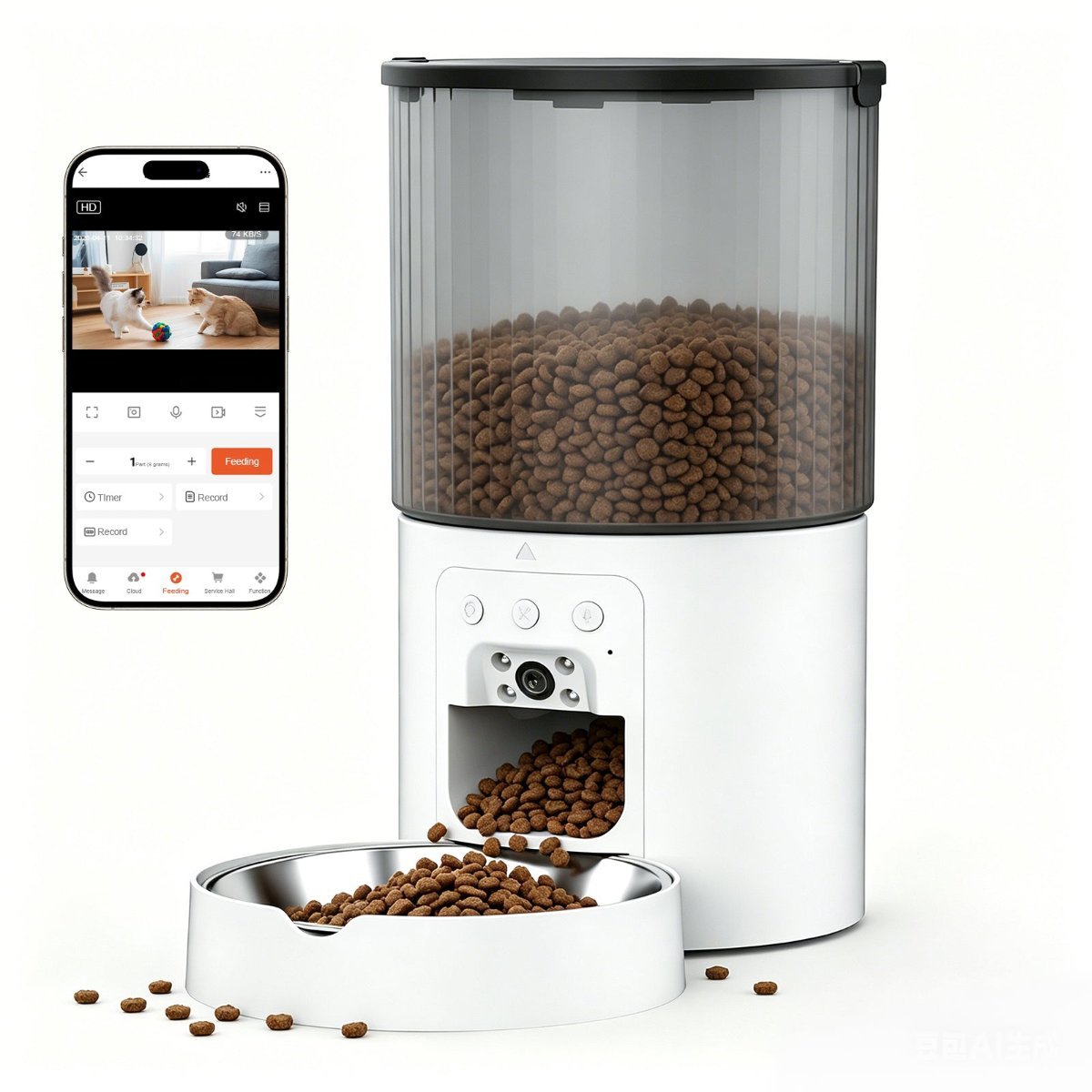
Advwin 4L Feeder with HD Camera
A 1080p wide-angle camera with night vision built into a 4L feeder.
CHECK CURRENT PRICEBest Automatic Pet Feeders in Australia Compared
| Product | Link | Type | Best For | Key Spec |
|---|---|---|---|---|
| i.Pet 9L WiFi Automatic Pet Feeder | Check price | Single bowl, WiFi | Large dogs | 9L hopper, app scheduling |
| i.Pet 5L Dual Bowl Automatic Pet Feeder | Check price | Dual bowl, WiFi | Two pets | 5L, one-to-two splitter |
| i.Pet 2-in-1 Feeder and Water Dispenser | Check price | Feeder and waterer | Weekends away | 4L food, 3L water |
| Advwin RFID Automatic Cat Feeder | Check price | RFID microchip | Pets on different diets | RFID tag access control |
| Advwin Smart Feeder for Wet and Dry Food | Check price | 6-compartment tray | Wet food diets | 6 compartments, WiFi app |
| Advwin 4L Feeder with HD Camera | Check price | Camera feeder | Checking in remotely | 4L, 1080p, night vision |
1. i.Pet 9L WiFi Automatic Pet Feeder – Best for Large Dogs
Nine litres is the biggest hopper here by some margin, holding enough dry food that a large dog can be fed for well over a week without anyone opening the lid. The body is a plain freestanding column rather than anything designed to be looked at.
Capacity solves the problem people actually have with feeders, which is refilling a small hopper every three days until they stop bothering. App scheduling over WiFi sets meal times and portions from a phone, and the timer keeps running if the connection drops. Portion control also stops a dog that gulps its food from emptying a day of meals in one sitting.
A hopper this size takes up real floor space and is overkill for a single cat. Households with a big dog, or two dogs sharing, will refill it once a fortnight instead of twice a week.
Pros
- 9L hopper, the largest here
- WiFi app scheduling and portion control
- Keeps its timer if the connection drops
- Suits large or multiple dogs
- Stops fast eaters emptying the bowl
Cons
- Large footprint for a single cat
- Plain freestanding design
Key specs: 9L food capacity, WiFi app control, programmable meal times and portion sizes, dry food
CHECK CURRENT PRICE2. i.Pet 5L Dual Bowl Automatic Pet Feeder – Best for Two Pets
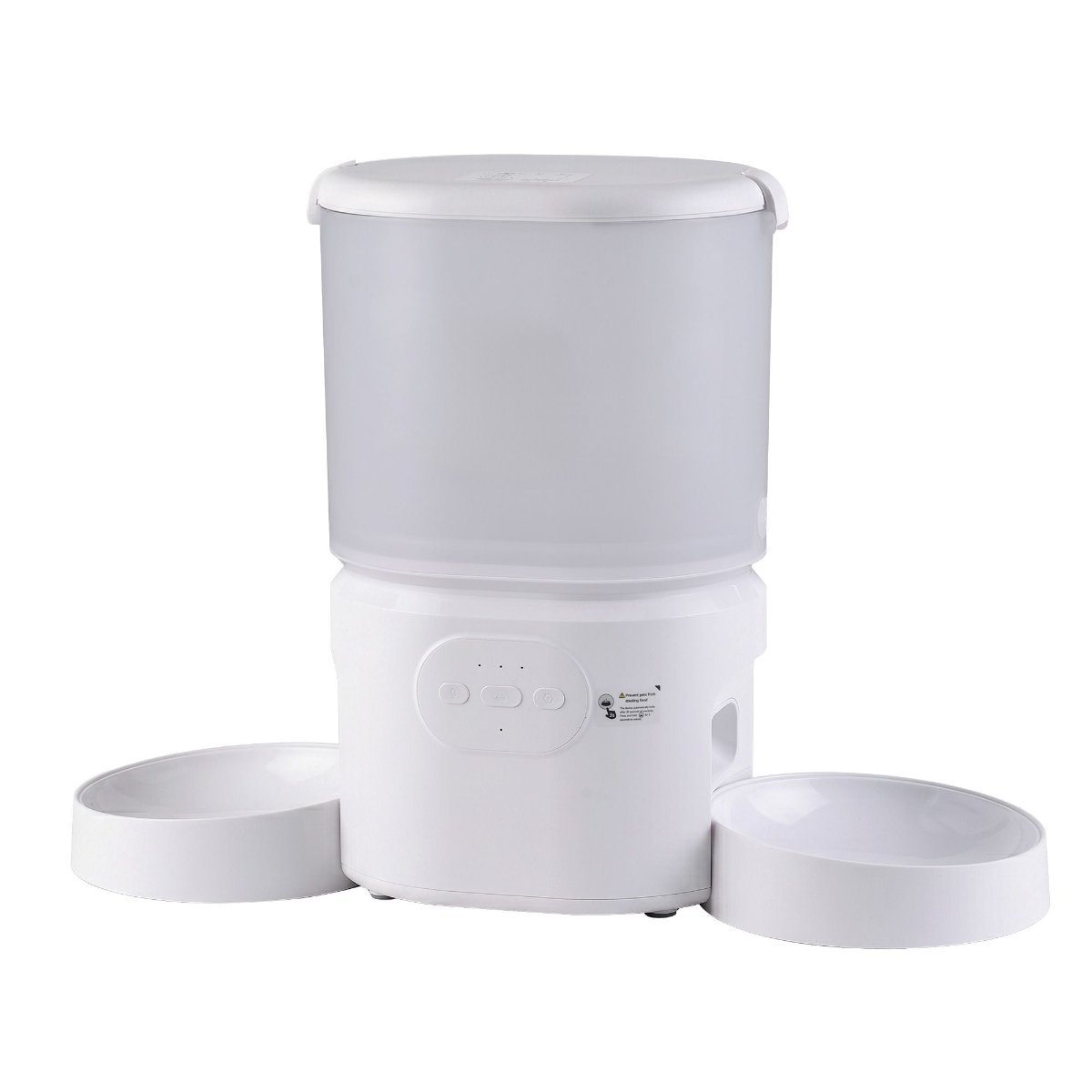
A one-to-two splitter sits under the 5L hopper and drops food into two separate bowls at the same moment. Both animals eat at once, in their own space, from a single machine.
Food guarding is what makes multi-pet feeding difficult, and the usual fix of two separate feeders costs twice as much and needs two schedules kept in sync. Splitting one dispense into two bowls means neither animal finishes first and moves onto the other, which is where most mealtime conflict starts. App control handles both bowls together.
Both bowls receive the same portion, so it will not suit two animals on different diets or very different sizes. For two cats, or a cat and a small dog on the same food, it replaces two machines with one.
Pros
- One-to-two splitter feeds both bowls at once
- Ends food guarding between two pets
- Single schedule for both animals
- 5L hopper
- App control over WiFi
Cons
- Both bowls get the same portion
- Not suited to pets on different diets
Key specs: 5L capacity, one-to-two way splitter, dual bowl layout, smart app control, programmable portions
CHECK CURRENT PRICE3. i.Pet 2-in-1 Feeder and Water Dispenser – Best Food and Water Combination
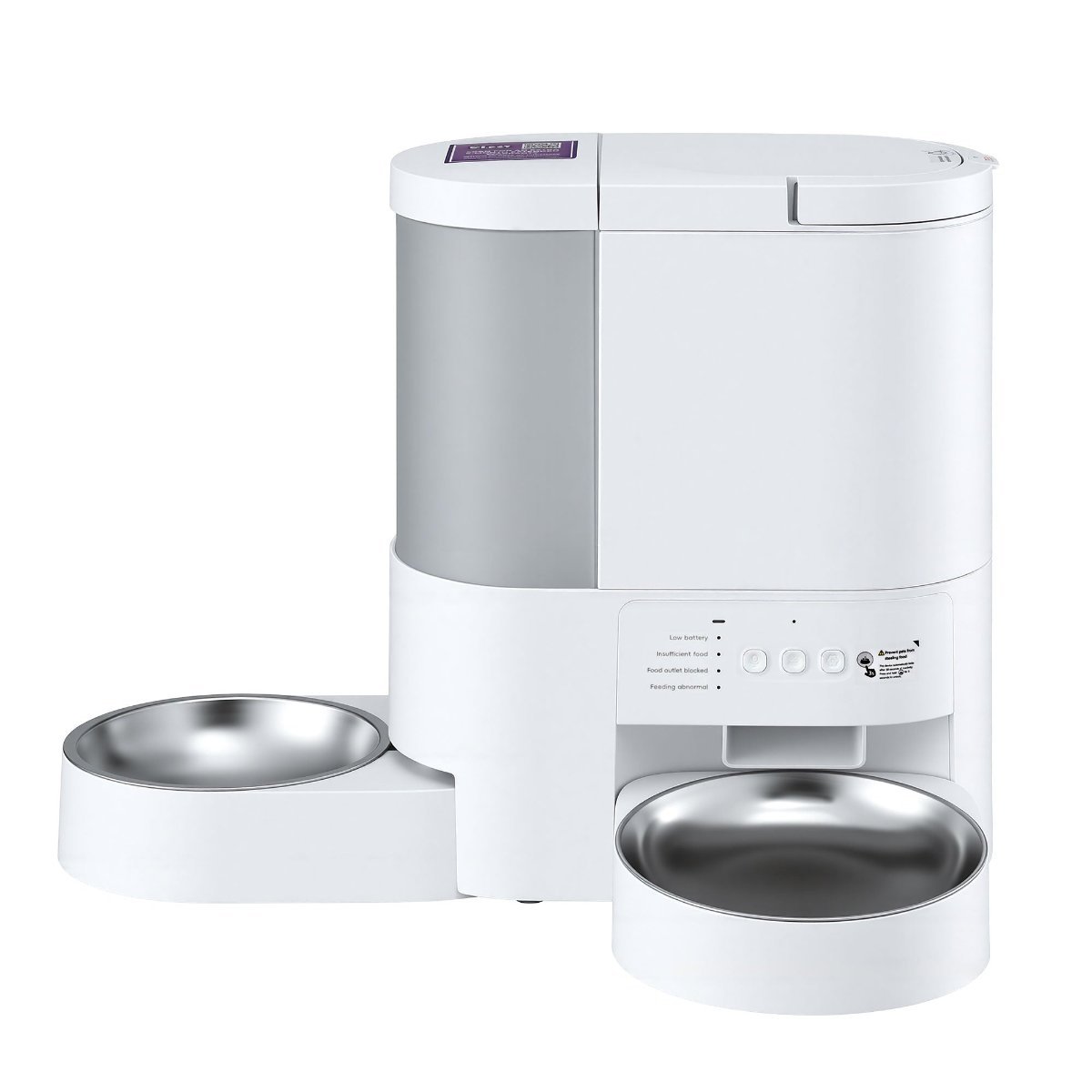
Two reservoirs sit side by side in one housing: a 4L food tank and a 3L water supply. One power point, one app, one thing to clean rather than a feeder at one end of the kitchen and a fountain at the other.
Hydration is the half of automated pet care people forget. A cat left with a bowl of water for a weekend will find it warm and full of dust by Sunday, and cats under-drink at the best of times. Running both from one unit means the water is circulating on the same schedule the food is dispensing, and the combined footprint is smaller than two separate machines.
Sharing a housing means a spill on the water side sits near the food side, so it wants a spot that can be wiped down. For anyone who goes away for weekends rather than just working late, it covers both needs in one purchase.
Pros
- 4L food and 3L water in one unit
- Single app manages both functions
- Smaller combined footprint than two machines
- One power point
- Keeps water circulating while away
Cons
- Water and food share one housing to clean
- Food capacity smaller than the 9L model
Key specs: 4L food tank, 3L water supply, 2-in-1 housing, smart WiFi app control for both functions
CHECK CURRENT PRICE4. Advwin RFID Automatic Cat Feeder – Best for Multi-Cat Homes
RFID microchip technology gates the lid on this one. Only a pet carrying the programmed tag can open it, which no other feeder in this guide attempts.
This is the answer to a problem that defeats every other feeder: one cat on prescription or weight-control food and another that will happily eat it. Portion control means nothing if the wrong animal reaches the bowl first. Gating access by tag makes automated feeding workable in a house where the animals are on genuinely different diets, and it stops the greedy one from taking two meals.
It handles one designated pet per unit, so a house with two animals on two diets needs two feeders. Where a vet has prescribed different food for different animals, it is the only design here that actually enforces it.
Pros
- RFID tag restricts access to one pet
- Enforces prescription and weight-control diets
- Prevents food theft between animals
- Suited to cats and small dogs
- Solves what portion control alone cannot
Cons
- One designated pet per unit
- Pet must wear or carry the tag
Key specs: RFID microchip access control, programmed tag pairing, suits cats and small dogs, dietary management
CHECK CURRENT PRICE5. Advwin Smart Feeder for Wet and Dry Food – Best for Wet Food
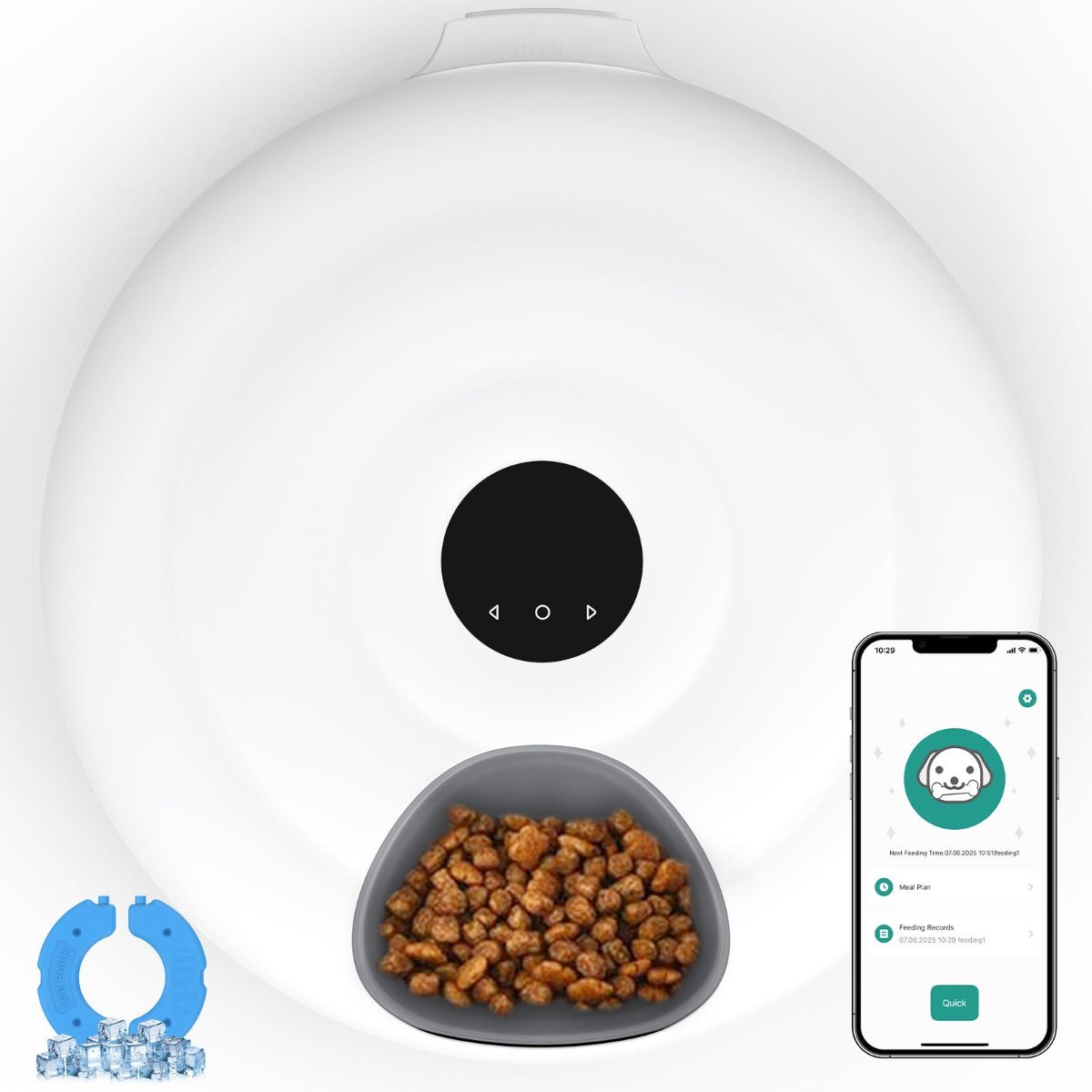
A rotating tray of six compartments replaces the hopper here, each one holding a separate meal and staying covered until its turn comes around.
Every hopper feeder in this guide handles dry biscuits only, because wet food clogs an auger and spoils in an open reservoir. Compartments solve that: the food stays sealed until the tray turns, so a cat on a wet diet can be fed on schedule for the first time. Six compartments cover six meals, or three days at two meals a day, with the app setting each time.
Six meals is a hard ceiling and the tray needs washing between cycles, so it is more maintenance than a dry hopper. For the many cats that will not eat biscuits, it is the only workable automatic option here.
Pros
- Six sealed compartments suit wet food
- Each meal stays covered until dispensed
- WiFi app schedules up to 6 meals a day
- Handles wet, dry and snacks
- Solves what hopper feeders cannot
Cons
- Six meals per fill is a hard limit
- Tray needs washing between cycles
Key specs: 6-compartment rotating tray, up to 6 meals, WiFi app control, adjustable timer, wet and dry food
CHECK CURRENT PRICE6. Advwin 4L Feeder with HD Camera – Best Camera Feeder
A 1080p lens with a 120 degree field of view and infrared night vision sits in the body of this 4L feeder, pointed at the bowl.
Confirmation is the thing a camera adds. A schedule tells you food was meant to drop; a camera shows you the animal actually came and ate it, which is how you find out about a jam or an illness while you are still away rather than on return. Night vision covers the small hours when most cats eat, and the wide angle takes in the surrounding floor rather than just the bowl.
It is the smallest hopper in this guide at 4L, so a large dog will empty it quickly. For a cat owner who travels and wants to see rather than assume, the camera matters more than the extra litres.
Pros
- 1080p camera with 120 degree view
- Infrared night vision
- Confirms the pet actually ate
- Lowest cost feeder in this guide
- App control and scheduling
Cons
- 4L is the smallest hopper here
- Too small for a large dog
Key specs: 4L capacity, 1080p HD camera, 120 degree wide angle, infrared night vision, app control
CHECK CURRENT PRICEHow to Choose an Automatic Pet Feeder
Size the hopper to the animal, not the packaging. A cat eating 60 grams a day will get about three weeks from a 4 litre hopper. A 25kg dog eating 300 grams a day will empty the same hopper inside a week. Work out days of food rather than litres, and buy the size that means refilling on your schedule rather than the machine.
Check what happens in a blackout. The specification that separates a good feeder from a bad one is what it does without mains power. Look for battery backup that keeps the clock and the schedule running, so the unit resumes rather than restarting or sitting idle. A feeder that loses its schedule during a summer storm defeats the purpose of owning one.
Wet food needs compartments, not a hopper. An auger and reservoir design only handles dry biscuits. Wet food clogs the mechanism and spoils in an open hopper within hours. If your animal will not eat dry food, a rotating tray of sealed compartments is the only design that works, and it caps you at roughly six meals per fill.
Match the multi-pet feature to the actual problem. Two animals on the same food that squabble need a dual-bowl splitter. Two animals on different diets need RFID access control, because portion sizing does nothing if the wrong pet reaches the bowl first. These are different problems and only one of them is solved by buying two ordinary feeders.
Look at how it comes apart for cleaning. Biscuit dust and oil build up in the chute and the bowl, and a feeder that cannot be stripped down will start to smell within a couple of months. Removable bowls and a detachable hopper are the minimum. Anything handling wet food needs the tray out and washed between every cycle.
Set up the rest of the room while you are at it. Dry food scatters and a feeder running twice a day makes more mess than one bowl did, so a robot vacuum earns its place nearby. If the point of the feeder is leaving the animal alone for a weekend, one of the home security cameras covers the rest of the house rather than just the bowl.
Frequently Asked Questions
Are automatic pet feeders safe to leave a pet with?
For a weekend, yes, provided the feeder has battery backup and the animal has water. For longer absences they are not a substitute for someone checking in, because a jam, an illness or an empty water bowl needs a person. Cats should never be left more than two or three days regardless of the feeder.
Can automatic feeders handle wet food?
Only compartment models. A hopper feeder uses an auger that wet food clogs, and an open reservoir of wet food spoils within hours. A rotating tray with sealed compartments keeps each meal covered until it is dispensed, which typically allows around six meals before refilling.
What happens to an automatic feeder in a power cut?
Models with battery backup keep the internal clock and schedule running and resume dispensing normally. Models without it may reset, skip meals or restart their timer from zero. Check for battery backup specifically, because WiFi connectivity and power backup are separate features.
How much food should an automatic feeder dispense?
An average adult cat needs roughly 60 grams of dry food a day, split across two to four meals. Dogs vary widely by size, from around 100 grams for a small breed to 300 grams or more for a large one. Follow the feeding guide on the food packaging and weigh a portion once to calibrate the machine.
Can one feeder work for two pets?
A dual-bowl splitter suits two animals on the same food, feeding both at once so neither guards the bowl. Two animals on different diets need an RFID feeder that opens only for the tagged pet, since portion control alone cannot stop the wrong animal eating first.
How often should an automatic pet feeder be cleaned?
Wash the bowl every few days and strip the hopper and chute monthly, because biscuit dust and oil build up and eventually smell. Compartment feeders handling wet food need the tray washed between every cycle. Let all parts dry fully before refilling, since moisture in a hopper causes clogging.
Verdict
For most households the i.Pet 9L is the sensible default, because the single biggest reason people stop using a feeder is refilling a small hopper twice a week. Two animals on different diets are a different problem entirely, and the Advwin RFID unit is the only one here that actually enforces who eats what. If the cat refuses dry biscuits, the six-compartment Advwin is the only design in this guide that will automate a wet food diet at all.


