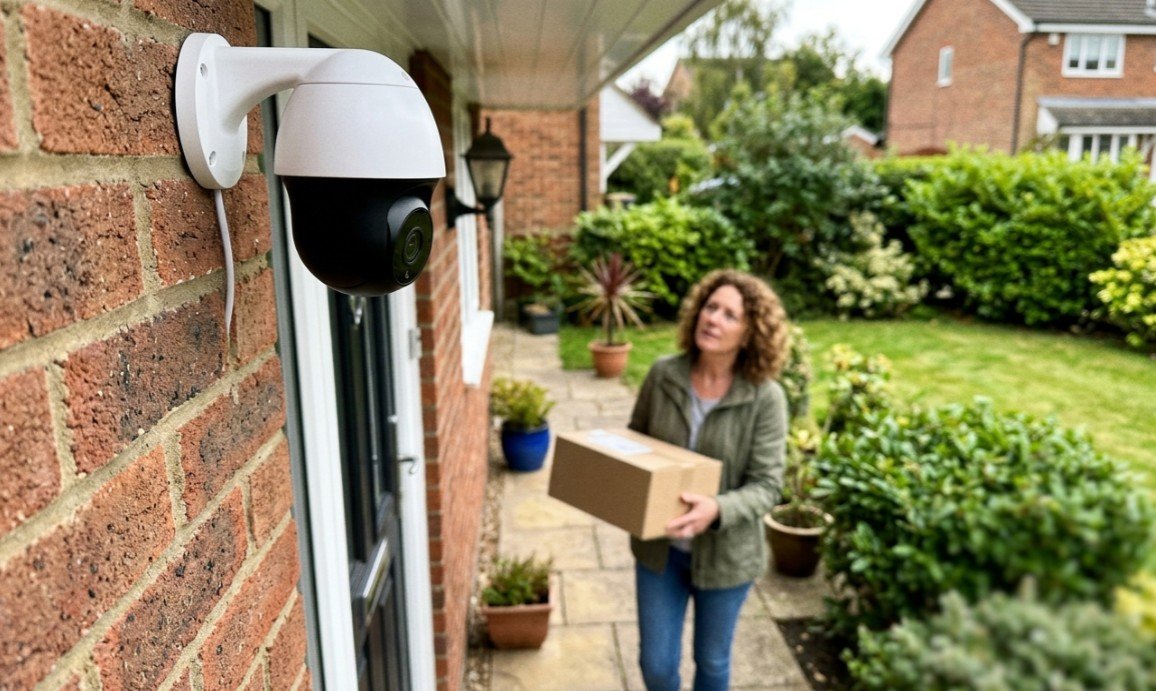
The best home security cameras in Australia are internet connected cameras that record video of a property, detect motion and push alerts to a phone app, working either as a single standalone unit or as a multi camera kit wired back to a recorder. They differ from indoor baby and pet monitors in that they are built to survive outdoor conditions and to keep recording when the home network drops out.
Four types dominate the Australian market. Wireless NVR kits pair several WiFi cameras with a network video recorder that holds a hard drive. Wired DVR kits run coaxial cable to every camera for a link that cannot be jammed or dropped. Solar battery cameras need no cabling at all and suit sheds, gates and rural boundaries. Indoor pan and tilt cameras sweep a room from a ceiling or shelf and handle two way audio for checking on rooms, pets and deliveries.
Infrared night vision on the outdoor units in this guide reaches up to 20 metres, or roughly 66 feet, which covers a typical suburban backyard end to end but falls well short of a long rural driveway. The specifications that decide value are sensor resolution, that infrared range, the ingress protection rating against rain and dust, whether footage lands on a microSD card or a recorder hard drive, and whether the camera runs on mains power, battery or solar.
This guide compares ten cameras and camera kits held in Australian stock, spanning large property CCTV systems, single add on cameras, solar outdoor units, indoor pan and tilt models and long life battery cameras that need no wiring at all.
Quick Picks
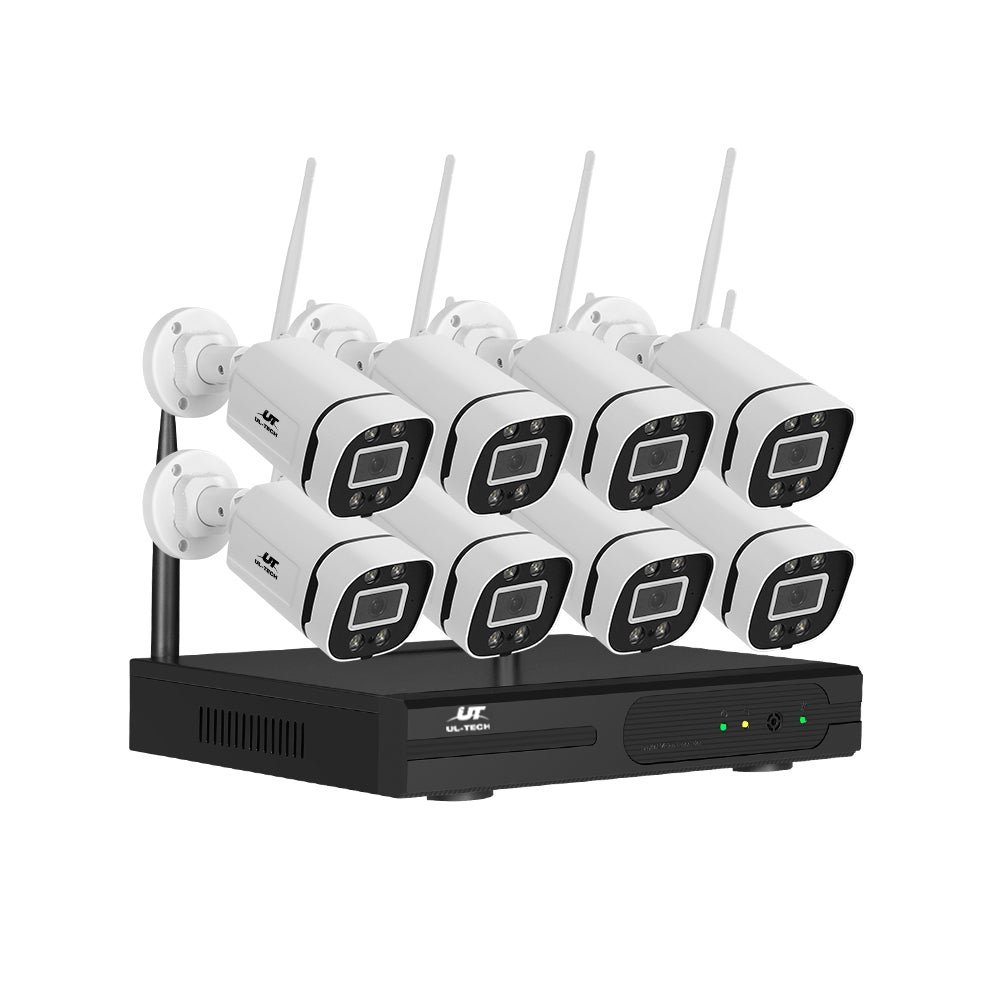
UL-Tech Wireless CCTV 8CH NVR 3MP 8 Square Cameras
Eight 3MP cameras and an eight channel wireless recorder, enough to ring a large block without running video cable to every corner.
CHECK CURRENT PRICE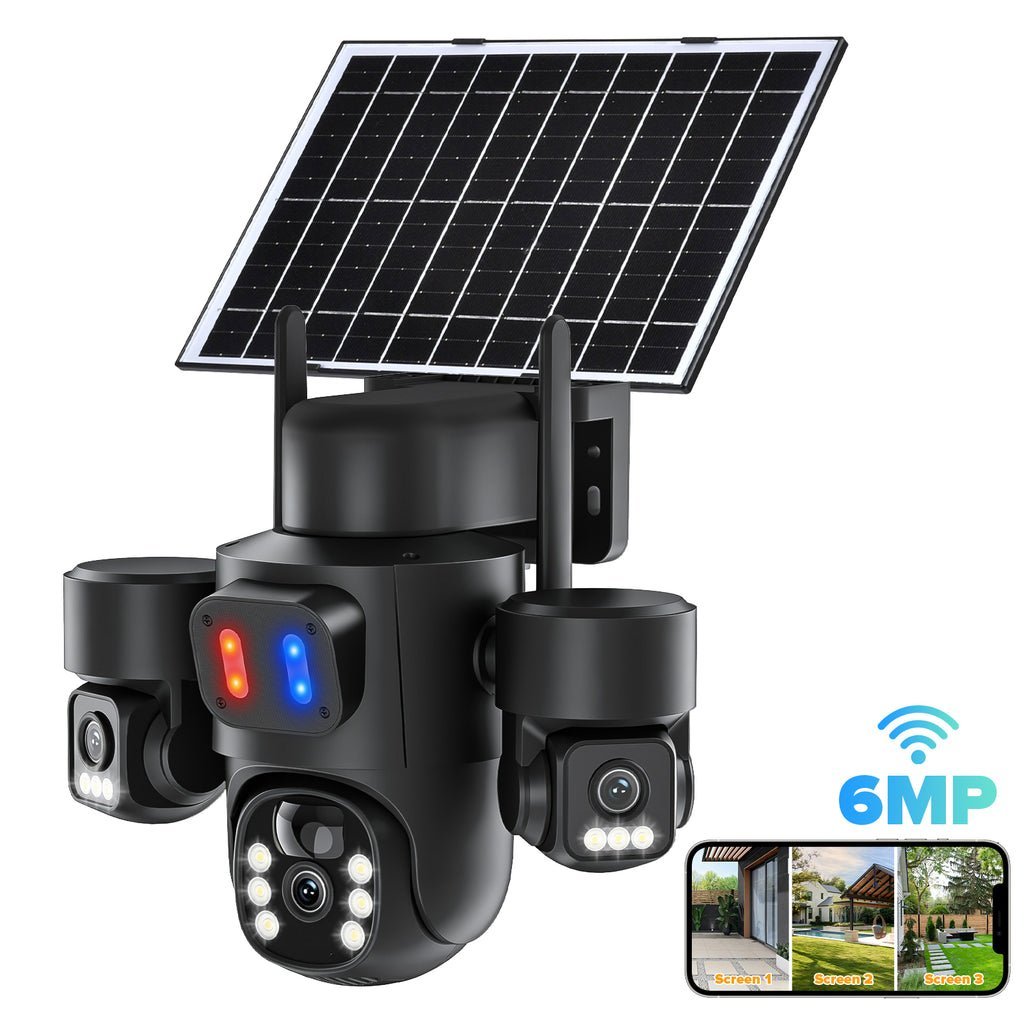
Advwin Solar WiFi PTZ Security Camera with Siren
Three lenses, a solar panel and a built in siren, so a gate or shed is covered with no wiring and no monthly charging routine.
CHECK CURRENT PRICE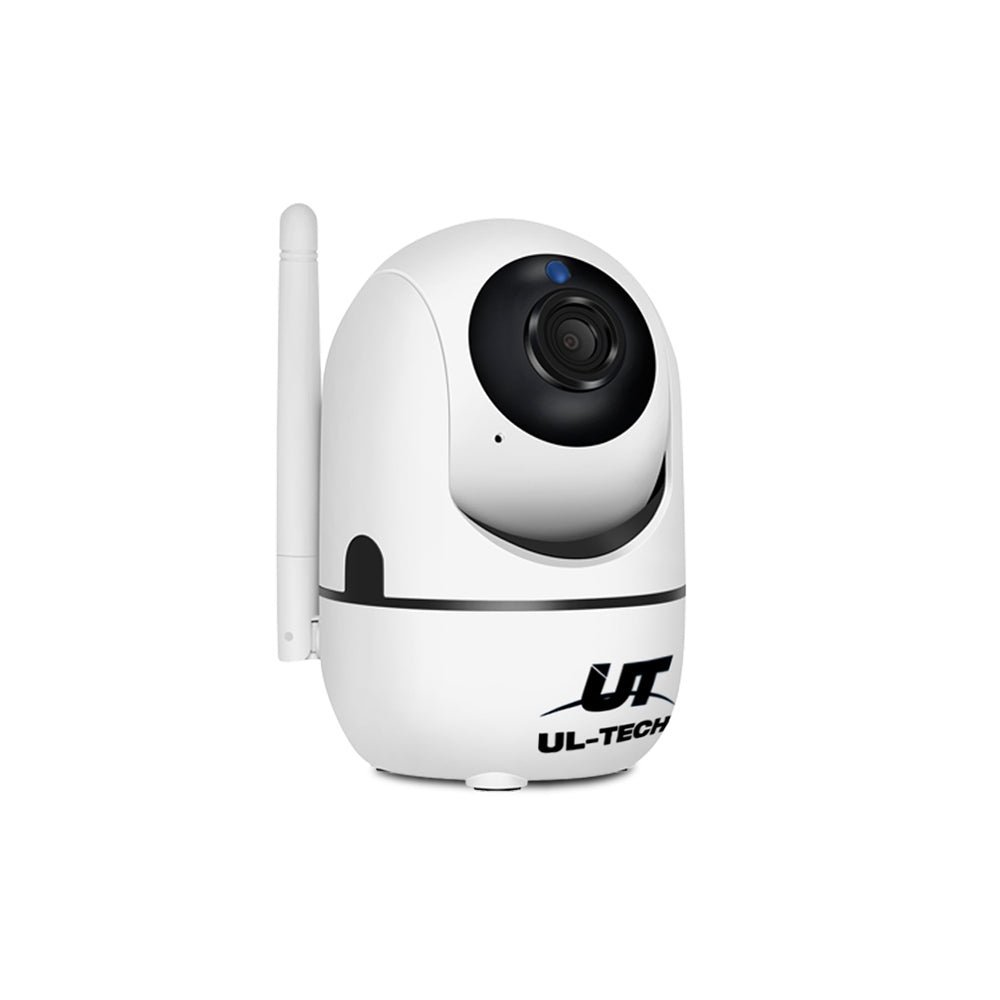
UL-Tech 1080P Wireless IP Home Security Camera
A ceiling mounted pan and tilt camera with two way audio for checking rooms, pets and deliveries from a phone.
CHECK CURRENT PRICEThe 10 Best Home Security Cameras in Australia Compared
| Product | Link | Type | Best For | Key Spec |
|---|---|---|---|---|
| UL-Tech Wireless CCTV 8CH NVR 3MP 8 Square Cameras | Check price | Wireless NVR kit | Large properties | 3MP, 20m IR, IP65 |
| UL-Tech Wireless CCTV 8CH NVR 3MP 6 Bullet Cameras | Check price | Wireless NVR kit | Mid size homes | 3MP, 8 channel WiFi NVR |
| UL-Tech 1080P 8CH DVR with 8 Square Cameras | Check price | Wired DVR kit | Wired reliability | 1080p, 20m IR, IP66 |
| UL-Tech Wireless 3MP Square Camera | Check price | Single add on camera | Expanding a kit | 3MP, 20m IR, IP65 |
| UL-Tech 1080P Wireless IP Home Security Camera | Check price | Indoor pan and tilt | Indoor rooms | 1080p, 355 degree pan |
| Advwin Solar WiFi PTZ Security Camera with Siren | Check price | Solar PTZ camera | Off grid gates and sheds | 3 x 1080p, 7.5W solar, IP66 |
| Advwin 4 Piece Solar Outdoor WiFi Camera Kit | Check price | Solar multi camera kit | Whole boundary with no wiring | 2K, 7800mAh, IP66 |
| Advwin HD Smart Security and Pet Camera | Check price | Indoor AI tracking camera | Pets and nurseries | 1080p, AI tracking, 2.4 and 5GHz |
| Tapo Wire-Free Outdoor Battery Camera | Check price | Battery camera | Walls with no power | 2K QHD, 10000mAh, IP66 |
| eufyCam Solar Security Camera Kit | Check price | Solar 4K kit | Identifying faces | 4K, 2 cameras, local storage |
1. UL-Tech Wireless CCTV 8CH NVR 3MP 8 Square Cameras – Best for Large Properties
Eight square housing cameras pair with an eight channel wireless network video recorder here, so each camera needs only a power lead rather than a run of video cable back to the recorder. The cameras carry an IP65 rating for rain and dust and use a 1/3 inch CMOS sensor behind a 3.6mm lens. The recorder takes a single 3.5 inch SATA drive of up to 6TB, which is not supplied.
Footage records at 3MP, or 2304 x 1296 pixels, which is a genuine step up from 1080p when the point is reading a number plate or a face rather than simply seeing that someone was there. Four infrared LEDs in each camera push night vision to about 20 metres, roughly 66 feet. H.265+ compression keeps eight channels of continuous recording from filling a drive as fast as older H.264 systems, and two way audio plus motion alerts run through the phone app over P2P.
The trade off is the 2.4GHz WiFi link, because eight wireless streams sharing one band will struggle in a dense apartment block or through double brick. On a large freestanding block, or a small commercial site where cutting cable channels through finished walls is off the table, this is the strongest answer in the guide. Budget for the drive in the same order.
Pros
- 3MP resolution across all eight cameras
- No video cable runs between cameras and recorder
- IP65 sealing for outdoor mounting
- H.265+ compression stretches drive capacity
- HDMI and VGA outputs for a local monitor
Cons
- Hard drive not included
- Eight streams share one 2.4GHz band
- Each camera still needs a power lead
Key specs: 3MP (2304 x 1296), 8 channel wireless NVR, 20m infrared night vision, IP65, 2.4GHz WiFi 802.11b/g/n, H.264 and H.265+, supports up to 6TB SATA drive, two way audio, HDMI and VGA out
CHECK CURRENT PRICE2. UL-Tech Wireless CCTV 8CH NVR 3MP 6 Bullet Cameras – Best for Mid-Size Homes
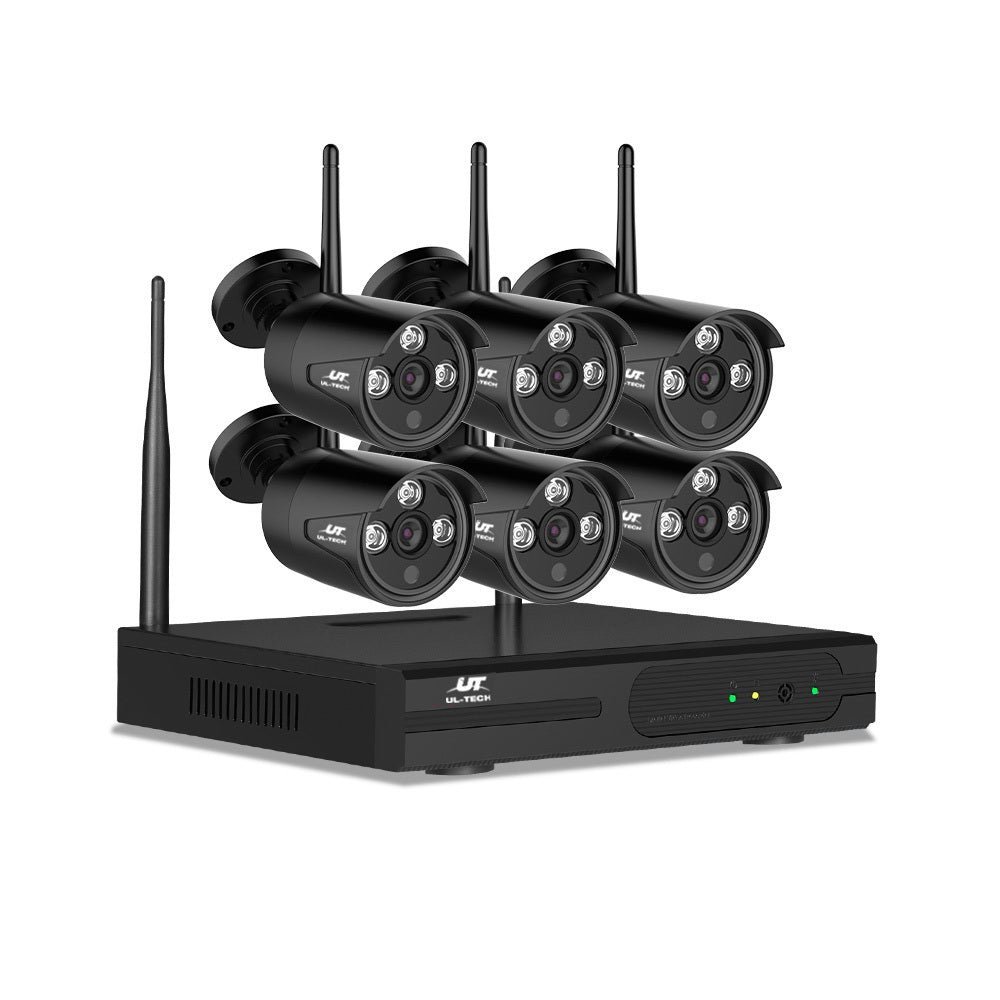
The recorder platform is identical to the kit above, supplied with six bullet cameras instead of eight square housings. Bullet bodies sit on an adjustable arm, which makes them easier to aim along a fence line or driveway than a fixed square housing. The recorder ships with a USB mouse, outputs to HDMI or VGA, and again takes its hard drive separately.
Six 3MP channels is the practical sweet spot for a standard four bedroom home: front door, driveway, back door and three side or boundary angles. Built in IR cut filters switch the cameras to infrared after dusk, and the recorder holds its configuration through a power outage so the system returns without a reset. Motion detection can trigger email alarms as well as app notifications, and all eight channels stream live to a phone at once even though only six cameras are supplied.
Because two channels sit unused, the kit leaves room to add cameras later without replacing the recorder. Infrared range is not published for this configuration, so anyone who needs a specific distance should treat the eight camera kit’s 20 metre figure as indicative rather than guaranteed. Those two spare channels are the whole argument against a six channel unit, and they matter most on a block that will grow another camera or two within a year.
Pros
- Two spare channels for later expansion
- Bullet housings aim precisely along fences and driveways
- Retains settings through a power outage
- Email alarms as well as app alerts
- USB mouse included for local setup
Cons
- Infrared range not published for this configuration
- Hard drive not included
- Wireless link still depends on 2.4GHz coverage
Key specs: 3MP, 8 channel WiFi NVR with 6 bullet cameras, H.264+, IR cut night vision, P2P remote access, HDMI and VGA out, motion detection with email alarm, indoor and outdoor rated, USB mouse included
CHECK CURRENT PRICE3. UL-Tech 1080P 8CH DVR with 8 Square Cameras – Best Wired System
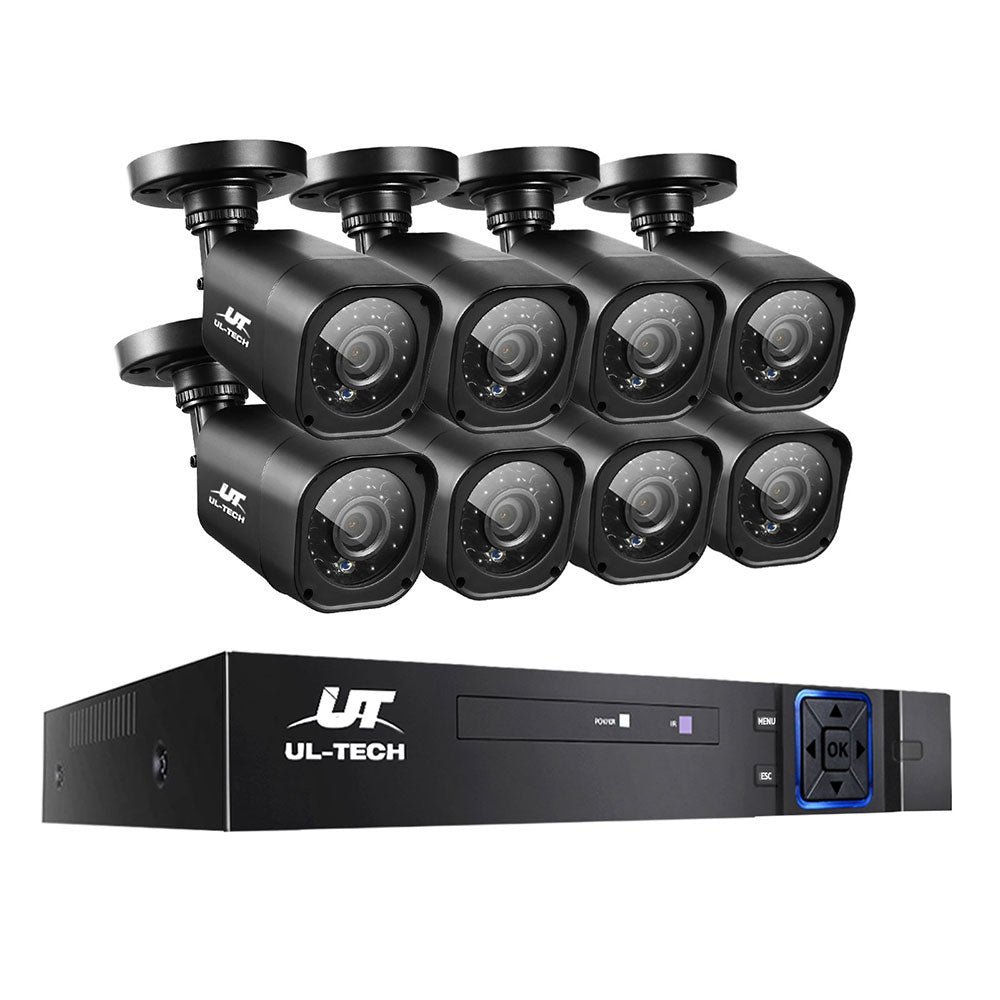
Where the wireless kits above cut the cable, this system deliberately keeps it, connecting each of the eight cameras to the digital video recorder over a supplied 18.3 metre, or 60 foot, two in one BNC and power lead. That is more work to install, and it removes the wireless link as a point of failure entirely. The housings are rated IP66, a step above the IP65 kits, so they tolerate heavier driven rain.
Resolution steps back to 1080p from the 3MP of the wireless kits, so fine detail at distance is weaker, but a wired feed does not drop out when the router reboots or a neighbour saturates the 2.4GHz band. Infrared night vision covers a 20 metre radius, about 66 feet. Remote viewing runs through the XMEye app over P2P, and the recorder supports both an internal disk and an external drive.
Cabling is the real cost here, in labour rather than money, because eight runs of 18 metre cable need a path through a roof space or along the eaves. New builds and renovations where the walls are already open are the obvious home for it, as is any property whose WiFi gives up at the back fence. Anyone unwilling to pull cable should take one of the wireless kits above instead.
Pros
- Wired feeds cannot be dropped or jammed
- IP66 housings handle heavier rain than IP65
- Cable supplied for all eight cameras
- 20 metre infrared night vision radius
- Supports internal and external storage
Cons
- 1080p rather than 3MP
- Eight cable runs to install
- Hard drive not included
Key specs: 1080p, 8 channel DVR, 8 square cameras, 20m infrared radius, IP66 all weather, wired BNC and power, 18.3m (60ft) cable per camera, XMEye app, P2P remote access
CHECK CURRENT PRICE4. UL-Tech Wireless 3MP Square Camera – Best Single Add-On
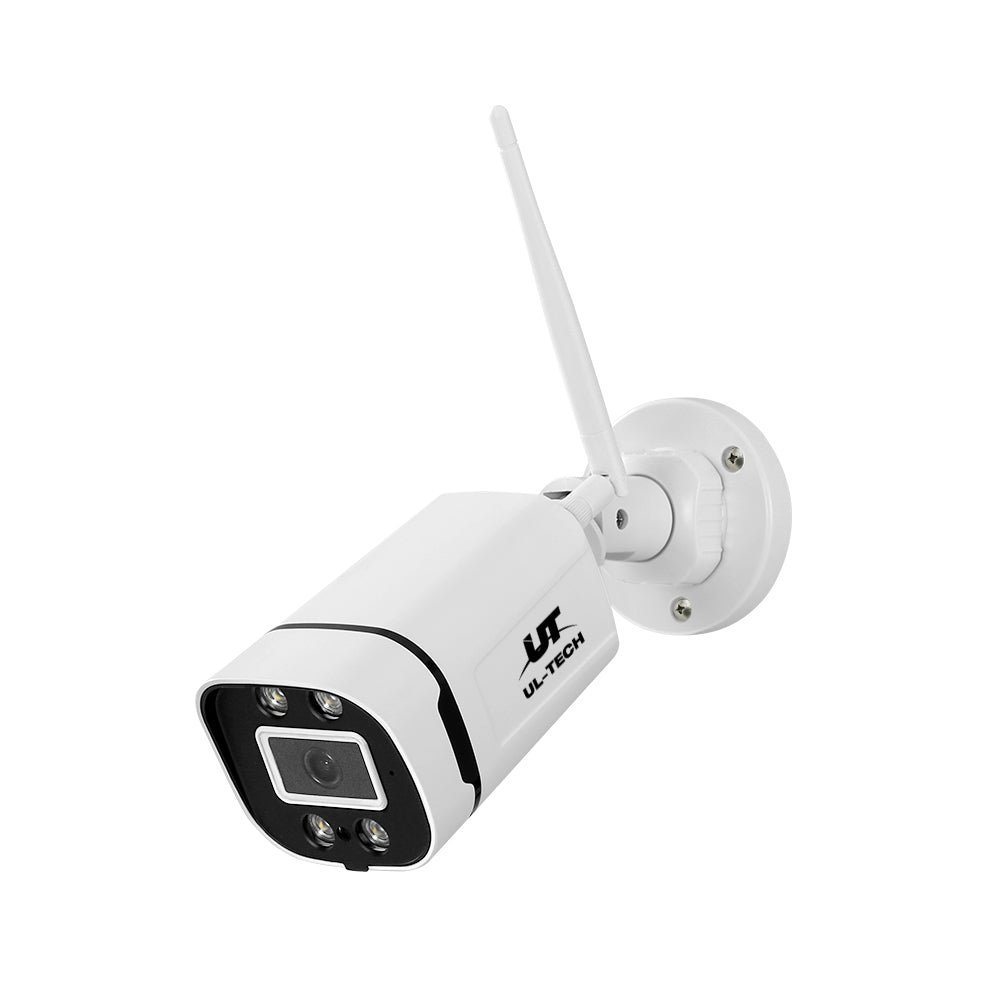
A single camera rather than a system, built to join an existing wireless network video recorder. It uses the same 1/3 inch CMOS sensor, 3.6mm lens and IP65 housing as the eight camera kit, so it matches rather than mismatches an established setup. Power is DC 12V at 1A, and it carries a built in microphone and speaker.
Image quality is 3MP at 2304 x 1296 pixels with infrared to about 20 metres, or 66 feet, identical to the flagship kit’s cameras. The rated operating range runs from minus 20 to 50 degrees Celsius, wide enough for an unshaded wall through a WA summer or a frosty Canberra morning. H.265+ compression means adding it to a recorder does not disproportionately consume drive space.
Working alone is the one thing it cannot do, because footage needs a network video recorder that is sold separately, so this is not a first camera for a household with nothing installed. Warranty is one year. Anyone who has run out of covered angles faces a choice between this and a second brand behind a second app, and matching the existing kit is almost always the cheaper of the two over time.
Pros
- Matches the specification of the eight camera kit
- 3MP with 20 metre infrared range
- IP65 sealing for outdoor mounting
- Built in microphone and speaker
- Rated from minus 20 to 50 degrees Celsius
Cons
- Requires a separate network video recorder
- Not a standalone camera
- One year warranty only
Key specs: 3MP (2304 x 1296), 1/3 inch CMOS, 3.6mm lens, 20m infrared, IP65, 2.4GHz WiFi 802.11b/g/n, DC 12V/1A, H.264 and H.265+, minus 20 to 50 degrees Celsius, one year warranty
CHECK CURRENT PRICE5. UL-Tech 1080P Wireless IP Home Security Camera – Best Indoor Plug-In
Indoors the priority changes from weather sealing to coverage, and a motorised head handles it better than a fixed lens. This ceiling mount unit rotates 355 degrees horizontally and 110 degrees vertically, so one camera can sweep an entire open plan living area. Power comes from a 5V 2A supply on a 96cm lead, drawing about 5W.
Recording is 1080p at 1920 x 1080 and lands on a microSD card of up to 128GB formatted FAT32, so there is no recorder and no subscription in the loop. Infrared reaches about 10 metres, half the range of the outdoor cameras above, which is ample for a room but not for a yard. Two way audio is genuinely usable for talking to a room rather than only listening to it.
It joins 2.4GHz networks only, so it will not sit on a 5GHz band, and it is an indoor unit with no ingress rating for outdoor mounting. For a nursery, a hallway, a home office or a pet left alone through the day, sweep coverage does more work than infrared distance ever will.
Pros
- 355 degree pan and 110 degree tilt from one position
- Records to microSD with no recorder needed
- Clear two way talk back
- Low 5W power draw
- Ceiling or shelf mounting
Cons
- Indoor only with no weather rating
- 2.4GHz WiFi only
- 10 metre infrared range
Key specs: 1080p (1920 x 1080), 2 megapixel, 355 degree pan and 110 degree tilt, 10m infrared with IR cut, microSD up to 128GB FAT32, 2.4GHz WiFi, two way audio, 5V/2A and 5W, indoor ceiling mount
CHECK CURRENT PRICE6. Advwin Solar WiFi PTZ Security Camera with Siren – Best Solar Powered
Neither mains power nor a data cable is needed here. A 7.5W solar panel keeps a 10800mAh six cell battery topped up, and the camera pairs over 2.4GHz WiFi with Bluetooth assisted setup. Three separate 4mm lenses cover a wide field, with the main head motorised and the two side lenses positioned by hand.
The main camera pans 355 degrees and tilts 90 degrees automatically, while the side lenses each give 320 degrees of manual pan, so combined coverage is closer to a full sweep than a single PTZ head manages. A 120 degree PIR sensor triggers at about 10 metres and can fire a siren with red and blue warning lights, which deters rather than merely records. Night vision runs in either infrared or full colour mode, and the housing is IP66 rated from minus 20 to 55 degrees Celsius.
Storage is a microSD card between 32GB and 256GB and is not supplied, so the camera arrives unable to record until one is fitted. Each of the three lenses is 1080p rather than 2K or higher, so this is about coverage and deterrence rather than fine detail. The case for it is simple at any gate, shed, carport or rural boundary where a trench for power would cost more than the camera.
Pros
- No mains power or data cabling needed
- Three lenses cover far more than a single head
- Siren with warning lights deters rather than only records
- Full colour night mode as well as infrared
- IP66 and rated to 55 degrees Celsius
Cons
- MicroSD card not included
- 1080p per lens rather than 2K
- 2.4GHz WiFi only
Key specs: 3 x 1080p with 3 x 4mm lens, 7.5W solar panel, 10800mAh 6 cell battery, main head 355 degree pan and 90 degree tilt auto, side lenses 320 degree manual pan, PIR 120 degrees at 10m, siren with red and blue lights, microSD 32GB to 256GB, IP66, minus 20 to 55 degrees Celsius
CHECK CURRENT PRICE7. Advwin 4 Piece Solar Outdoor WiFi Camera Kit – Best Multi-Camera Solar Kit
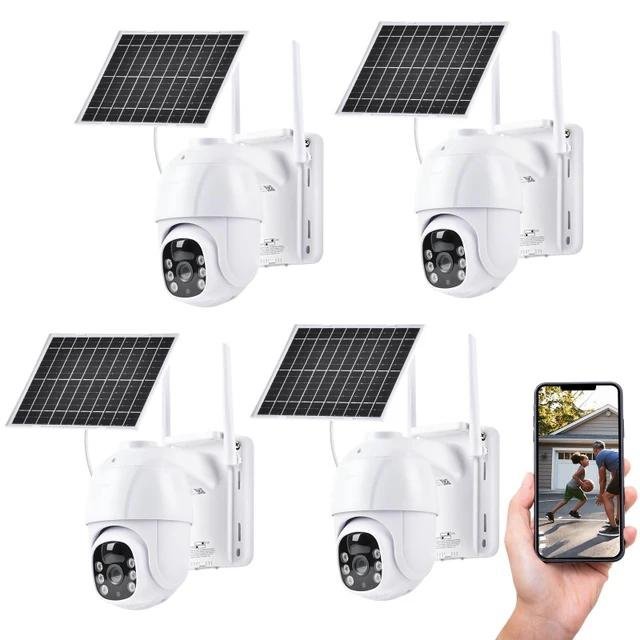
Four solar cameras, four panels and four brackets arrive as one kit, so an entire boundary can be covered without a single cable run or a recorder. Each camera has a built in 7800mAh battery charged by its own panel. Dual 5dBi antennas are fitted to hold a WiFi link at distance from the router, which is the usual failure point for cameras at the far corner of a block.
At 2K, the sensor is a real increase on the solar unit above, and each camera is a PTZ head with 355 degrees of pan, 90 degrees of tilt and 10x digital zoom. Colour night vision sits alongside a standard infrared black and white mode, with infrared reaching about 20 metres or 66 feet. PIR human detection filters alerts to people rather than to every moving branch, and footage goes to a microSD card of up to 128GB or to cloud storage.
Scale is the point here and also the catch, because four batteries and four panels mean four positions that each need genuine sun, which is a real constraint on a south facing wall or under heavy tree cover. Cards are not included. Rentals where drilling is not an option, and larger or rural blocks needing all four aspects covered at once, are where four cameras and no cable earns its keep.
Pros
- 2K resolution across four cameras
- No cabling or recorder anywhere in the system
- Dual 5dBi antennas hold WiFi at distance
- PIR human detection cuts false alerts
- Colour and infrared night modes with 10x zoom
Cons
- Four positions each need real sun exposure
- MicroSD cards not included
- Cloud storage carries its own separate terms
Key specs: 2K resolution, 4 cameras with 4 solar panels and brackets, 7800mAh battery per camera, 355 degree pan and 90 degree tilt, 20m infrared plus colour night vision, 10x digital zoom, PIR human detection, microSD up to 128GB or cloud, dual 5dBi antenna, IP66, two way audio
CHECK CURRENT PRICE8. Advwin HD Smart Security and Pet Camera – Best for Pet Monitoring

Motion tracking, rather than static coverage, is what this compact indoor camera is built around. The head moves through 350 degrees horizontally and 110 degrees vertically, and the tracking is automatic, so the camera follows a moving subject across a room instead of waiting for it to cross a fixed frame. An anti noise microphone and speaker handle two way audio.
The sensor matches the indoor camera at entry five, 1080p with smart infrared LEDs reaching about 10 metres, enough for a dark lounge room. Where it pulls ahead is the network: it joins either a 2.4GHz or a 5GHz band, which matters in an apartment where 2.4GHz is already congested. Motion and sound detection both trigger alerts, and footage goes to a microSD card of up to 128GB or to cloud storage.
It is indoor only with no weather rating, and 1080p means it is for identifying what happened in a room rather than reading detail at distance. Leave an animal or a child’s room unattended and the difference between a camera that follows and one that misses is the entire point of the purchase.
Pros
- Automatic tracking follows a moving subject
- Joins 2.4GHz or 5GHz networks
- 350 degree pan and 110 degree tilt
- Sound as well as motion detection
- MicroSD or cloud storage
Cons
- Indoor only with no weather rating
- 1080p resolution
- 10 metre infrared range
Key specs: 1080p HD, 350 degree horizontal and 110 degree vertical, AI motion tracking, 10m smart infrared, two way anti noise audio, motion and sound detection, microSD up to 128GB or cloud, 2.4GHz and 5GHz WiFi, indoor use
CHECK CURRENT PRICE9. Tapo Wire-Free Outdoor Battery Camera – Best Battery Life

Battery life is the whole argument for this one. A 10000mAh cell carries it for months rather than days, so the camera goes on a wall with no power point, no cable run and no panel needing sun, which is the one gap every other outdoor unit in this guide leaves open. Mounting is wire free indoors or out, and the housing is rated IP66.
Video is 2K QHD with colour night vision rather than infrared black and white, and the field of view runs to 150 degrees, wider than the fixed lens cameras earlier in this guide and wide enough to hold a whole driveway in one frame. Person detection runs on the camera with no subscription attached, so alerts filter down to people without a monthly fee. A solar panel accessory is supported for anyone who does want indefinite runtime, sold separately.
The trade off is the ecosystem, because this is a single camera on its own app rather than a channel on a recorder, so it does not join the NVR and DVR systems above and adds another login to the house. Recharging still means bringing it down off the wall unless the panel is added. Where a wall has no power within reach and no reliable sun, this is the only camera here that solves the problem outright.
Pros
- Months of runtime from one charge
- No cable, no power point and no panel required
- 150 degree field of view, wider than the fixed lens kits
- Colour night vision rather than infrared only
- Person detection with no subscription
Cons
- Will not join the NVR or DVR systems in this guide
- Solar panel sold separately
- Recharging means taking it off the wall
Key specs: Tapo C425, 2K QHD, 10000mAh rechargeable battery, 150 degree field of view, colour night vision, free AI person detection, IP66, wire free indoor or outdoor mounting, solar panel supported and sold separately
CHECK ON AMAZON10. eufyCam Solar Security Camera Kit – Best 4K Detail

At 4K, this two camera kit records four times the pixel count of the 1080p systems above and roughly double the 2K solar units, which changes what the footage is actually good for. Both cameras are wireless and solar fed, and recordings stay on local storage in the kit rather than on a paid cloud plan.
Face recognition is the feature that separates it from everything earlier in this guide, sorting known household faces from unknown ones instead of simply flagging that a person crossed the frame. Night vision is built in, and there is no monthly fee anywhere in the system. The kit is expandable, so a third and fourth camera can join later without replacing what is already mounted.
Two cameras is a smaller footprint than the eight channel kits at the top of this guide, so covering a whole block means buying more of them, and the per camera cost is the highest here by a wide margin. Face recognition and 4K only earn their keep where identifying a specific person matters more than knowing someone was there, which is a narrower requirement than the specification sheet implies.
Pros
- 4K, the highest resolution in this guide
- Face recognition sorts known faces from unknown
- Local storage included with no monthly fee
- Solar fed and fully wireless
- Expandable beyond the two supplied cameras
Cons
- Two cameras cover far less than an eight channel kit
- Highest cost per camera in this guide
- Solar positions still need genuine sun
Key specs: eufyCam S330, 4K resolution, 2 camera kit, solar powered and wireless, AI face recognition, night vision, local storage with no monthly fee, expandable with additional cameras
CHECK ON AMAZONHow to Choose a Home Security Camera
Wireless, wired or solar. A wired DVR system is the only one of the three that cannot be knocked out by a router reboot or a congested WiFi band, and it is the right answer wherever cable can actually be run. Wireless NVR kits remove the video cable but still need power at each camera, which is the compromise most suburban homes settle on. Solar cameras remove both, and pay for it in resolution and in a hard dependence on genuine sun at every mounting point. Where a shed or gate already has a portable power station on site, a mains camera running off that supply sidesteps the sunlight problem altogether.
Resolution matters less than infrared range. A 3MP sensor resolves a face where 1080p resolves only a person, but neither does anything at all beyond the reach of its infrared LEDs. Most break ins happen in darkness, so a 1080p camera with 20 metres of infrared is more useful on a long driveway than a 3MP camera with 10.
Check where the footage actually lives. Recorder based kits need a hard drive that is almost never included, and standalone cameras need a microSD card that is almost never included either. Budgeting for the camera and forgetting the storage is the most common reason one of these systems arrives home and cannot record a thing.
Australian conditions are harsher than the rating suggests. IP65 handles rain, while IP66 handles driven rain, which matters on an exposed far north Queensland wall. Ambient heat is the quieter problem, because an unshaded west facing wall through a WA summer can sit near the top of a camera’s rated range, so a unit specified to 55 degrees Celsius carries more headroom than one specified to 50.
Plan the aim before the purchase. A camera at 2.5 metres covers a driveway, while the same camera at 4 metres sees more ground and less face. Mounting under eaves buys shade as well as weather protection, and shade is the more valuable of the two in an Australian summer. Angles that overlook a neighbour’s yard are far easier to resolve at the planning stage than after the bracket is drilled in.
Match the camera to the rest of the house. A camera that joins only a 2.4GHz band will struggle in an apartment where that band is already crowded, and app fragmentation becomes a real cost once a household runs three brands behind three separate logins. Anyone weighing up aerial coverage of a large rural block instead of fixed mounting points should compare the best drones in Australia, which solve a different half of the same problem. Every camera sold here carries consumer guarantees under Australian Consumer Law regardless of the manufacturer’s own warranty period.
Frequently Asked Questions
Do home security cameras in Australia need a hard drive or a subscription?
Recorder based kits need a 3.5 inch SATA hard drive, which is almost never supplied, while standalone cameras record to a microSD card instead. Neither requires a subscription to record locally, though some cameras offer optional cloud storage on their own separate terms.
How far can a home security camera see at night?
Infrared night vision on the outdoor cameras in this guide reaches up to 20 metres, or about 66 feet, and about 10 metres on the indoor pan and tilt models. Beyond that range a camera still registers movement but will not capture identifiable detail.
Is a wired or wireless security camera better for an Australian home?
Wired systems cannot be dropped by a router reboot or a congested WiFi band, so they suit properties with poor coverage at the boundary or walls that are already open. Wireless kits install far faster and are usually sufficient for a standard suburban block.
Do solar security cameras work through an Australian winter?
Yes, provided each panel gets genuine direct sun for part of the day. A south facing wall or a position under heavy tree cover will not keep a battery topped up through a Melbourne winter, and those positions are better served by a mains powered camera.
What IP rating does an outdoor camera need in Australia?
IP65 is sufficient for a sheltered wall under eaves. IP66 is worth the step up on exposed walls and in far north Queensland, where driven rain and high humidity are routine rather than occasional.
Is it legal to record neighbours with a home security camera in Australia?
Cameras should be aimed at the owner’s own property. Surveillance device and privacy laws differ by state and territory, and deliberately recording inside a neighbour’s home or private yard can breach them, so any angle that overlooks a boundary is better adjusted or masked.
A large block that needs many angles at a resolution high enough to identify a face is best served by the UL-Tech Wireless CCTV 8CH NVR 3MP kit with eight square cameras, provided a hard drive goes in at the same time. Where WiFi coverage at the boundary is unreliable or the walls are already open, the wired UL-Tech 1080P 8CH DVR system trades resolution for a feed that simply does not drop. For a gate, shed or rural boundary with no power run available, the Advwin Solar WiFi PTZ camera covers the ground and adds a siren that the recording only systems do not.