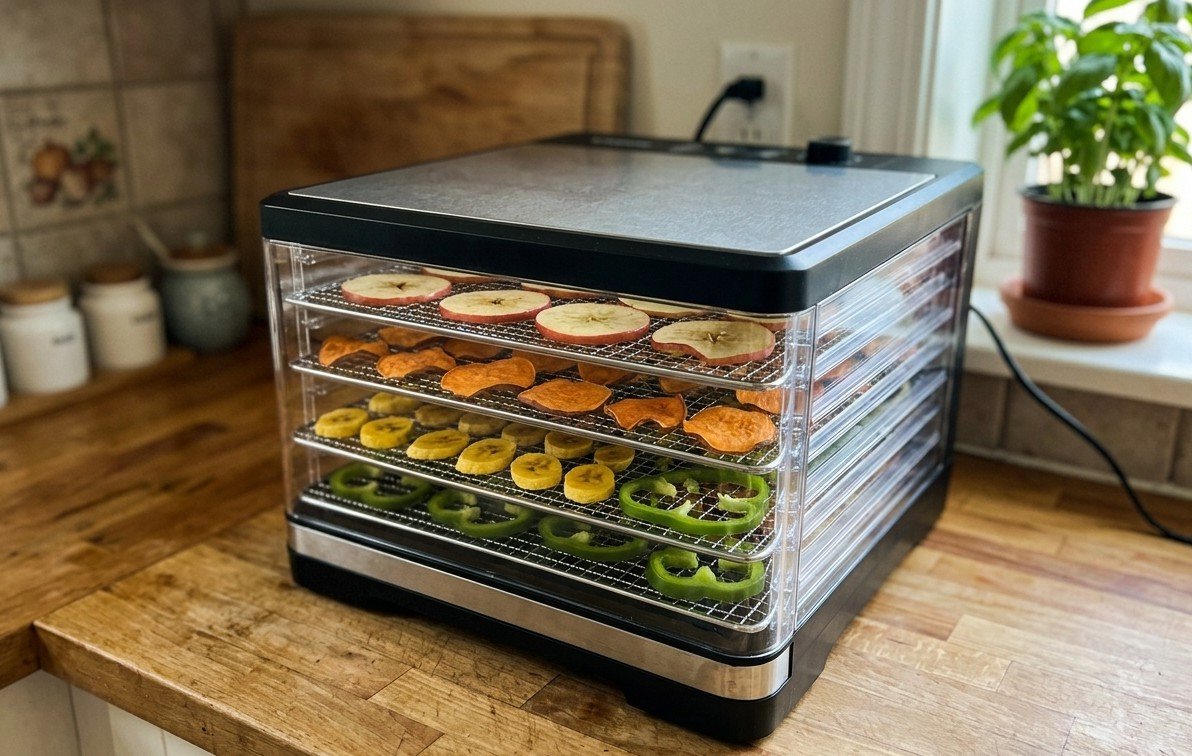
Pulling moisture out of food slowly, at a controlled low temperature, is the entire job of a food dehydrator: a benchtop appliance built around a heating element, a circulating fan, and a stack of removable trays that turns fresh fruit, vegetables, meat and herbs into a shelf-stable dried product over several hours rather than several minutes in an oven. The best food dehydrators in Australia range from compact 5-tray benchtop units through to 10-tray stainless steel models built for regular, larger batches.
Dehydrators sold locally generally fall into three build types. Stacking tray dehydrators use round, interlocking trays that airflow moves through vertically, and trays can often be added later to increase capacity. Box-style dehydrators house shelves inside a rectangular stainless steel cabinet, which tends to dry more evenly because every tray sits roughly the same distance from the fan. Commercial rack dehydrators are larger stainless steel units built around a removable hanging rack, aimed at people drying meat or produce in bulk rather than a single batch a week.
Temperature control is the specification worth checking first: most dehydrators sold here run between roughly 30C and 90C (86F and 194F). The bottom of that range suits herbs and delicate fruit that would cook rather than dry at high heat, while jerky and other meat need the top end. Tray count, wattage and how finely the temperature can be adjusted are the other three details that separate a good unit from one you will outgrow in a month.
Someone drying a bag of apple slices once a month needs a different unit to someone making jerky in bulk every week, and the seven models below span that range: three Devanti stainless steel dehydrators at different tray counts, a Devanti stainless rack unit built for larger batches, two Maxkon-style units from Crazysales, and one high-capacity stainless steel import for households that dry food often. If you also cook a lot of meat at home, our vacuum sealer guide covers the storage side once the drying is done.
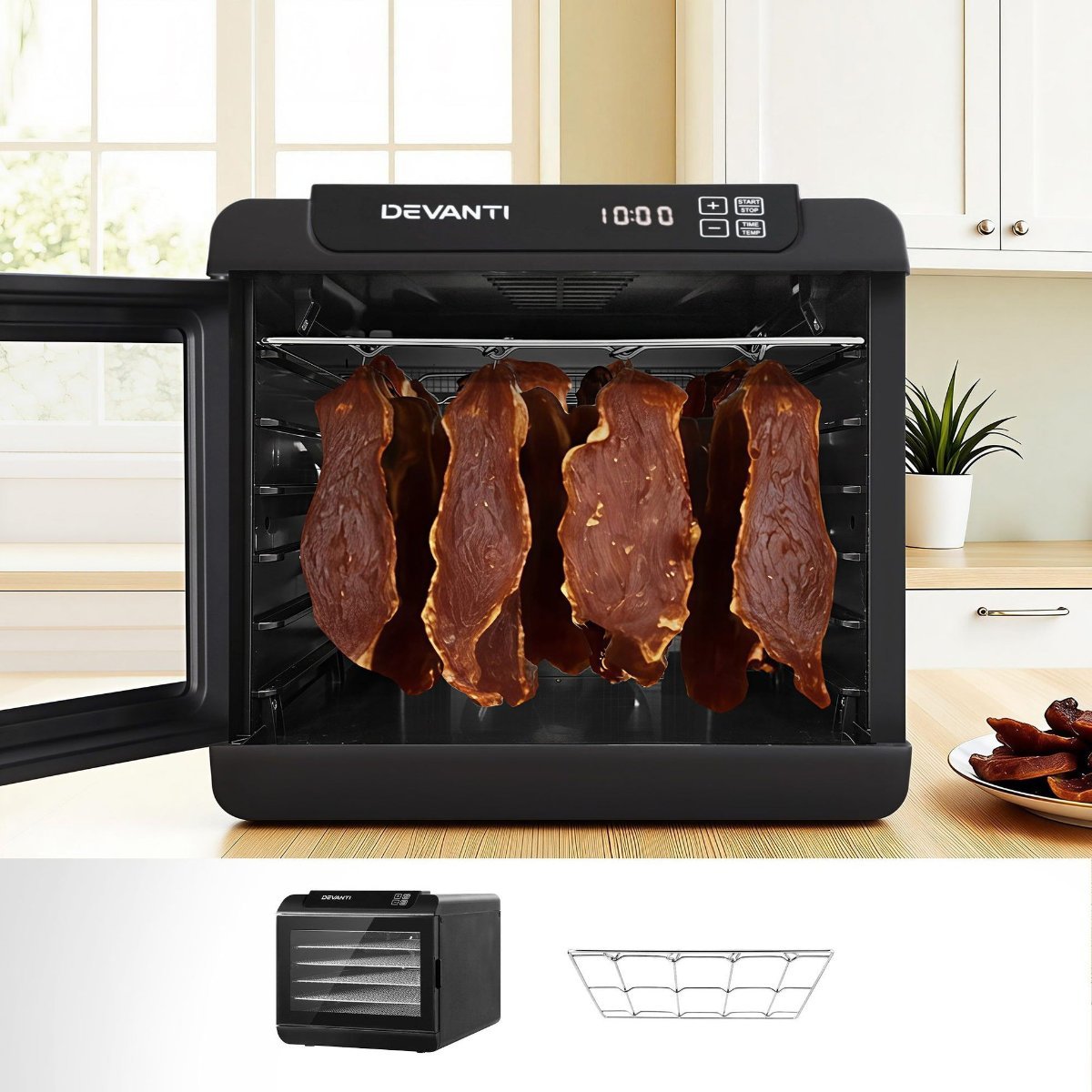
Devanti 6-Tray Stainless Steel Rack Dehydrator
A stainless steel hanging rack and a wide temperature range built for regular, larger drying batches.
CHECK CURRENT PRICE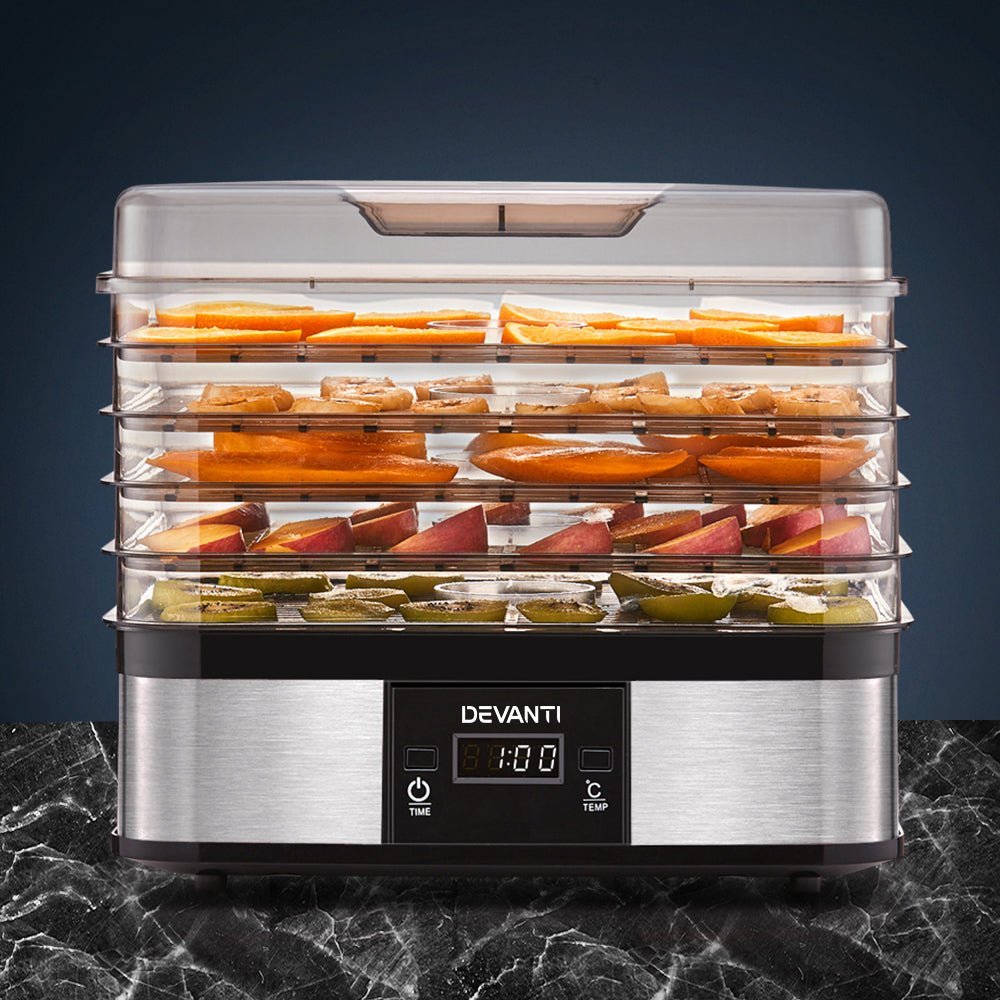
Devanti 5-Tray Food Dehydrator
The smallest footprint on this list, sized for a single household batch rather than bulk drying.
CHECK CURRENT PRICE
Maxkon 6-Tray Digital Food Dehydrator
An LED timer and digital temperature readout instead of a manual dial, for anyone who wants to set it and walk away.
CHECK CURRENT PRICEBest Food Dehydrators Australia Compared
| Product | Link | Type | Best For | Key Spec |
|---|---|---|---|---|
| Devanti 6-Tray Stainless Steel Rack | Check price | Commercial rack | Bulk batches | 420-500W, 35-70C |
| Devanti 6-Tray Stainless Steel | Check price | Box-style | Stainless build | 420-500W, 35-70C |
| Devanti 7-Tray | Check price | Stacking tray | Large families | 245W, 40-70C |
| Devanti 5-Tray | Check price | Stacking tray | Compact design | 245W, 40-70C |
| Maxkon 6-Tray Digital | Check price | Stacking tray | Digital controls | 500W, digital timer |
| 5-Tier Stackable | Check price | Stacking tray | Budget pick | Adjustable height trays |
| VEVOR 10-Tray Stainless Steel | Check price | Box-style | High-volume drying | 1000W, 30-90C, 10 trays |
1. Devanti 6-Tray Stainless Steel Rack Dehydrator – Best for Bulk Batches
The stainless steel hanging rack is what separates this unit from the rest of the list: instead of stacking trays, food hangs from hooks inside a tall cabinet, closer to how a commercial smokehouse handles volume than a benchtop appliance. The cabinet holds six full-size stainless shelves as well, so hanging and flat drying can run in the same load.
At 420-500W it draws noticeably more power than the smaller Devanti units on this list, and the trade-off is a wider even-heat zone across a taller cabinet rather than a narrower stack of trays. The digital touch panel runs from 35C to 70C with a timer up to 19.5 hours, enough range for jerky at the top end and herbs near the bottom.
Bench space is the real cost here: this is a floor-standing or dedicated-shelf unit, not something tucked away in a cupboard between uses. Anyone drying meat or home-garden produce in real volume gets more out of the rack design than the flat trays below it, but a household drying the occasional punnet of strawberries will find the smaller Devanti units easier to live with.
Pros
- Stainless steel hanging rack suits bulk jerky and larger cuts
- Six full shelves plus rack space in one cabinet
- Digital touch control with a 19.5-hour timer ceiling
Cons
- Higher running wattage than the smaller units on this list
- Takes up more permanent bench or floor space
Key specs: 6 shelves plus hanging rack, 420-500W, 35-70C, timer to 19.5 hours
CHECK CURRENT PRICE2. Devanti 6-Tray Stainless Steel – Best Stainless Steel Build
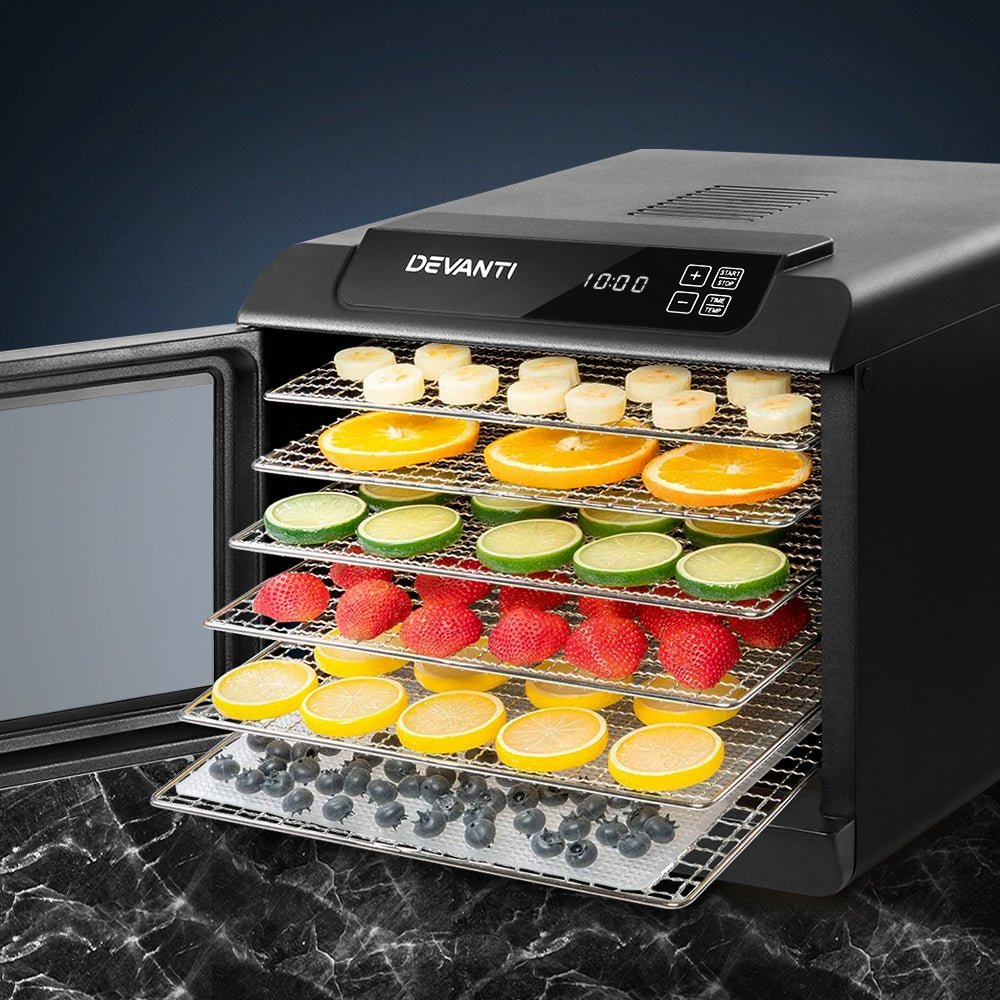
Stainless steel casing rather than the plastic housing used on the cheaper Devanti trays is the main upgrade here, paired with a transparent front door so a batch can be checked without opening it and losing heat. Six removable trays sit inside, each rated to take about a kilogram of food.
The 420-500W motor and 35-70C range mirror the rack unit above at a fraction of the price and footprint, and the timer runs from half an hour up to 19.5 hours on the same LCD touch panel. Trays are dishwasher safe, which matters more on this model than the plastic ones since food residue on stainless does not wipe off as easily.
This sits in the middle of the range: more durable than the plastic-tray Devanti models below, but without the rack unit’s hanging capacity for bulk jerky. A household making dried fruit, vegetable chips or the odd batch of jerky on a semi-regular basis is the target buyer, rather than someone drying a single punnet a year or running a small production line.
Pros
- Stainless steel casing and transparent front door
- Same 35-70C range and touch panel as the rack unit at less than half the price
- Dishwasher-safe trays
Cons
- Six trays is less capacity than the rack unit above
- Stainless build costs more than the plastic-tray Devanti models below
Key specs: 6 trays, 420-500W, 35-70C, timer to 19.5 hours
CHECK CURRENT PRICE3. Devanti 7-Tray Food Dehydrator – Best for Large Families
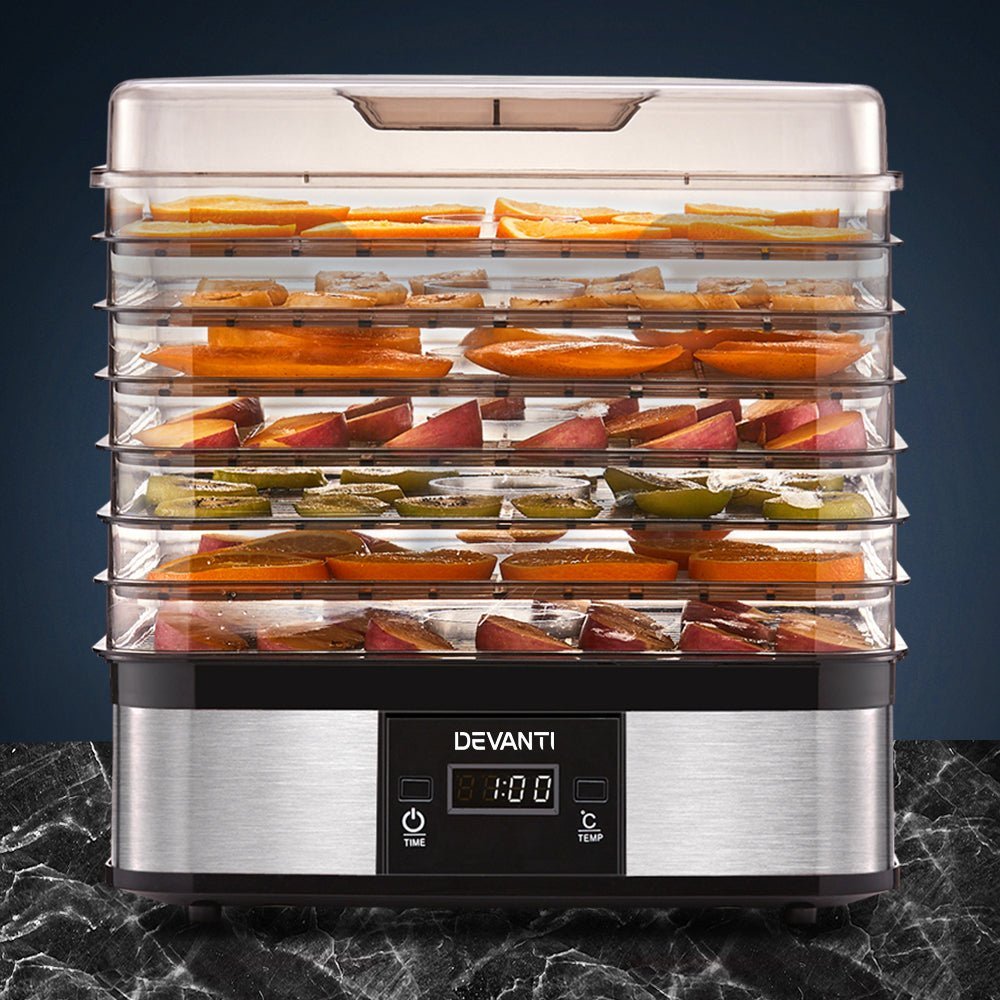
Seven food-grade trays give this the largest single-load capacity of the plastic-tray Devanti models, with a built-in handle on the housing that the 5 and 6 tray versions do not carry. Each tray still holds roughly a kilogram, so a full load runs to around seven kilograms of fresh produce before drying.
Power draw is lower than the stainless models at 245W, and the temperature band is narrower too, running 40C to 70C rather than down to 35C. The timer stretches to a generous 48 hours, useful for thicker cuts of meat or a very slow low-temperature dry.
The extra trays make sense for a household putting through fruit, vegetables or jerky regularly enough that five trays would mean running the machine twice. Anyone drying delicate herbs that need the lower 35C setting on the stainless models should look at the 5 or 6 tray Devanti instead, since 40C is as low as this one goes.
Pros
- Seven trays for the largest single load among the benchtop Devanti models
- 48-hour timer ceiling, well beyond the stainless units
- Lower running wattage at 245W
Cons
- Minimum temperature is 40C, too high for some delicate herb drying
- Plastic tray housing rather than stainless steel
Key specs: 7 trays, 245W, 40-70C, timer to 48 hours
CHECK CURRENT PRICE4. Devanti 5-Tray Food Dehydrator – Best Compact Design
Five trays and the smallest footprint on this list make this the one to buy if bench space or cupboard storage is tight. The transparent lid sits directly on top of the tray stack rather than behind a hinged door, keeping the overall height down.
It shares the 245W motor and 40-70C range with the 7-tray version above it, along with the same 48-hour timer ceiling, so drying performance does not drop just because the unit is smaller. The trade is capacity: five trays hold roughly five kilograms rather than seven.
This is the sensible starting point for anyone who has not dehydrated food before and does not want to commit bench space to something used once a month. Once a household is regularly running full loads, the 7-tray version above becomes the better buy for the same running cost.
Pros
- Smallest footprint on this list
- Same 245W motor, 40-70C range and 48-hour timer as the larger 7-tray model
- Lower upfront cost than every other entry except the budget stackable below
Cons
- Five trays fills up quickly with a large batch
- 40C minimum temperature, not the lowest on this list
Key specs: 5 trays, 245W, 40-70C, timer to 48 hours
CHECK CURRENT PRICE5. Maxkon 6-Tray Digital Food Dehydrator – Best Digital Controls
An LED display and digital button controls replace the dial-style thermostat on the Devanti units, making it easier to set an exact temperature and timer at a glance rather than judging a dial position. Six trays are included, each removable for cleaning.
500W puts it at the higher end of the wattage range for a benchtop unit this size, and Maxkon rates it for fruit, vegetables, herbs, meat jerky and pet treats. The digital timer and temperature readout is the main functional difference from the Devanti range rather than a difference in drying performance.
Anyone who finds an analogue dial fiddly to read, especially in a kitchen without great lighting near the appliance, gets more day-to-day use out of the digital panel here than out of the Devanti dial. It does not out-perform the Devanti units on temperature range or timer length, it just makes setting them easier.
Pros
- LED digital display and button controls instead of a dial
- Six removable trays rated for meat, fruit, vegetables and pet treats
- Straightforward to read and set at a glance
Cons
- 500W running cost is higher than the smaller Devanti units
- No published temperature range as precise as the Devanti spec sheet
Key specs: 6 trays, 500W, digital timer and temperature display
CHECK CURRENT PRICE6. 5-Tier Stackable Food Dehydrator – Best Budget Pick
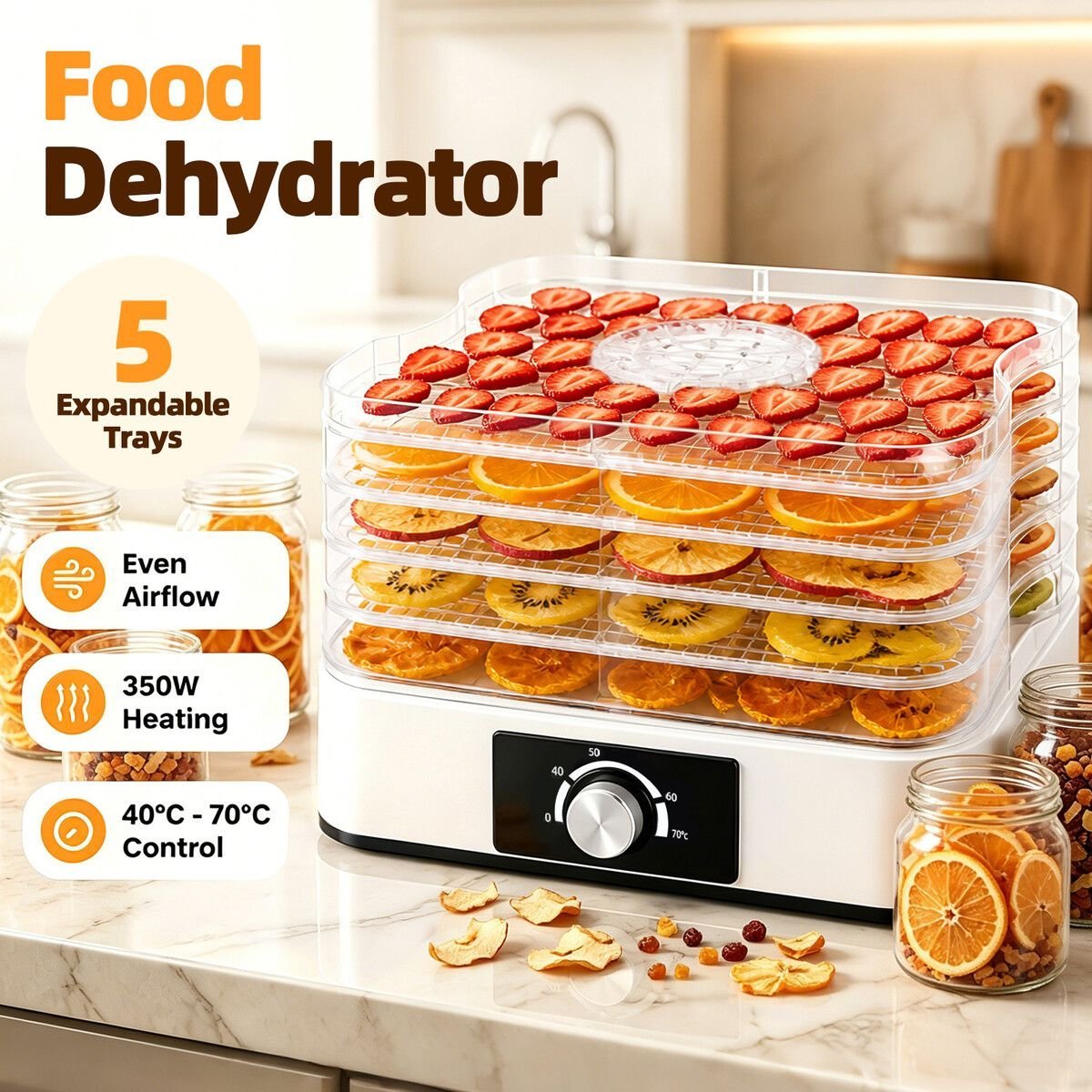
This is the cheapest unit on the list, built around five stackable tiers with adjustable height rather than a fixed tray spacing, so taller items like whole mushrooms or thick jerky strips can get extra clearance between trays.
Adjustable tray height is the standout feature against the fixed-spacing Devanti and Maxkon units above, though the trade-off is a lighter-duty build overall at this price point. It covers the same core use cases: fruit, herbs, meat jerky and vegetables.
Buyers testing whether dehydrating is something they will actually keep doing, rather than committing to a stainless steel unit up front, are better served by this than by any other entry here. Someone who already knows they will run it weekly should skip straight to the 5 or 7 tray Devanti instead, since the running cost difference is small next to the durability gap.
Pros
- Lowest price on this list
- Adjustable tray height for taller items
- Covers the same core drying uses as the pricier units
Cons
- Lighter-duty build than the stainless steel options
- No digital display, temperature is dial-controlled
Key specs: 5 tiers, adjustable height trays, electric temperature control
CHECK CURRENT PRICE7. VEVOR 10-Tray Stainless Steel Food Dehydrator – Best for High-Volume Drying
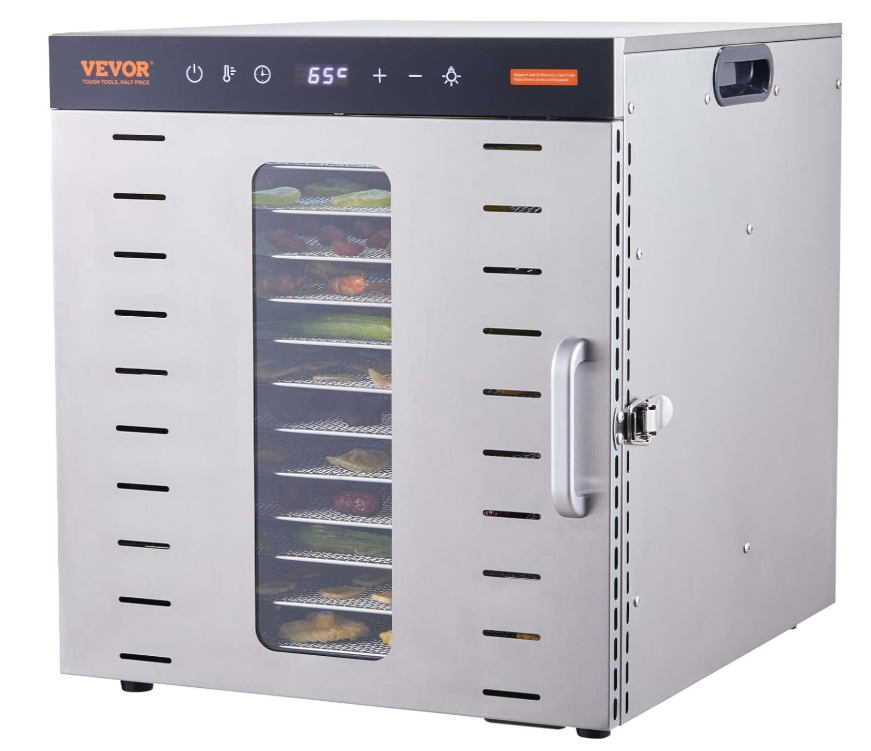
Ten stainless steel trays and a 1000W motor put this ahead of every other entry on raw capacity, with each tray measuring 37 by 28 centimetres and rated to hold close to a kilogram, for a full load approaching ten kilograms of fresh food.
The temperature band runs the widest of any unit here, from 30C to 90C, with a timer adjustable from half an hour out to 48 hours. A rear-mounted fan drives 360-degree air circulation through the stack rather than relying on convection alone, and a built-in LED light lets you check progress without opening the door.
No Commission Factory merchant in this sweep stocks a 10-tray, 1000W unit at a comparable price, which is the specific gap this fills rather than a general recommendation to buy on Amazon first. It suits a household or small operation drying meat, fruit or vegetables often enough that the rack unit above would still mean running two loads.
Pros
- Ten stainless steel trays, the largest capacity on this list
- Widest temperature range at 30-90C
- 360-degree air circulation with a viewing light
Cons
- Amazon’s 24-hour cookie against a 30-day Commission Factory cookie elsewhere on this list
- Largest physical footprint of any unit here
Key specs: 10 trays, 1000W, 30-90C, timer to 48 hours
CHECK ON AMAZONHow to Choose a Food Dehydrator
Tray count and capacity decide how much you can dry in one run, and it is worth sizing this to a real batch rather than the largest number available. Five trays covers a typical household punnet-of-fruit or one batch of jerky, seven to ten trays suits someone processing a home garden glut or making jerky in bulk, and anything built around a hanging rack is aimed at genuinely commercial-style volume.
Temperature range matters more than most buyers expect before their first batch. Herbs and delicate fruit dry best around 35C to 40C, low enough that they do not cook, while meat needs to run at the top of a unit’s range, typically 65C to 90C, for food safety. A dehydrator that bottoms out at 40C, like several models on this list, simply cannot do a gentle herb dry.
Material splits into plastic-tray and stainless steel builds. Plastic trays are lighter and cheaper but pick up staining and odour from strong-smelling foods like garlic or chilli over time. Stainless steel costs more upfront and adds weight, but wipes clean and holds up better to repeated dishwasher cycles.
Digital versus dial controls is mostly a convenience question rather than a performance one. A digital panel shows the exact temperature and remaining time at a glance, which helps when a recipe calls for a specific setting, while a dial is simpler to operate but harder to read precisely in low kitchen light.
Timer length and auto shut-off protect against a batch drying too long or a forgotten unit running overnight. Look for at least 24 hours on the timer if you plan to dry meat, since thicker cuts can take that long, and confirm the unit actually shuts off at zero rather than needing to be switched off manually.
Noise and running cost come down to wattage and hours run rather than the appliance itself. A 250W unit running for eight hours draws a small fraction of what an oven left on for the same stretch would use, though a 1000W unit narrows that gap. If dehydrating is one part of a bigger home food-prep routine, our food processor guide covers the appliance most people reach for before the drying stage, for chopping and shredding produce down to a consistent size first.
Frequently Asked Questions
What temperature should I use for a food dehydrator?
Set it to match what you are drying rather than using one temperature for everything. Herbs and delicate fruit dry best around 35C to 40C, general fruit and vegetables sit around 50C to 60C, and meat for jerky needs the top of the unit’s range, usually 65C to 90C, both for texture and food safety.
How long does it take to dehydrate fruit or jerky?
Fruit slices typically take 6 to 12 hours depending on thickness and water content, while jerky usually needs 4 to 8 hours at a higher temperature. Herbs are the fastest, often done in 1 to 4 hours. A unit with a timer that runs to at least 24 hours gives enough headroom for thicker cuts.
Do food dehydrators use a lot of electricity?
Most benchtop units draw between 245W and 500W, similar to a countertop fan heater on a low setting, though some higher-capacity models reach 1000W. Because they run at a steady low temperature rather than cycling a full oven, an eight-hour drying run generally costs a small fraction of leaving an oven on for the same time.
What is the difference between a stacking-tray and a stainless steel rack dehydrator?
A stacking-tray unit holds food flat on removable trays that sit one above the other, and is the more common benchtop design. A rack dehydrator hangs food from hooks inside a taller cabinet, which suits bulk jerky or larger cuts better than flat trays do, at the cost of more bench or floor space.
Is it safe to dehydrate meat at home?
Meat needs to reach a safe internal temperature during the drying process, so most manufacturers recommend running jerky at the top of the appliance’s temperature range rather than the middle. Check the instructions for your specific model, since safe timing and temperature vary with the cut and thickness of the meat.
Are dehydrator trays dishwasher safe?
Stainless steel trays are generally dishwasher safe, which most manufacturers confirm in the product specifications. Plastic trays are more often hand-wash only or top-rack safe, since repeated dishwasher heat can warp thinner plastic over time, so it is worth checking the specific model rather than assuming.
Verdict
For anyone drying food regularly enough to justify a stainless steel build, the Devanti 6-Tray Stainless Steel Dehydrator from GoodBuyz covers most households without the bench space the rack unit needs. Someone processing meat or produce in real volume is better served by the Devanti Stainless Steel Rack Dehydrator, and its hanging capacity is the only way on this list to dry large cuts rather than flat slices. For the widest single-unit capacity, the VEVOR 10-Tray reaches further than any Commission Factory stock in this category currently allows, at the cost of the largest footprint here.