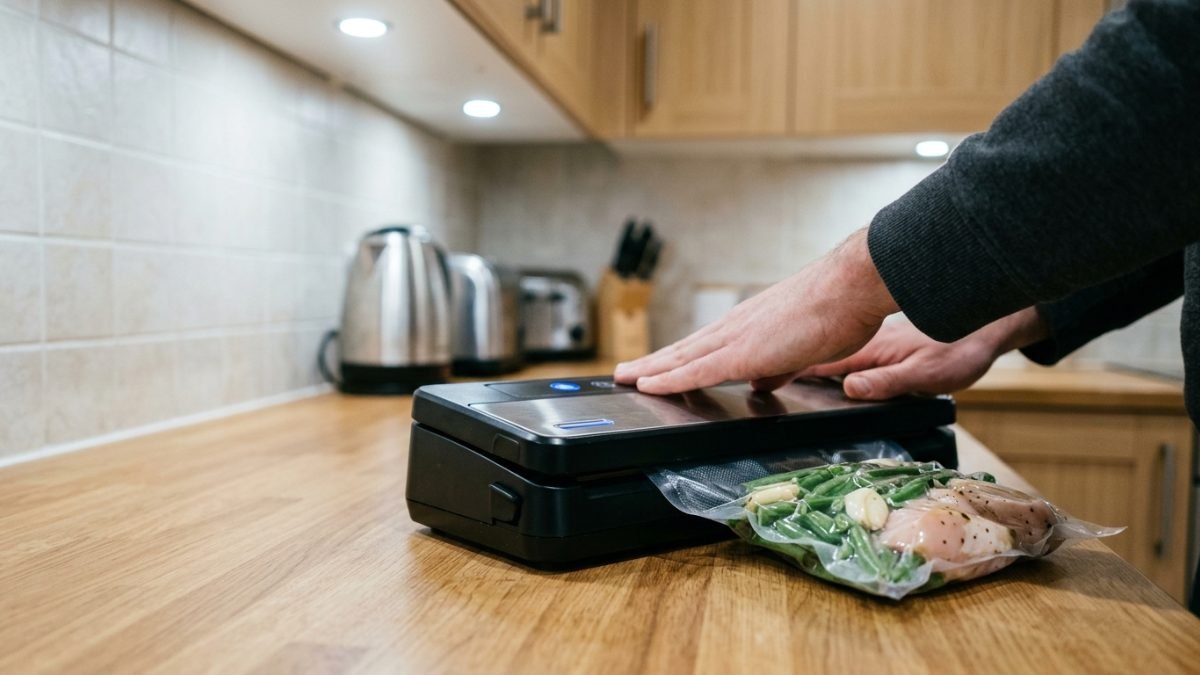
The best vacuum sealer in Australia is the one that copes with wet food, because that is where most machines fail. A vacuum sealer draws air out of a plastic bag and then fuses the open end shut against a heated strip. Removing the air slows the oxidation and freezer burn that spoil food, and that is what extends storage life rather than the seal on its own.
A sealer earns its place in a kitchen on the days nobody is cooking. External suction machines clamp the open end of a bag and pull air out through it, which covers dry and lightly moist food and accounts for most of this list. Chamber machines enclose the whole bag inside a sealed box and evacuate that instead, which is the only design that seals soup or sauce directly. Handheld sealers run on a battery and work with valved reusable bags for everyday leftovers. Jar and canister attachments draw air out of rigid vessels through a hose rather than sealing a bag at all.
Bag width is the specification that quietly limits everything else. A common bench machine takes bags up to 30 cm across, a little under 12 inches, and a wider bag will not fit the seal bar no matter how strong the pump is. Past width, three things decide the result: suction measured in kilopascals, whether there is a moist setting that lengthens the heat time, and whether the machine can seal repeatedly without stopping to cool.
Sealing a litre of soup is the test that sorted this list, and most of the shortlist could not do it. Ten machines remain, grouped so the three that share one bag standard and one 110 W motor sit together, followed by the chamber and external units that each answer a narrower problem.
Quick Picks
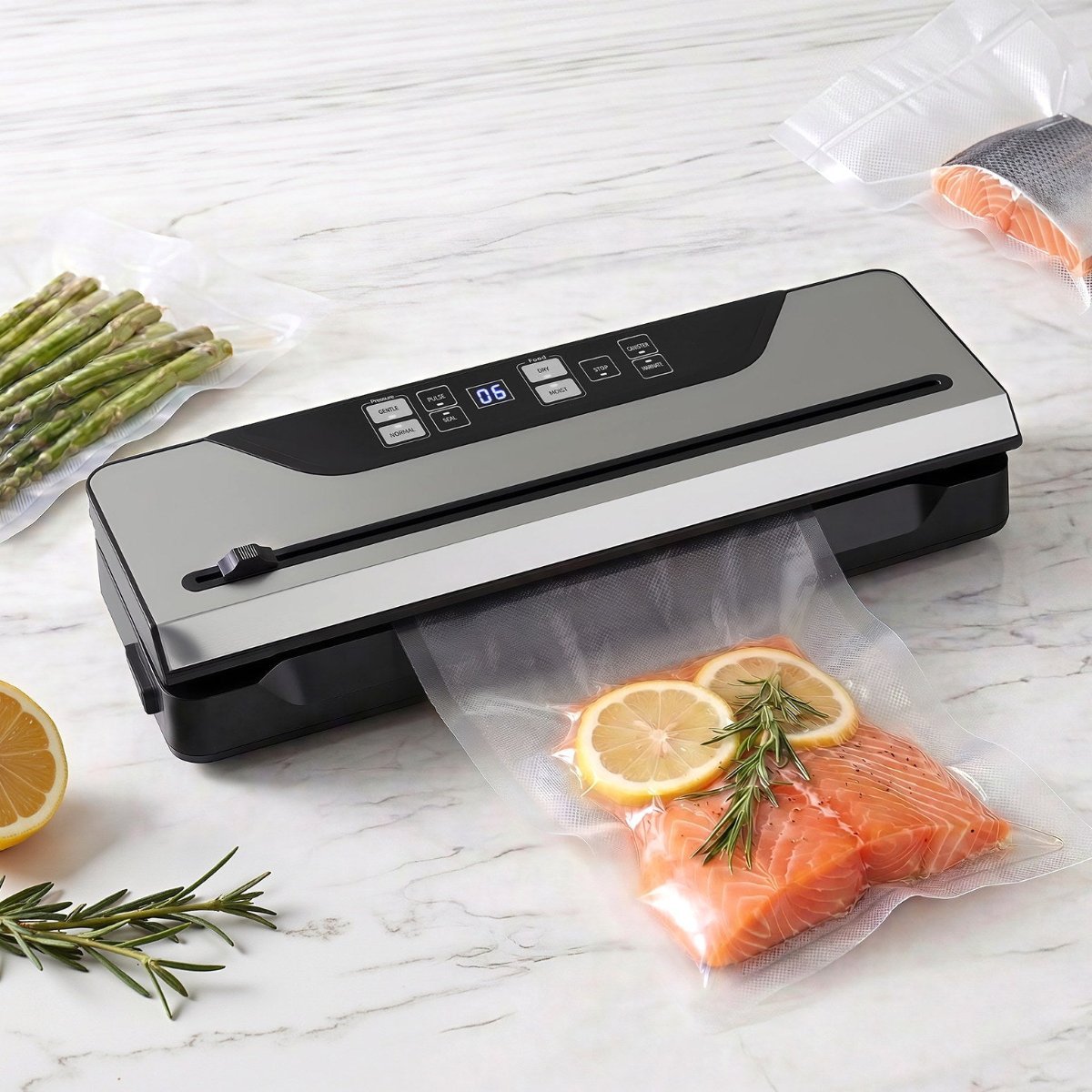
Devanti 9-Mode Marinate Sealer
Nine auto modes, a marinate cycle and the widest sealing bar of the three.
CHECK CURRENT PRICE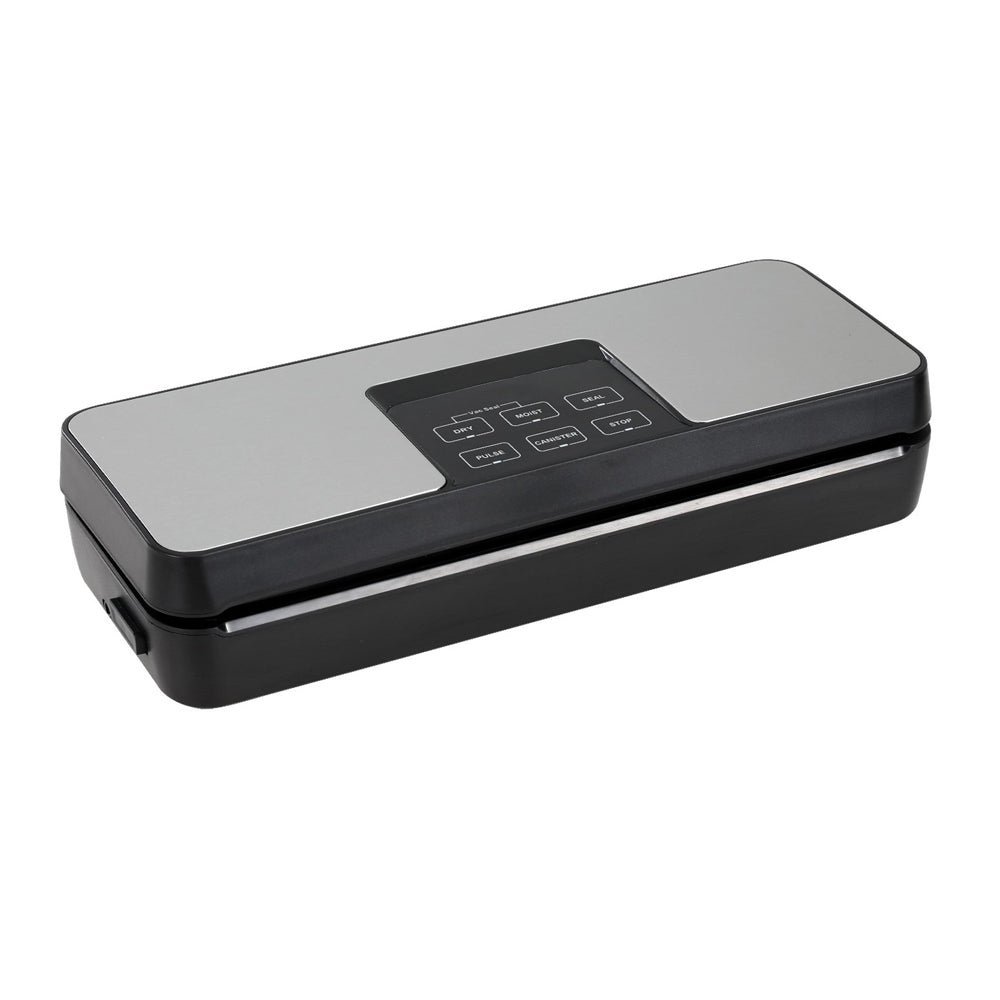
Devanti Wet and Dry Sealer
80 kPa handles damp food that weaker external machines leak on.
CHECK CURRENT PRICE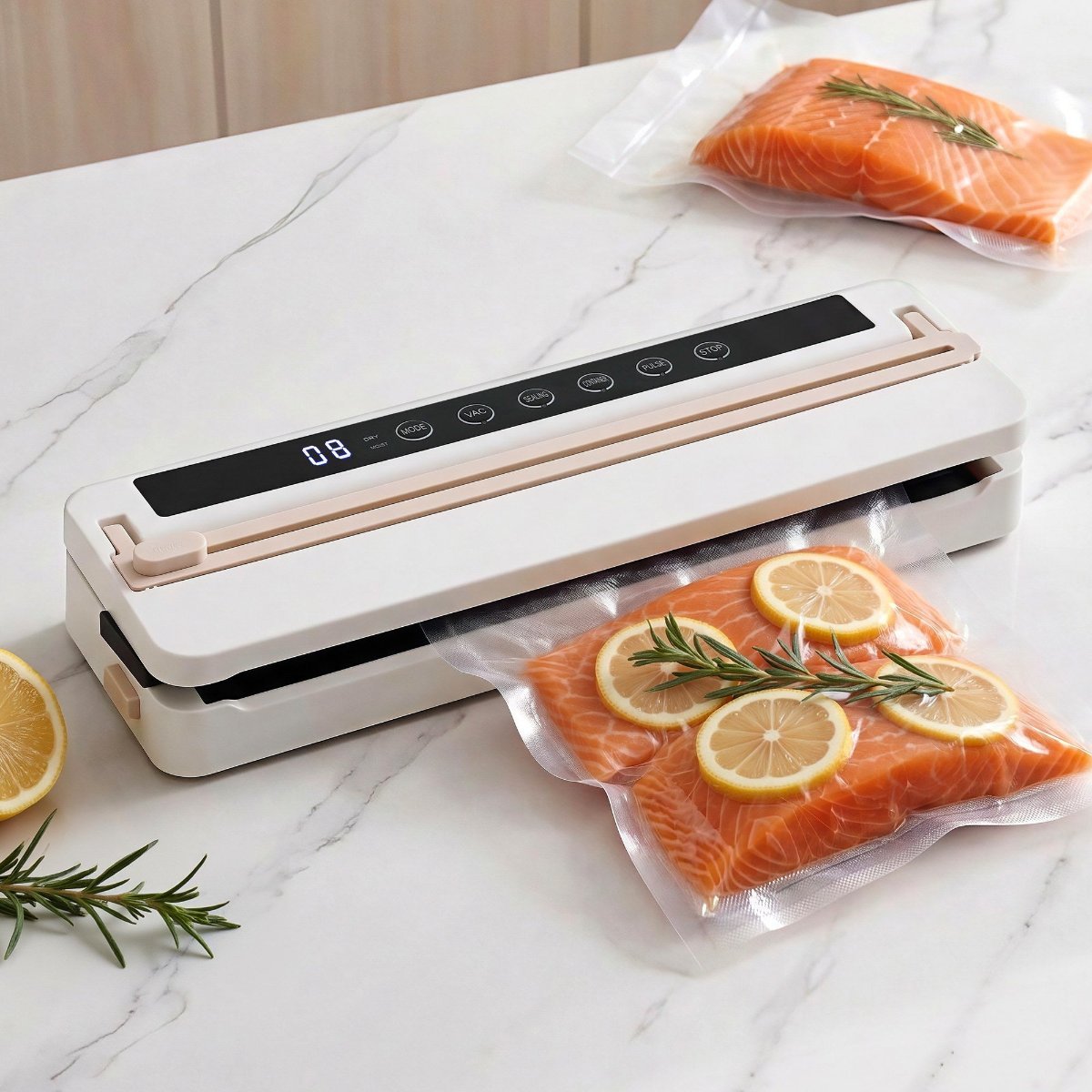
Devanti 6-Mode Sealer
Six modes, a built-in cutter and a canister hose, with nothing surplus.
CHECK CURRENT PRICEBest Vacuum Sealers in Australia Compared
| Product | Link | Type | Best For | Key Spec |
|---|---|---|---|---|
| Devanti 9-Mode Marinate Sealer | Check price | External | Marinating meat | 70 kPa, 32 cm bar |
| Devanti Wet and Dry Sealer | Check price | External | Damp food | 80 kPa |
| Devanti 6-Mode Sealer | Check price | External | Dry goods | 60 kPa, 0.97 kg |
| Vacmaster VP230 Chamber Vacuum Sealer | Check price | Chamber | Soups and sauces | 12.25 inch seal bar |
| Wevac Stainless Vacuum Sealer | Check price | External | Heavy use | 95 kPa stainless |
| INKBIRD Vacuum Food Sealer | Check price | External | Wide portions | 12 inch bag width |
| Russell Hobbs Seal Fresh | Check price | External | Sous vide | 2 rolls, 28 cm x 3 m |
| 10Modes B629 Vacuum Sealer | Check price | External | Bulk sessions | 12 mm double heat strip |
| FoodSaver Wireless Handheld | Check price | Handheld | Leftovers | 100 seals per charge |
| GIRAFFYCO Handheld Sealer Set | Check price | Handheld | Reusable bags | 30 bags in 3 sizes |
1. Devanti 9-Mode Marinate Sealer – Best for Marinating
A 32 cm sealing bar makes this the widest of the three machines sharing this motor, and the extra two centimetres matter when a whole fillet has to lie flat. Nine auto modes cover dry through to moist, with adjustable vacuum pressure on top of them. An LED timer, touch controls and a built-in cutter sit along the front edge.
The marinate cycle is the reason to choose it: the machine pulls a vacuum, holds it so the marinade is driven into the meat, then releases and repeats. Suction reaches 70 kPa, which is enough for damp food though not for a filled liquid bag. Ten bags and an external tube for canisters, zipper bags and wine stoppers come in the box.
Adjustable pressure adds a setting most people will leave alone, and nine modes is more choice than a weeknight needs. Against that, it is the only machine at this level here with a genuine marinate function. Anyone who cooks meat in a marinade regularly will use it more than the mode count suggests.
Pros
- Widest sealing bar of the three at 32 cm
- Genuine marinate cycle, not just a moist mode
- Nine auto modes with adjustable vacuum pressure
- Built-in cutter and LED timer display
- Includes 10 bags and a canister hose
Cons
- 70 kPa is below the sibling model
- Nine modes is more than most cooking needs
- Cannot seal a filled liquid bag
Key specs: External suction, 110 W, 70 kPa, 9 auto modes plus marinate, adjustable vacuum pressure, 32 cm sealing bar, built-in cutter, LED timer and touch controls, includes 10 bags and an external tube for canisters, zipper bags and wine stoppers.
CHECK CURRENT PRICE2. Devanti Wet and Dry Sealer – Best for Wet Food
Suction here reaches 80 kPa, the strongest of the three machines built on this 110 W motor and higher than several of the larger units further down. Five modes cover wet, dry, canister and plain sealing, with both automatic and manual operation. The sealing bar is 30 cm and the cutter is built in.
Extra suction is what keeps a seal intact on food that carries moisture, which is the failure most external machines share. Manual mode is the useful part, letting the vacuum be stopped by hand before it crushes something soft like bread or berries. Fewer modes than its sibling, and none of them wasted.
There is no marinate cycle and no adjustable pressure, so it trades features for pull. It also costs slightly more than the nine-mode unit above despite offering less on paper. For anyone sealing meat and fish rather than dry goods, the stronger vacuum is the better purchase.
Pros
- Strongest suction of the three at 80 kPa
- Manual mode stops the vacuum crushing soft food
- Handles wet, dry and canister sealing
- Built-in cutter for custom bag sizes
- Includes 10 bags and a vacuum tube
Cons
- No marinate function
- No adjustable vacuum pressure
- Narrower bar than the nine-mode unit
Key specs: External suction, 110 W, 80 kPa, 5 modes covering wet, dry, canister and seal, automatic and manual operation, 30 cm sealing bar, built-in cutter, smart touch control, includes 10 bags and a canister tube.
CHECK CURRENT PRICE3. Devanti 6-Mode Sealer – Best Entry-Level Bench Sealer
At 36.5 by 11 by 5 cm and 0.97 kg this is small enough to live in a drawer rather than on a bench, which changes how often it gets used. Six auto modes run behind an LED timer and touch controls. The 30 cm bar and built-in cutter match the model above it.
Suction sits at 60 kPa, the lowest of the three, and that shows on anything wet where the seal has less margin. On dry goods, coffee, nuts, rice and portioned bread it performs identically to its more expensive siblings. The VAC function drives canisters, zipper bags and wine stoppers through the supplied tube.
Buying the cheapest of three near-identical machines only makes sense if the food going into it is dry, and that describes a lot of household sealing. Anyone who will seal raw meat should move up to the 80 kPa unit. As a first bench sealer it is hard to fault on what it actually does.
Pros
- Compact at 0.97 kg and 5 cm tall
- Six auto modes with LED timer
- 30 cm bar and built-in cutter
- Canister, zipper bag and wine stopper functions
- Lowest cost of entry to a bench machine here
Cons
- Lowest suction of the three at 60 kPa
- Struggles on genuinely wet food
- No marinate or manual mode
Key specs: External suction, 110 W, 60 kPa, 6 auto modes, 30 cm sealing bar, built-in cutter, LED timer and touch control, VAC function for canisters and wine stoppers, 36.5 x 11 x 5 cm, 0.97 kg, includes 10 bags and a tube.
CHECK CURRENT PRICE4. Vacmaster VP230 Chamber Vacuum Sealer – Best for Sealing Liquids
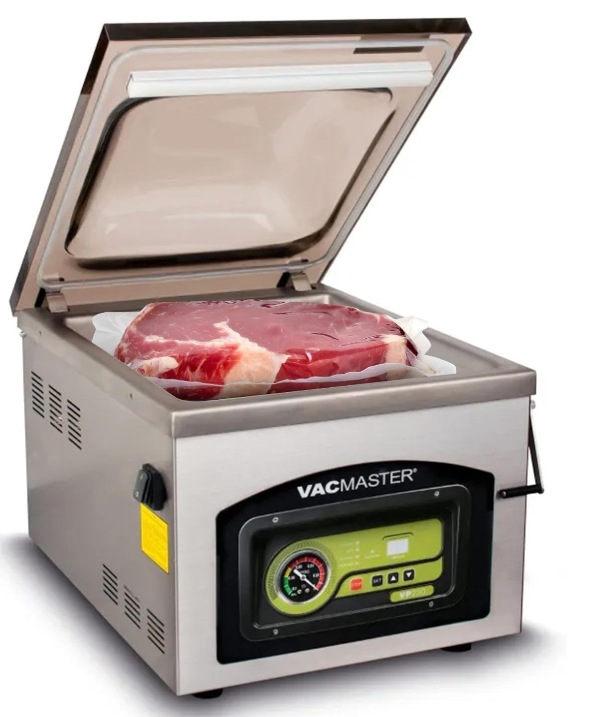
This is a chamber machine, which means the bag sits inside a sealed box measuring 12.5 by 15 by 5 inches and the air is drawn out of the chamber rather than through the bag. The seal bar runs 12.25 inches and takes bags up to 12 inches wide. Overall it occupies 15.5 by 19 by 15.75 inches of bench.
Because pressure equalises around the bag instead of pulling through its opening, soup, sauce and marinade seal without being drawn towards the pump. A double seal lays two parallel welds for redundancy on anything destined for long storage. It also handles heavier 3 to 7 MIL Mylar bags that external machines cannot pull flat.
Size and outlay are both in a different class from everything else here, and this is an appliance rather than a gadget. Nothing else on this list will seal a filled liquid bag, though, which for some kitchens is the only specification that matters. Sous vide cooks and anyone portioning stock are the buyers.
Pros
- The only machine here that seals filled liquid bags
- Double seal lays two parallel welds
- Handles 3 to 7 MIL Mylar bags
- 12.25 inch seal bar
- Built for continuous use
Cons
- Takes substantial bench space
- Highest outlay in this guide
- Chamber bags cost more than rolls
Key specs: Chamber vacuum sealer, chamber 12.5 x 15 x 5 inches, overall 15.5 x 19 x 15.75 inches, 12.25 inch seal bar, maximum bag width 12 inches, double seal system, compatible with 3 to 7 MIL Mylar bags.
CHECK ON AMAZON5. Wevac Stainless Vacuum Sealer – Best Build Quality
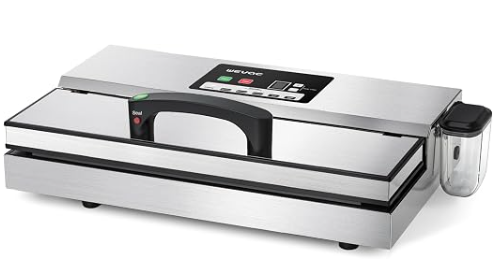
A stainless steel housing separates this from the moulded plastic used almost everywhere else in this guide, and at 54 by 26.2 by 14.2 cm it is the longest external machine here. Suction is rated 95 kPa, the highest figure on the list. Operation is semi-automatic over a corded supply.
That 95 kPa pulls a bag flatter than any other external unit, which shows on irregular shapes like bone-in cuts where air tends to pocket. The metal body also sheds heat better, so it tolerates a longer run of bags before needing a pause. It remains an external machine, so a filled liquid bag is still out of reach.
The length is the practical objection, since it needs a clear stretch of bench rather than a corner. Documentation is thin compared with the mainstream brands. Anyone sealing in volume every week, rather than occasionally, gets the most from the metal construction.
Pros
- Highest external suction here at 95 kPa
- Stainless steel housing rather than plastic
- Sheds heat well for longer sealing runs
- Pulls irregular shapes flat
- Semi-automatic operation
Cons
- Longest external machine here at 54 cm
- Sparse documentation
- Still cannot seal a filled liquid bag
Key specs: External suction, 95 kPa, stainless steel housing, 54 x 26.2 x 14.2 cm, semi-automatic operation, corded electric.
CHECK ON AMAZON6. INKBIRD Vacuum Food Sealer – Best for Wide Bags
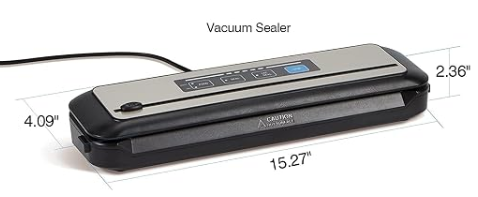
Bags and rolls up to 12 inches wide fit this one, which is the widest an external machine on this list accepts. A built-in cutter sizes the bag off the roll, and the vacuum cover lifts away for cleaning rather than needing to be wiped in place. The starter kit includes five 8 by 12 inch bags, a roll measuring 8 by 79 inches and an air suction hose.
Taking the full 12 inch width means a whole rack of ribs or a large fish lies flat instead of being cut down first, which is the practical difference in a busy kitchen. The lift-off cover matters more than it sounds, since spilled liquid is the usual cause of a machine failing. A twelve month warranty applies.
It is a plainly built machine without the mode count of the Devanti units. Anyone regularly sealing large single portions rather than many small ones should weigh the width above the feature list. The included hose covers canisters and zip bags.
Pros
- Accepts bags and rolls up to 12 inches wide
- Vacuum cover lifts off for cleaning
- Built-in cutter for custom bag sizes
- Starter kit with bags, roll and hose
- Twelve month warranty
Cons
- Fewer modes than the Devanti machines
- Plain build and presentation
- No marinate cycle
Key specs: External suction, accepts bags and rolls to 12 inch width, built-in cutter, lift-up vacuum cover, includes air suction hose, five 8 x 12 inch bags and one 8 x 79 inch roll, twelve month warranty.
CHECK ON AMAZON7. Russell Hobbs Seal Fresh – Best for Sous Vide
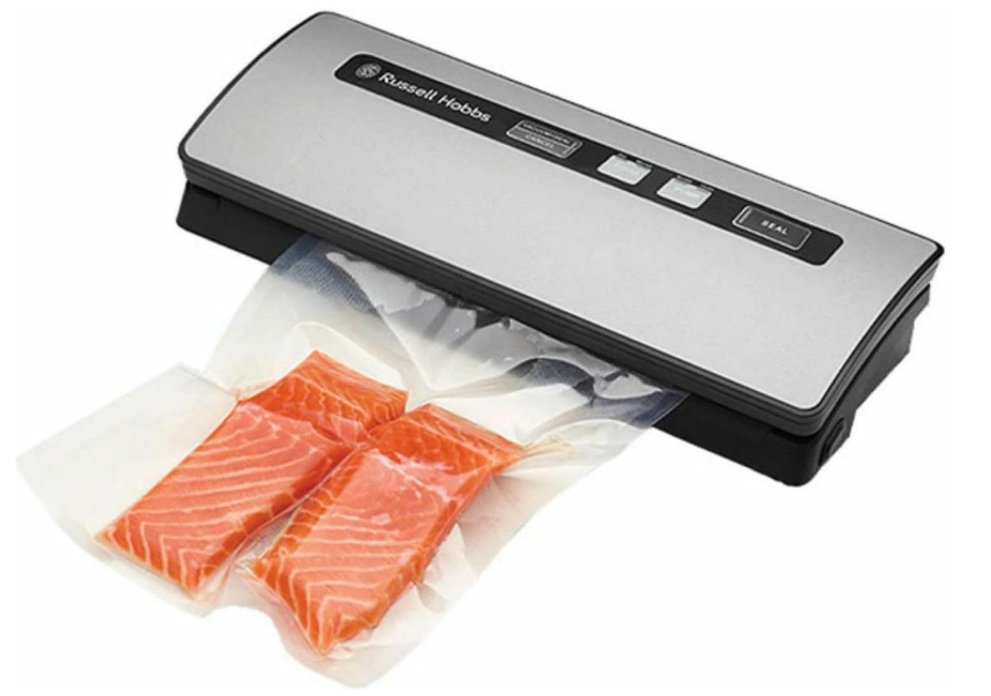
One button drives the whole cycle here, vacuum then seal, with a separate food type selector that switches between dry and moist. Two rolls measuring 28 cm by 3 m come with it, so it is usable straight out of the box. The body is compact and upright.
Sous vide is where it earns the label, since the bags are rated for the water bath and the moist setting gives the seal the extra heat time a marinated cut needs. As a general purpose sealer it is unremarkable but consistent. The single button is genuinely quicker than choosing between nine modes.
The 28 cm roll width is narrower than the 12 inch machines above, so a large flat cut may need trimming. Being a mainstream brand, replacement rolls are easy to find locally, which is not true of every machine here. Anyone cooking sous vide regularly should shortlist it first.
Pros
- One touch vacuum and seal
- Dry and moist food selector
- Bags rated for sous vide water baths
- Includes two 28 cm x 3 m rolls
- Replacement rolls easy to source locally
Cons
- 28 cm width narrower than the 12 inch units
- No marinate cycle
- Unremarkable as a general sealer
Key specs: External suction, one touch automatic vacuum and seal, dry and moist food selection, sous vide compatible bags, includes two rolls of 28 cm x 3 m.
CHECK ON AMAZON8. 10Modes B629 Vacuum Sealer – Best for Continuous Sealing
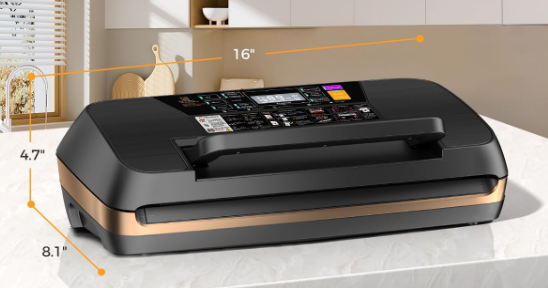
A patented one-hand handle locks the lid, so the machine can be operated while the other hand holds the bag. The heating element is a 12 mm widened double strip that lays two welds at once. Bag roll storage and a cutter are built into the body, with a countdown display on top.
An integrated cooling system is the specification that matters: it drops the heating wire temperature fast enough to seal bag after bag without the pause every other external machine here needs. Ten pre-cut bags are supplied as a starter kit. Double sealing is claimed to hold freshness up to eight times longer.
The brand carries no reputation to fall back on, and support would be a question if something failed. For anyone breaking down a whole carton of meat in one session, continuous sealing is worth more than a familiar name. Occasional users will never reach its limit.
Pros
- Integrated cooling allows continuous sealing
- 12 mm double heating strip lays two welds
- One-hand lid locking handle
- Built-in roll storage and cutter
- Countdown display shows seal progress
Cons
- Unknown brand with uncertain support
- No marinate function
- Cannot seal filled liquid bags
Key specs: External suction, 12 mm widened double heating strip, double heat sealing, integrated cooling for continuous sealing, one-hand locking handle, built-in bag roll storage and cutter, countdown display, includes 10 pre-cut bags.
CHECK ON AMAZON9. FoodSaver Wireless Handheld – Best for Leftovers
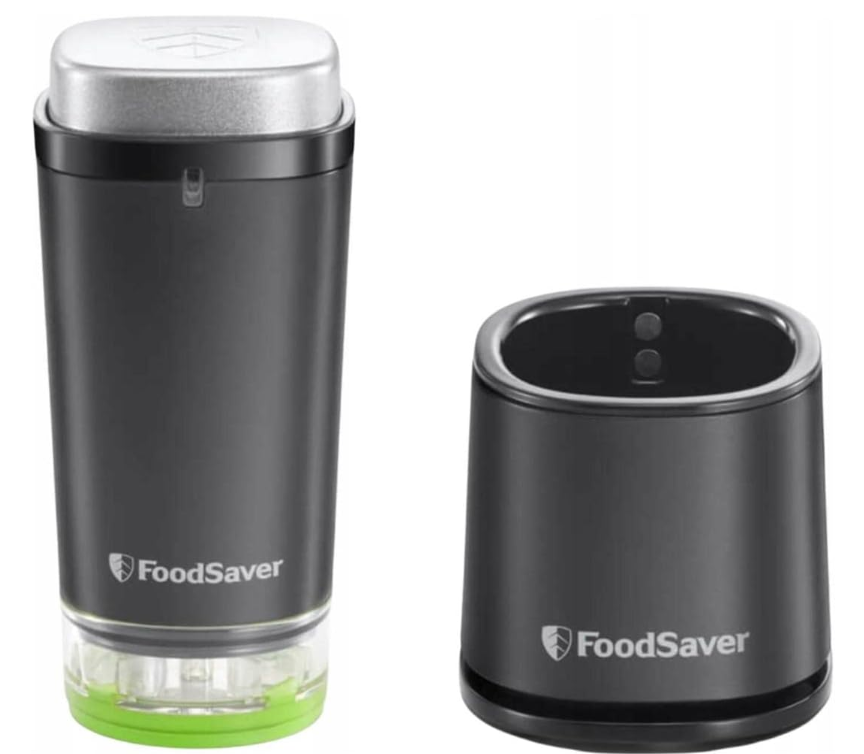
This is a cordless handheld unit with a charging station rather than a bench machine, sized to sit in a drawer. It draws air through a valve in a reusable zip bag or a rigid container instead of welding a bag shut. One charge covers about a hundred seals.
Reaching for it takes seconds, which is the whole point: leftovers get sealed on a weeknight in a way a bench machine never quite does. A marinating mode works in about twelve minutes using the matching container. Food keeps roughly twice as long as it would loosely covered.
It cannot cut a bag from a roll, so bulk portioning is outside its range, and it only works with valved bags and containers from the same system. That tie-in is the real cost over time. For a household sealing dinner rather than a delivery of meat, it is the machine that gets used.
Pros
- Cordless with about 100 seals per charge
- Sized for a drawer, not a bench
- Marinating mode in around 12 minutes
- Works with reusable zip bags and containers
- Fastest to reach for of anything here
Cons
- Only works with matching valved bags and containers
- Cannot cut bags from a roll
- Not suitable for bulk portioning
Key specs: Cordless handheld sealer, charging station included, around 100 seals per charge, vacuum and marinate modes, marinating in about 12 minutes, compatible with matching vacuum containers and reusable zip bags.
CHECK ON AMAZON10. GIRAFFYCO Handheld Sealer Set – Best Reusable Bag System
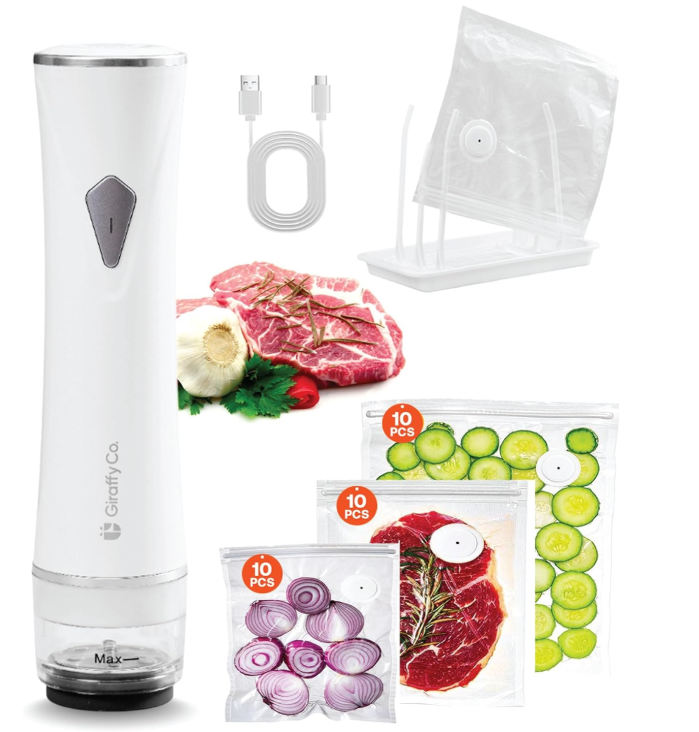
The set pairs a battery powered handheld pump, 48 by 208 by 48 mm and running on 5 volts, with thirty reusable bags in three sizes. Ten small bags measure 22 by 21 cm, ten medium 26 by 28 cm and ten large 30 by 34 cm. Housing is a mix of aluminium, stainless steel and plastic.
Thirty bags arriving with the pump is what separates this from other handhelds, since a full set of sizes covers snacks through to a large cut without a second purchase. Operation is manual, so the vacuum stops when the pump stops. Suction is well below any bench machine, which is expected in this format.
This will not replace a bench sealer for freezer storage and it is not trying to. As a lunchbox and fridge system it removes single-use bags from the routine entirely. Households cutting down on plastic waste are the clearest fit.
Pros
- Thirty reusable bags included across three sizes
- Compact at 48 x 208 x 48 mm
- Battery powered, no cord
- Replaces single-use bags for fridge storage
- Aluminium and stainless construction
Cons
- Suction far below any bench machine
- Manual operation only
- Not suitable for long-term freezer storage
Key specs: Battery powered handheld sealer, 5 volts, 48 x 208 x 48 mm, manual operation, includes 30 reusable bags: ten at 22 x 21 cm, ten at 26 x 28 cm and ten at 30 x 34 cm, aluminium, stainless steel and plastic construction.
CHECK ON AMAZONHow to Choose the Best Vacuum Sealer in Australia
Decide first whether liquid is part of the job. An external machine pulls air out through the bag opening, so soup or sauce travels towards the pump and ruins both the seal and eventually the machine. A chamber machine evacuates a sealed box around the bag and is the only design here that seals a filled liquid bag without freezing it first.
Check the bag width against the seal bar. A machine rated to 30 cm cannot seal a wider bag whatever its suction figure claims, and the widest units here take 12 inches. Confirm the machine accepts a common roll width rather than a proprietary bag.
Look for a moist setting rather than a bigger kilopascal number. Suction between 60 and 95 kPa covers everything a domestic kitchen asks for, and a moist mode that lengthens the heat time does more for a seal that holds. A machine with a single setting will leak on anything damp.
Count how many bags it will seal in a row. Most consumer machines stop to let the heating strip cool, and only the units with active cooling seal continuously. Anyone breaking down a whole carton of meat in one session should treat that as the deciding specification.
Measure the bench before ordering. A chamber machine is an appliance rather than a gadget, and the largest one here is longer than most microwaves. That is the same bench calculation the best ice maker machines force, and it is better done before the box arrives than after.
Add the bag cost to the purchase. Rolls cut to size waste less than pre-cut pouches, valved reusable bags suit a handheld, and chamber bags cost more than either. Across a few years of heavy use the consumable spend can pass what the machine cost, much as the best coffee machines are judged on what they keep consuming rather than the one-off outlay.
Fruit, vegetables and jerky dried in a food dehydrator keep even longer once they’re vacuum sealed.
Frequently Asked Questions
Can a vacuum sealer seal liquids?
Only a chamber machine seals a bag of liquid directly, because it removes air from a sealed box around the bag rather than drawing it through the opening. On an external machine the workaround is to freeze the liquid first and seal the solid block.
How much suction does a vacuum sealer need?
Between 60 and 95 kPa covers every domestic use. Past that the limiting factor becomes the seal itself rather than the vacuum, which is why a moist setting that lengthens the heat time matters more than a higher kilopascal figure.
What bag width should a vacuum sealer take?
A machine accepting bags up to 30 cm suits most household sealing, and the widest units here take 12 inches, which fits a rack of ribs or a whole fish flat. Check that the width is a common roll size rather than a proprietary bag.
Does vacuum sealing make food last longer in the freezer?
Removing the air slows oxidation and freezer burn, and that is what extends storage life. The gain is largest on fatty meat and fish, where oxidation produces off flavours before anything else goes wrong.
Can vacuum sealer bags be reused?
Bags that held raw meat should not be reused. A bag that held dry goods can be washed and resealed provided enough length remains to cut a fresh weld, and the valved bags supplied with a handheld are designed for repeated use.
Is a handheld sealer as good as a bench machine?
For leftovers and fridge portions it is comparable and much faster to reach for. For freezer storage and bulk portioning it is not, because a handheld relies on valved reusable bags rather than cutting a bag from a roll, and its suction is far lower.
Verdict
A roll of cling film is the real competition here, and only some of these beat it. Anything genuinely wet points to the Vacmaster VP230, the only machine here that seals a filled liquid bag, because a chamber removes air from around the bag instead of pulling it through the opening. Most kitchens never need that, and the Devanti nine-mode unit covers dry and moist food with a real marinate cycle and a 32 cm bar for a small fraction of the outlay. For leftovers rather than bulk storage the FoodSaver handheld manages about a hundred seals per charge and lives in a drawer, which is the difference between a machine that gets used on a weeknight and one that stays in the cupboard.