An air purifier is a fan and filter appliance that draws room air through a HEPA element and returns it with the airborne particles trapped, so the best air purifiers in Australia are the ones whose clean air delivery rate matches the room they stand in. Filtration quality decides what comes out, and airflow decides how quickly.
Four technologies do the work. True HEPA elements trap fine particles mechanically, activated carbon layers adsorb odours and cooking smoke that HEPA passes straight through, ionisers charge particles so they clump and settle, and smart sensing models tie fan speed to a live particle reading instead of a manual dial.
Clean air delivery rate is the number that decides suitability, and the units compared here span 13m3/h to 421m3/h, covering anything from a car cabin up to 109 square metres, or roughly 1,170 square feet. Match that rating to the room first and read the noise floor before the feature list.
This guide compares ten air purifiers sold in Australia on clean air delivery rate, filtration stages, room coverage and noise level. Moving air and filtering it solve different problems, which is worth keeping in mind when weighing these against bladeless fans.
Quick Picks
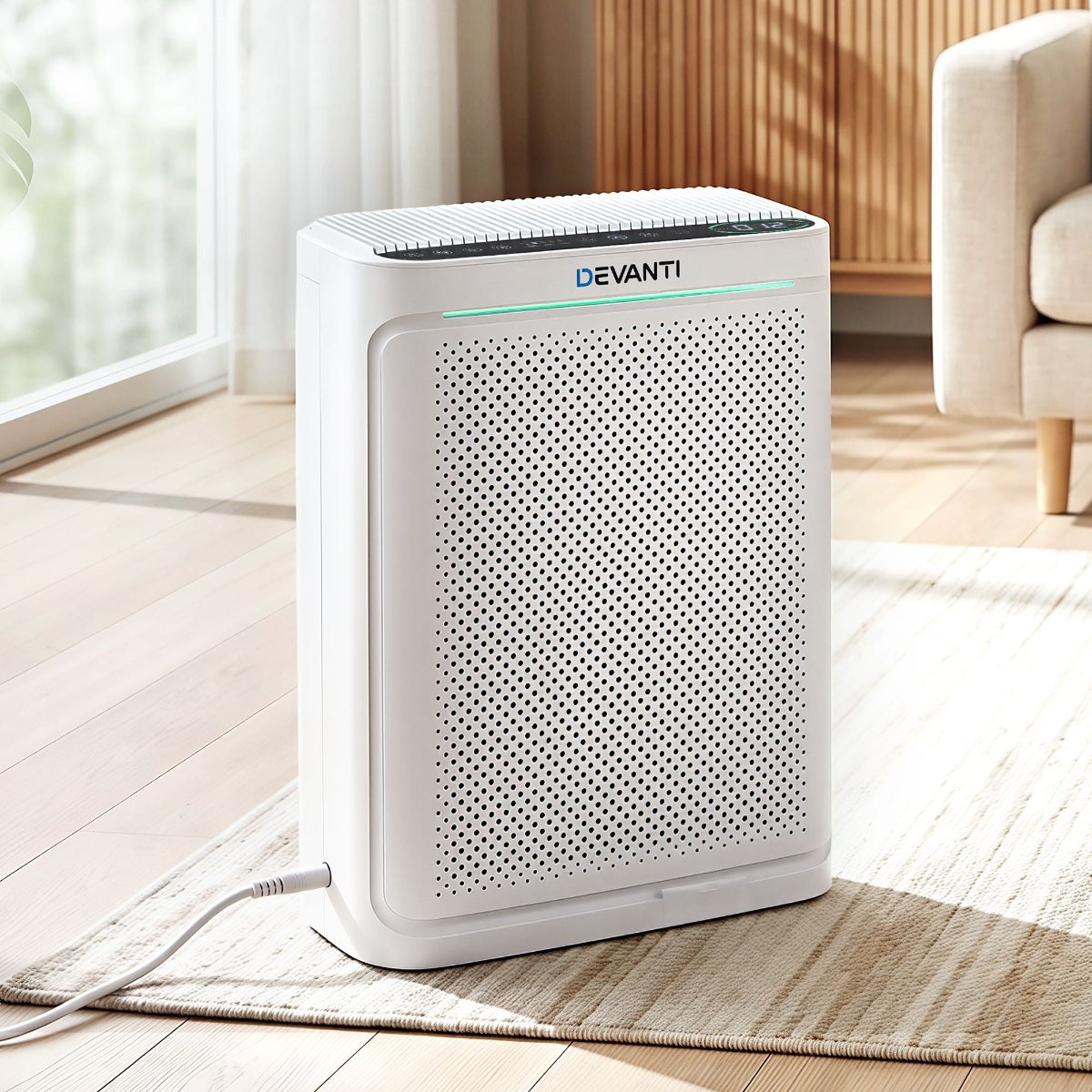
Devanti HEPA Air Purifier with Digital Display
HEPA and carbon filtration with a PM2.5 readout, sized for a bedroom rather than a living room.
CHECK CURRENT PRICE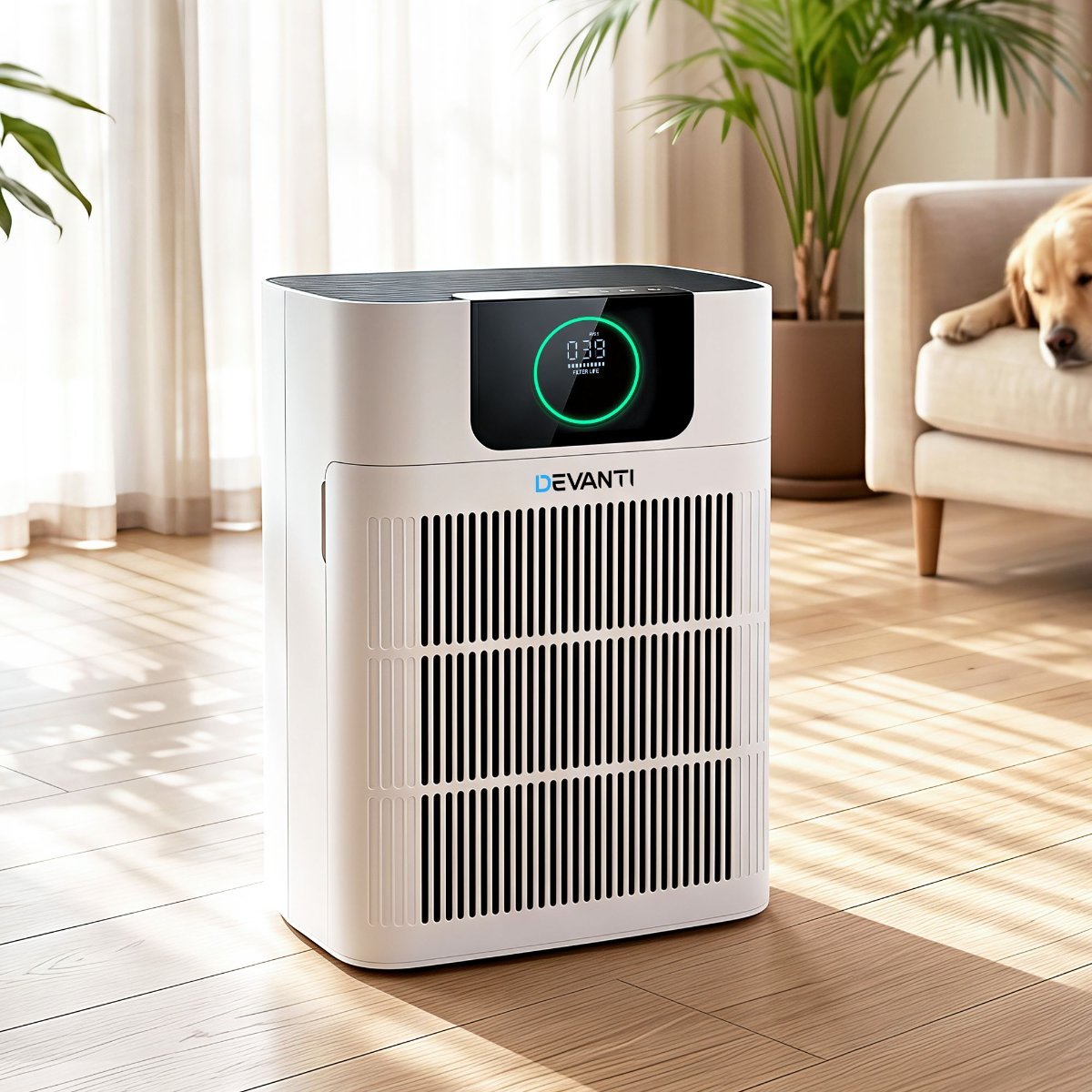
Devanti Pet Air Purifier
Double-sided intake and dual filters aimed at pet hair, dander and the smells that come with them.
CHECK CURRENT PRICE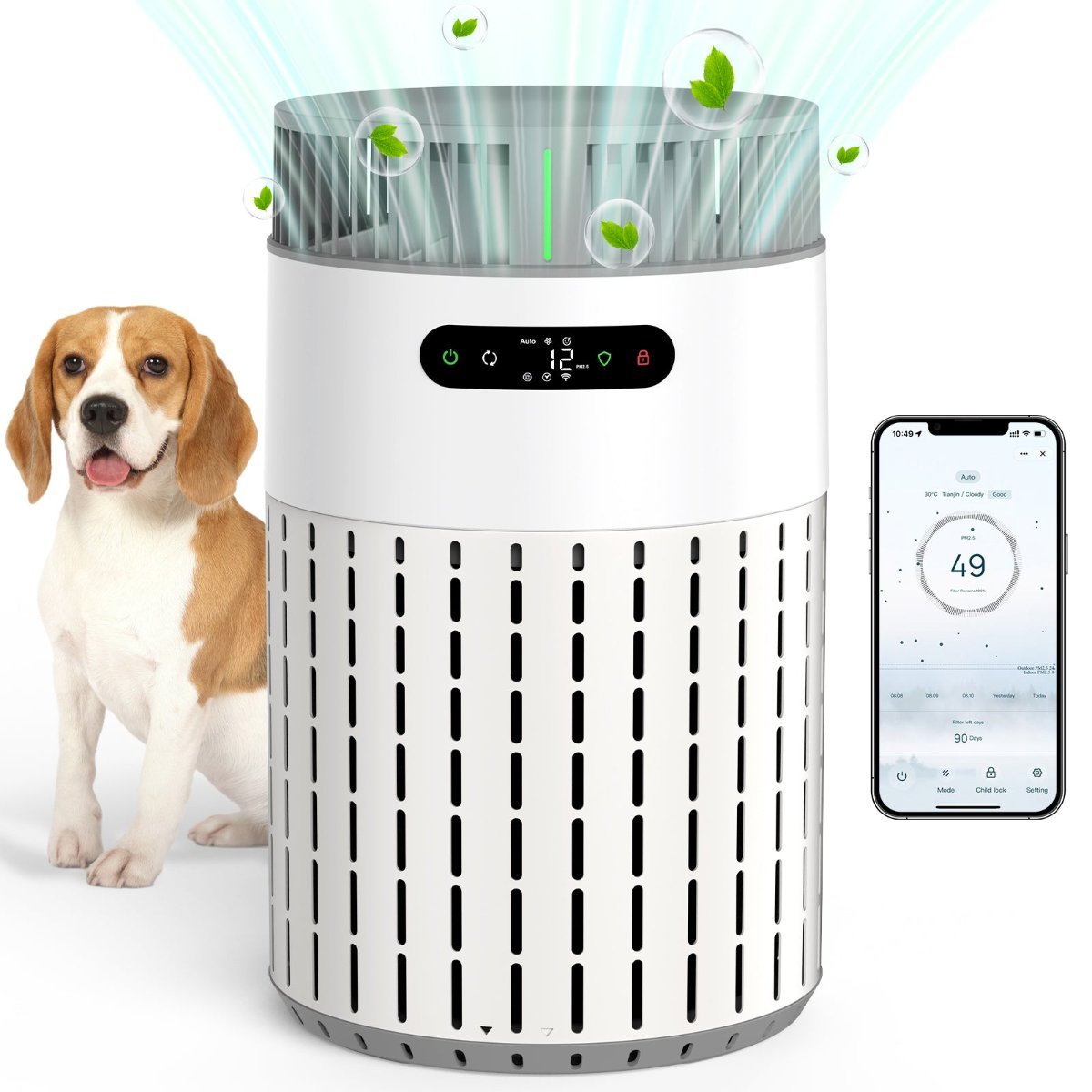
Advwin 6-Stage HEPA Air Purifier
Six filtration stages and a DC motor, aimed at cooking smoke and dander rather than pollen alone.
CHECK CURRENT PRICEBest Air Purifiers in Australia Compared
| Product | Link | Type | Best For | Key Spec |
|---|---|---|---|---|
| Devanti HEPA Air Purifier with Digital Display | Check price | HEPA + carbon | Bedrooms and home offices | 200m3/h CADR, 20 to 30m2 |
| Devanti 4 Stage HEPA Air Purifier | Check price | 4-stage + ioniser | Allergy season | 4-layer filtration, ioniser |
| Parkmate 3-Stage Car Air Purifier | Check price | Vehicle unit | Cars and desks | 13m3/h CADR, 12/24V or USB-C |
| Devanti Pet Air Purifier | Check price | Dual-intake HEPA | Pet hair and odour | 300m3/h CADR, 30 to 35m2 |
| Advwin 6-Stage HEPA Air Purifier | Check price | 6-stage HEPA | Cooking fumes | 6-stage filtration, DC motor |
| Coway Airmega Mighty Air Purifier | Check price | True HEPA | Large rooms | 421m3/h CADR, up to 109m2 |
| Philips 1000i Series Air Purifier | Check price | 3-layer NanoProtect | Sensor accuracy | 300m3/h CADR, 78m2, 15dB minimum |
| Levoit Core 302S Smart Air Purifier | Check price | 3-stage + ion | Open-plan spaces | 258m3/h CADR, up to 108m2 |
| RENPHO Large Room Air Purifier | Check price | 5-stage | Nurseries and bedrooms | 5-stage filter, 24dB sleep mode |
| Levoit Core Mini Air Purifier | Check price | 3-in-1 filter | Desks and small rooms | 3-in-1 filter, 25dB |
1. Devanti HEPA Air Purifier with Digital Display – Best for Bedrooms
Rated at 200m3/h clean air delivery, this unit is pitched at rooms of 20 to 30 square metres rather than open living areas. A HEPA element and an activated carbon layer sit behind the intake, with a digital PM2.5 readout on the front.
The PM2.5 figure updates as conditions change, so the effect of closing a window or running a vacuum is visible rather than assumed. Auto mode ties fan speed to that reading, and sleep mode drops it back for overnight running.
Coverage tops out well short of the large-room machines further down this list. In a bedroom or a study, four fan speeds, a timer and a child lock cover what most people actually adjust.
Pros
- PM2.5 reading on the front panel
- Auto mode responds to air quality
- Sleep mode for overnight running
- Child lock and filter reminder
Cons
- Coverage limited to about 30 square metres
- No app or voice control
Key specs: 200m3/h CADR; 20 to 30m2 coverage; HEPA and activated carbon; PM2.5 display; 4 fan speeds; 2, 4 and 8 hour timer; child lock.
CHECK CURRENT PRICE2. Devanti 4 Stage HEPA Air Purifier – Best for Hay Fever
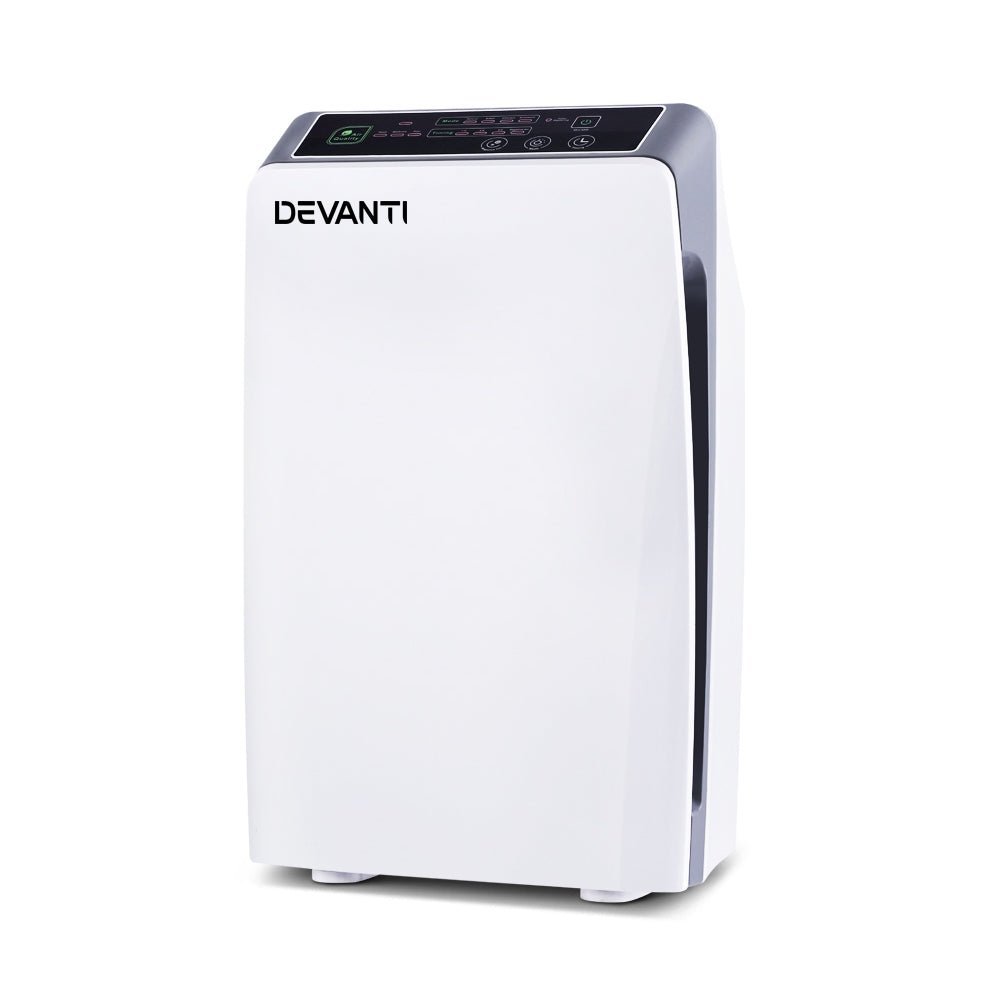
Four filtration layers stack up in this one, ending at a HEPA element rated to catch 99.97 percent of particles down to 0.3 microns. A built-in ioniser releases negative ions that bond with positively charged particles to help drop them out of the air.
That combination targets pollen and fine dust, the two things that make spring difficult for hay fever sufferers. A colour-coded air quality sensor on the housing shows current conditions without needing a numeric display.
Ionisers divide opinion because some models generate trace ozone as a by-product, and the function cannot be separated from the unit here. For a household where seasonal pollen is the main complaint, the four-stage stack does the heavy work regardless.
Pros
- Four-layer filtration to 0.3 microns
- Built-in ioniser for fine particles
- Colour-coded air quality sensor
- Targets pollen and seasonal allergens
Cons
- Ioniser cannot be disabled separately
- No numeric PM2.5 readout
Key specs: 4-stage filtration; HEPA rated 99.97 percent at 0.3 microns; built-in ioniser; colour-coded air quality sensor.
CHECK CURRENT PRICE3. Parkmate 3-Stage Car Air Purifier – Best for Cars
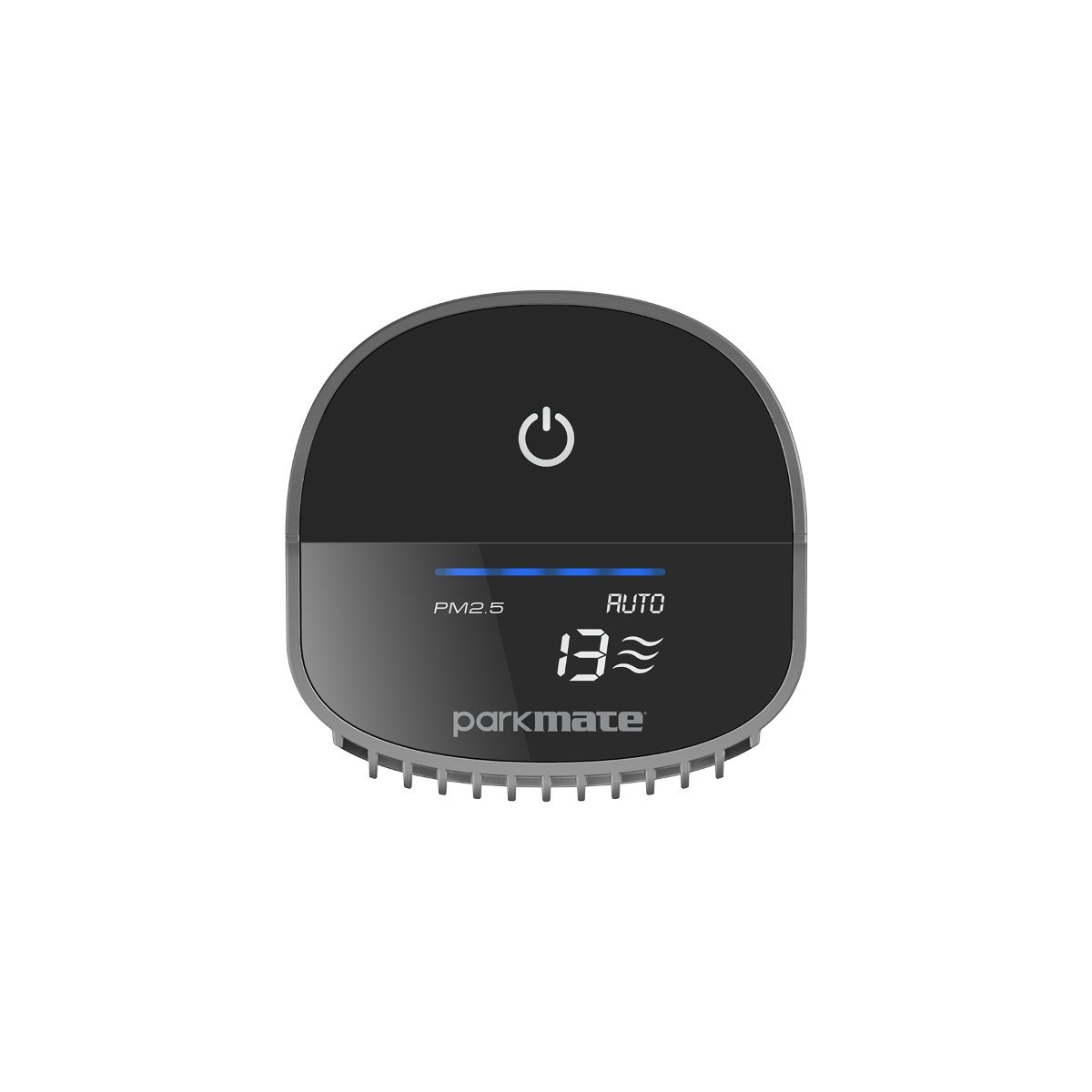
This is a vehicle unit rather than a room appliance, running from a 12/24V car socket or a USB-C cable. Three filtration stages sit inside a housing small enough for a cup holder or a desk corner.
Clean air delivery is 13m3/h, which is trivial for a lounge room but appropriate for the cabin volume of a car. It targets pollen, dust, odours and pet hair in the confined space where those things concentrate fastest.
Nobody should buy this expecting it to treat a house, and the comparison table above makes the gap obvious. For a driver with asthma or an allergy sufferer who commutes, it addresses the one space a room purifier cannot reach.
Pros
- Sized for a car cabin or a desk
- Runs from 12/24V socket or USB-C
- Three-stage filtration
- Includes charger and cable
Cons
- Not a substitute for a room purifier
- 13m3/h suits confined spaces only
Key specs: Vehicle air purifier; 3-stage filtration; up to 13m3/h CADR; 12/24V car charger or USB-C; includes charger, cable and manual.
CHECK CURRENT PRICE4. Devanti Pet Air Purifier – Best for Pet Households
Air enters both sides of this unit rather than one face, with a filter stack on each flank. Each side runs a pre-filter, a HEPA element and activated carbon, and the whole thing is rated at 300m3/h across 30 to 35 square metres.
Double-sided intake matters with pets because loose hair blinds a single pre-filter quickly, and splitting the load slows that down. The carbon layers handle the odour side, which is usually the complaint that prompts the purchase.
Two filter sets mean two replacements when the reminder triggers, so running costs sit above the single-sided units above it. In a house with a shedding dog or more than one cat, the extra intake area is the reason to choose it.
Pros
- Double-sided intake resists hair blinding
- Dual HEPA and carbon filter sets
- 300m3/h CADR across 30 to 35m2
- PM2.5 display and filter reminder
Cons
- Two filter sets to replace
- Larger footprint than single-intake units
Key specs: 300m3/h CADR; 30 to 35m2 coverage; double-sided air intake; dual pre-filter, HEPA and carbon sets; PM2.5 display; 3 fan speeds; timer and child lock.
CHECK CURRENT PRICE5. Advwin 6-Stage HEPA Air Purifier – Best Multi-Stage Filtration
Six filtration stages is the most of any unit in this guide, driven by a high-precision DC motor across three fan speeds. The stack is built around cooking fumes and pet dander rather than pollen alone.
DC motors draw less power than the AC type at the same airflow and hold a steadier speed at the low end, which is what makes a quiet setting genuinely quiet. Stepping through three speeds covers background running and a fast clear-out after cooking.
More stages means more surface to replace eventually, and filter cost scales with complexity. Kitchens that open onto living areas are where the extra stages earn their keep, because cooking smoke is the hardest thing on this page to clear.
Pros
- Six filtration stages
- DC motor runs quieter at low speed
- Three fan speeds
- Targets cooking fumes and dander
Cons
- More filter media to replace
- No PM2.5 numeric display
Key specs: 6-stage filtration; high-precision DC motor; 3 fan speeds; HEPA filtration; designed for cooking fumes and pet dander.
CHECK CURRENT PRICE6. Airmega Mighty Air Purifier – Best Filtration Performance
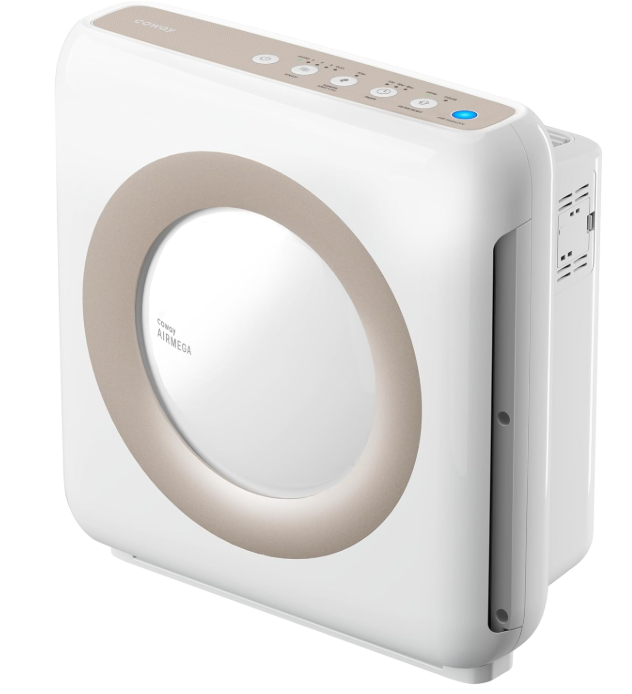
Clean air delivery of 421m3/h puts this well clear of everything above it, covering rooms up to 109 square metres and clearing spaces under 43 square metres more than four times an hour. Filtration is rated to remove up to 99.999 percent of particles down to 0.01 micrometres.
That 0.01 micrometre figure is two orders of magnitude finer than the 0.3 micron benchmark most HEPA claims quote, which is the substantive difference between this and the budget units. Auto mode tracks air quality and eco mode stops the fan entirely after 30 minutes of clean readings, restarting when the sensor picks something up.
It is the physically largest machine here and the filters cost accordingly. Where a whole open-plan floor needs covering by one appliance rather than two, nothing else in this guide has the airflow to attempt it.
Pros
- 421m3/h CADR covers up to 109m2
- Filters to 0.01 micrometres
- Eco mode shuts the fan on clean air
- Auto mode adjusts to air quality
Cons
- Largest footprint in this guide
- Replacement filters are a running cost
Key specs: 421m3/h CADR; up to 109m2 coverage; intensive purification under 43m2; true HEPA to 0.01 micrometres; auto and eco modes.
CHECK ON AMAZON7. Philips 1000i Series Air Purifier – Best Air Quality Sensing
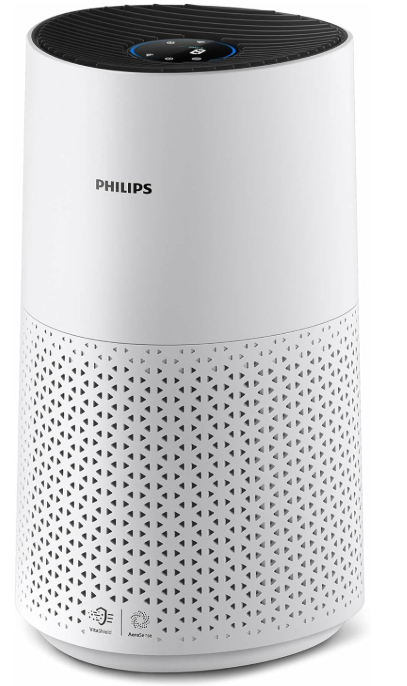
A three-layer stack of pre-filter, NanoProtect HEPA and active carbon sits behind an AeraSense sensor that samples the air a thousand times a second. Rated coverage is 78 square metres at 300m3/h, and it clears a 20 square metre room in about ten minutes.
Sampling that often means the fan responds to a change almost as it happens rather than a minute later, which is the practical gap between this and a basic sensor. Readings surface in a companion app, and the unit answers to Alexa and Google Home.
Its quoted minimum noise of 15dB is the lowest figure claimed on this page, low enough to disappear behind ordinary room noise. The integrated filter runs up to twelve months, so the maintenance rhythm is annual rather than seasonal.
Pros
- AeraSense sensor samples 1,000 times a second
- 15dB minimum noise
- App plus Alexa and Google Home control
- Filter lasts up to 12 months
Cons
- Single integrated filter must be replaced whole
- App account needed for full control
Key specs: 300m3/h CADR; up to 78m2; 3-layer NanoProtect HEPA, carbon and pre-filter; AeraSense sensor; 15dB minimum; 27W; 12-month filter life.
CHECK ON AMAZON8. Levoit Core 302S Smart Air Purifier – Best for Open-Plan Living
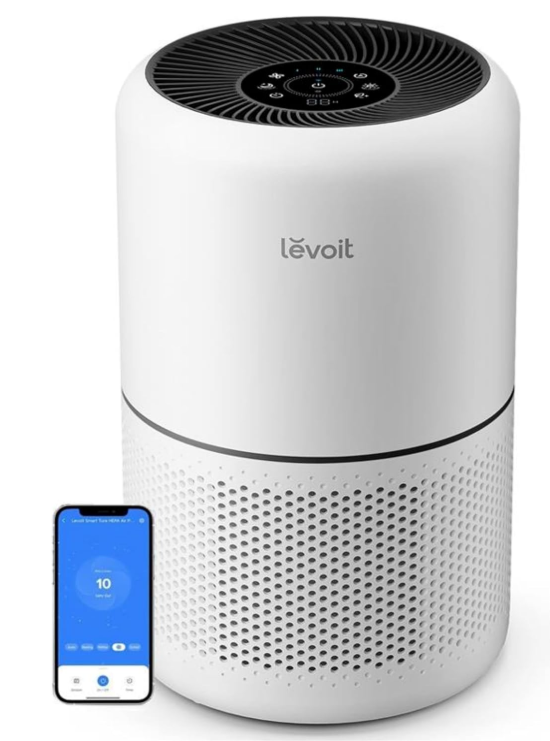
A laser dust sensor reads particles down to 0.3 microns here, feeding a three-stage stack of primary filter, HEPA and carbon. Rated coverage reaches 108 square metres at 258m3/h.
Laser sensing detects smaller particles faster than the infrared sensors common at this size, so auto mode reacts to cooking or dust before it becomes obvious. A secondary ion mode runs alongside the fan for additional treatment.
Coverage approaches the large Coway unit while the airflow figure sits noticeably lower, so it works a bigger room more slowly rather than faster. App and voice control through Alexa or Google Assistant make it the easier of the two to fold into an existing smart home.
Pros
- Laser sensor detects particles to 0.3 microns
- Covers up to 108m2
- App plus Alexa and Google Assistant
- Ion mode supplements the fan
Cons
- Lower airflow than its coverage rating suggests
- Ion function is not to every taste
Key specs: 258m3/h CADR; up to 108m2; 3-stage primary, HEPA and carbon; laser dust sensor; ion mode; app and voice control.
CHECK ON AMAZON9. RENPHO Large Room Air Purifier – Best Quiet Operation
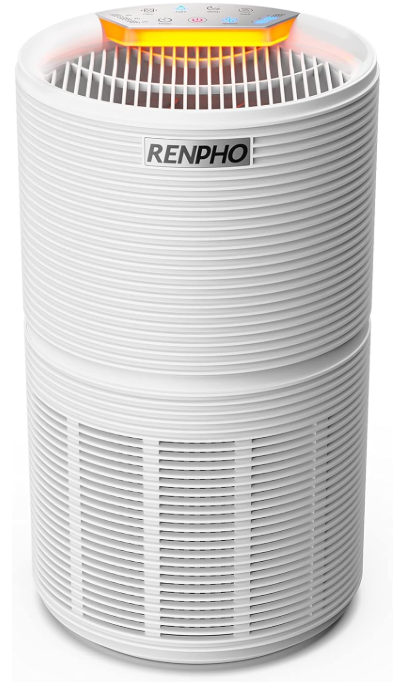
Air is drawn in through a full 360 degree intake rather than one face, passing through five stages that end at a coated HEPA element and an activated carbon layer. It turns over the air in a 22 square metre room five times an hour.
Sleep mode drops the unit to 24dB and switches every light off automatically, which matters in a nursery where an indicator LED is as disruptive as fan noise. A separate night light offers white or colour-changing output and can be turned off on its own.
Five stages in a slim 8.6cm wide tower means the filters are physically small, so replacement intervals come round sooner than on the larger machines. For a child’s room or a light sleeper’s bedroom, the 24dB floor is the specification that decides it.
Pros
- 360 degree intake
- 24dB sleep mode with lights off
- Separate night light with colour options
- Slim 8.6cm footprint
Cons
- Small filters need replacing more often
- Coverage suits one room at a time
Key specs: 5-stage filtration with coated HEPA and activated carbon; 360 degree intake; 5 air changes per hour at 22m2; 24dB sleep mode; 3 fan speeds; 2, 4 and 8 hour timers; child lock.
CHECK ON AMAZON10. Levoit Core Mini Air Purifier – Best Compact Pick
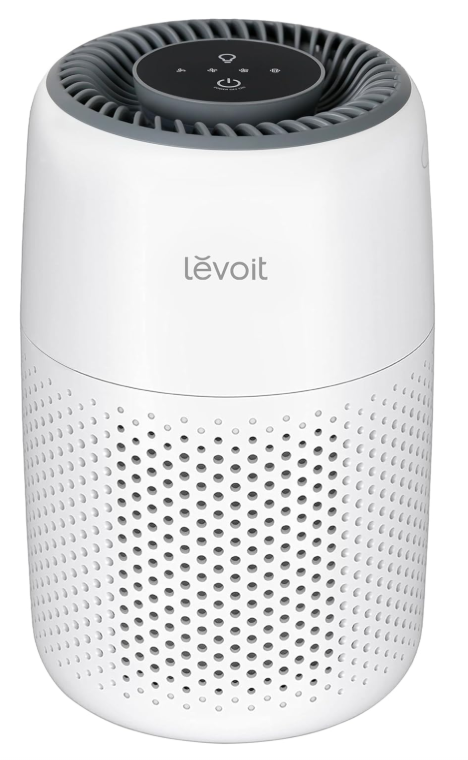
The smallest unit in the guide runs a single 3-in-1 cartridge combining pre-filter, HEPA and activated carbon, and operates from two buttons cycling three speeds. A built-in night light provides soft ambient output.
At 25dB it is quiet enough for a desk during a call, and the display switches itself off a minute after the last button press so it does not glow overnight. The carbon layer targets smoke and cooking odours in the small volumes it is built for.
Coverage is a fraction of anything else here, and it will not treat a living room whatever the run time. As a unit for a desk, a nursery corner or a small bedroom, its size and 25dB floor are exactly the point.
Pros
- Smallest footprint in the guide
- 25dB operation
- Single 3-in-1 filter cartridge
- Auto-off display and night light
Cons
- Suits only very small spaces
- No air quality sensor
Key specs: 3-in-1 pre-filter, HEPA and activated carbon cartridge; 3 fan speeds; 25dB; built-in night light; auto-off display.
CHECK ON AMAZONHow to Choose an Air Purifier in Australia
Size by clean air delivery rate, not by room label. A unit marketed for bedrooms means little on its own. Divide the rated CADR by the room volume to work out air changes per hour, and treat four changes an hour as the target for allergy relief rather than two.
Insist on true HEPA, and check what sits in front of it. A HEPA element rated at 99.97 percent to 0.3 microns is the baseline. A washable pre-filter ahead of it catches hair and lint that would otherwise clog the expensive layer, which is what determines how often the replacement cost lands.
Add carbon if odour is the problem. HEPA filtration does nothing for smells, cooking smoke or volatile compounds from paint and cleaning products, because those are gases rather than particles. Only an activated carbon layer adsorbs them, and thicker carbon beds last longer than a thin coated mesh.
Read the noise floor at the speed you will actually use. Quoted minimums are measured on the lowest setting, which often moves too little air to matter. A unit that is quiet at speed two is more useful than one that is silent at speed one and unusable above it.
Work out the filter cost before buying. Replacement filters are the real cost of ownership and vary widely across the units here, from a single integrated cartridge to two separate sets. A cheap purifier with dear annual filters can cost more across three years than a dearer machine.
Reduce the dust load rather than only filtering it. A purifier competes with whatever keeps re-entering the air, so soft furnishings, bedding and carpet all matter, and regular floor cleaning with a robot vacuum lowers the particle load a filter has to handle. Australian Consumer Law also covers a purifier that fails prematurely, regardless of the manufacturer warranty period.
Frequently Asked Questions
What size air purifier do I need for my room?
Work out the room area and match it to the quoted coverage, then check the clean air delivery rate. As a guide, a 200m3/h unit suits a bedroom of 20 to 30 square metres, while an open-plan living area needs 300m3/h or more to achieve enough air changes an hour.
Do air purifiers help with hay fever?
Yes, for the airborne portion. A true HEPA element captures pollen and fine dust while they are suspended, which reduces what reaches the airways. It does nothing about pollen already settled into bedding or carpet, so filtration works alongside cleaning rather than replacing it.
Is HEPA enough, or is carbon needed too?
HEPA traps particles and carbon adsorbs gases, and they are not interchangeable. Cooking smells, smoke and fumes from cleaning products pass straight through a HEPA element, so any purifier bought to deal with odour needs an activated carbon layer as well.
How often do air purifier filters need replacing?
Most HEPA and carbon filters run six to twelve months depending on use and dust load. Units with a washable pre-filter last longer between changes because the coarse material is caught before it reaches the HEPA layer, and most models here include a replacement reminder.
Are ionisers safe to run indoors?
Ionising functions can generate trace ozone as a by-product, which is why some buyers prefer a purely mechanical filter. Where an ioniser can be switched off independently, that is worth doing in a small closed bedroom, though the mechanical filtration continues either way.
Should an air purifier run all day?
Running one continuously on a low or auto setting works better than short bursts on high, because particle levels rebuild as soon as the fan stops. Auto mode handles this by lifting fan speed only when the sensor detects a change, which keeps power use and noise down.
Verdict
For a whole open-plan floor, the Coway Airmega Mighty is the only unit here with the airflow to do it, moving 421m3/h and filtering considerably finer than the 0.3 micron benchmark the rest quote. A house with a shedding dog is better served by the Devanti Pet Air Purifier, whose double-sided intake stops loose hair blinding a single pre-filter within weeks. At the other end, the Levoit Core Mini is the one to put on a desk or in a nursery corner, where a 25dB noise floor and a footprint measured in centimetres matter more than coverage figures.