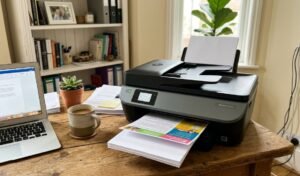
Document trays in Australia are stackable or tiered desk containers that separate loose paperwork, mail and folders into defined layers instead of one sliding pile on the desk. They range from a single flat A4 tray sold in packs of two or three, up to five-tier mesh towers with a sliding drawer built into the base, and the right one comes down to how much paper actually crosses your desk in an average week.
Three real sub-types turn up in Australian stock: flat stacking trays (single-layer, bought in multiples and built up as paper volume grows), tiered mesh organisers (three to five open trays welded from steel wire and finished in a powder coat), and drawer combo units (a mesh or metal frame with a sliding drawer, a pen cup and sometimes a vertical hanging-file slot bolted on). Solid wood trays are the smaller fourth category – heavier, better looking on a shared desk, and priced accordingly.
The number that actually separates them is tier count against footprint – a 3-tier tray takes up roughly the same desk space as a 5-tier one but holds close to 40% less paper before you’re stacking loose sheets on top. The spec most buyers skip past is tray depth: a shallow 5cm tray holds A4 sheets fine but chokes on ring binders or thick manila folders, while the drawer-and-hanging-file combos here run closer to 30cm deep to fit both.
This guide compares ten document trays sold on Amazon Australia, from a single flat tray at the budget end to a solid-wood three-tier organiser at the premium end, running through flat stackers, mesh tiers, drawer combos and one wood pick. CHOICE’s home office setup guide makes the point that a cluttered desk costs you more in stress than the room itself is worth, and that budget matters more than brand once the gear doesn’t need to survive a decade in a corporate office – exactly the trade-off running through every entry below. If a fair bit of what lands in your tray is only there until you can bin it safely, it’s worth pairing whichever pick you land on with our guide to the best paper shredders, especially heading into EOFY paperwork season.
Document Trays in Australia Compared
| Product | Link | Type | Best For | Key Spec |
|---|---|---|---|---|
| Simple Houseware 3-Tier Desk Organiser | Check price | Drawer combo | Overflow paperwork | 4 compartments, 29 x 33 x 26cm |
| Auvo 5-Tier Mesh Organiser | Check price | Mesh tiers + file slot | High-volume paperwork | 5 trays + vertical slot, 30 x 30 x 31.5cm |
| Supeasy 5-Tray Handle Organiser | Check price | Mesh tiers | Moving between rooms | 5 trays, carry handle, 32 x 23 x 34cm |
| KIRIGEN Wooden 3-Tier Tray | Check price | Solid wood | Shared or client-facing desks | 3 open trays, 24 x 24 x 18cm |
| Mind Reader 2-Piece Stackable Tray | Check price | Flat stacker | Starting small and adding on | 2 trays, 36 x 25 x 15cm stacked |
| Simple Houseware 5-Tier Pen Holder Organiser | Check price | Mesh tiers | Small or narrow desks | 5 tilted trays, 33 x 23 x 36cm |
| Amazon Basics 2-Pack Letter Tray | Check price | Flat stacker | Budget multi-packs | 2 trays, 34 x 25 x 6cm each |
| VANRA 3-Compartment Letter Sorter | Check price | Compact mesh | Small desks and entryways | 3 upright slots, 18 x 8 x 13cm |
| Detectalia Single A4 Tray | Check price | Flat stacker | Cheapest single-tray entry | 1 tray, 35 x 25 x 5.2cm |
| Esselte Nouveau Document Tray | Check price | Flat stacker | Classic single tray in colour | 1 tray, 35.6 x 26.2 x 7.6cm |
How We Picked
We started with a wide sweep across general dropship retailers and marketplace catalogues sold into Australia, looking specifically for actual document and letter trays instead of desks or shelving that only mentioned paper storage in passing. Most of those catalogues came up empty – document trays are a stationery category most Australian dropship generalists simply don’t stock in depth, so the lineup below leans on marketplace listings instead, each one checked individually for current AU stock, a realistic delivery window, and specs that actually matched the product, not a copy-pasted listing.
Every product on this list was cross-checked against its own review history for recurring patterns rather than a single five-star outlier – the kind of consensus you’d find echoed on ProductReview.com.au or in a CHOICE buying guide, even where neither site has tested this specific category. Where two listings turned out to be the same physical tray sold under a different colour or pack size, we treated it as one product, not two, which is why a few well-reviewed variants of the same design don’t get separate entries here.
1. Simple Houseware 3-Tier Desk Organiser – Best for Home Offices with Overflow Paper

This is the one to reach for if paperwork multiplies faster than you can file it. The frame combines two side-load letter trays with a sliding drawer and a detachable pen bucket, so invoices, forms and stationery all get a defined spot instead of merging into one pile by Wednesday. A renter working from a spare bedroom in a Melbourne apartment gets the same benefit a small business owner gets at a proper desk – everything visible, nothing buried.
The build is metal mesh over a plastic drawer shell, and it holds its shape under a heavy stack better than the flat stackers further down this table. Amazon AU reviewers frequently mention the drawer’s six adjustable dividers as the actual selling point – it’s less a stationery tray and more a small filing cabinet with paper storage bolted on top. Well, half filing cabinet – the drawer alone wouldn’t hold much, but paired with the two trays above it, it covers both jobs at once, which is exactly why it costs more than the single flat trays among the picks below.
Not everything about it is a step up, though. The drawer runners feel a bit plasticky under a full load of staplers and tape dispensers, and the rubber feet mark soft desk finishes if you drag rather than lift it. Under Australian Consumer Law, a drawer that jams from new still qualifies for a free replacement regardless of what the individual seller’s own returns page says – worth knowing before you assume you’re stuck with a dud.
Pros
- Drawer with six adjustable dividers doubles as small-item storage
- Detachable pen bucket keeps stationery separate from paperwork
- Sturdy enough for a tall stack of A4 sheets without bowing
Cons
- Drawer runners feel a bit plasticky under a heavy load of small items
- Rubber feet mark soft desktop finishes if you drag it instead of lifting
- Assembly instructions assume you’ve built flat-pack furniture before
Key specs: Metal mesh and plastic construction, 4 compartments (2 trays, 1 drawer, 1 pen bucket), 29.2 x 33 x 26.2cm, tool-free assembly.
CHECK ON AMAZON2. Auvo 5-Tier Mesh Organiser – Best for High-Volume Paperwork

Picture a home-based bookkeeper in the fortnight before a BAS lodgement, drowning in receipts, supplier invoices and half-finished reconciliations. That’s the buyer this tray is built for. Five full-width trays plus a dedicated vertical file slot give it close to double the sorting capacity of the 3-tier drawer combo above, and the trade-off is a taller footprint that eats more vertical space above the desk than most of the other picks here.
Assembly really is tool-free – the steel mesh panels click together in a few minutes, which matters if you’re setting this up in a QLD share house and don’t own a screwdriver. Reviewers with the biggest paper volumes – EOFY tax time, small tutoring businesses, freelancers juggling multiple clients – are the ones who leave the most detailed feedback, and the recurring theme is that five tiers stops the “one more folder and it all topples” problem the 3-tier options run into within a few months.
The frame itself is solid, but the powder coat on ours showed a couple of thin spots at the welds straight out of the box – cosmetic, not structural, but worth a look before you commit it to a visible spot on the desk. It’s also the tallest unit in this guide, so it’s not the pick for a shelf with limited headroom above the desk.
Pros
- Five full trays plus a vertical file slot for real paper volume, not just overflow
- Tool-free assembly in a few minutes
- Rust-resistant coating rated for daily handling
Cons
- A few thin patches in the powder coat turned up at the welds on arrival
- Tallest pick here, so it needs clearance above the desk
- Five loaded tiers get top-heavy if you only ever use the top two
Key specs: Powder-coated steel mesh, 5 trays plus 1 vertical file slot, 30 x 30 x 31.5cm, tool-free assembly.
CHECK ON AMAZON3. Supeasy 5-Tray Handle Organiser – Best for Moving Between Rooms

A step up in price from the two mesh towers above, with a useful feature neither of them has: a built-in carry handle across the top (about the width of a shoebox lid, easy enough to grip one-handed). That’s a small thing until you’re the one hauling a fully-loaded tray from the kitchen table to a spare room every time someone needs the table back for dinner – a fair few Australian households working from home don’t have a dedicated office and shuffle their setup daily.
Five open trays hold roughly the same volume as the Auvo above, but the handle changes how it actually gets used day to day. Reviewers who mention moving house or switching between a home office and a shared coworking desk consistently flag the handle as the reason they bought this one over a cheaper five-tier option without it.
Pros
- Built-in carry handle for shifting the whole stack in one trip
- Five trays give it real capacity for a busy week
- Sturdy welded frame that doesn’t flex when full
Cons
- Bare wire mesh on some batches shows early surface rust near coastal suburbs with salt air
- Handle placement means the top tray is slightly harder to load with two hands full
- No drawer or pen storage, so stationery still needs somewhere else to live
Key specs: Steel mesh with carry handle, 5 open trays, 32 x 23.2 x 33.8cm, no assembly required.
CHECK ON AMAZON4. KIRIGEN Wooden 3-Tier Tray – Best-Looking Pick for a Shared Office

This is the one we almost left off the list – solid wood trays usually mean a flimsy veneer over particleboard that swells the first humid summer. It stayed on because it isn’t that. Real mortise-and-tenon joinery holds it together with no visible screws, and the finish is a proper lacquer rather than a stain that rubs off on your sleeve.
Where the mesh towers above look like they belong in a warehouse office, this one looks like furniture – the obvious pick for a reception desk, a therapist’s consulting room, or any shared space where three metal trays would look out of place. Brisbane and Cairns buyers should still be mindful that timber moves with humidity even when it’s solid; keep it off a windowsill that gets direct sun and it holds its shape fine.
It’s also the priciest pick in this guide, and the trade-off is capacity – three shallow trays hold noticeably less than the five-tier mesh options, so it suits light, tidy paperwork, not a desk that’s already drowning in it. Worth a look if the tray needs to look good on camera during video calls as much as it needs to hold paper.
Pros
- Genuine solid wood with mortise-and-tenon joinery, not veneer over particleboard
- Looks like furniture, not warehouse equipment
- Arrives fully assembled
Cons
- Sits at the premium end of this guide for noticeably less paper capacity
- Timber can swell slightly in a truly humid room without air conditioning
- Only comes in a natural timber finish, so it won’t match a black or white desk setup
Key specs: Solid wood, 3 open tiers, 23.9 x 23.9 x 17.8cm, fully assembled on arrival.
CHECK ON AMAZON5. Mind Reader 2-Piece Stackable Tray – Best Stackable Duo
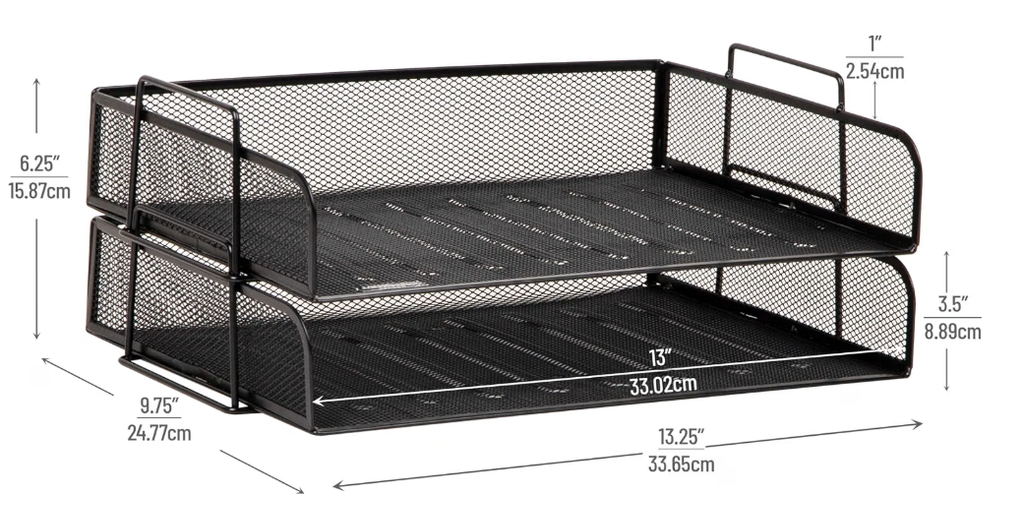
Two identical mesh trays that stack directly on top of each other, sold as a pair instead of a fixed tower. That matters more than it sounds. Start with one tray on the corner of the desk, add the second only once the first actually fills up, and you’ve avoided buying a five-tier unit that sits half-empty for the first year.
No assembly, no drawer, no pen holder – just two open trays that lock together via moulded feet. Amazon’s Choice badge here isn’t accidental; the review volume and consistency suggest this is one of the more consistently reliable stacking designs in the category, not just a lucky run of good reviews.
Pros
- Buy one now and add the second tray only when you actually need it
- Stacks securely without sliding apart under normal handling
- Simple mesh design wipes clean in seconds
Cons
- No drawer or pen storage at all – it’s paper only
- Only available in black, so it won’t suit every desk colour scheme
- Individual trays feel light enough that a full stack can shift if the desk gets bumped
Key specs: Metal mesh, sold as 2 stackable trays, 35.6 x 24.8 x 15.2cm as a pair, no assembly required.
CHECK ON AMAZON6. Simple Houseware 5-Tier Pen Holder Organiser – Best for Small Desks

Same brand as the drawer combo at the top of this list, but built for a narrower footprint. Five tilted trays stack vertically instead of spreading sideways, which suits a desk tucked into an alcove or a corner where width is the scarce resource, not height.
Pros
- Narrower footprint than the drawer combo above, better for tight corners
- Detachable pen bucket included
- Tilted trays make it easy to see what’s in each layer at a glance
Cons
- No drawer, so small stationery still needs a separate home
- Taller than the drawer combo above, which can shadow a monitor on a low desk
- Pen bucket detaches a little too easily when you’re grabbing something in a hurry
Key specs: Steel mesh, 5 tilted trays plus detachable pen bucket, 33 x 22.9 x 35.6cm, tool-free assembly.
CHECK ON AMAZON7. Amazon Basics 2-Pack Letter Tray – Best Budget Multi-Pack
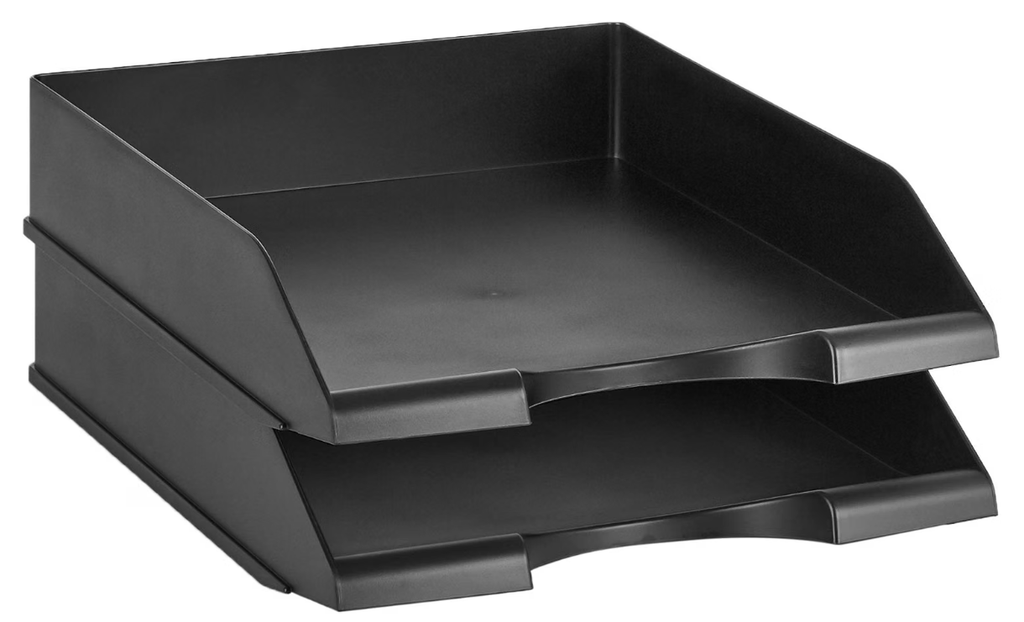
The most affordable multi-pack of the ten, and close to what you’d pay at Officeworks for a similar own-brand plastic tray. Two flat, stackable trays in durable PS plastic, no mesh, no drawer, nothing to assemble – just a straightforward way to split incoming paper from outgoing paper on the same corner of the desk.
It won’t win any styling points next to the wood pick above, but it does the job it’s built for, and the 1-year Amazon Basics warranty is backed by Australian Consumer Law guarantees regardless of what the warranty card itself says. A decent unit for a student desk, a shared study nook, or anywhere the tray needs to be functional over photogenic.
Pros
- Cheapest multi-pack option here
- Durable PS plastic that doesn’t flex or crack under a full stack
- Low profile keeps a monitor or laptop screen unobstructed
Cons
- Plain black plastic look, no mesh or wood options in this pack
- Shallow 6.4cm height means thick folders sit proud of the tray edge
- Stacking pegs feel a little loose after repeated separation and restacking
Key specs: PS plastic, sold as 2 stackable trays, 33.8 x 25.4 x 6.4cm each, 1-year manufacturer warranty.
CHECK ON AMAZON8. VANRA 3-Compartment Letter Sorter – Best Compact Pick

Smaller than every other tray in this guide, and that’s the entire point. A share-house desk, a granny flat office nook, or the narrow gap next to a printer – this fits where a five-tier tower simply can’t. Three upright slots sort bills, active paperwork and mail without eating the desk space a horizontal tray needs. Tiny footprint, on purpose.
Compared with the flat stackers further up this table, it trades raw capacity for footprint – you honestly can’t fit as much paper in three narrow slots as you can in a wide five-tier tower, but if the problem is desk space and not paper volume, that trade makes sense.
Pros
- Smallest footprint of the ten, fits truly tight desk spaces
- Rust-resistant powder coat holds up to daily handling
- Upright slots make it easy to grab one document without disturbing the others
Cons
- Limited to three slots, so it fills up fast with anything more than light mail
- Not tall enough for full A4 sheets to sit fully upright without folding slightly
- Only two colour options available at the time of writing
Key specs: Powder-coated steel mesh, 3 upright compartments, 17.8 x 8.3 x 13.3cm, no assembly required.
CHECK ON AMAZON9. Detectalia Single A4 Tray – Best Value for a Single Tray

The cheapest single tray among these ten, and one of the most heavily reviewed. Buy two or three and stack them offset for a DIY tiered system that costs less than most of the pre-built towers above, with the flexibility to add a fourth tray later without replacing anything.
It’s plain matte black plastic with a rounded front cut-out for grabbing documents one-handed, and a label slot on the side for anyone who actually labels their trays. Over 1,500 Amazon AU reviews land consistently around the same theme – sturdy enough for daily use, nothing fancy, does exactly what a document tray needs to do and nothing more.
Pros
- Cheapest single tray here, easy to buy in bulk
- Rounded front cut-out for one-handed access
- Stacks offset or squared, whichever suits the desk
Cons
- Sold as a single unit, so a full tiered system means buying several
- Matte finish shows scuff marks more than a gloss finish would
- No drawer, pen storage or hanging-file slot at all
Key specs: Recyclable plastic, sold as a single tray, 35 x 25 x 5.2cm, label slot on front edge.
CHECK ON AMAZON10. Esselte Nouveau Document Tray – Best Classic Single Tray

Esselte is the one genuinely established stationery brand in this lineup – the kind you’ll find in the same aisle as your printer paper at Officeworks – instead of a generic dropship listing with a made-up brand name stuck on it. This single tray comes in a handful of colours beyond plain black, which matters if the tray needs to match an existing desk set instead of standing out.
One verified Australian buyer put it well after months of daily use: it holds its shape and its joints don’t loosen the way older, cheaper trays they’d replaced eventually did. That’s not a huge sample size to lean on, but it lines up with what a brand this established generally delivers – unglamorous, reliably built stationery, not a flashy design that cracks within a year.
Pros
- Established stationery brand widely stocked in Australian office supply stores
- Available in several colours, not just black
- Reviewers report it holding its shape well over months of daily use
Cons
- Stock on Amazon AU runs thin for some colours, so availability can be patchy
- Sold individually, same limitation as the Detectalia tray above
- Colour range is more limited than the brand’s own in-store stationery range
Key specs: Plastic, sold as a single tray, 35.6 x 26.2 x 7.6cm, multiple colourways available.
CHECK ON AMAZONHow to Choose a Document Tray in Australia
Start with how much paper you actually handle in a week, not how much you’d like to handle. A single flat tray or a two-piece stackable duo covers most home offices where the “paperwork” is really just bills, a few forms and the odd delivery slip. Running an EOFY-heavy small business, tutoring out of a spare room, or doing bookkeeping for clients pushes you toward the five-tier mesh towers instead – buying a five-tier unit for two bills a week just wastes desk space you don’t have.
Check the tray depth against what you’re actually storing. A4 sheets sit fine in a shallow 5cm tray, but a ring binder or a thick manila folder needs the deeper drawer-and-file combos to sit flush instead of propped open. Measure an actual folder from your desk before assuming any tray will fit it.
Think about where the desk actually lives. A tray that’s fine on a permanent desk in a spare room becomes a hassle fast if you’re setting up and packing away on the kitchen table every evening – that’s where a carry handle earns its keep. Got a desk that gets used by two or three people across the day? A wider drawer combo with defined sections avoids the “whose pile is this” problem that a single flat tray never solves.
Match the material to the room, not just the desk. Solid wood looks the part in a client-facing space but needs to stay off a sunny windowsill, and bare wire mesh in a coastal Perth or Wollongong apartment can show early surface rust if the sea air gets in through an open window. Powder-coated steel or plastic sidesteps that problem entirely if the desk sits anywhere near an open window most of the year.
Know your rights if it arrives faulty. Under Australian Consumer Law, every product sold in Australia – including anything shipped through a marketplace – carries a consumer guarantee that it works as described and lasts a reasonable time, independent of whatever return window the individual seller advertises. The ACCC’s page on consumer rights and guarantees spells out exactly what you’re entitled to if a tray arrives cracked or a drawer jams from new – a repair, replacement or refund, not just store credit.
Don’t overbuy the first time. If you’re not sure how much capacity you need, start with a two-piece stackable duo like the Mind Reader pick above and add a second unit later once you actually know your own paper habits. A fully-loaded five-tier tower that sits half-empty for a year doesn’t organise anything – it’s just a bigger thing to dust. Setting the desk up properly matters more broadly too, and it’s worth checking our guide to the best standing desks in Australia if the tray is the first piece of a wider home office rebuild and not a standalone fix.
You’ll Also Want
A compact label maker turns any of the multi-tray picks above from “roughly sorted” into an actual filing system – label each tier once and you stop re-sorting the whole stack every time you’re hunting for one invoice.
If you’ve gone with a tray that skips the pen bucket, like the flat stackers or the VANRA sorter above, a simple wire mesh pen cup covers the stationery gap for a couple of dollars without cluttering the tray itself.
For anything you need to keep, not action this week, a hanging file folder box sits underneath or beside the tray and handles the paperwork that’s headed for long-term storage instead of your inbox.
And if the drawer on the Simple Houseware combo units above ends up a jumble of paperclips and dead pens within a fortnight, a cheap clear drawer organiser tray set fixes that in about five minutes.
Notes and reminders that don’t belong in a tray stay visible on a wall-mounted corkboard, no tape or magnets needed.
Paperwork you’d rather not keep at all can go through a document scanner and be saved as a digital file instead.
Frequently Asked Questions
How many document trays do I actually need for a home office?
Most home offices handling ordinary bills, forms and the odd delivery slip do fine with a single flat tray or a two-piece stackable duo – one tier for incoming paperwork and one for anything waiting to be actioned. Only step up to a four or five-tier mesh tower if you’re handling a high paper volume, such as running a small business, tutoring, or bookkeeping for clients out of the same desk. Buying more capacity than you use just eats desk space without solving anything.
What’s the difference between a mesh tray and a plastic stacking tray?
Mesh trays are welded steel wire finished in a powder coat, generally sturdier under a heavy stack and better ventilated so damp paper dries out instead of sitting flat against solid plastic. Plastic stacking trays are lighter, cheaper, and usually sold in packs of two, which suits a lower-volume desk that just needs incoming and outgoing paper kept apart. Neither is objectively better – mesh suits volume and daily handling, plastic suits a tight budget or a simple two-pile system.
Will a wooden document tray warp in an Australian summer?
A solid wood tray with proper joinery holds up fine through most Australian conditions as long as it stays off a sunny windowsill or a spot with direct aircon blast, both of which dry timber unevenly over time. The risk is higher in truly humid conditions – a Brisbane or Cairns wet season – where any timber, including solid wood, can swell slightly if the room has no climate control at all. Cheaper veneer-over-particleboard trays are far more vulnerable to this than a solid wood build.
Does Australian Consumer Law cover a document tray bought on Amazon?
Yes. Australian Consumer Law consumer guarantees apply to products sold to Australian consumers regardless of the platform, including marketplace purchases, and exist independently of whatever return window an individual seller advertises. If a tray arrives cracked, a drawer jams from new, or a hinge fails within a reasonable time of normal use, you’re entitled to a repair, replacement or refund. Check the ACCC’s consumer rights and guarantees page for the specific remedy that applies to your situation before assuming you’re stuck with a faulty unit.
Can a document tray handle A4 ring binders, or just loose sheets?
It depends entirely on tray depth, not tier count. A shallow tray around 5cm deep holds loose A4 sheets and thin folders fine but won’t close around an actual ring binder, which needs closer to 7 to 8cm of clearance to sit flush instead of propped open at an angle. The drawer-and-file combo units in this category, built with a dedicated vertical hanging-file slot, handle binders and thick manila folders far better than any flat stacking tray.
Is it worth buying a five-tier tray if I only fill two of the trays?
Generally no – a half-empty five-tier tower takes up the same desk footprint and vertical clearance as a fully-loaded one, without any of the benefit. It’s more cost-effective to start with a two-piece stackable duo or a compact three-slot sorter and add capacity later once your actual paper volume becomes clear, instead of guessing high on day one. Most buyers who overbuy end up using the top two tiers for active paperwork and the bottom ones as dead storage for things they should have filed or binned months ago.
Verdict
For most Australian home offices, the Simple Houseware 3-Tier Desk Organiser is the one we’d point a friend to first – the drawer and pen bucket earn their keep for anyone whose desk handles more than just bills. If desk space is the real constraint, the VANRA 3-Compartment Letter Sorter fits where nothing else on this list can, and if paper volume is the bigger problem, not the square footage, the Auvo 5-Tier Mesh Organiser has the sorting capacity to keep up with a small business through a busy EOFY.