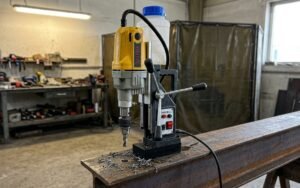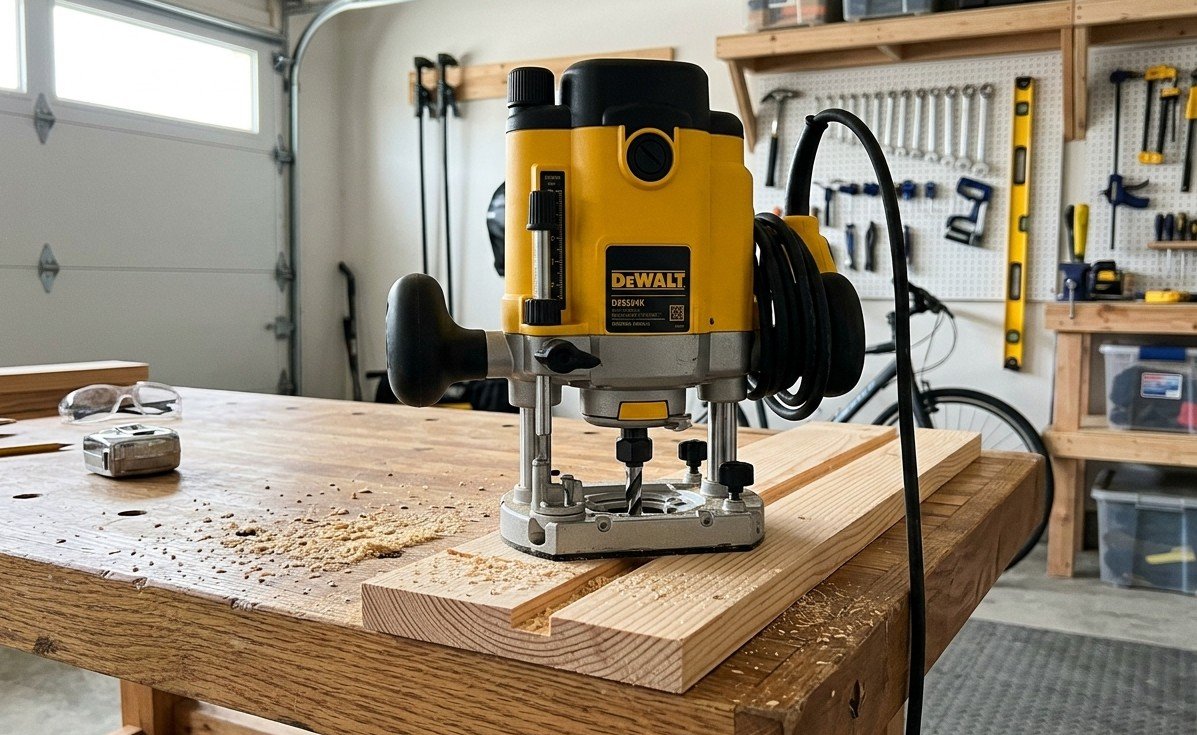
A plunge router is a woodworking power tool whose motor rides on spring-loaded columns, letting the spinning cutter drop into the middle of a workpiece and lift back out without touching an edge. The best plunge routers in Australia match motor power to collet capacity, hold their speed under load, and lock plunge depth precisely enough to repeat a cut across a run of identical parts.
Three formats cover the category. Full-size corded routers from around 1200W to 2200W handle grooving, rebating and template work. Compact and trim routers with plunge bases suit edge profiling, hinge recesses and light grooving. Cordless routers trade outright power for freedom from an extension lead on site.
Collet size sets the ceiling on what a router can ever do, and it is the specification buyers regret ignoring. The machines here run quarter-inch and 8mm shanks up to half-inch, which is 6.35mm through to 12.7mm, and only the half-inch machines accept the large panel-raising and worktop cutters. No amount of extra wattage compensates for a collet that will not hold the bit.
This guide compares ten plunge routers sold in Australia across those three formats, from 710W compact dual-base machines to a 2200W dual-mode router built for table work.
Best Plunge Routers in Australia Compared
| Product | Link | Type | Best For | Key Spec |
|---|---|---|---|---|
| Bosch POF 1200 AE Plunge Router | Check price | Corded full-size | First full-size router | 1200W, 28,000 RPM |
| Bosch POF 1400 ACE Plunge Router | Check price | Corded full-size | Hardwood edge work | 1400W, 3.5kg |
| Trend T7 Variable Speed Workshop Router | Check price | Corded workshop | Worktop jointing and templates | 2100W, half-inch collet |
| Trend T8 Dual-Mode Plunge Router | Check price | Corded dual-mode | Router table work | 2200W, dual-mode |
| DeWalt Plunge and Fixed Base Router Combination Kit | Check price | Corded combo kit | One tool covering both base types | 900W, dual base |
| DeWalt 18V XR Brushless Router with Plunge Base | Check price | Cordless compact | On-site edge work | 18V, 25,500 RPM |
| Bosch AdvancedTrimRouter 18V-8 Kit | Check price | Cordless trim | First cordless router | 18V, battery included |
| Trend T1 Dual Base Compact Router | Check price | Corded compact | Trimming and edge moulding | 710W, dual base |
| Makita RP0900K Plunge Router | Check price | Corded compact | Template and cabinet work | 1.25HP, 2.7kg |
| FERM precisionRouter Plunge Router | Check price | Corded full-size | Getting started with cutters included | 1300W, 6 bits included |
1. Bosch POF 1200 AE Plunge Router – Best Value Full-Size
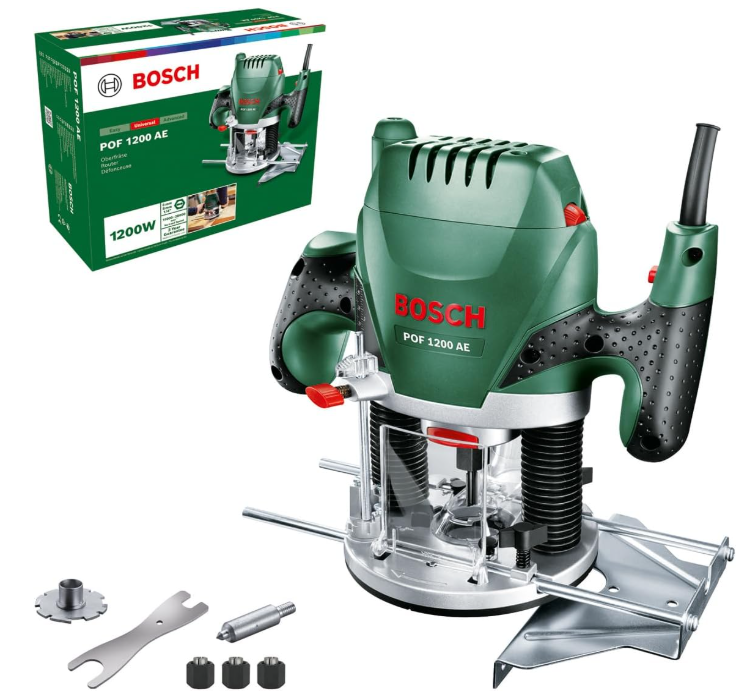
Three collets arrive in the box alongside a parallel guide, a template guide, a dust adapter and a starter bit, so the router is ready to cut the day it lands.
The 1200W motor spins to 28,000 RPM, fast enough for small-diameter cutters where edge quality depends directly on tip speed. At 5.34kg it carries enough mass to sit steady on a workpiece without fighting you.
This is the green consumer line rather than the blue trade range, so continuous production work will outrun it. There is no half-inch collet either, which puts the largest panel-raising cutters permanently out of reach.
Pros
- Three collets plus both guides and a starter bit included
- 28,000 RPM suits small-diameter cutters
- Weight keeps it planted on the work
Cons
- No half-inch collet, so large cutters will not fit
- Consumer-line tool, not built for continuous use
Key specs: 1200W corded, 240V, 28,000 RPM, three collets, 5.34kg, parallel guide, template guide, dust adapter and 8mm bit included
CHECK ON AMAZON2. Bosch POF 1400 ACE Plunge Router – Best for Hardwood
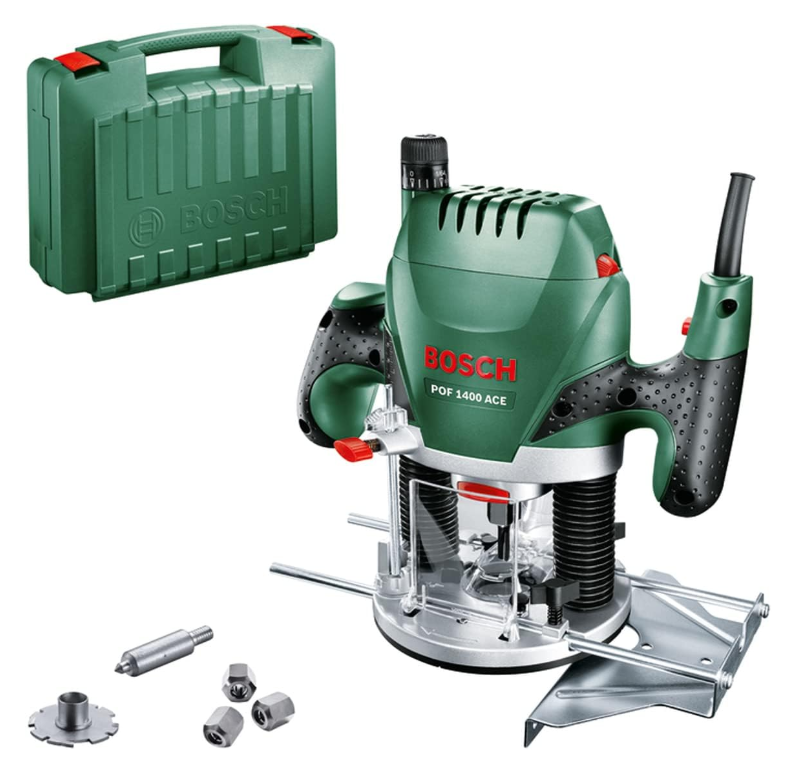
Constant electronic speed control is what separates this from the 1200W model, holding cutter speed steady as the bit loads into dense timber.
An extra 200W helps on deeper passes, and at 3.5kg it is lighter than its lower-powered sibling despite the higher output, which makes edge work markedly less tiring. It ships in a case.
It is still a consumer-line machine at close to trade money, and the half-inch collet is still missing. Hardwood users taking shallow passes will feel the benefit, while anyone hogging deep rebates should step up to a 2000W machine.
Pros
- Constant electronic speed control under load
- 1400W with a lighter 3.5kg body
- Supplied in a case
Cons
- No half-inch collet
- Priced close to trade tools despite the consumer line
Key specs: 1400W corded, 240V, 28,000 RPM, constant electronic speed control, 3.5kg, case included
CHECK ON AMAZON3. Trend T7 Variable Speed Workshop Router – Best for Worktops
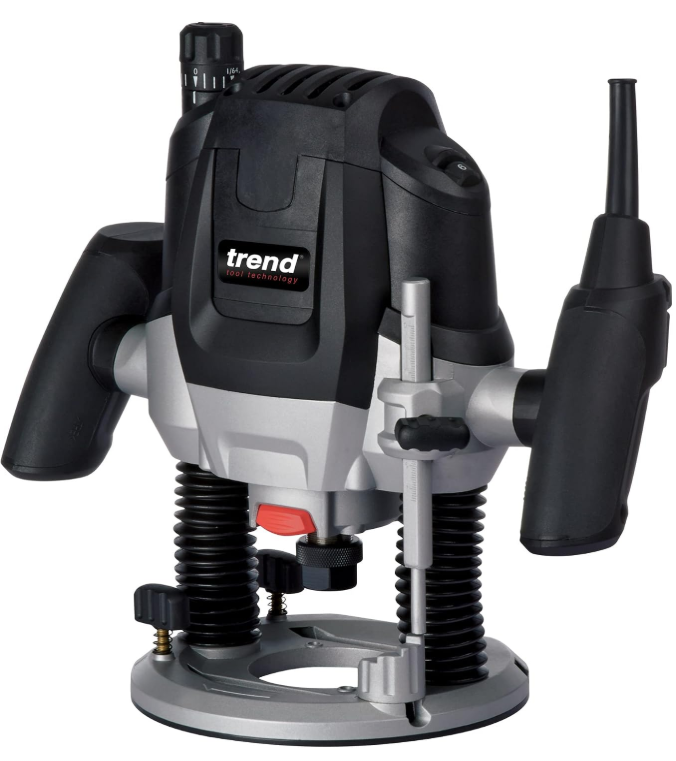
Half-inch collet capacity puts this in a different class, because it accepts the large cutters that kitchen worktop jointing genuinely requires.
The 2100W motor drives those cutters without complaint, and variable speed lets big-diameter bits turn slowly enough to stay safe. A kitbox is included, and the machine weighs 9kg.
Nine kilograms makes this a workshop and jig tool rather than something to hold on an edge all afternoon. For anyone cutting worktop joints or running templates on a bench, that mass works in your favour.
Pros
- Half-inch collet takes worktop jointing cutters
- 2100W with variable speed for large-diameter bits
- Kitbox included
Cons
- 9kg is heavy for freehand edge work
- Overpowered for light hobby routing
Key specs: 2100W corded, 240V, half-inch collet, variable speed, 9kg, kitbox included
CHECK ON AMAZON4. Trend T8 Dual-Mode Plunge Router – Best for Router Tables
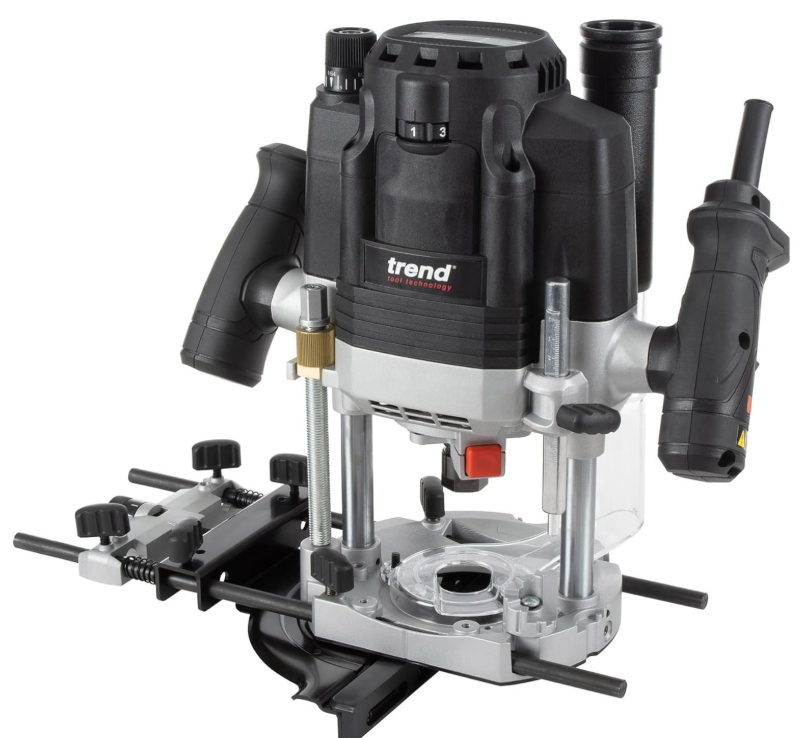
Dual-mode operation lets the same machine work handheld or inverted beneath a router table, with fine depth adjustment reachable from above the table surface.
At 2200W it is the most powerful router in this guide and takes half-inch cutters, so raised panel and large profile work is within reach. The depth adjustment is fine enough for repeatable table settings.
Nobody spends long doing freehand edge work with 9kg of router in their hands. This is a machine bought for a table or a jig and priced on that basis, which makes it a poor choice as a first router.
Pros
- Works handheld and inverted in a router table
- 2200W, the most powerful here
- Fine depth adjustment accessible above the table
Cons
- 9kg is unwieldy for handheld use
- Specialised enough that it suits a second router, not a first
Key specs: 2200W corded, 240V, half-inch collet, dual-mode handheld and table use, 9kg, fine depth control
CHECK ON AMAZON5. DeWalt Plunge and Fixed Base Router Combination Kit – Best Dual-Base Kit
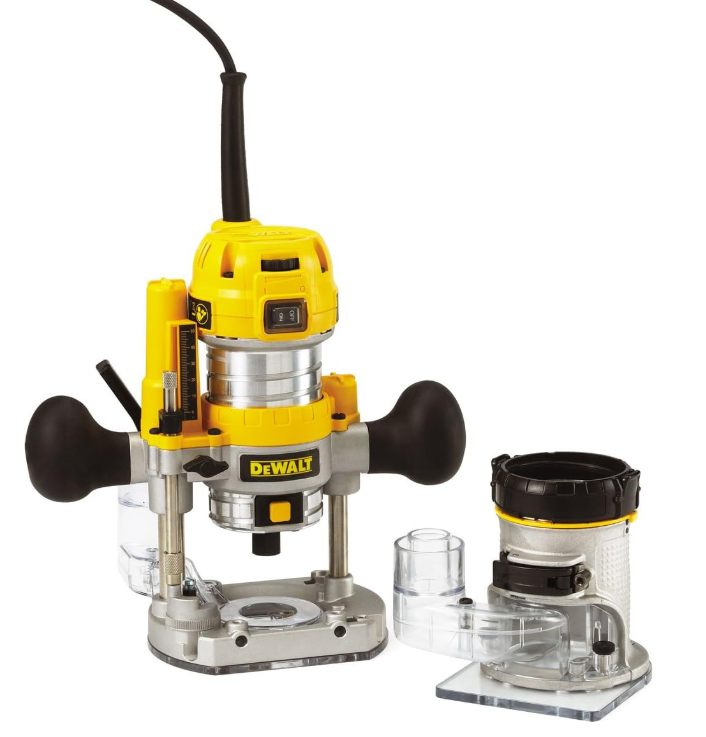
One motor, two bases: drop it into the plunge base for mortices and stopped grooves, then move it to the fixed base for edge profiling and table mounting.
The 900W motor turns 27,000 RPM, and the nine-piece kit covers both bases along with guides. Aluminium construction keeps everything rigid where the motor locks into each base.
What the price buys is the dual-base system rather than raw power, and 900W is modest alongside the Trend machines. Stock on this listing has been thin, so it may not be there long.
Pros
- Plunge and fixed bases from one motor
- Nine-piece kit covers both bases plus guides
- Rigid aluminium base construction
Cons
- 900W is modest for the money
- Only a few units showing in stock
Key specs: 900W corded, 240V, 27,000 RPM, quarter-inch and 8mm collet, plunge and fixed bases, nine-piece kit, aluminium construction
CHECK ON AMAZON6. DeWalt 18V XR Brushless Router with Plunge Base – Best Cordless
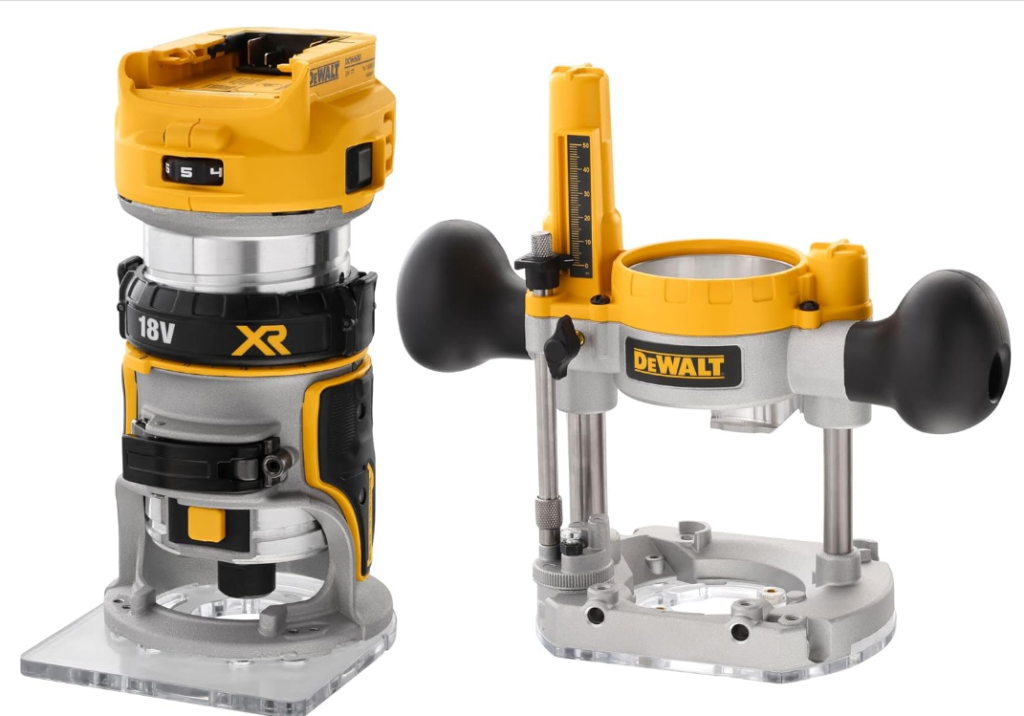
Cutting the cord matters most on site, where dragging an extension lead to a door edge or a stair string takes longer than the routing itself.
The brushless motor reaches 25,500 RPM through an 8mm collet, and at 1.03kg the body is light enough for controlled one-handed edge work. A plunge base is included rather than sold as an extra.
It arrives without a battery or charger, so the platform you are already on decides the true cost. An 8mm ceiling on cutter shanks also rules out the larger profile bits completely.
Pros
- Cordless freedom with a brushless motor
- Only 1.03kg for one-handed edge work
- Plunge base included
Cons
- No battery or charger supplied
- 8mm collet limits cutter size
Key specs: 18V brushless cordless, 25,500 RPM, 8mm collet, 1.03kg, plunge base included, bare tool
CHECK ON AMAZON7. Bosch AdvancedTrimRouter 18V-8 Kit – Best Cordless Starter Kit
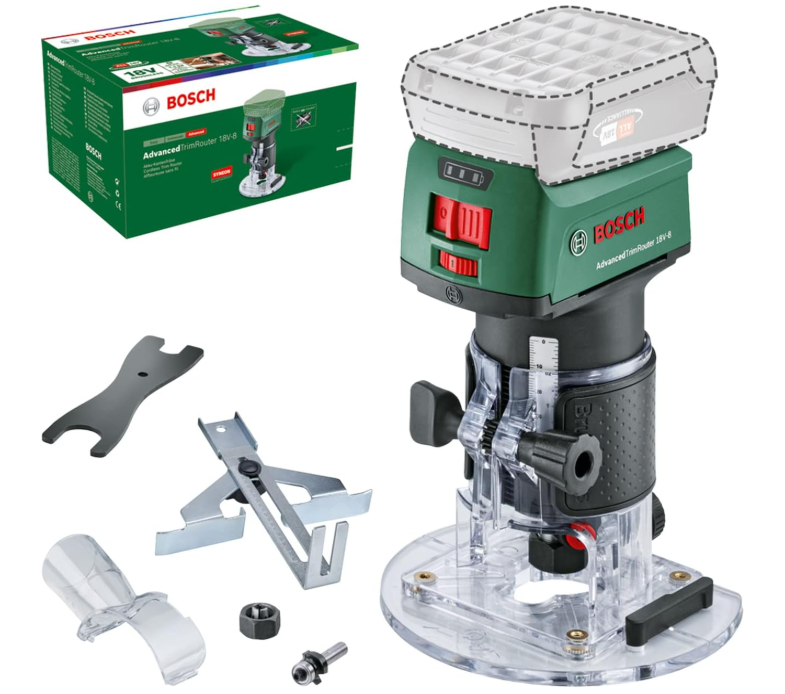
Everything needed to start arrives in one box: the trim router, a plunge base, a round-over bit, a parallel guide, a 2.5Ah battery and a fast charger.
The brushless motor spins to 30,000 RPM, and the compact trim-router body suits edge profiling, hinge recesses and small template work. Fitting the plunge base extends it to stopped grooves.
A trim router motor runs short of ability on deep passes in hardwood, so this is light-duty by design rather than by compromise. As a first cordless router with no battery to buy separately, it removes the cost that usually ambushes buyers.
Pros
- Battery and fast charger included
- 30,000 RPM brushless motor
- Plunge base, round-over bit and parallel guide supplied
Cons
- Trim router motor struggles with deep hardwood passes
- Quarter-inch collet only
Key specs: 18V brushless cordless, 30,000 RPM, quarter-inch collet, plunge base, 3mm round-over bit, parallel guide, 2.5Ah battery and fast charger
CHECK ON AMAZON8. Trend T1 Dual Base Compact Router – Best Compact Dual-Base
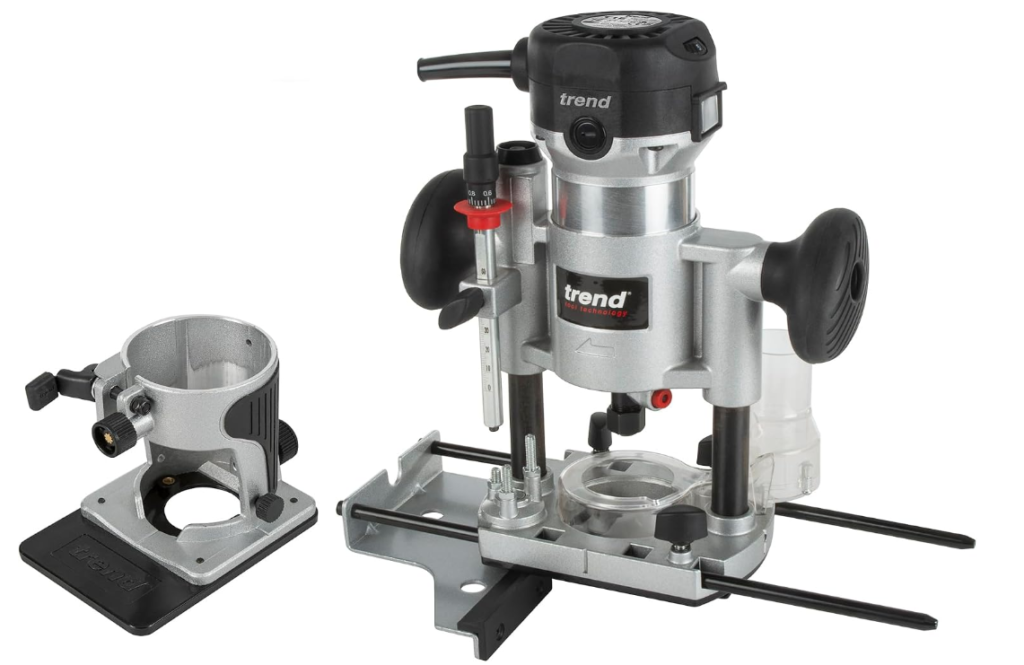
Two bases on a 710W compact body deliver much of the flexibility of the DeWalt combination kit in a smaller and considerably cheaper package.
It turns 30,000 RPM through a quarter-inch collet, which covers trimming, edge moulding and light grooving cleanly. The 5.33kg listed weight is heavier than the output would suggest.
The listing describes a UK-configured machine, so confirm the plug and voltage before ordering. Quarter-inch capacity and 710W keep it firmly in light-duty territory whatever base is fitted.
Pros
- Two bases at a compact size and lower cost
- 30,000 RPM suits trimming and edge moulding
- Aluminium construction
Cons
- Listed as a UK configuration, so check the plug
- 710W and quarter-inch collet limit it to light work
Key specs: 710W corded, 240V, 30,000 RPM, quarter-inch collet, dual base, 5.33kg, aluminium construction
CHECK ON AMAZON9. Makita RP0900K Plunge Router – Best Trade Compact
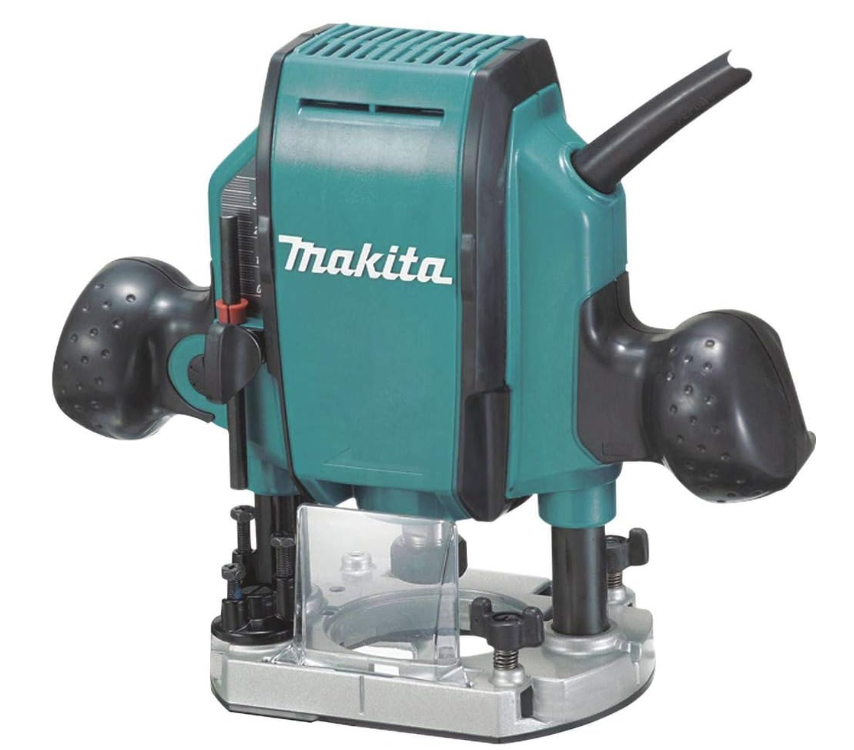
This compact plunge router has been a fixture in Australian cabinet shops for years, and the plunge lock and depth lever are the reason it stayed there.
A 1.25 horsepower motor turns 27,000 RPM and the whole tool weighs 2.7kg, genuinely light for a plunge machine and easy to steer around a template. A case is included.
Only a single unit was showing in stock at the time of writing, so availability is the real risk here. It is also listed at 230V, so the plug configuration is worth confirming before ordering.
Pros
- Well-judged plunge lock and depth lever
- 2.7kg, light for a plunge router
- Case included
Cons
- Stock down to a single unit on this listing
- Listed at 230V, so confirm the plug type
Key specs: 1.25 horsepower corded, 230V, 27,000 RPM, 8 amps, 2.7kg, case included
CHECK ON AMAZON10. FERM precisionRouter Plunge Router – Best Accessory Bundle
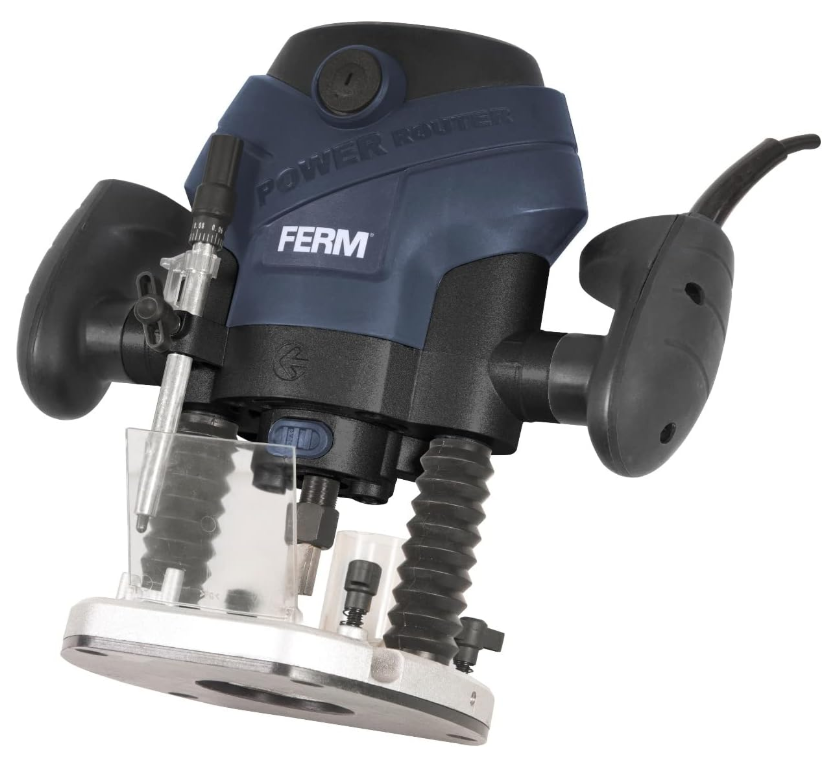
Six router bits, a parallel guide and a template guide are bundled in, which is more included tooling than anything else in this guide provides.
The 1300W motor reaches 25,000 RPM, dust extraction is built into the base, and an LED work light picks out the cut line. Collets cover 6mm and 8mm shanks.
Ratings for this machine sit lower than every other router listed, which usually points to inconsistent quality control rather than a bad design. It undercuts the Bosch machines by a clear margin, and that gap is the trade on offer.
Pros
- Six bits plus parallel and template guides included
- 1300W with built-in dust extraction
- LED work light on the base
Cons
- Lowest customer ratings of any router here
- Thin service and parts support in Australia
Key specs: 1300W corded, 230V, 25,000 RPM, 6mm and 8mm collets, 5.4kg, LED worklight, dust extraction, six router bits and both guides included
CHECK ON AMAZONHow to Choose a Plunge Router
Choose the collet before the motor. A quarter-inch or 8mm collet covers trimming, edge moulding, grooving and most joinery, but it will never hold a worktop jointing cutter or a raised panel bit. If cabinet doors or benchtop joints are in your future, buy a half-inch machine now rather than replacing the router later.
Read wattage as duty cycle, not speed. A 700W router and a 2200W router both spin fast; the difference shows when a large cutter loads up and the smaller motor slows, burns the timber and heats up. Light edge work is comfortable at under 1000W, while grooving hardwood or driving big cutters wants 1400W and up.
Weight is a genuine specification, not an afterthought. Nine kilograms is stable in a router table and punishing on a door edge, while a one-kilogram cordless trim router is the opposite. Most workshops end up with two routers for that reason, so decide which job comes first.
Check the plunge lock and depth stop before anything else. These are the parts you touch on every cut, and a vague lock or a sloppy turret makes repeatable depths impossible across a run of parts. Fine adjustment that can be reached while the router sits on the work is worth more day to day than another few hundred watts.
Take dust extraction seriously. Routing generates fine dust in large volumes at head height, and MDF dust in particular is a respiratory hazard worth engineering out rather than tolerating. A router with a proper extraction port and a shop vacuum attached keeps the cut line visible as well, which is the difference between following a line and guessing at it.
Confirm the electrical configuration on imported listings. Several routers sold here are UK or European stock listed at 230V, which suits Australian supply but may arrive with the wrong plug. A router is one tool in a kit rather than the whole of it, and it pairs naturally with a circular saw for breaking down sheet stock and one of the jigsaws for curved cuts a router cannot make.
Frequently Asked Questions
What is the difference between a plunge router and a fixed base router?
A plunge router rides on spring-loaded columns so the cutter can drop into the middle of a workpiece and retract without touching an edge, which is what mortices and stopped grooves need. A fixed base holds the cutter at a set depth and is steadier for edge profiling and table mounting.
What collet size do I need?
A quarter-inch or 8mm collet covers trimming, edge moulding, grooving and most joinery. Half-inch is required for worktop jointing cutters and raised panel bits, and the larger shank also flexes less in deep cuts. Buy half-inch if benchtop or door work is likely.
How much power does a plunge router need?
Under 1000W is comfortable for edge profiling and light grooving. Grooving hardwood, running templates all day or driving large-diameter cutters calls for 1400W or more. Wattage governs how well the motor resists slowing under load rather than how fast it spins.
Are cordless routers powerful enough?
For edge profiling, hinge recesses, trimming laminate and light grooving, yes. Brushless cordless routers hold speed well within that range. Deep passes in hardwood and large cutters still belong to corded machines, and cordless models are usually limited to 8mm shanks.
Do I need dust extraction on a router?
It is strongly recommended. Routing throws fine dust in volume at head height, and MDF dust is a recognised respiratory hazard. An extraction port connected to a shop vacuum also keeps the cut line visible, which directly improves accuracy.
Can I mount a plunge router in a router table?
Many can, but check that the base accepts a mounting plate and that depth adjustment is reachable from above the table. Dual-mode machines are designed for it and offer above-table fine adjustment; a plunge-only router without that feature is awkward to adjust once inverted.
Verdict
Most workshops are best served by the Bosch POF 1400 ACE, where constant electronic speed control and a 3.5kg body cover hardwood edge work without the fatigue of a full-size machine. Anyone cutting worktop joints or raised panels needs half-inch capacity, and the Trend T7 is the cheapest route to it at 2100W with a kitbox included. For site work where an extension lead is the real obstacle, the DeWalt 18V XR weighs 1.03kg and ships with its plunge base already in the box.