A box printed “1200x” is advertising roughly double its own real optical ceiling, and the physics behind that claim is settled, not a matter of opinion. A kids’ microscope is an optical or digital instrument built to magnify small objects and living specimens far beyond what the eye alone can resolve, ranging from a simple handheld pocket viewer to a full compound scope with slides, a light source and interchangeable eyepieces. Finding the best kids microscope in Australia starts with knowing which of those printed numbers to trust, and which to ignore entirely.
This category splits by what a child can physically do with it. Stereo (dissecting) microscopes are binocular and low-power, built for looking at real 3D objects like coins or insects with both eyes open. Compound microscopes use a single eyepiece and prepared slides to view flatter, higher-magnification specimens such as onion cells or pond water. Digital or LCD microscopes replace the eyepiece with a screen entirely, so several children can look at once. Preschool and talking microscopes use large dual eyepieces or pre-loaded images rather than a live specimen, built for a child who cannot yet close one eye or hold still over a lens.
The rule that actually governs a microscope’s usable magnification comes from the standard Olympus-authored optics primer: useful magnification tops out at “1000 times the numerical aperture” of the objective lens, and pushing past that produces only “empty magnification” – a bigger, blurrier image with no extra detail resolved. A typical kids’ scope’s strongest objective is 40x, which even at a lab-grade numerical aperture of 0.65 caps useful magnification at roughly 650x. Any box claiming 1000x, 1200x or more from that same objective is selling a number the optics cannot actually deliver.
This guide compares ten kids microscopes sold in Australia, all sourced through Amazon AU after a full sweep of this site’s approved retail partners found zero microscopes anywhere in the account – a genuinely Amazon-only category. Every pick is a recognisable brand with a real Australian review base, spanning stereo, compound, pocket and digital formats from an entry-level pocket viewer through to a full accessory-heavy compound kit.
Best Kids Microscope Australia Compared
| Product | Link | Type | Best For | Key Spec |
|---|---|---|---|---|
| National Geographic Dual Microscope | Check price | Compound + stereo (dual) | Best dual-purpose microscope | 20x/50x compound + 3D viewing, optical glass, 50+ accessories |
| National Geographic Microscope for Kids 400x | Check price | Compound microscope | Best all-rounder compound microscope | Up to 400x, 3 magnification levels, 18 slides/specimens included |
| Bresser Junior Stereo 3D Microscope ICD-Pro | Check price | Stereo/dissecting microscope | Best stereo dissecting microscope | 20x/50x binocular, incident + transmitted LED, 998g |
| GeoSafari Jr. Talking Kids Microscope | Check price | Preschool talking microscope | Best for preschoolers | 60 images, Fact/Quiz modes, Bindi Irwin narration, 3x AAA |
| GeoSafari Jr. My First Microscope | Check price | Preschool viewer | Best honest low-magnification pick | 8x fixed, extra-large eyepieces, non-skid feet, ages 3+ |
| Swift Kids SW50 Beginner Compound Microscope | Check price | Compound microscope | Best all-glass optics on a budget | All-glass optics, honest 40X/100X/400X, dual illumination |
| Carson MicroBrite Plus | Check price | Handheld pocket microscope | Best budget pocket microscope | 60x-120x, aspheric lens, 1x AA, 53,979 AU ratings |
| Carson MicroFlip | Check price | Handheld pocket microscope | Best field/outdoor pocket microscope | 100x-250x, UV torch, smartphone digiscoping clip |
| AmScope M30 Beginner Compound Microscope Kit | Check price | Compound microscope | Best real compound scope above 400x | 300x/600x/1200x (1200x exceeds real optical ceiling), metal arm, 48-piece kit |
| BEBANG 1000X Handheld 4K Digital Microscope | Check price | Digital microscope | Best digital screen-based microscope | 200x-1000x (5-level digital zoom), 2.0in screen, 155g |
How We Picked
We ran a full sweep of Australia’s approved retail partners before turning to the marketplace, and found not a single kids’ microscope anywhere in the account – not one product across every general-merchandise partner checked. Every pick in this guide is therefore sourced from Amazon AU, verified individually for Australian stock, delivery and star rating, with import-delayed and single-digit-stock listings excluded.
Two brand-family traps shaped the final mix. National Geographic-branded microscopes are manufactured by Bresser under licence, and Educational Insights owns the Learning Resources and GeoSafari lines – counting either family as a single brand kept the combined share of any one manufacturer under 30 percent instead of letting near-identical badge engineering pad out the list. Every magnification figure is quoted exactly as each manufacturer publishes it, checked against the optics explained earlier instead of repeated at face value.
1. National Geographic Dual Microscope – Best Dual-Purpose Microscope
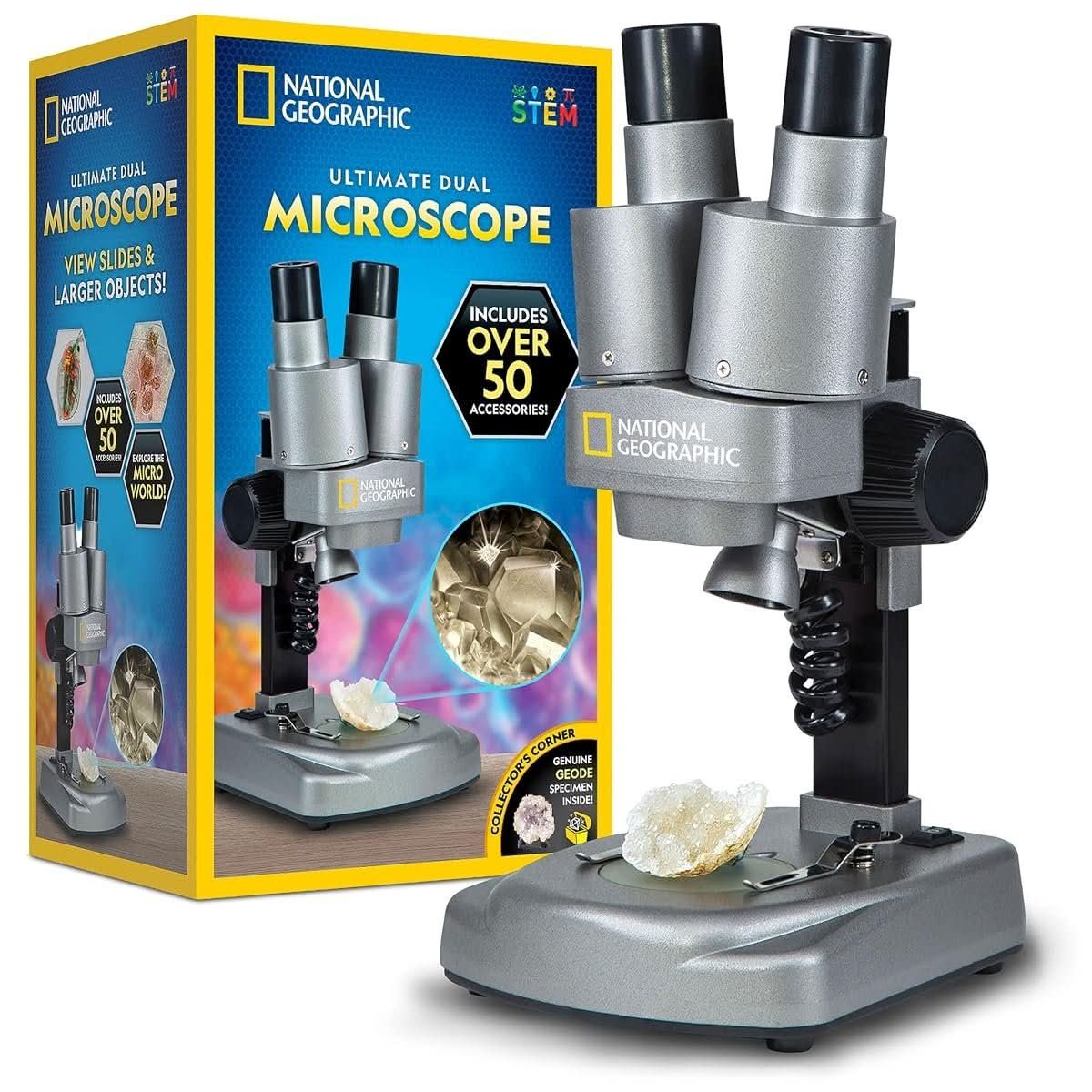
Most kids’ microscopes force a choice between a stereo scope for handling real objects and a compound scope for looking through prepared slides. This one does both: a lower LED illuminates slides from below at 20x or 50x compound magnification, while an upper LED lights up coins, insects or leaves for 3D viewing with no slide at all. National Geographic states two sets of optical glass lenses rather than staying silent on the optics, which in this price band usually means plastic.
The accessory count is properly deep – 50-plus pieces including 10 prepared slides, blank slides and covers, tweezers, an eyedropper, and a brine shrimp hatchery kit that gives a child something alive to look at within days, not only pre-made specimens. At 4.6 stars from 3,229 ratings, it carries the deepest review base of any full-size scope here.
Pros
- Dual-purpose – compound slides AND 3D objects in one unit
- Two sets of optical glass lenses, stated plainly instead of left unmentioned
- 50+ accessories including a brine shrimp hatchery kit
- 4.6 stars from 3,229 ratings
Cons
- The most expensive pick in this lineup
- Two illumination modes and two magnification ranges add real setup complexity for a first-time user under about 8
Key specs: 20x/50x compound + 3D viewing, optical glass lenses, dual LED, 50+ piece accessory kit
CHECK ON AMAZON2. National Geographic Microscope for Kids 400x – Best All-Rounder Compound Microscope
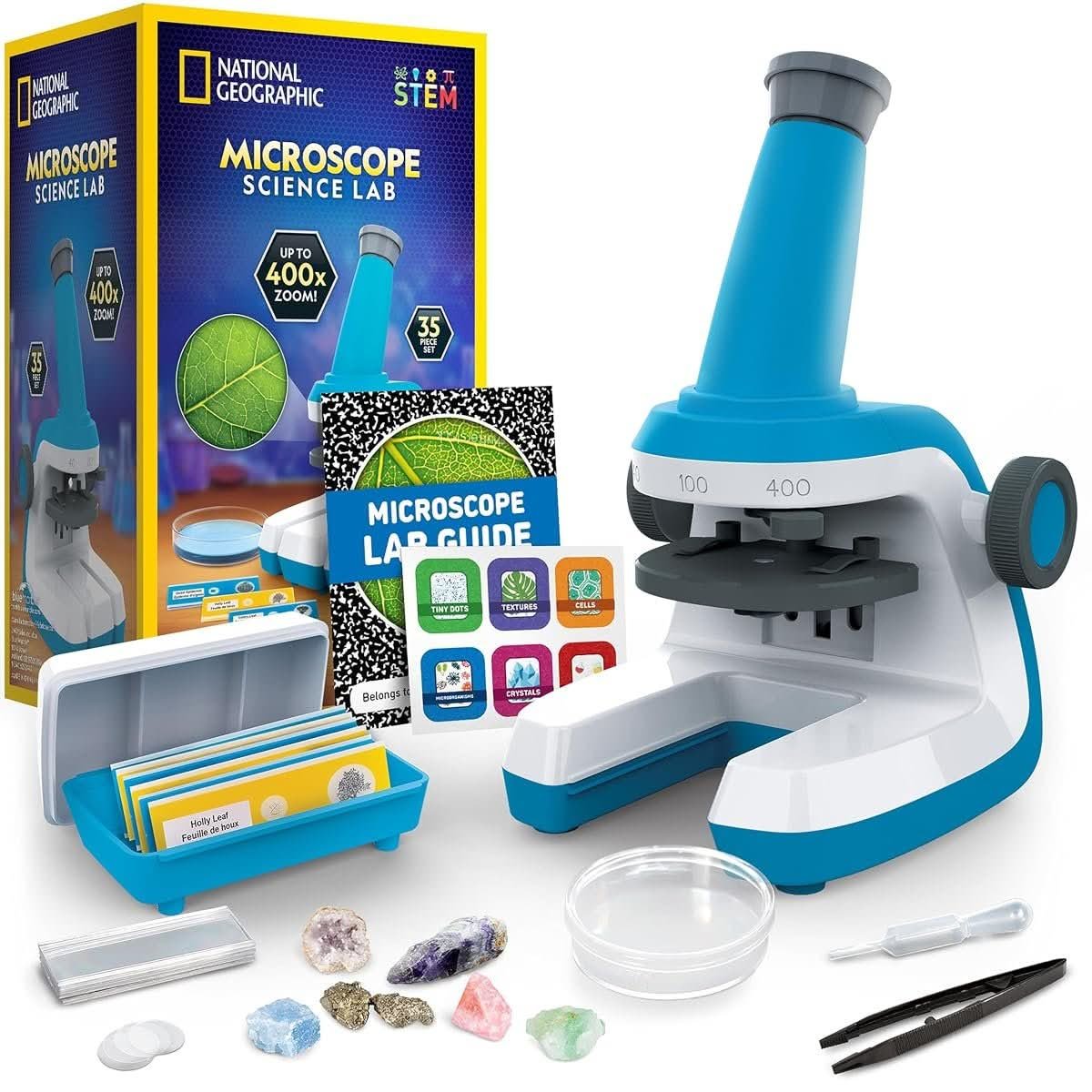
Where the Dual scope above tries to do two jobs, this one does the single compound-microscope job and stops at a properly useful ceiling: three magnification levels topping out at 400x, which happens to be the exact upper end of what school microscopy work actually asks for. NSW’s own Year 8 science syllabus has students make wet mount slides of onion cell, elodea and pond water – all squarely 40x to 400x work, and nothing this scope’s honest ceiling cannot handle.
Large focus knobs are a deliberate design choice for hands that have not yet developed fine motor control for a small fiddly dial, and the kit includes 6 prepared plant slides, 6 blank slides and 6 rock and mineral specimens alongside a pipette, dish and tweezers – enough to get started without an immediate trip back to the shops for consumables.
Pros
- Honest 400x ceiling, exactly the range real classroom microscopy work actually uses
- Large focus knobs suit younger or less coordinated hands
- 18 slides/specimens included across three categories
- 4.5 stars from 2,761 ratings
Cons
- No 3D/stereo viewing mode, slides only, like every compound-only scope here
- Single light path per magnification, not the dual illumination of the Dual model above
Key specs: Compound, up to 400x (3 magnification levels), 18 slides/specimens included
CHECK ON AMAZON3. Bresser Junior Stereo 3D Microscope ICD-Pro – Best Stereo Dissecting Microscope
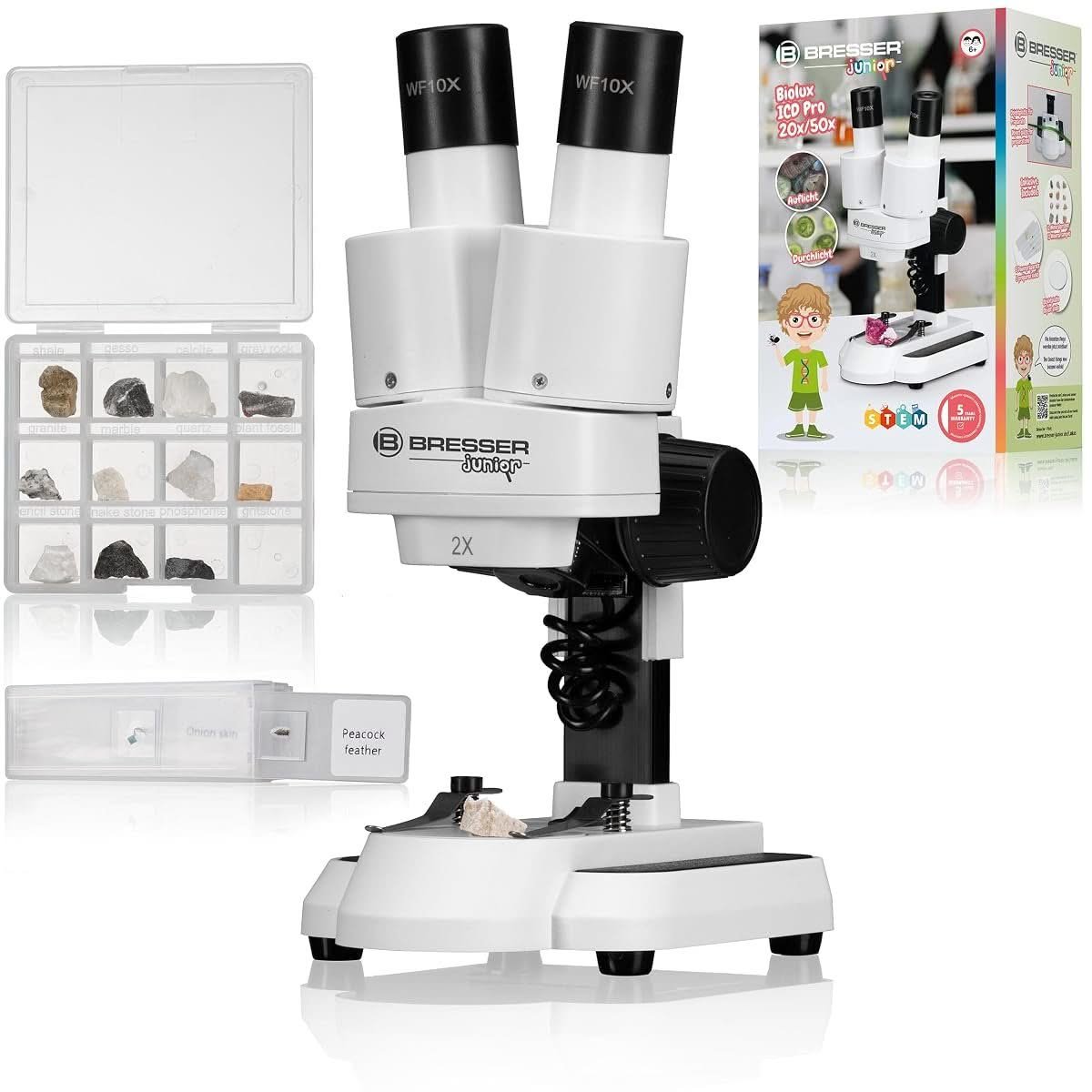
A stereo microscope solves the problem every compound scope creates for a first-time user: closing one eye and holding still over an eyepiece. This one is properly binocular, both eyes open, looking straight down at a real 3D object – a beetle, a coin, a leaf – instead of a flattened image through a prepared slide.
Two eyepiece pairs give 20x and 50x, with incident light (from above, for solid objects) and transmitted light (from below, for anything translucent) both included, plus adjustable eye relief for kids who wear glasses. At just under a kilogram it is heavier than the pocket scopes further down this list, a fair trade for a proper binocular head instead of a toy-grade one.
Pros
- Properly binocular – both eyes open, no need to close one eye like a compound scope
- Both incident (top-down) and transmitted (bottom-up) LED lighting included
- Adjustable eye relief works for kids who wear glasses
- 12 mineral samples included to get started
Cons
- At just under 1kg, heavier than every pocket-format scope in this lineup
- 20x-50x range only – no path to higher magnification if a child’s interest grows toward cells and slides
Key specs: Stereo/binocular, 20x/50x, incident + transmitted LED, 998g
CHECK ON AMAZON4. GeoSafari Jr. Talking Kids Microscope – Best for Preschoolers
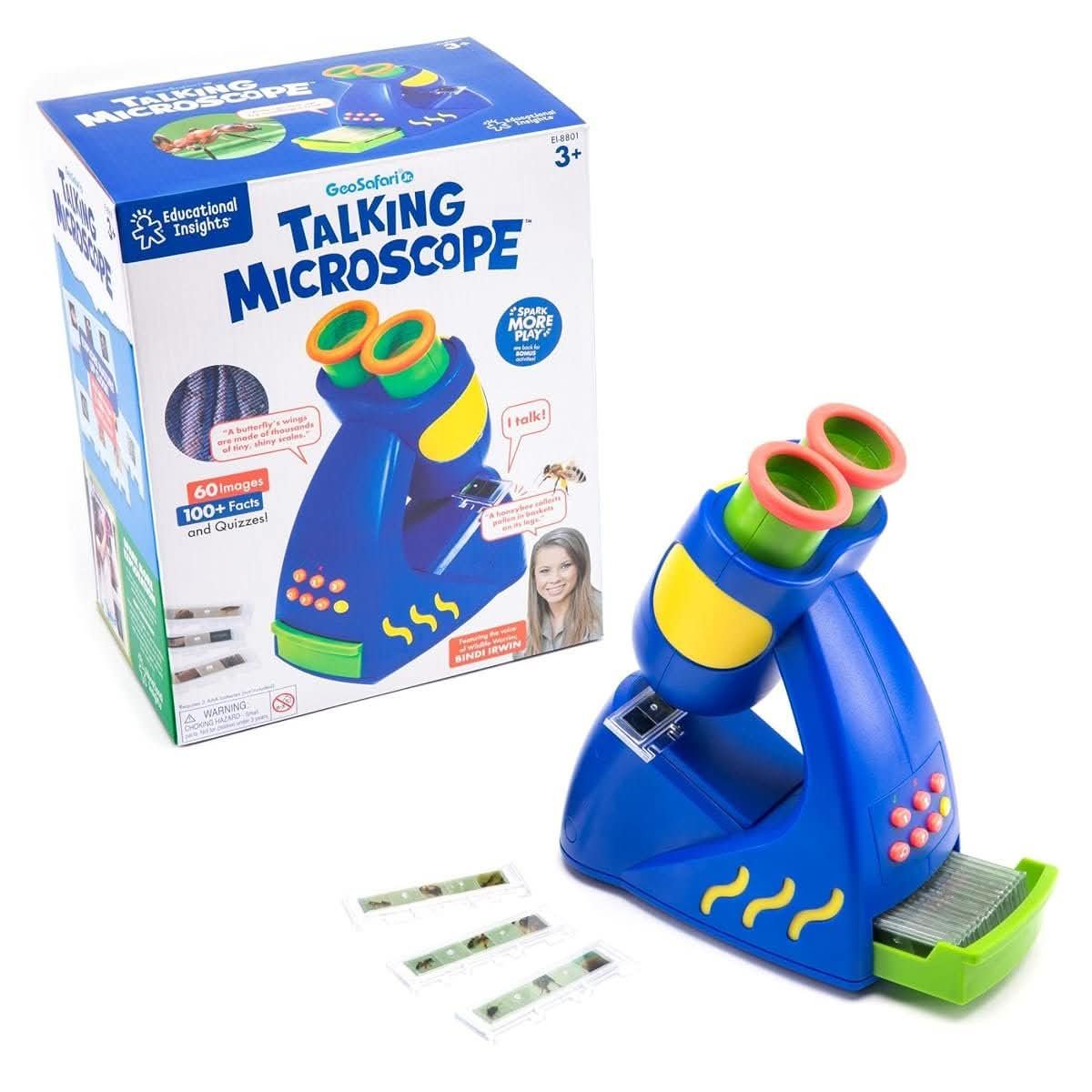
This is not a microscope in the optical sense – there is no live specimen under a lens, just 60 pre-loaded full-colour images cycled through Fact and Quiz modes, narrated in this Australian edition by Bindi Irwin. For the 3-5 age band that cannot yet centre a slide or close one eye, that is arguably the right trade: an engaging toy that teaches the idea of a microscope before a child is physically ready to use a real one.
It runs on 3 AAA batteries, and CHOICE’s own testing of online marketplace toys in November 2025 found 17 of 24 checked failed specifically on button and battery compartment safety – accessible without a tool, missing warning labels, or screws that did not stay secure. Check the battery door on this one locks or screws shut before handing it to a child in the target age band, the same check worth running on any battery toy this Christmas.
Pros
- Properly engaging for the 3-5 age band that cannot yet use a real optical microscope
- Bindi Irwin narration, a real Australian-specific hook
- 4.6 stars from 11,546 ratings, the deepest review base of any pick in this lineup
- Fact and Quiz modes add replay value beyond a single novelty session
Cons
- Not a real optical microscope – 60 pre-loaded images, not a live specimen under a lens
- Runs on 3 AAA batteries; check the compartment locks properly shut before giving it to a young child
Key specs: Preschool talking scope, 60 images, Fact/Quiz modes, 3x AAA batteries
CHECK ON AMAZON5. GeoSafari Jr. My First Microscope – Best Honest Low-Magnification Pick
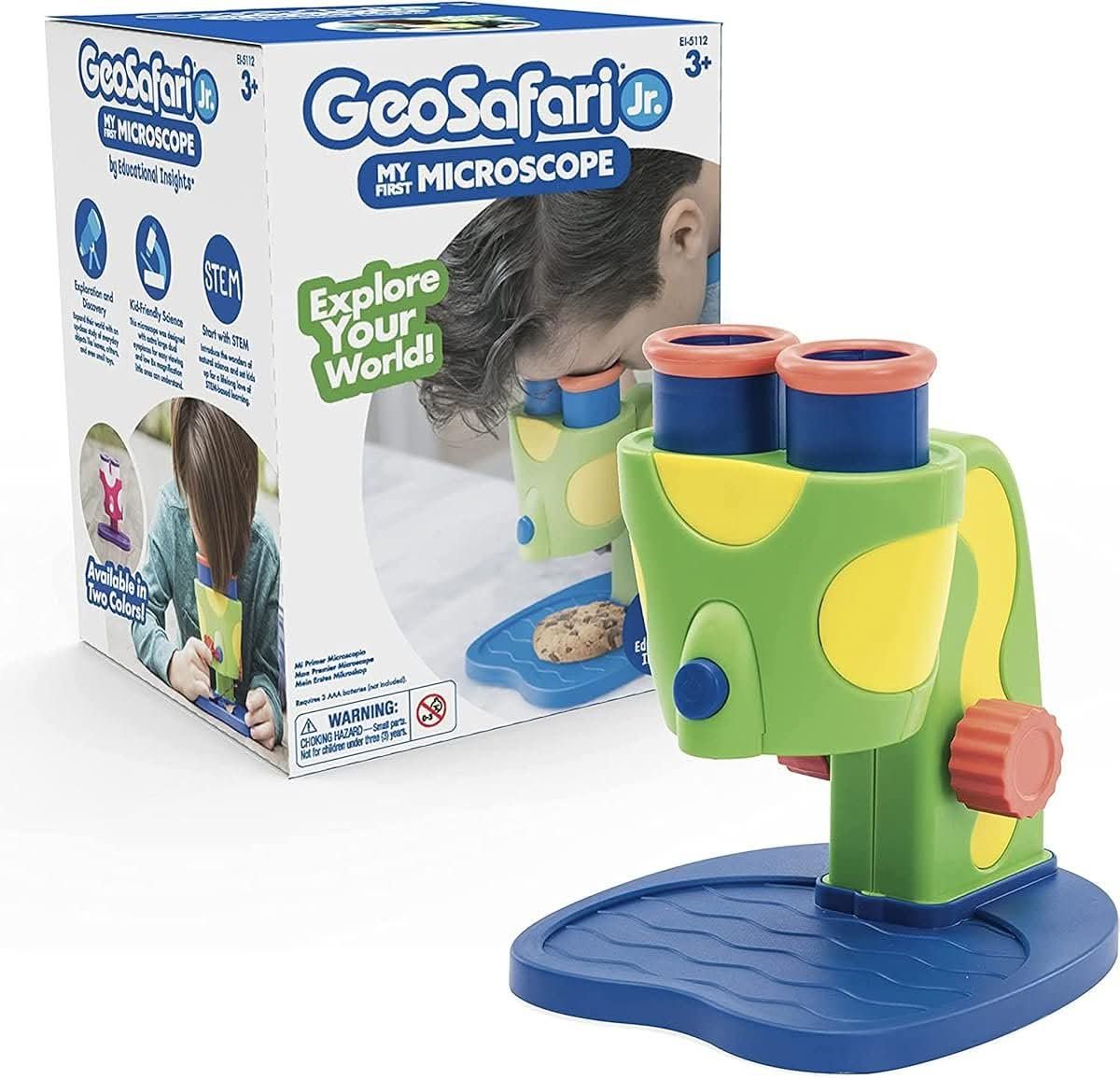
Eight times magnification and nothing more – and that restraint is exactly why this one earns a spot in a guide about honest specs. Two extra-large eyepieces mean a young child never has to close one eye, the single biggest barrier to actually using a microscope before about age 6, solving the same problem the Bresser stereo scope above does at roughly half the price and a tenth of the magnification range.
A chunky, oversized focus knob and non-skid feet are both deliberate concessions to small hands and a wobbly table, and the sample tray holds a real object steady underneath instead of requiring a slide to be prepared at all. At 4.0 stars from 5,992 ratings it is the softest score of any National Geographic or GeoSafari pick here, though still a solid result for a scope this simple.
Pros
- Makes no exaggerated magnification claim – 8x, stated plainly, and nothing more
- Two extra-large eyepieces mean no closing one eye, the main barrier for very young children
- Chunky focus knob and non-skid feet, both real concessions to small hands
- Roughly half the price of the Bresser stereo scope above
Cons
- 4.0 stars is the softest rating of any GeoSafari or National Geographic pick here
- 8x is properly limited – a child who outgrows it within a year or two will want a real step up, not a refill
Key specs: 8x fixed magnification, extra-large eyepieces, chunky focus knob, non-skid feet, ages 3+
CHECK ON AMAZON6. Swift Kids SW50 Beginner Compound Microscope – Best All-Glass Optics on a Budget
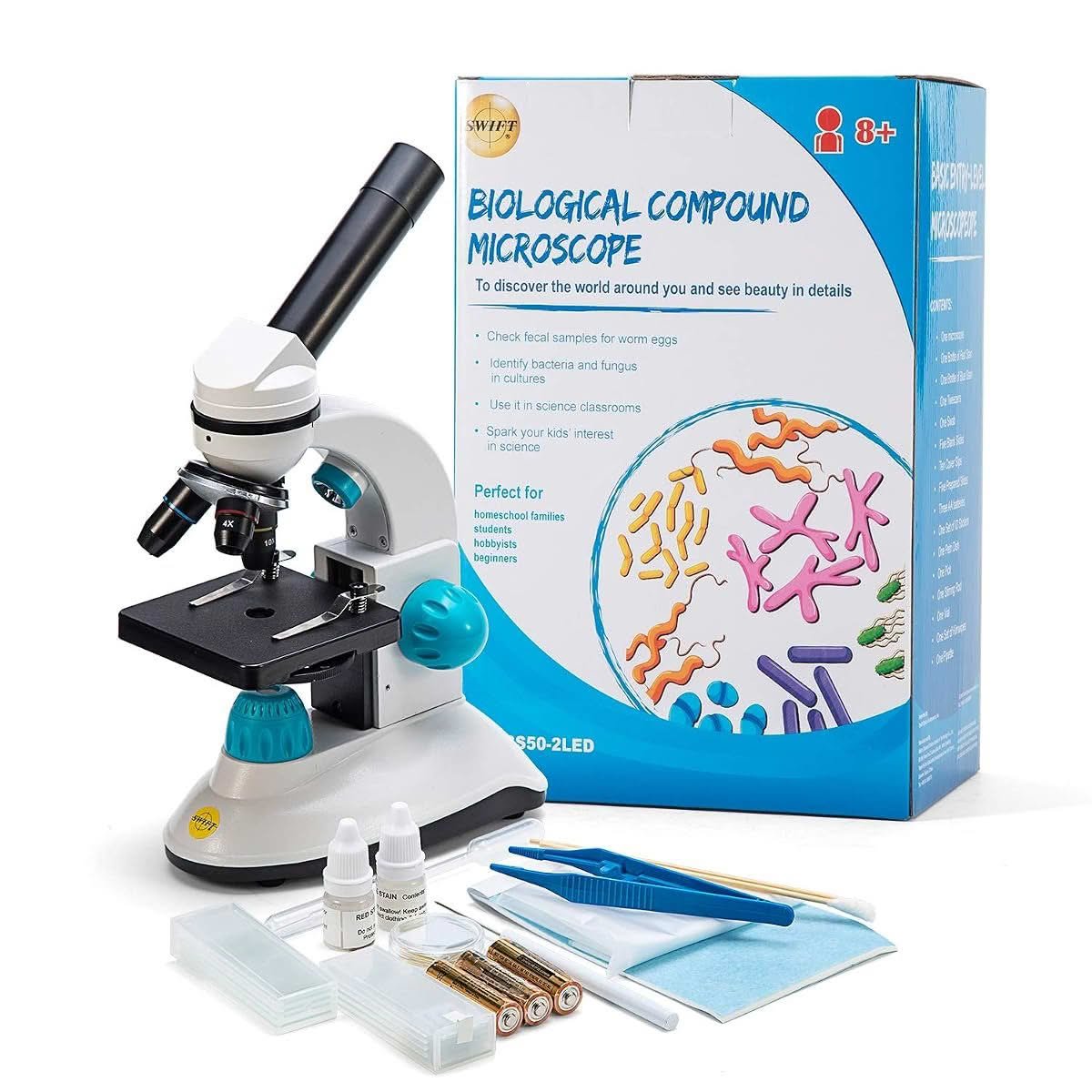
Swift states all-glass optics in its own product copy, one of only two scopes in this entire category found to make that claim outright instead of staying silent on what the lenses are actually made of – silence in this price band usually means plastic. The magnification range is honest too: 40X, 100X and 400X, nothing inflated, which happens to line up exactly with the useful ceiling the physics covered earlier actually supports.
Dual illumination (light from above and below) covers both prepared slides and solid objects, and the stage is sized with clips built for smaller hands instead of a scaled-down adult design. At 4.4 stars from a comparatively thin 110 ratings, it has the smallest review sample of any pick here – worth knowing even though the rating itself is strong.
Pros
- All-glass optics, stated explicitly – one of only two scopes in this category to make that claim
- Honest 40X/100X/400X range with no inflated numbers
- Dual illumination for both slides and solid objects
- Stage and clips sized for smaller hands
Cons
- 110 ratings is the thinnest review sample of any pick in this lineup, though the score itself is strong
- Costs more than the National Geographic 400x model above for a similar honest magnification ceiling
Key specs: All-glass optics, 40X/100X/400X, dual illumination, sized for smaller hands
CHECK ON AMAZON7. Carson MicroBrite Plus – Best Budget Pocket Microscope
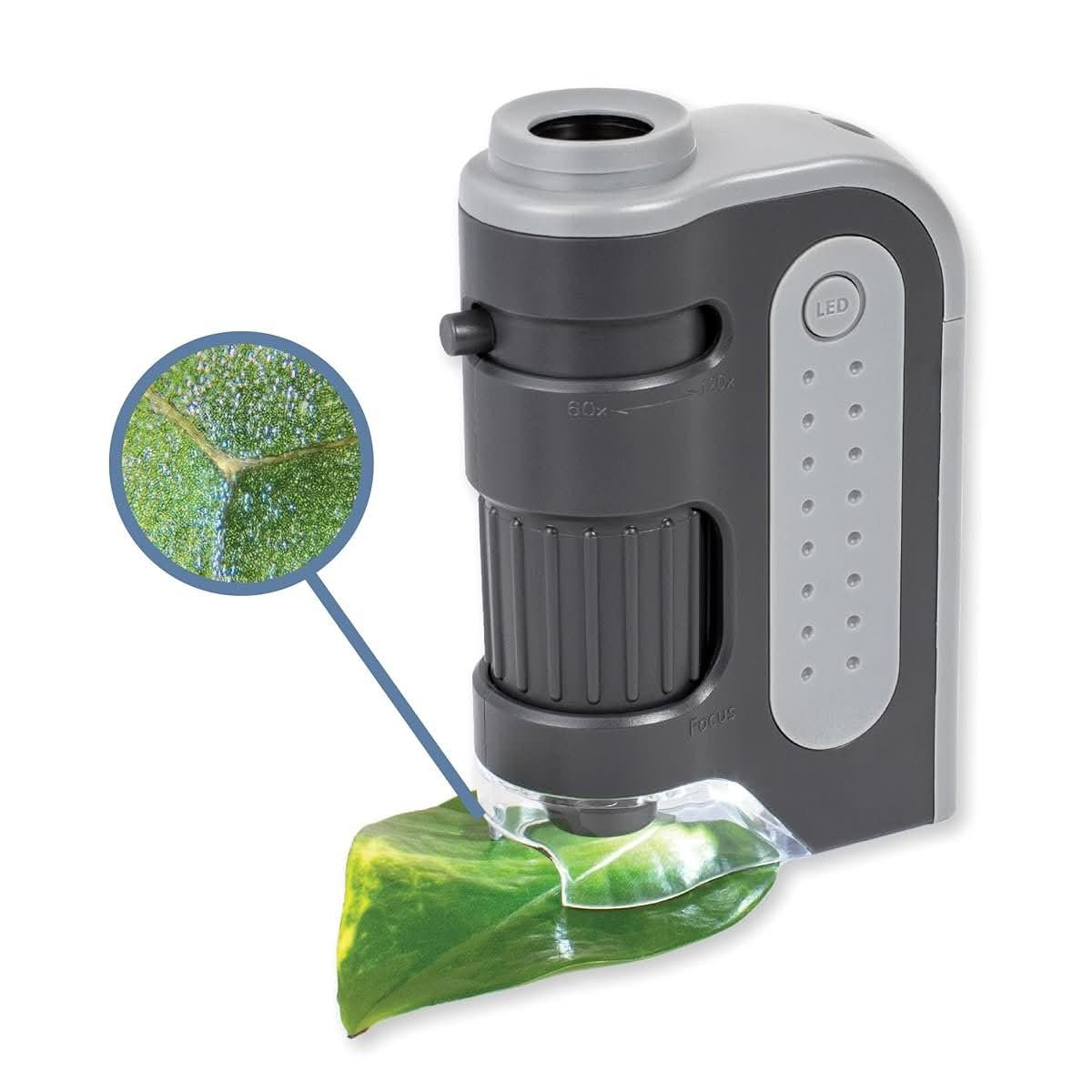
53,979 ratings is not a typo – this pocket scope has the single deepest review base of any product in this entire guide, by a wide margin. It is a properly different format from every compound and stereo scope above: no stage, no slide, just a handheld pocket instrument pointed at a leaf, a coin or a stamp and looked straight through, magnifying 60x to 120x on the spot.
An aspheric internal lens system is the reason a handheld design can still produce a usable image without a stand to hold it steady, and running on a single AA battery keeps it light enough to actually live in a school bag or a nature-walk pocket instead of sitting on a shelf at home.
Pros
- Deepest review base of any product in this entire guide, 53,979 ratings
- Properly portable – fits in a pocket, no stage or stand required
- Aspheric lens system keeps the image usable without a fixed mount
- Runs on a single AA battery
Cons
- 60x-120x only – no path to the higher magnifications a compound scope offers for cells or slides
- Not a desk instrument – a child who wants to sit and study a specimen for a while is better served by one of the compound picks above
Key specs: Handheld pocket scope, 60x-120x, aspheric lens, 1x AA battery
CHECK ON AMAZON8. Carson MicroFlip – Best Field/Outdoor Pocket Microscope
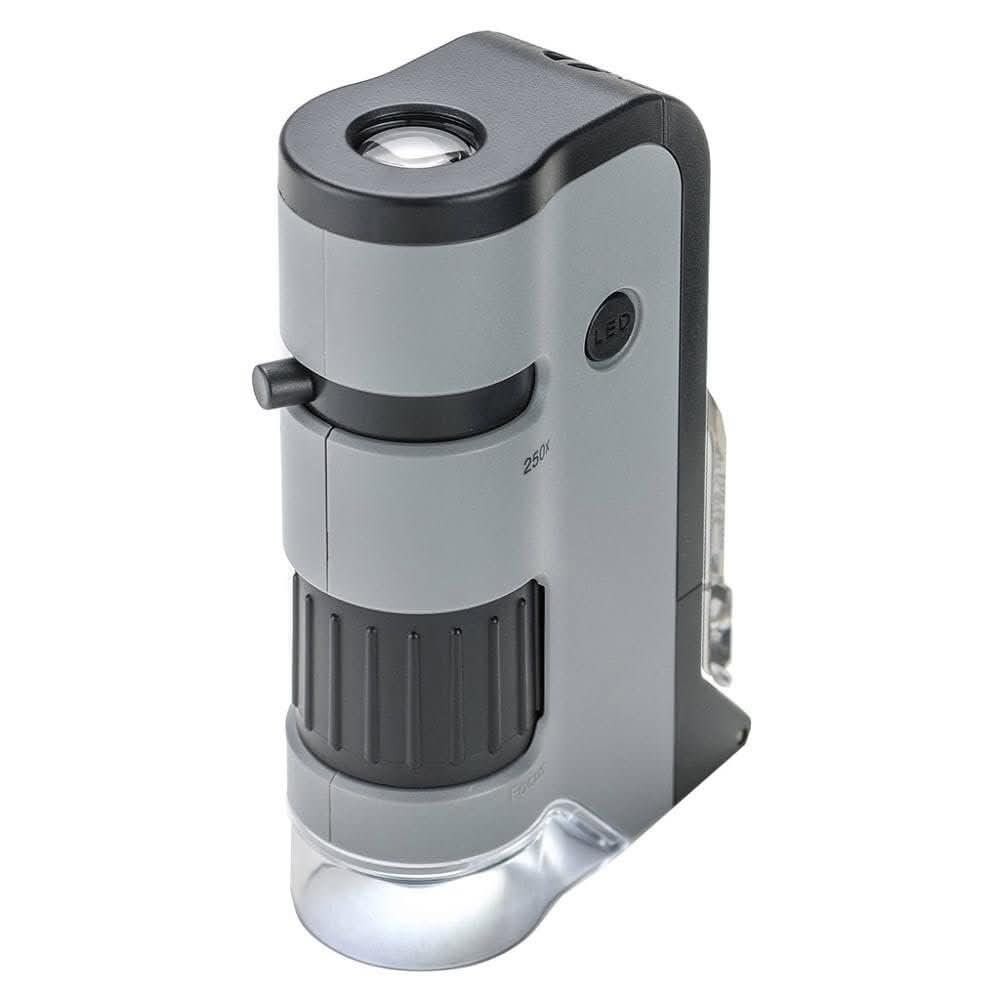
MicroFlip is Carson’s step up from the MicroBrite above: higher magnification at 100x to 250x, a fold-down sliding base that turns the handheld pocket format into something closer to a small standing scope, and a built-in UV torch for the kind of fluorescent-mineral or scorpion-glow trick that gets a reluctant kid actually excited about looking at things.
A smartphone clip lets a child photograph whatever is under the lens instead of just glimpsing it and moving on, which matters for anyone who wants to show a parent or a teacher what they found. At 8,939 ratings and 4.1 stars it carries real social proof, a step behind the MicroBrite above but still a properly deep sample for this category.
Pros
- Higher magnification than the MicroBrite above at 100x-250x
- Built-in UV torch for fluorescent mineral and scorpion-glow effects
- Smartphone clip lets a child photograph and share what they find
- Fold-down sliding base doubles as a small stand
Cons
- Only one starter slide included, fewer accessories than the compound kits above
- Still a single AA battery pocket format – not a substitute for a proper compound scope if slide work is the goal
Key specs: 100x-250x, UV torch, smartphone digiscoping clip, fold-down base, 1x AA
CHECK ON AMAZON9. AmScope M30 Beginner Compound Microscope Kit – Best Real Compound Scope Above 400x
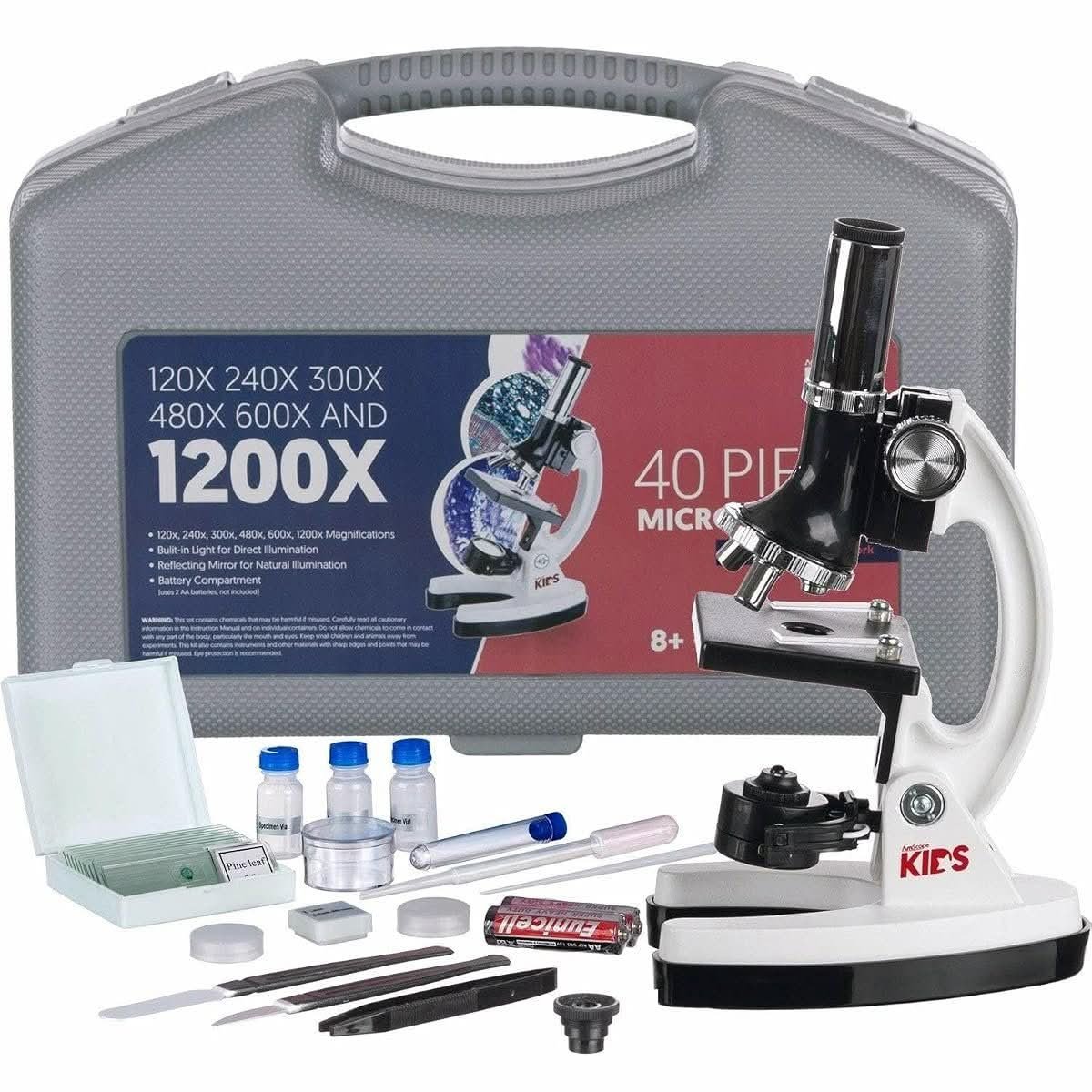
This is the scope to use as the honest test case for the 1200x claim printed right on its own box. A 40x objective, the highest this kit or almost any kids’ scope actually has, caps useful magnification at roughly 650x even at a lab-grade numerical aperture, per the physics covered earlier. The extra magnification past that point comes from a high-power eyepiece multiplying an already-blurry image, not resolving more detail – what optics texts call empty magnification.
None of that makes it a bad scope. At 300x and 600x it does everything a real compound microscope should, with a metal arm frame that is sturdier than the mostly-plastic bodies elsewhere in this price band, and a 48-piece kit that covers slides, tools and specimens to get started immediately. Treat 1200x as a number to ignore, not a reason to avoid the product.
Pros
- Metal arm frame, sturdier than the mostly-plastic bodies common at this price
- 300x and 600x are both properly useful, real compound-microscope magnifications
- 48-piece kit covers slides, tools and specimens
Cons
- The advertised 1200x figure exceeds the real optical ceiling of any 40x objective – treat it as marketing, not a usable magnification
- 847 ratings is a moderate sample, thinner than the National Geographic or GeoSafari picks above
Key specs: Compound, 300x/600x/1200x (1200x exceeds real optical ceiling – see intro), metal arm frame, 48-piece kit
CHECK ON AMAZON10. BEBANG 1000X Handheld 4K Digital Microscope – Best Digital Screen-Based Microscope
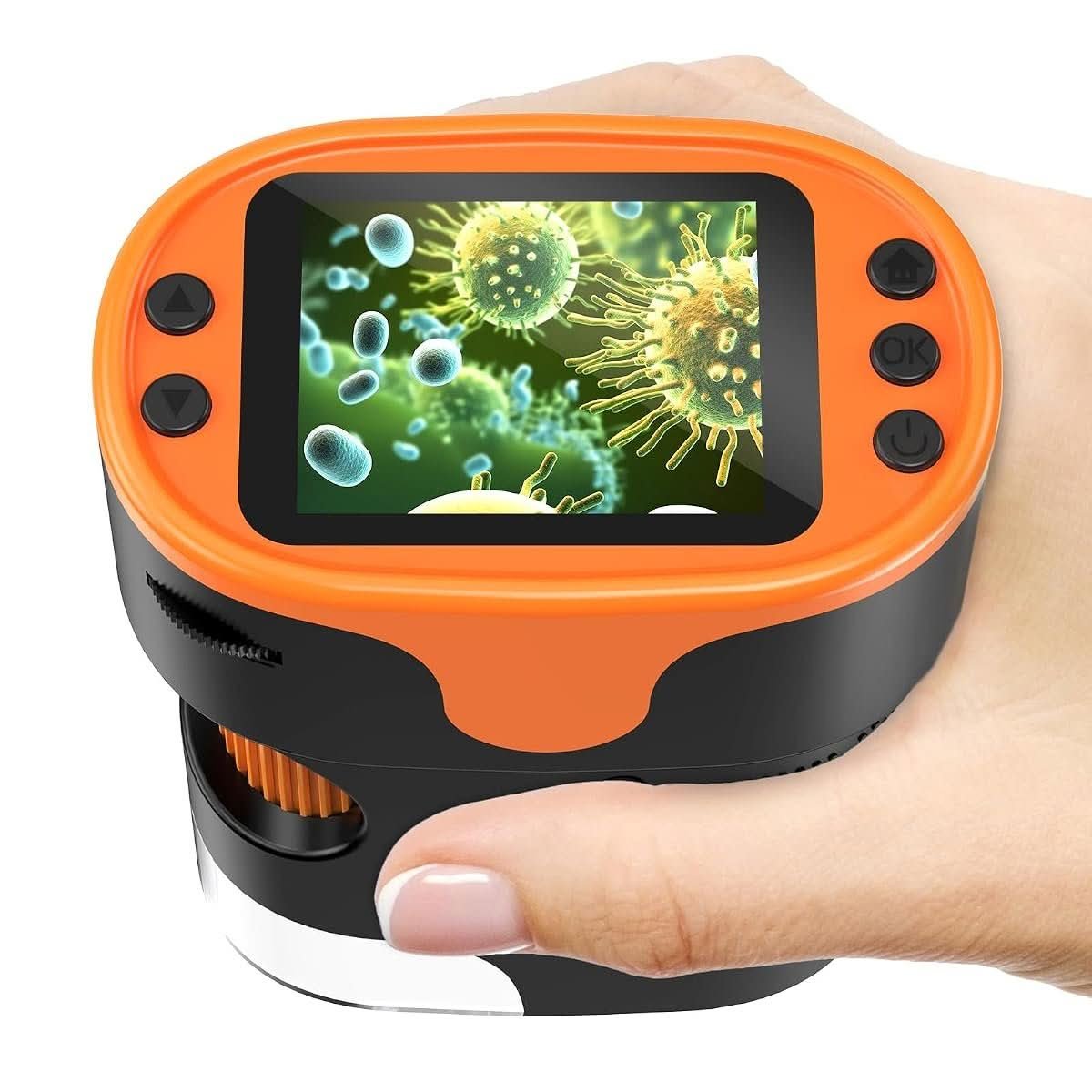
Every other scope here asks a child to close one eye and look through an eyepiece. This one has no eyepiece at all – a 2.0 inch screen shows the image live, which means several kids can crowd around and look at the same time, and nobody has to master the one-eyed squint that trips up most first-time microscope users.
The advertised 200x-1000x range is delivered through a 5-level zoom, discrete steps instead of continuous optical magnification, so treat “1000x” the same way this guide treats every other inflated number: real, but not free of the same empty-magnification limits. At 155 grams with a 2.5 hour battery life, a neck strap and an EVA carry case, it is built to travel instead of sit on a desk.
Pros
- No eyepiece – a 2.0 inch screen lets several kids look at once
- Solves the one-eyed-squint barrier differently from every optical scope above
- Lightweight at 155g with a neck strap and carry case
- 4.5 stars from 2,195 ratings
Cons
- The 200x-1000x range is a 5-level digital zoom, not continuous optical magnification – same honesty caveat as every other high number here
- 2.5 hour battery life needs recharging partway through a long session
Key specs: Digital, 200x-1000x (5-level zoom), 2.0-inch screen, 155g, 2.5hr battery
CHECK ON AMAZONHow to Choose a Kids Microscope in Australia
Ignore the biggest number on the box – it is the least useful spec. Would a microscope that actually delivered 1200x from a basic 40x objective not be front-page optics news, not an ordinary kids’ toy? The standard optics reference on this sets useful magnification at up to 1000 times the numerical aperture of the objective lens, and calls anything past that “empty magnification” – a bigger image with no extra detail. Published numerical aperture values put a 40x objective, the strongest most kids’ scopes have, at roughly 0.65 – a useful ceiling of about 650x even at lab quality. A box claiming 1000x, 1200x or more from that same lens is selling a number the optics cannot deliver, and three products in this guide print exactly that claim.
Match the instrument to what small hands can actually do, not to the age printed on the box. A 3 to 5 year old cannot centre a slide, close one eye or turn a fine-focus knob, so a dual-eyepiece low-power viewer or a talking scope is the honest fit. A 5 to 7 year old can manage a stereo scope at 20x-50x looking at real 3D objects. An 8 to 10 year old can make a wet mount with help and is ready for a compound scope at 40x-400x with glass optics. From about 11, coarse-and-fine focus and a mechanical stage matter more than any number on the box.
Four things predict a good kids’ microscope more reliably than the magnification figure. Glass objectives beat plastic, though most listings stay silent on which they use – silence usually means plastic. LED lighting is the modern default, and dual illumination (a lamp above for objects, one below for slides) is a real step up. Coarse-and-fine focus beats coarse-only once magnification climbs past about 100x. And blank slides, cover slips and a pipette matter more long-term than a stack of prepared slides, which are usually a first-hour novelty.
Match the magnification to what is actually being looked at, not the other way around. NSW’s own Year 8 science syllabus has students “make a wet mount slide (eg onion cell, elodea, hay infusion, pond water)” – coins, insects and fabric sit at 10x-50x stereo range; onion cells and plant stems need roughly 40x-100x; pond water protozoa need 100x-400x; and 400x is the practical top for anything a child will look at at home. Nothing in a home kit genuinely needs 1000x, let alone 1200x or 2000x.
Check the battery compartment before anything else if buying for a child under about 8. CHOICE’s own testing of online marketplace toys, published in December 2025, found 6 of 22 checked failed safety testing, and its November 2025 round found 17 of 24 failed specifically on button and battery compartment safety – accessible without a tool, or with screws that did not stay secure. Four mandatory Australian standards for button batteries have applied since 2022, requiring a battery compartment that opens only with a tool – check that requirement is actually met before handing any battery-powered microscope to a young child.
Replacement slides and consumables are properly easy to find in Australia. A dedicated Australian microscope specialist stocks prepared slide sets, blank slide kits and slide storage cases from about the price of a coffee, so running out of consumables is not a reason to avoid a compound scope. Australian Geographic’s own retail range sells a basic kids’ microscope for roughly the price of the cheapest pocket pick in this guide – useful as a ceiling for what a bricks-and-mortar Australian retailer charges for the same category.
You’ll Also Want
A 48-piece prepared slide set covers insects, plants and animals well beyond the handful of slides bundled with most kits here. 48-piece prepared microscope slide set.
Blank slides and cover slips are what actually keep a compound microscope in use once the bundled prepared slides run out. 50-piece blank glass slide set.
A handheld insect-viewing loupe pairs naturally with any of the pocket scopes above for a backyard bug hunt that does not need a full microscope setup. Carson BugView insect magnifier.
Frequently Asked Questions
What magnification does a kids’ microscope actually need?
Far less than the box usually claims. Coins, insects and fabric only need 10x to 50x. Onion cells and plant stems need roughly 40x to 100x. Pond water microorganisms need 100x to 400x, and 400x is the practical top for anything a child will look at at home. Claims of 1000x or more from a basic objective exceed the real optical limit of the lens.
Why does a box say 1200x when the microscope can’t actually show more detail at that level?
Because useful magnification is capped by the lens, not the eyepiece. Optics references put the ceiling at about 1000 times the numerical aperture of the objective, and a typical kids’ scope’s strongest lens caps out around 650x even at lab quality. Past that, a high-power eyepiece just enlarges the blur, a real phenomenon called empty magnification, not a manufacturing trick specific to any one brand.
What age is a real microscope appropriate for, versus a toy viewer?
Around 8 is the realistic age for a real compound microscope with slides, since that is when most children can make a simple wet mount with help. Younger children, roughly 3 to 7, get more use from a low-power stereo scope or a talking/image-based viewer, since they cannot yet close one eye or hold steady over an eyepiece.
Are cheap kids’ microscopes safe, especially the battery compartment?
Check it directly rather than assuming. CHOICE’s own 2025 testing of online marketplace toys found more than two-thirds failed on battery compartment safety specifically – compartments openable without a tool, or with screws that did not stay secure. Australian mandatory standards require a tool to open any battery compartment on a children’s toy; confirm that in practice before handing one to a young child.
Do I need to buy extra slides separately?
Eventually, yes, if a child stays interested. Prepared slides bundled with most kits are a first-week novelty, and what keeps a microscope in ongoing use is a supply of blank slides and cover slips for making new specimens. These are inexpensive and easy to buy in Australia through specialist optics retailers or the marketplace.
What is the difference between a stereo microscope and a compound microscope?
A stereo (dissecting) microscope is binocular and low-power, built for looking at whole 3D objects like insects or coins with both eyes open. A compound microscope uses a single eyepiece and prepared slides to view flatter, higher-magnification specimens such as cells, and is generally the harder format for a young child to use unaided.
For most families, the National Geographic 400x compound microscope covers real classroom-style microscopy without an inflated magnification claim to work around; anyone with a child under 6 should start with the GeoSafari Jr. My First Microscope or the Bresser stereo scope instead, since neither demands closing one eye; and the Carson MicroBrite Plus is the easy low-risk add-on at any age, backed by the deepest Australian review base of anything here.