A deep fryer is a benchtop appliance that fully submerges food in hot oil, held at a set temperature by a heating element, to cook it in one to five minutes with a crisp exterior an oven or a pan cannot reproduce. Where an air fryer circulates hot air around food coated in a thin film of oil, a deep fryer immerses the food completely, and that difference in method is the difference in result: real deep-fried batter, not an approximation of one.
Three formats are sold in Australia. Single-tank countertop fryers hold 2 to 4 litres of oil for one basket at a time and suit a household cooking chips or nuggets a few times a month. Multi-cooker fryers pair frying with boiling, roasting or braising in the same bowl, trading some frying performance for versatility. Commercial-style benchtop fryers scale up to 10 to 20 litres and 4000W plus, often across two separate tanks, built for a household that fries often or in real volume. Choice’s own buying guide is blunt about where the more popular appliance stops short: if you want to cook battered foods, an air fryer can’t replace a deep fryer.
Oil capacity decides how much food cooks in one batch, and across these eight fryers it runs from 2 litres to 12 litres. The spec most buyers skip is recovery time: how fast the oil returns to temperature after food drops it. A fryer that recovers slowly cooks the first batch properly and the third one soggy, because the oil never climbs back to 180 degrees before the next load goes in. On ProductReview’s deep fryer category, the single most repeated complaint across brands and price points is a unit that simply won’t get hot enough.
This guide compares eight electric deep fryers sold in Australia, from a 2-litre countertop unit to a 12-litre double-basket commercial-style fryer, budget to premium. One honest boundary: oil frying carries a real burn and fire risk an air fryer does not, and How to Choose deals with that directly instead of glossing over it. Prefer to skip the oil altogether? The air fryer comparison covers that alternative.
Quick Picks

Breville the Smart Deep Fryer BDF500BSS
Rates 4.0 on ProductReview against 3.0 for the Sunbeam further down, on real Australian data.
CHECK ON AMAZON
Tefal Filtra Pro Deep Fryer FR5181
A built-in oil filter, the one feature reviewers say turns cleanup from a chore into five minutes.
CHECK ON AMAZON
Sunbeam DF4500 Multi Cooker Deep Fryer
Cheapest fryer here on Amazon AU (4.3), but only 3.0 on ProductReview’s Australian data.
CHECK ON AMAZONBest Deep Fryers in Australia Compared
| Product | Link | Type | Best For | Key Spec |
|---|---|---|---|---|
| Breville the Smart Deep Fryer BDF500BSS | Check price | Single-tank fryer | Households frying weekly | 4L oil, digital control |
| Tefal Filtra Pro Deep Fryer FR5181 | Check price | Single-tank fryer | Frequent fryers who hate cleanup | 4L oil, built-in filter |
| Russell Hobbs 24570 Deep Fryer | Check price | Single-tank fryer | Occasional home frying | Basic single tank, viewing window |
| Sunbeam DF4500 Multi Cooker Deep Fryer | Check price | Multi-cooker fryer | Budget buyers wanting versatility | 5L, boil/roast/fry |
| Healthy Choice 3.8L Deep Fryer | Check price | Single-tank fryer | One or two people | 3.8L, thermal safety cutoff |
| Devanti 20L Deep Fryer Double Tank | Check price | Commercial-style double-tank fryer | Large households or small food businesses | 20L, two 4400W tanks |
| Tefal Versalio 7 in 1 MultiFryer FR4900 | Check price | Multi-cooker fryer | Households that fry rarely | Adjustable oil volume, 7 functions |
| TANGME Commercial Deep Fryer 12L | Check price | Commercial-style double-basket fryer | Large-batch frying on a budget | 12L, two 6.35QT baskets, 5000W |
How We Picked
We swept the Australian catalogues of five affiliate retailers for electric deep fryers and found none: every fryer-labelled product on those storefronts was an air fryer, several explicitly marketed as oil-less. This shortlist is sourced entirely from Amazon AU as a result, filtered from roughly 25 listings down to true immersion fryers with an Australian plug and local stock. One well-reviewed unit was dropped outright for shipping with a UK plug despite sitting on the Australian store, confirmed by multiple Australian buyers hitting the same problem.
Picks were cross-referenced against ProductReview’s deep fryer category, 131 Australian reviews across competing models, plus Choice’s air fryer guide for the boundary between the two appliances, with recurring complaints used to write the drawbacks in each entry. We don’t physically test every product. Selections are informed by affiliate partnerships, but commission never overrides editorial ranking when a lower-commission product is the better pick.
1. Breville the Smart Deep Fryer BDF500BSS – Best Build Quality
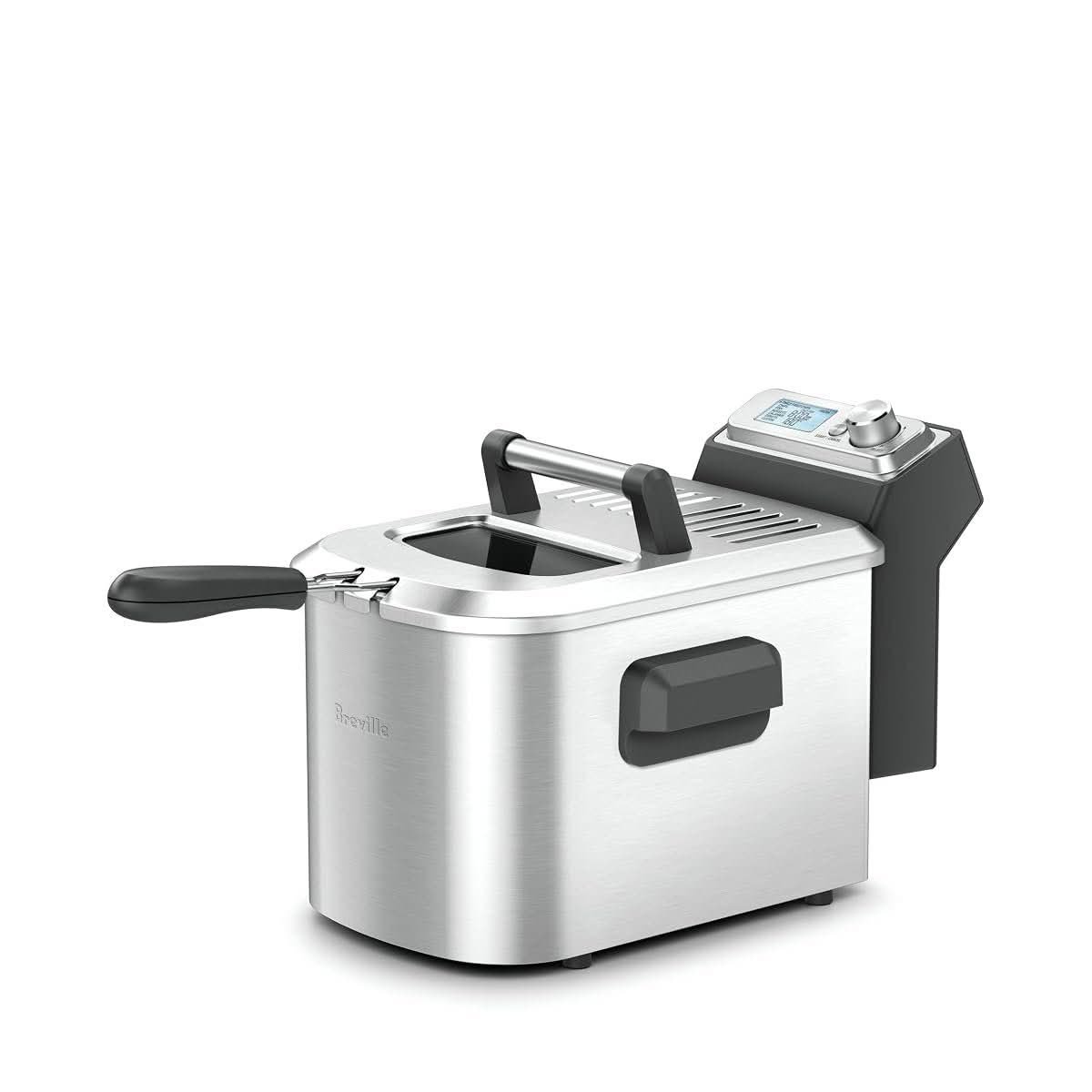
Breville’s name on small appliances is the reason to start here, and the evidence backs it up on two separate platforms: 4.3 out of 5 across 99 Amazon AU ratings, and 4.0 on ProductReview’s dedicated deep fryer category, the highest score any fryer on that page carries. The whole unit disassembles for cleaning, which reviewers single out against cheaper fryers that trap oil in seams a sponge can’t reach.
One Australian ProductReview buyer describes using it for chicken schnitzels, doughnuts, beer-battered fish and banana fritters. That’s a fair snapshot of what a 4-litre single-tank fryer is actually for on a Friday night. Reliability is the one attribute that splits opinion: most units run for years, a minority fail around the two-month mark, and on a benchtop appliance at this money that’s worth knowing going in.
It costs close to double the Russell Hobbs further down this page, and the extra buys a digital timer, a proper control unit, and a cleanup that doesn’t leave your kitchen smelling of last week’s oil (a real problem in a small apartment with no rangehood). Premium end of this lineup, and if that feels steep, the Russell Hobbs does the same basic job for roughly half.
Pros
- 4.0 on ProductReview, the highest score of any fryer on that category page
- Full disassembly for cleaning, unlike fryers with fixed internal seams
- Digital timer and temperature control instead of a low-medium-high dial
- 4-litre capacity handles a family-size batch of chips or schnitzels
Cons
- A minority of reviewers report failure at around the two-month mark, on an otherwise well-built unit
- The control unit can’t be immersed in water, easy to forget mid-clean
- Costs close to double the Russell Hobbs further down for broadly the same core job
- Only three units showing in stock at the time of writing
Key specs: 4L oil capacity; 1.3kg food capacity; digital timer and temperature control; fully removable, dishwasher-safe parts; rated 4.3 out of 5 from 99 Amazon AU ratings and 4.0 out of 5 on ProductReview.
CHECK ON AMAZON2. Tefal Filtra Pro Deep Fryer FR5181 – Best Oil Filtration
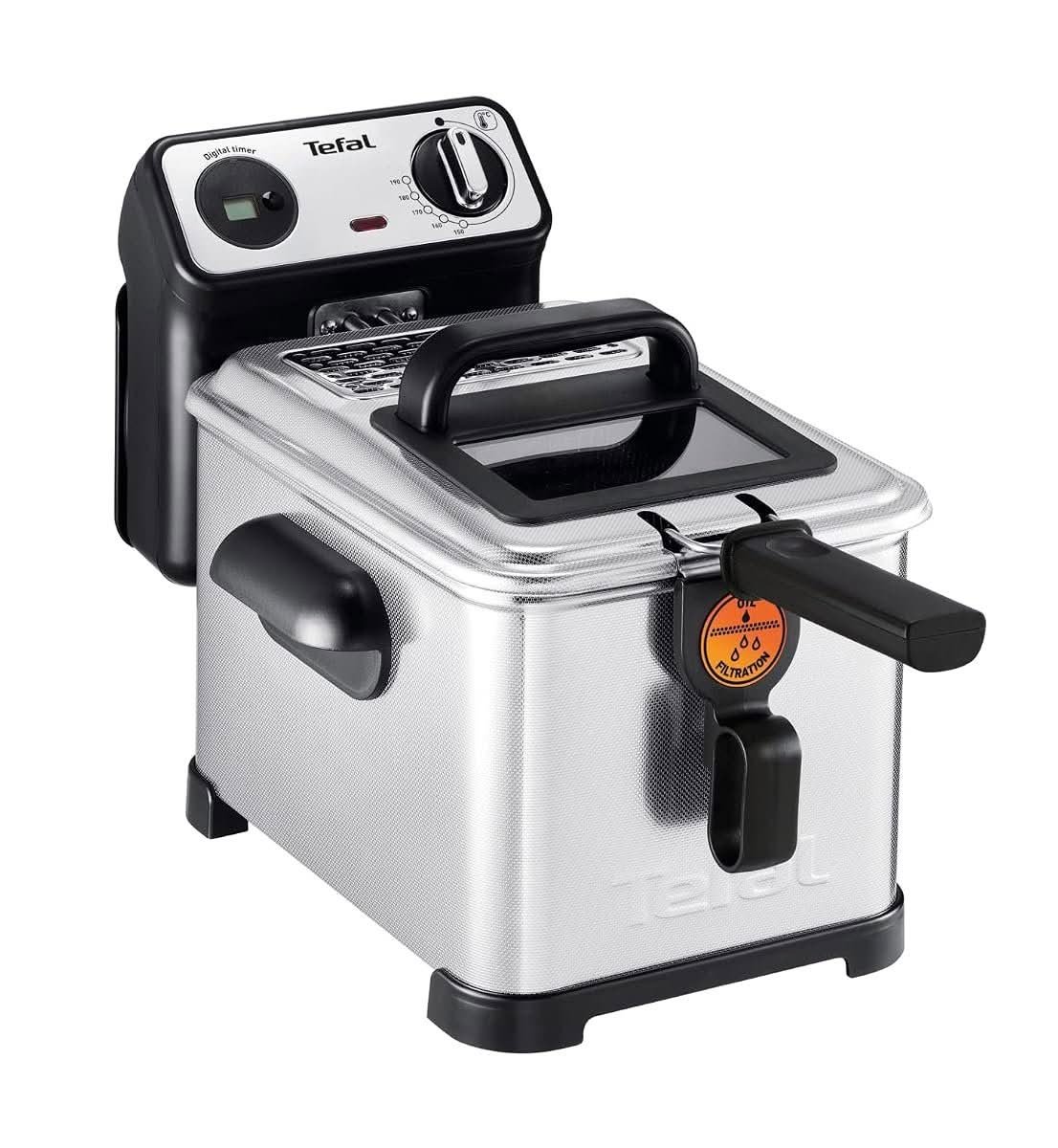
The Filtra Pro name describes exactly what sets it apart from every other fryer on this page: a built-in filtration system that strains used oil back into a clean state as it drains, instead of leaving you to pour hot oil through a funnel over the sink at 10pm. Reviewers rate it 4.5 out of 5 across 170 Amazon AU ratings, and quality is the single most-mentioned attribute, ahead of ease of use and everyday functionality both.
One Australian buyer switched from a Sunbeam that wouldn’t reach frying temperature and hasn’t looked back. Another specifically praises it for tempura and Japanese fried chicken, both of which need a higher, steadier oil temperature than a basic chip fryer, so that’s a real stress test of the 2000W element and thermostat working together, not a throwaway compliment.
The viewing window and digital timer round it out. Where it loses ground against the Breville above is food capacity: both hold 4 litres of oil, but the Tefal’s 1.3kg food capacity is matched, not beaten, so this is a filtration upgrade at a similar price, not a bigger fryer.
Pros
- Built-in oil filtration, which reviewers repeatedly credit with cutting cleanup to a few minutes
- 4.5 out of 5 across 170 Amazon AU ratings, the top score on this page
- A buyer specifically credits it with nailing tempura and Japanese fried chicken
- Digital timer and a viewing window to check colour without lifting the lid
Cons
- Oil usage draws mixed feedback, without full agreement on how efficiently it manages a full tank
- Same 1.3kg food capacity as the Breville above at a similar price, so the upgrade is filtration, not size
- Dishwasher-safe parts still need a full strip-down to actually reach the filter itself
- Sold through the Rowenta storefront instead of a dedicated Tefal one, which trips some buyers up at checkout
Key specs: 4L oil capacity; 1.3kg food capacity; built-in oil filtration; digital timer; viewing window; dishwasher-safe removable basket; rated 4.5 out of 5 from 170 Amazon AU ratings.
CHECK ON AMAZON3. Russell Hobbs 24570 Deep Fryer – Best Budget Pick
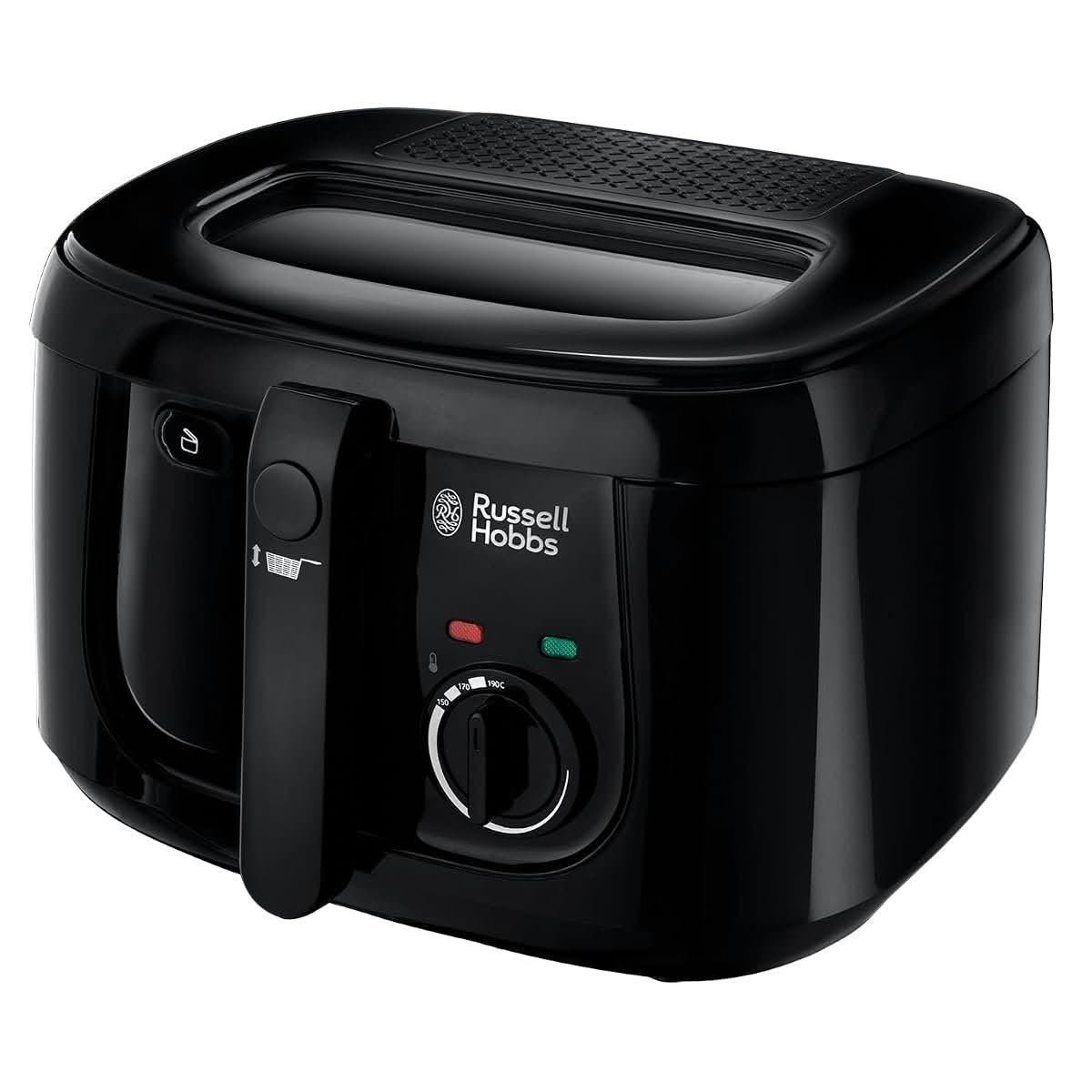
At 4,101 ratings this is the most-reviewed fryer on this page by a wide margin, and 4.2 out of 5 across that many buyers is a sample worth trusting. Cooking performance is the most-praised attribute; one reviewer specifically notes it fries chips perfectly every time, which is the one job most people buy a fryer to do.
Quality and value for money split opinion more than any other attribute in its data, and two mechanical complaints turn up often: the lid popping open mid-fry, and the basket sitting too high to fully submerge food. Neither is universal, but both show up enough to expect, not write off as one unlucky delivery.
The most affordable single-tank pick here, at close to half what the Breville above asks, for a simpler fryer with no digital controls and no full disassembly. Fair trade for chips a few times a month instead of a weekly fry-up, and the review volume here means the average outcome is well documented, even if the ceiling and the floor both sit lower than the pricier picks around it.
Pros
- 4.2 out of 5 across 4,101 ratings, the deepest evidence base on this page
- Reviewers specifically praise consistent chip results
- Costs close to half the Breville above
- Simple controls with nothing to learn
Cons
- A repeated complaint reports the lid popping open by itself mid-fry
- Multiple reviewers say the basket doesn’t sit low enough to fully submerge food
- Quality and value for money are the two most-mixed attributes in its own data
- No digital timer or temperature readout, just a dial
Key specs: Single-tank electric fryer; viewing window; adjustable thermostat; removable basket; rated 4.2 out of 5 from 4,101 Amazon AU ratings.
CHECK ON AMAZON4. Sunbeam DF4500 Multi Cooker Deep Fryer – Best Multi-Function Value
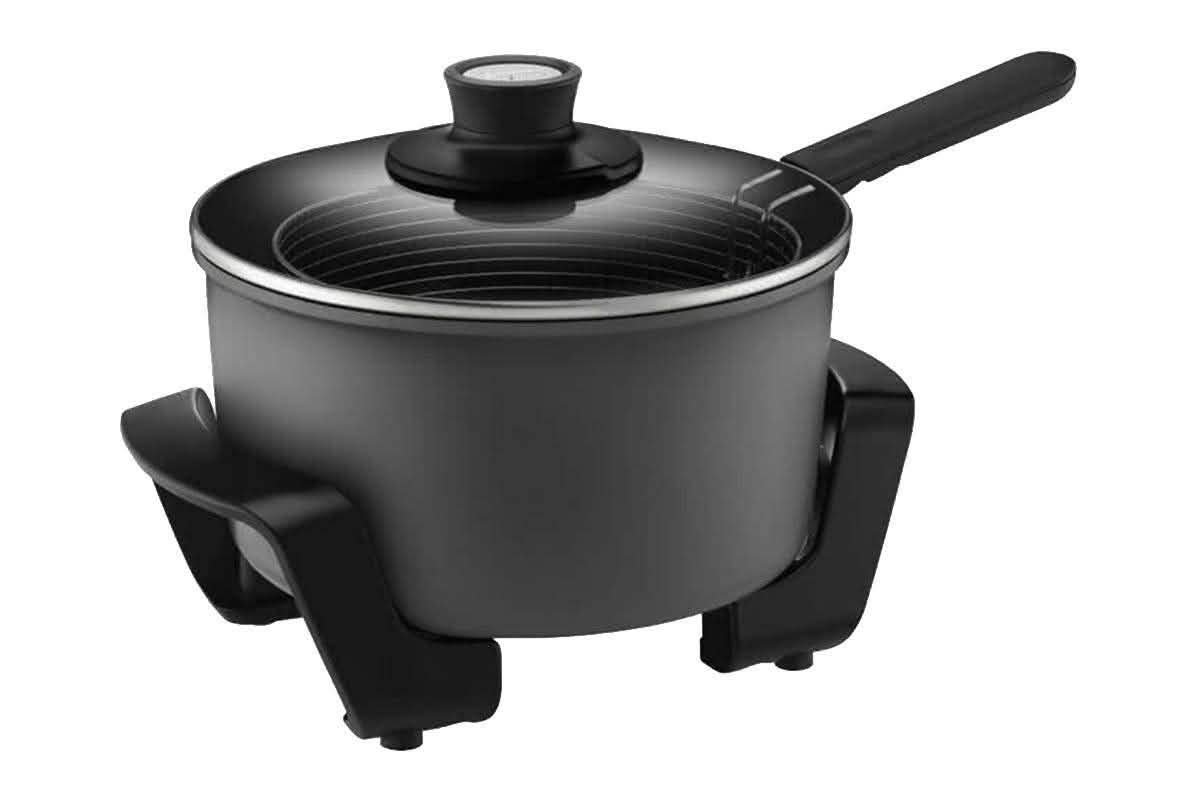
The DF4500 does more than fry. Boil, roast, casserole and braise all live on the same 5-litre bowl, which explains the Multi Cooker name over a straight deep fryer badge. One Australian reviewer used it for fried chicken and turned the dial down from the advised setting to hit the result she wanted, which points to a thermostat running a touch hot, not cold.
The discrepancy worth knowing before you buy: 4.3 on Amazon AU across 124 ratings, but only 3.0 on ProductReview’s dedicated fryer category, where buyers are comparing it directly against single-purpose fryers, not a general multi-cooker. Temperature control is the attribute flagged most, several saying it won’t get hot enough for a proper fry, and reliability draws a real cluster of failures within six months, closer to a Perth summer than a full winter of use.
As the cheapest fryer on this page, it’s the multi-cooker to buy if frying is one job among several you want, not the fryer to buy if a consistent, high temperature is the only thing you need. Set against the Breville and Tefal above, both single-purpose and both independently rated higher, the DF4500 is doing three extra jobs for one lower score.
Pros
- Cheapest fryer on this page
- Doubles as a multi-cooker for boiling, roasting and braising
- 5-litre capacity, bigger than the Breville and Tefal above
- Dishwasher-safe basket
Cons
- 3.0 on ProductReview, notably below its 4.3 on Amazon AU, when judged specifically as a fryer
- Several reviewers report the temperature control won’t get hot enough for a proper fry
- A real cluster of reports of failure within six months
- Being a multi-cooker first means it compromises on frying specifically, next to the single-purpose Breville and Tefal above
Key specs: 5L capacity; 1600W; stainless steel basket; boil, roast, casserole, braise, stir-fry and deep-fry functions; rated 4.3 out of 5 from 124 Amazon AU ratings, 3.0 out of 5 on ProductReview.
CHECK ON AMAZON5. Healthy Choice 3.8L Deep Fryer – Best for Solo Cooking
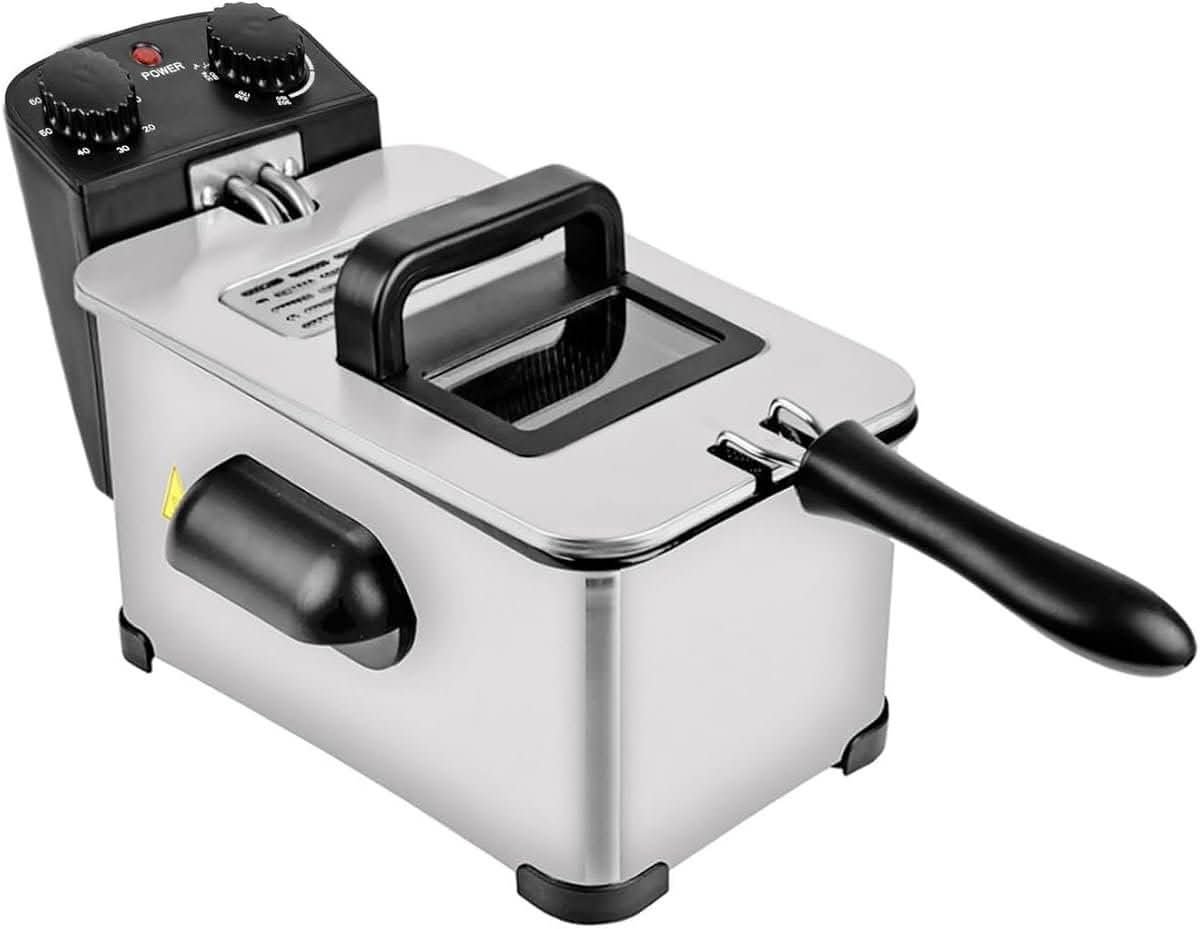
An Australian appliance brand at the lowest price for an actual single-tank fryer, with a thermal safety cutoff named as a feature instead of buried in the fine print. At 3.8 litres it sits just under the Breville and Tefal above, sized for one or two serves instead of a family batch, closer to a share-house kitchen than a Sunday roast crowd. The catch is evidence: only 8 ratings on the Australian listing, all positive, one reviewer summing it up as good value at a good price and not much more detail than that. Eight ratings at 4.7 is a small sample, not enough on its own to promise the reliability the Breville or Tefal have shown across ten times as many reviewers.
For little outlay, buy it if price is what decides the buy and you’re happy being an early tester on the review data. Want a track record first? The Russell Hobbs above has forty times the evidence for similar money.
Pros
- Lowest price of any single-purpose fryer on this page
- Named thermal safety cutoff device
- Australian retail brand with local support
- Compact 3.8L size suits one or two people instead of a family
Cons
- Only 8 ratings on the Australian listing, a slim sample
- No independent ProductReview data to cross-check the Amazon AU score
- Smaller capacity than every other single-tank fryer on this page
- Basic timer control knob with no digital readout
Key specs: 3.8L capacity; timer control knob; thermal safety device; adjustable temperature; rated 4.7 out of 5 from 8 Amazon AU ratings.
CHECK ON AMAZON6. Devanti 20L Deep Fryer Double Tank – Best Double-Tank Capacity
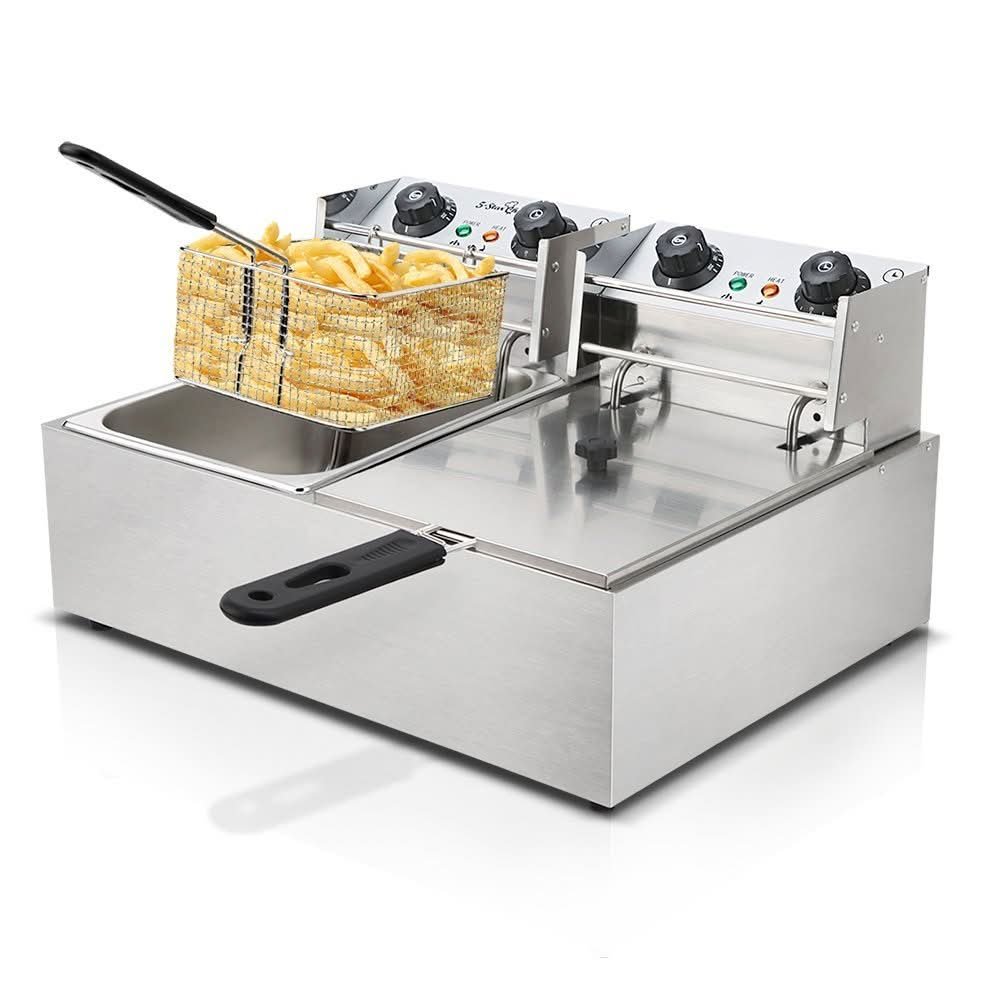
Two independent oil wells at 4400W combined, built to the scale of a small commercial fryer, not a household one. One Australian reviewer, a former restaurant owner, assumed a unit like this would need three-phase power and was surprised it runs fine on a standard domestic circuit, which is the single most useful fact in its review data if you’re wondering whether your kitchen can actually feed it.
Two tanks means frying fish in one and chips in the other without either batch tasting of the other, or doubling the volume through one basket when the 4-litre Breville above would bottleneck a family meal. At 3.9 out of 5 across 40 ratings, quality and durability split opinion, with a real cluster of reports of chipped paint and dents straight out of the box.
It’s the biggest and priciest fryer here by a clear margin, roughly four times what the Amazon AU-rated TANGME below asks for a similar batch size, and it isn’t the right fit for a household frying chips twice a month. It’s the pick for a household that fries often enough, or in enough volume, that a single 4-litre tank becomes a real bottleneck instead of a comfortable fit.
Pros
- Two independent 4400W tanks, so you can fry two foods without cross-flavouring or double a single batch
- Runs on a standard domestic circuit despite commercial-style scale, per an ex-restaurant-owner reviewer
- 20-litre total capacity, by far the largest on this page
- Stainless steel construction throughout
Cons
- A real cluster of reviewers report chipped paint and dents on arrival, a durability concern at this size
- At 3.9 out of 5 it rates below the Breville, Tefal and Russell Hobbs above on Amazon AU
- Priciest fryer on this page and the heaviest to lift, drain and store
- Oversized for a household frying only occasionally
Key specs: 20L total oil capacity across two 4400W tanks; stainless steel body; basket and lid included; rated 3.9 out of 5 from 40 Amazon AU ratings.
CHECK ON AMAZON7. Tefal Versalio 7 in 1 MultiFryer FR4900 – Best for Occasional Frying
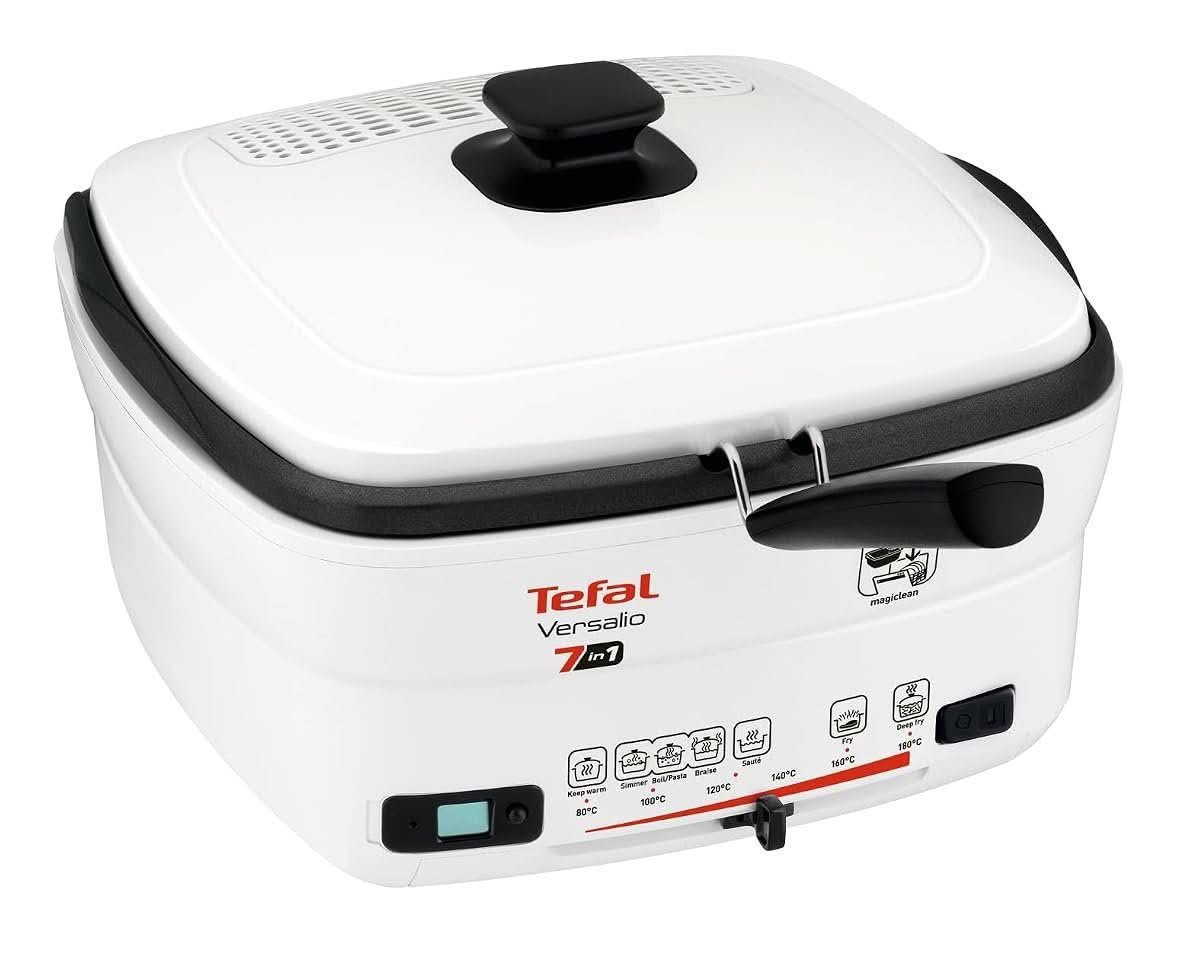
Where the Sunbeam above is a multi-cooker first, the Versalio leans the other way: mainly a fryer that also handles other cooking, with an adjustable oil volume that lets you use less for a smaller batch instead of always filling to the max line.
One Australian reviewer, still deciding whether it truly satisfies as a deep fryer, says it doesn’t quite get hot enough for the crunch she’s after, while calling it excellent as an electric frypan for general use. Only 17 ratings back that up, so treat both halves of her verdict as a small sample, not a settled score. The dishwasher-safe bowl and lid make cleanup simple whatever you cooked in it.
Pros
- Adjustable oil capacity, so a small batch doesn’t need a full tank of oil
- Doubles as a general-purpose electric frypan between fry nights
- Dishwasher-safe bowl and lid
- 4.4 out of 5, though from a thin sample of 17 ratings
Cons
- A reviewer specifically notes it doesn’t heat quite hot enough for a proper deep-fry crunch
- Only 17 ratings, the second-thinnest evidence base on this page after the Healthy Choice above
- Being a multi-function appliance means it compromises on pure frying performance, same trade-off as the Sunbeam above
- Sold through the Rowenta storefront, the same quirk as the Tefal Filtra Pro two entries up
Key specs: Adjustable oil capacity; 7-in-1 multi-cooker functions; removable, dishwasher-safe bowl and lid; adjustable thermostat; rated 4.4 out of 5 from 17 Amazon AU ratings.
CHECK ON AMAZON8. TANGME Commercial Deep Fryer 12L – Best Commercial-Style Value
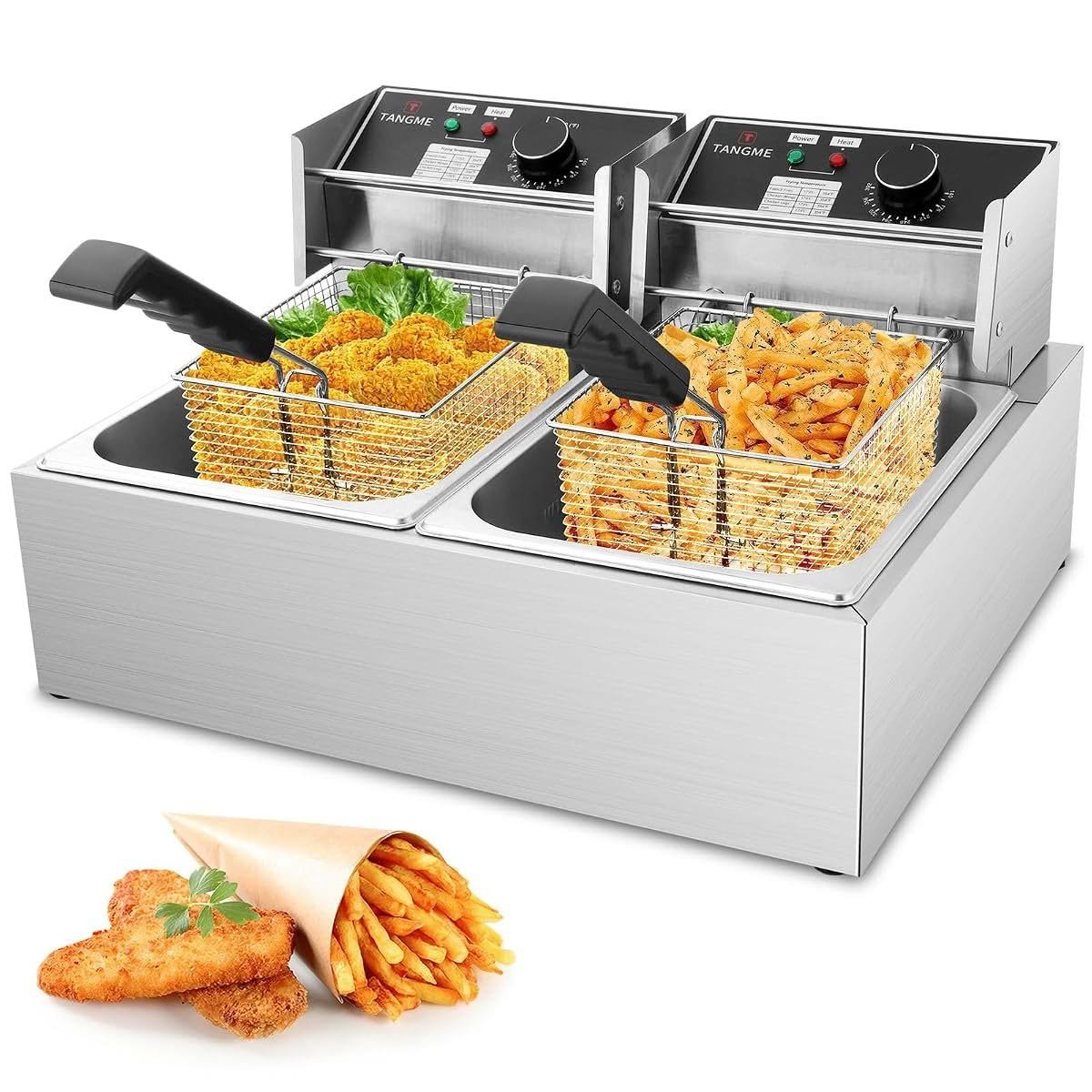
5000W across two baskets and 12 litres of oil, at roughly a quarter of what the Devanti double-tank above costs. This is the fryer for someone who wants commercial-style batch size without commercial-style money, and 583 Amazon AU ratings at 4.3 out of 5 is a real body of evidence behind that claim, not just a listing full of stock photos. The step down in price from the Devanti above is the whole reason to consider it.
Heating speed and ease of cleaning are the most-praised attributes, and one reviewer specifically prefers it to an air fryer for a real deep-fried result, which is exactly the comparison this whole guide exists to make. Frying performance and value for money both draw mixed feedback, though, and durability is the real soft spot: a repeated cluster of reviewers report it breaking down inside two months, a pattern worth stating plainly instead of burying in the specs. One buyer also flags the 10-litre size’s basket handle as weak under a full load, worth testing gently with an empty basket first, the same way you’d check a demo unit on the floor at Harvey Norman before it goes in the boot.
At this price, for someone frying in volume only occasionally (a Christmas Eve seafood spread, not a weekly Friday-night fry), it’s a reasonable bet. For daily use, the Devanti above or the Breville up top have the stronger reliability record.
Pros
- 5000W across two baskets for 12 litres total, at roughly a quarter of the Devanti’s price
- 583 Amazon AU ratings, the second-largest evidence base on this page
- Heating speed and ease of cleaning are the most-praised attributes
- A reviewer specifically prefers it to an air fryer for a real deep-fried result
Cons
- A repeated cluster of reviewers report it breaking down within two months of use
- The basket handle is reported as weak under a full load on at least one size variant
- Frying performance and value for money both draw mixed feedback in its own data
- Generic brand with no track record beyond this single listing, unlike Breville, Tefal or Sunbeam above
Key specs: 12L total oil capacity; two 6.35QT baskets; 5000W; 0.6mm thickened stainless steel; temperature limiter; rated 4.3 out of 5 from 583 Amazon AU ratings.
CHECK ON AMAZONHow to Choose a Deep Fryer
Match oil capacity to how often you actually fry. A 2 to 4 litre single-tank fryer suits a household frying chips or crumbed chicken a few times a month. Feeding five people every week, or wanting two oil wells so the fish doesn’t taste like last night’s onion rings, points to a bigger unit at 10 litres or more. More oil also means more weight to lift and drain, so the biggest fryer here isn’t automatically the right one for a Bondi one-bedder with a galley kitchen, and running a 5000W element through a humid Queensland summer adds real cents per kilowatt hour to the power bill on top of the oil.
Recovery time matters more than wattage on the box. The single most repeated gripe on ProductReview’s deep fryer category is oil that won’t get back to temperature between batches. A fryer advertising big wattage should recover within a minute or two of a cold batch going in. Cooking three batches in a row on dropping heat is how a home fryer turns out soggy chips instead of the crunch you paid for.
Oil frying carries a real risk. It’s manageable, not a reason to skip this appliance. Hot oil spits, and a lid sealed over an overfull tank can force oil up past the seal. Never fill past the max line, lower food in slowly instead of dropping it, and keep the lid cracked rather than sealed while frying unless the manual says otherwise. A splash guard and a stable, heat-resistant bench are not optional extras on this category. Skip the whole conversation and the intro above already points to the appliance that avoids it entirely.
Filtration decides whether you keep using it past the first month. Oil that has to be poured, strained through a funnel and bottled between uses is a real barrier to frying regularly. A built-in filter, like the one Tefal builds into its Filtra Pro, turns cleanup from a 20-minute chore into five. If a slow cooker already covers your set-and-forget nights, a fryer is the appliance for the opposite kind of evening, and that only happens if cleanup doesn’t put you off.
A viewing window and a thermostat you can actually read earn their keep. A window means checking colour without lifting a hot lid and filling the kitchen with steam and oil vapour, which matters more in a Melbourne terrace with no proper extraction than in a house with a rangehood over the stove. A dial with nothing printed on it but low, medium and high makes 160 versus 190 degrees pure guesswork, and that gap is the gap between soggy and burnt.
Brand name and buyer satisfaction don’t always line up. On ProductReview, the Breville rates 4.0 while the Sunbeam sitting in a similar price bracket manages only 3.0, and one well-known budget brand elsewhere on that same list sits at 1.0 after a real safety complaint. Price is a rough guide to build quality here, not a guarantee, and the reviews on the specific model number tell you more than the badge on the front ever will.
You’ll Also Want
The single biggest safety upgrade for any deep fryer is knowing the actual oil temperature instead of trusting a dial, so a deep-fry thermometer with a pot clip pays for itself the first time it stops you frying at 220 degrees by accident.
Used oil has to go somewhere between fries, and a stainless steel funnel with a built-in strainer catches crumbs on the way back into a storage bottle, which matters most on the fryers here without built-in filtration.
Frying in a rental with no rangehood, or a kitchen that shares air with the lounge? A slow cooker on the bench beside it covers the set-and-forget nights, and the slow cookers guide compares the options.
Frequently Asked Questions
What is the difference between a deep fryer and an air fryer?
A deep fryer fully submerges food in hot oil to cook it, producing a genuine deep-fried crust that browns and crisps in the oil itself. An air fryer circulates hot air around food coated in a thin layer of oil, which crisps the surface without the food ever being submerged. Deep fryers generally produce closer results to restaurant-style fried food, while air fryers use far less oil and are easier to clean, with no oil to strain or store afterwards.
How much oil does a deep fryer need?
Most household deep fryers hold between 2 and 5 litres of oil, filled to a marked maximum line rather than to the brim, since oil expands and bubbles when food goes in. Commercial-style benchtop units scale up to 10 to 20 litres, often split across two separate tanks. Never fill past the maximum line marked inside the fryer, both because overfilled oil can spill during frying and because the oil needs headroom to bubble without overflowing.
Why does my deep fryer stop getting hot enough?
Adding a large or cold batch of food drops the oil temperature significantly, and a fryer with a weak heating element or an underpowered thermostat can’t recover fast enough before the next batch goes in, leaving food soggy instead of crisp. This is the most repeated complaint across Australian deep fryer reviews. Frying smaller batches, letting the oil fully recover between batches, and choosing a fryer with a higher wattage rating for its oil capacity all help.
Is it safe to leave a deep fryer unattended?
No. Hot oil can spit, boil over if overfilled, or catch fire if it overheats beyond its smoke point, and a deep fryer should be watched for its entire cooking cycle the same way you’d watch a pot on a stovetop. Keep the appliance on a stable, heat-resistant surface away from the edge of the bench, keep the cord clear of small children, and check your fryer’s manual on whether the lid should be closed or cracked during frying, since this varies by model.
How often should you change deep fryer oil?
For home use, oil that fries light foods like chips can typically be reused 5 to 8 times if it’s strained after each use and stored covered in the fridge or a cool cupboard. Oil used for battered or crumbed food, or oil that turns dark, foams, or smells rancid, should be replaced sooner. A built-in filtration system, where the fryer has one, extends how many uses you get from a single batch of oil by removing food particles as it drains.
What size deep fryer do I need for a family of four?
A 4-litre single-tank fryer, holding around 1 to 1.3kg of food per batch, comfortably feeds a family of four in one or two batches for something like chips or nuggets. A household frying more often, in larger volumes, or wanting to fry two different foods without flavour transfer should look at a double-tank fryer of 10 litres or more instead of running a small single-tank unit through repeated batches.
For most Australian households the Breville the Smart Deep Fryer earns the top spot: it’s the only fryer on this page independently rated above 4 out of 5 on both Amazon AU and ProductReview, and full disassembly makes the cleanup that puts most people off frying at home genuinely manageable. Budget-conscious buyers frying only occasionally get more for their money from the Russell Hobbs, backed by the deepest review history here. And a household that fries often enough to want two oil wells running at once should skip the single-tank picks entirely for the Devanti 20L, sized for real volume rather than a Tuesday-night snack.