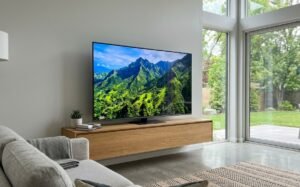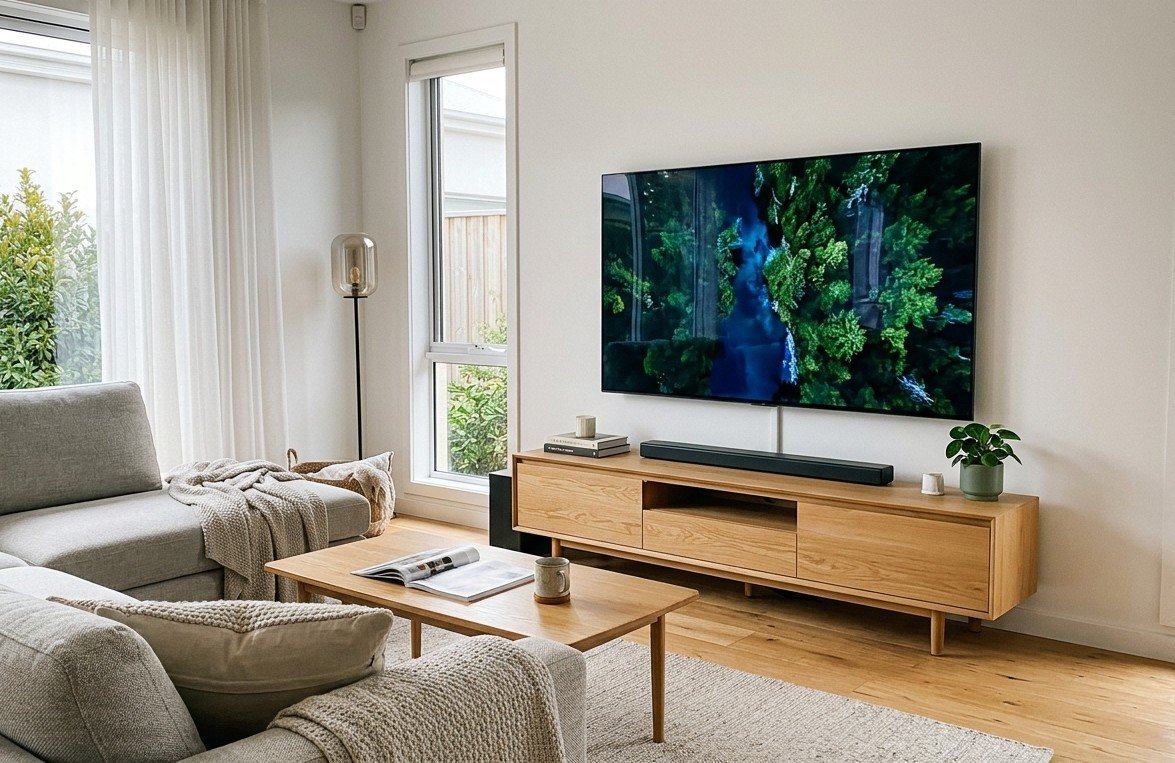
A 65 inch TV measures 165 centimetres across the diagonal and carries roughly forty percent more screen area than a 55 inch set. Picking the best 65 inch TV in Australia depends less on the panel than most buyers expect, because at this size the room begins imposing conditions the television has to meet rather than the other way around.
A screen this large changes what the room has to do, not merely what the wall has to hold. Four panel types are sold at 65 inches here: mini LED for rooms with daylight nobody controls, QLED for wide colour without the backlight cost, full array and direct lit LED for steadier contrast at lower prices, and outdoor rated panels built to survive being left outside.
A 165 centimetre panel wants a seating distance of roughly 2.4 to 4 metres (8 to 13 feet). Closer than 2.4 metres and processing weaknesses stop hiding, because every artefact is enlarged along with the picture. Three things matter more at this size than at 55 inches: how the panel handles reflections, whether the wall mount is rated for the weight, and how evenly the backlight covers a much larger area.
The ten sets below are grouped by how they cope with a bright room, since an Australian lounge room at four in the afternoon is the hardest test most of them will ever face. Backlight uniformity is the second axis and it matters far more here than at smaller sizes, simply because there is more panel across which a weak backlight can fail.
Quick Picks
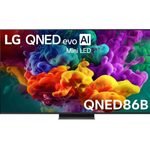
LG 65 Inch QNED86B Evo AI Mini LED
The brightest panel here, and the backlight scales cleanly across 65 inches.
CHECK ON AMAZON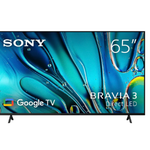
Sony 65 Inch BRAVIA 3 4K HDR LED
Upscaling that keeps broadcast and streaming clean on a large screen.
CHECK ON AMAZON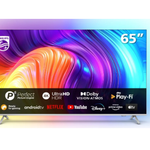
Philips 65 Inch 4K LED Ambilight
Ambient wall lighting that makes a long film in a dark room far easier to watch.
CHECK ON AMAZONBest 65 Inch TV in Australia Compared
| Product | Link | Type | Best For | Key Spec |
|---|---|---|---|---|
| LG 65 Inch QNED86B Evo AI Mini LED | Check price | Mini LED | Uncontrolled daylight | Mini LED, 2026 processing |
| Sony 65 Inch BRAVIA 3 4K HDR LED | Check price | Direct lit LED | Large open rooms | 4K HDR, Google TV, XR upscaling |
| LG 65 Inch QNED81A AI LED UHD | Check price | QNED LED | Mixed household viewing | Quantum dot with NanoCell, webOS |
| SKYWORTH 65 Inch Q6600H QLED Plus | Check price | QLED | Wide or L shaped rooms | 120Hz, Gen 5 quantum dot |
| LG 65 Inch QNED70B AI Mini LED | Check price | Mini LED | First large upgrade | Mini LED entry model, webOS |
| JVC 65 Inch 4K Mini LED 144Hz | Check price | Mini LED | PC and console gaming | 144Hz, mini LED, Google TV |
| Kogan 65 Inch Mini-LED QLED 144Hz | Check price | Mini LED QLED | Second living areas | Mini LED, quantum dot, 144Hz |
| Philips 65 Inch 4K LED Ambilight | Check price | LED with ambient lighting | Dedicated dark rooms | Three sided Ambilight, Dolby Vision |
| Kogan 65 Inch QLED 4K 144Hz | Check price | QLED | Maximum size per dollar | Quantum dot, 144Hz, Google TV |
| SYLVOX 65 Inch Outdoor Waterproof Smart TV | Check price | Outdoor rated | Alfresco and poolside | 1000 nits, weatherproof housing |
1. LG 65 Inch QNED86B Evo AI Mini LED – Best Peak Brightness
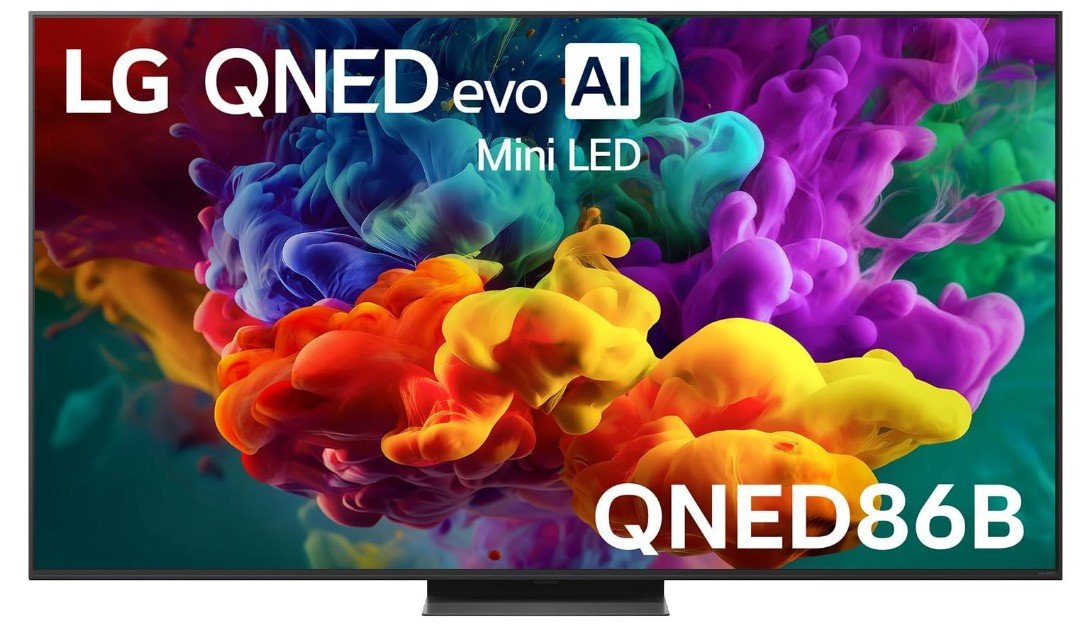
Peak brightness is what a 65 inch panel needs most in an Australian room, and mini LED is how this one gets there. Thousands of small backlight elements sit behind the panel instead of a handful of large ones. Control over those elements is what the 2026 processing adds.
Across a screen this wide, backlight uniformity becomes a visible problem rather than a theoretical one. A cheap backlight that looks acceptable at 55 inches will show banding and corner falloff stretched across 165 centimetres. This is one of the few sets here where the backlight scales cleanly to the size.
North-facing rooms and open-plan living areas with large windows are where the money goes to work. In a room that is dark whenever the television is on, a cheaper set with good contrast will get close for considerably less.
Pros
- Highest peak brightness in this guide
- Backlight uniformity scales cleanly to 65 inches
- Current 2026 image processing
- Holds contrast with the curtains open
Cons
- Premium pricing
- Advantage narrows sharply in a dark room
- webOS carries promoted content on the home screen
Key specs: 65 inch (165 cm) mini LED, QNED86B Evo, webOS, 4K HDR, 2026 model
CHECK ON AMAZON2. Sony 65 Inch BRAVIA 3 4K HDR LED – Best for Long Viewing Distances
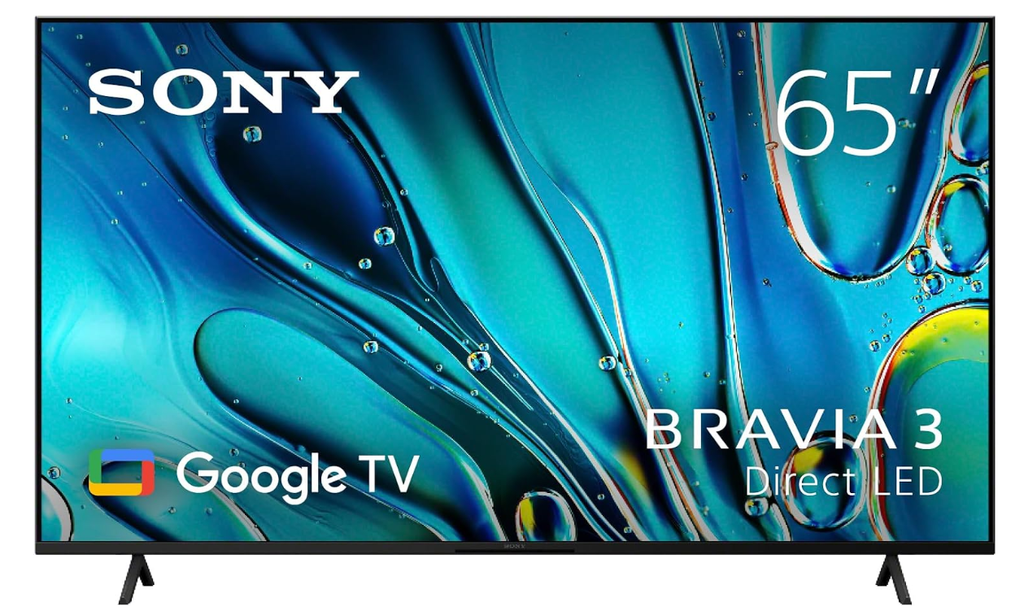
Upscaling carries more weight at 65 inches than at any smaller size, because a large panel magnifies every flaw in a low bitrate stream. Sony’s processing is the reason to look here. The panel itself is direct lit rather than zone controlled.
Free-to-air broadcast and compressed streaming both look noticeably cleaner than they do on budget sets of the same size, where the same content turns soft and blocky once enlarged. Colour is handled conservatively and stays believable on skin tones. What is missing is local dimming, so a dark room will show raised black levels.
A big open living area where the sofa sits four metres back suits this well, since distance hides the contrast limitation while the upscaling advantage remains visible. Close seating in a dark room is the wrong application entirely.
Pros
- Best upscaling here for broadcast and compressed streaming
- Conservative, believable colour
- Clean Google TV interface
- Holds up well at four metres and beyond
Cons
- No local dimming, so black levels lift in the dark
- Direct lit panel only
- Not suited to close seating
Key specs: 65 inch (165 cm) direct lit LED, 4K HDR, Google TV, BRAVIA 3 series
CHECK ON AMAZON3. LG 65 Inch QNED81A AI LED UHD – Best All Round Picture
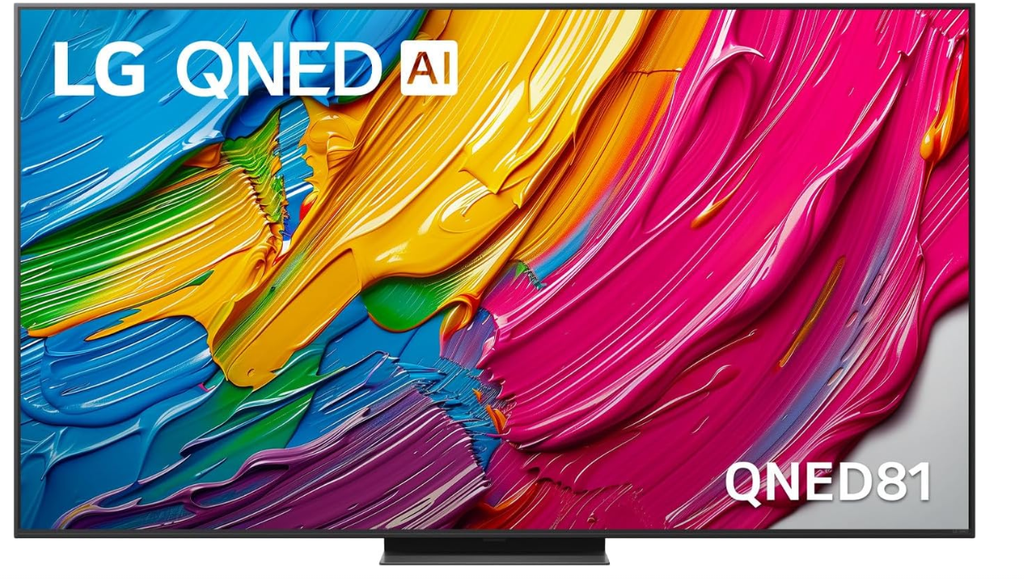
Quantum dot and NanoCell layers together widen the colour range and clean up colour purity without the cost of a mini LED backlight. It is the sensible middle of the LG range at this size. Nothing about it is remarkable, which is rather the point.
Households where the television runs all day across news, sport, streaming and children’s programming are poorly served by a set optimised for one thing. This handles all of them competently and none of them exceptionally. Brightness is adequate for a normally lit room rather than a sunlit one.
Buy this where the television is shared and the viewing is varied. A dedicated film room or a bright sunroom both have better answers elsewhere in this guide.
Pros
- Quantum dot and NanoCell widen and clean up colour
- Handles every content type competently
- Sensible middle of the range pricing
- Good choice for a shared household television
Cons
- Not bright enough for a sunlit room
- No mini LED backlight
- Exceptional at nothing in particular
Key specs: 65 inch (165 cm) QNED LED, quantum dot with NanoCell, webOS, 4K HDR
CHECK ON AMAZON4. SKYWORTH 65 Inch Q6600H QLED Plus – Best Wide Angle Seating
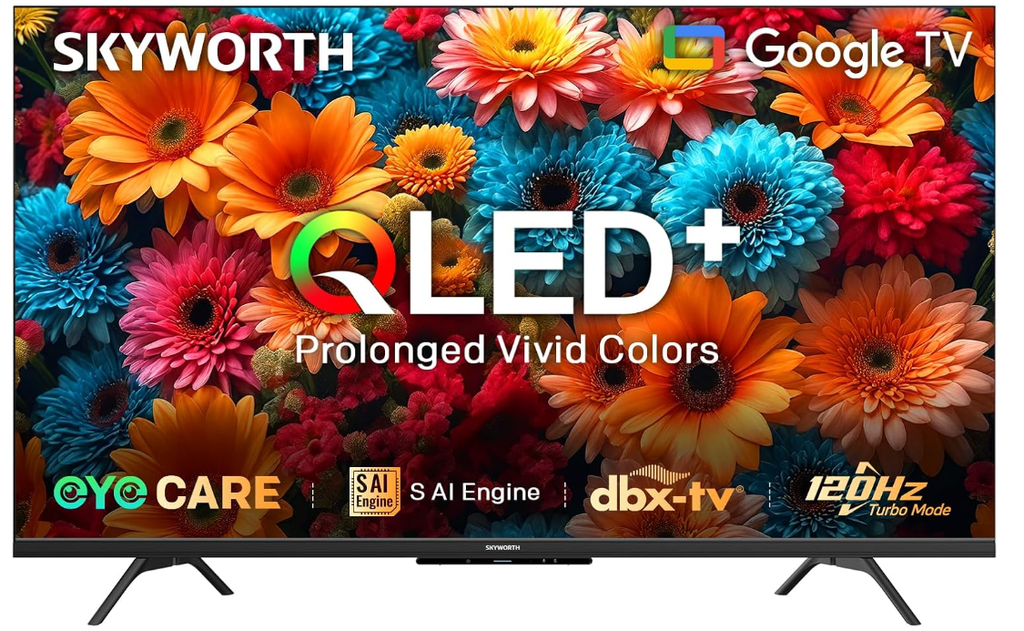
Seating that spreads wide across a room is a problem most panels handle badly, with colour washing out for anyone not sitting square to the screen. The quantum dot layer here holds saturation further off axis than a standard LED panel manages. A 120Hz refresh rate covers gaming adequately.
An L-shaped lounge or a long room with seating down one side puts several viewers at a sharp angle to the screen, and that is where this earns its place. Straight-on picture quality is good rather than class leading. Backlight control is basic, so dark scenes lack the depth the mini LED sets produce.
Rooms with awkward seating geometry get more from this than from a technically better set that only looks right from the middle of the sofa.
Pros
- Holds colour saturation well off axis
- Suits L shaped and wide seating layouts
- 120Hz covers console gaming
- Quantum dot colour range
Cons
- Basic backlight control
- Dark scenes lack depth
- Straight on picture is bettered elsewhere here
Key specs: 65 inch (165 cm) QLED, 120Hz, Gen 5 quantum dot, Google TV, 4K HDR
CHECK ON AMAZON5. LG 65 Inch QNED70B AI Mini LED – Best Step Up From Standard LED
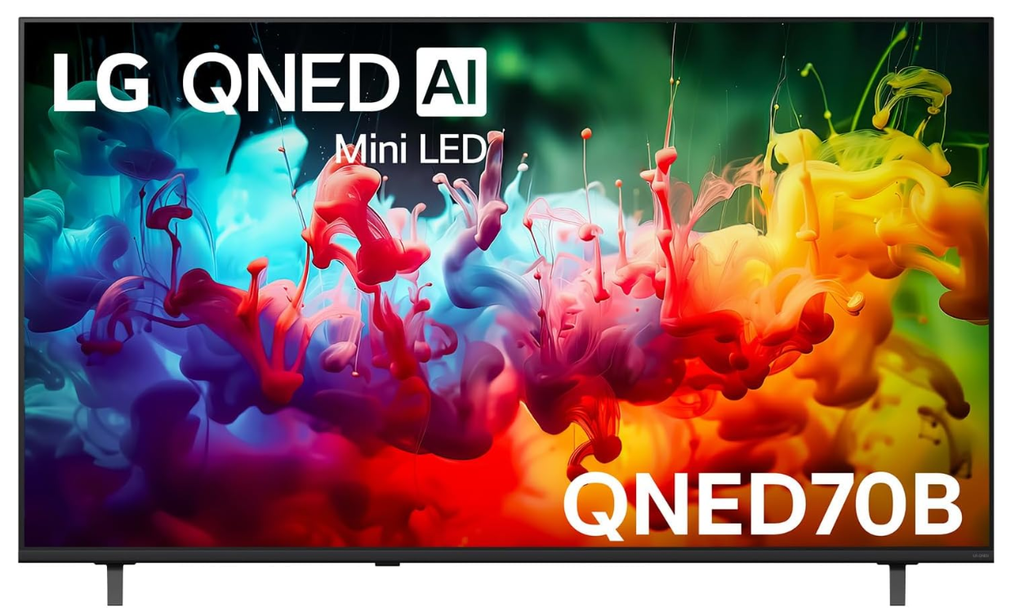
This is the cheapest genuine mini LED backlight at 65 inches from a major brand, which makes it the natural first step for anyone moving up from an older LED television. The backlight technology is the real thing rather than a marketing label. Processing sits below the QNED86B.
Against a five or ten year old LED set the difference is obvious immediately, particularly in how bright scenes hold their contrast. Against the QNED86B above, the gap only opens on demanding content in a dark room. Most viewers upgrading from an older television will not notice what is missing.
Someone replacing an ageing set and unwilling to spend at the top of the range should look here first. Viewers coming from a recent mini LED television will find little to gain.
Pros
- Cheapest genuine mini LED at 65 inches from a major brand
- Large visible gain over an older LED set
- webOS platform supported for years
- Natural first step into mini LED
Cons
- Processing below the QNED86B
- Gap shows on dark demanding content
- Little gain for anyone already on mini LED
Key specs: 65 inch (165 cm) mini LED, QNED70B, webOS, 4K HDR, 2026 model
CHECK ON AMAZON6. JVC 65 Inch 4K Mini LED 144Hz – Best Refresh Rate
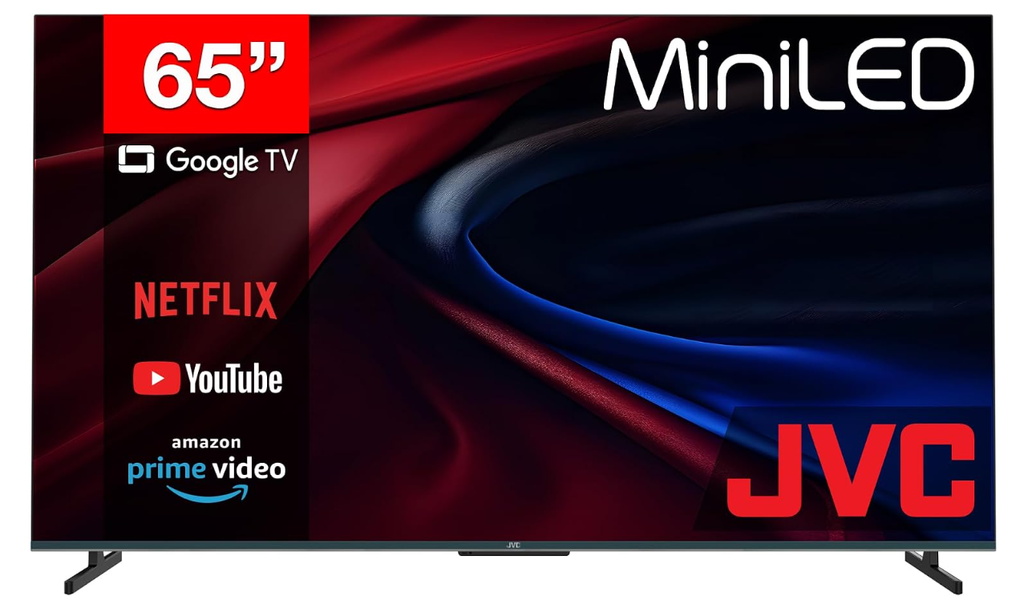
A 144Hz refresh rate on a 65 inch mini LED panel is aimed at a gaming setup rather than a lounge room, and at this size that means a PC as often as a console. The panel can display frame rates most televisions discard. Google TV covers streaming without additional hardware.
On a screen this large, input lag and response time are felt more acutely because head and eye movement across the panel is greater. The high refresh rate reduces both. Where it gives ground is in the processing that turns a good panel into a good picture, and film content shows that gap more than games do.
A gaming room built around a large screen is the right context. As a family television watching mostly broadcast and streaming, the LG and Sony sets above return more for the money.
Pros
- 144Hz on a 65 inch mini LED panel
- Low input lag, which matters more on a large screen
- Google TV built in
- Handles PC frame rates as well as consoles
Cons
- Film content exposes the processing gap
- Blooming on dark scenes
- Aimed at gaming rather than general viewing
Key specs: 65 inch (165 cm) mini LED, 144Hz, Google TV, 4K HDR, HDMI 2.1
CHECK ON AMAZON7. Kogan 65 Inch Mini-LED QLED 144Hz – Best Hardware for the Money
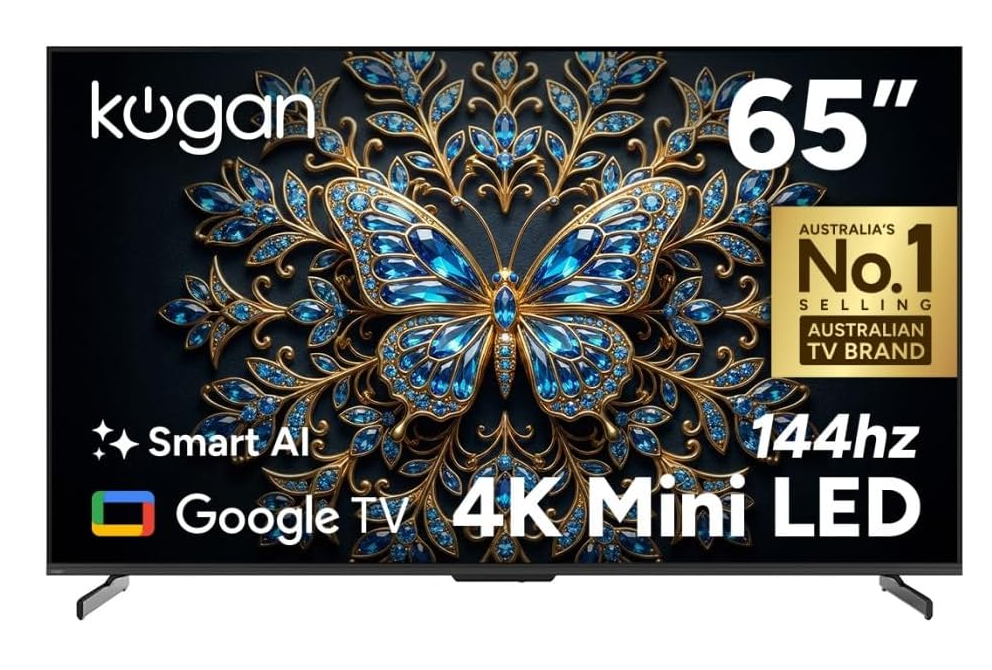
Mini LED, quantum dot and 144Hz on a 65 inch panel at this price would have been implausible a few years ago. The components are real and the specification is not padded. Image processing is where the cost came out.
Large panels punish weak processing more than small ones do, because every artefact is enlarged along with everything else. Motion on sport shows some smearing and dark scenes show more blooming than the LG sets. In bright, colourful, well-produced content none of that is apparent.
A rumpus room, a second living area or a rental property is where this makes clear sense. As the main screen in a room where films are watched attentively, the compromises become harder to ignore.
Pros
- Mini LED, quantum dot and 144Hz at a low price
- Specification is genuine rather than padded
- Strong choice for a secondary room
- Bright colourful content looks excellent
Cons
- Smearing on fast sport
- More blooming than the LG mini LED sets
- Large panels magnify weak processing
Key specs: 65 inch (165 cm) mini LED QLED, 144Hz, Google TV, 4K HDR
CHECK ON AMAZON8. Philips 65 Inch 4K LED Ambilight – Best for a Dark Media Room
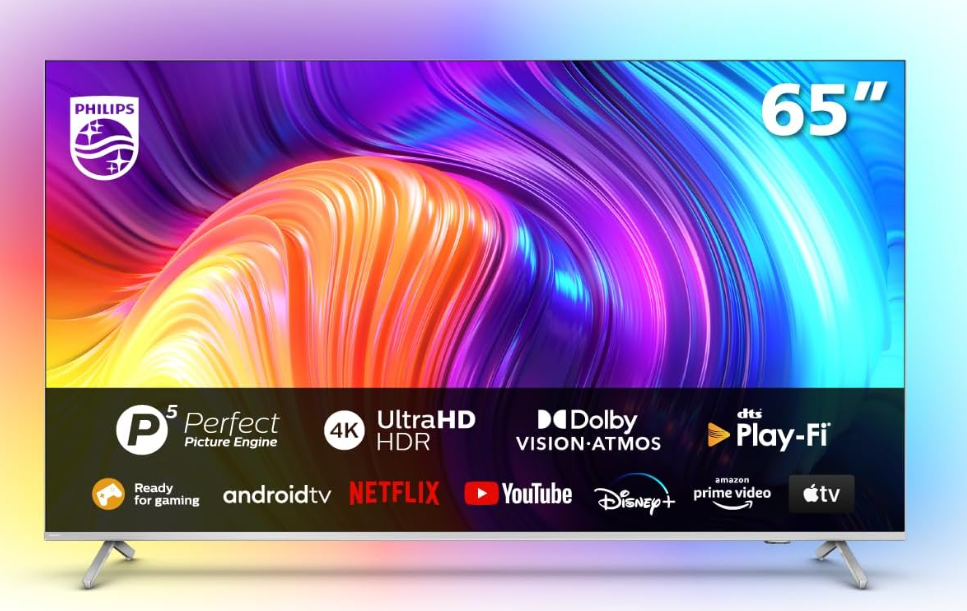
Three sided ambient lighting projects colour from the screen onto the wall behind it, and at 65 inches the effect covers a substantial area. The purpose is to reduce the contrast between a bright panel and a dark wall. Eye fatigue over a long film is the problem it addresses.
A large bright screen in a dark room is genuinely tiring to watch for two hours, and no amount of panel specification fixes that. Lighting the surrounding wall does. Panel performance itself is mid-range, running conventional LED with Dolby Vision decoding rather than a premium backlight.
A dedicated media room with the lights down is where this makes sense, and the wall behind the set needs to be close enough and pale enough for the effect to land. In a bright room the lighting is invisible and the panel alone does not justify the choice.
Pros
- Three sided ambient lighting covers a wide area at this size
- Noticeably less tiring across a long film
- Dolby Vision decoding included
- Addresses a problem panel specifications cannot
Cons
- Needs a pale wall close behind the screen
- Mid range panel performance
- Effect is useless in a bright room
Key specs: 65 inch (165 cm) LED, three sided Ambilight, 4K UHD, Dolby Vision, Android TV
CHECK ON AMAZON9. Kogan 65 Inch QLED 4K 144Hz – Best Large Screen on a Budget
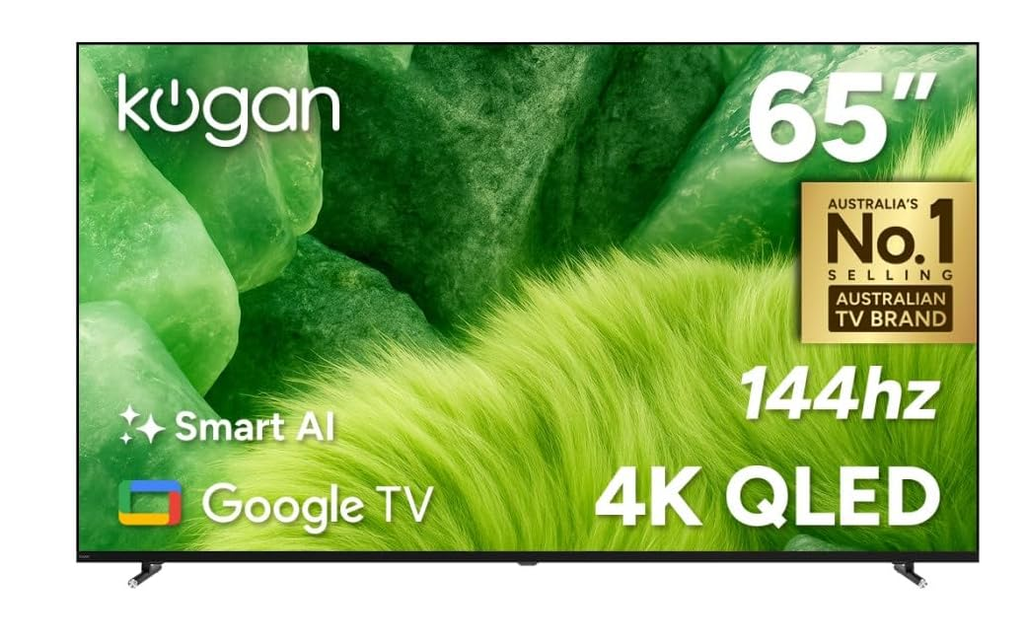
Where the goal is the largest screen a budget allows, this is the entry that gets to 65 inches for the least outlay while still carrying a quantum dot layer. Colour range is genuinely wider than a plain LED set. Contrast is where the savings show.
Without mini LED zoning, black scenes sit closer to dark grey and the panel relies on ambient light to disguise it. In a normally lit room that works better than it sounds. In a darkened room the limitation is immediately visible on letterboxed film.
Getting to this screen size at all is the point, and for a large room on a tight budget that trade is often the right one. Anyone who watches films in the dark should spend the difference on a mini LED set instead.
Pros
- Largest screen per dollar in this guide
- Quantum dot colour rather than plain LED
- 144Hz panel included
- Google TV keeps software current
Cons
- Black scenes read as dark grey
- No mini LED zoning
- Needs ambient light to disguise the contrast limit
Key specs: 65 inch (165 cm) QLED, 144Hz, Google TV, 4K HDR
CHECK ON AMAZON10. SYLVOX 65 Inch Outdoor Waterproof Smart TV – Best Weatherproof Option
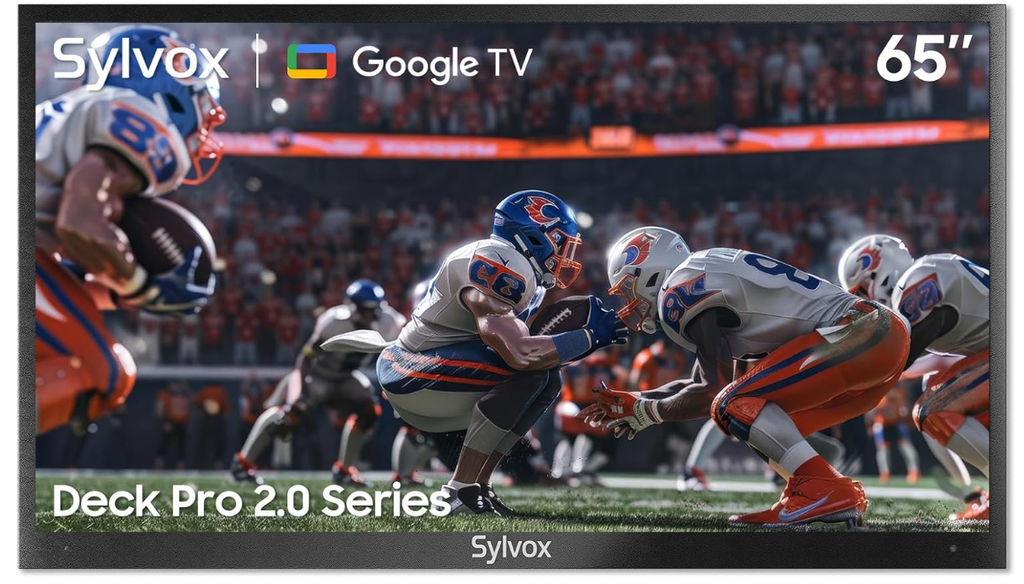
Outdoor rating rather than picture quality is the entire proposition here, and it puts this set outside any sensible comparison with the rest of the guide. A sealed housing keeps moisture and dust out. A 1000 nit panel fights ambient light a covered patio cannot exclude.
Australian outdoor conditions are harder on electronics than most markets, combining humidity, heat and dust in a way that kills an indoor television left in a covered area within a season. This is built for that. Judged as a television against the indoor sets above, it is unremarkable and considerably dearer.
A covered alfresco area, a pool house or an outdoor bar is the only place this belongs. Indoors it is an expensive way to buy an ordinary picture.
Pros
- Sealed against moisture, humidity and dust
- 1000 nits for covered outdoor viewing
- Built for Australian outdoor conditions
- Removes the need to move a television in and out
Cons
- Unremarkable picture judged against indoor sets
- Considerably dearer for the same screen size
- No reason to buy it for an indoor room
Key specs: 65 inch (165 cm) outdoor rated, 1000 nits, weatherproof housing, 4K HDR, smart platform
CHECK ON AMAZONHow to Choose a 65 Inch TV
Measure the wall and the walk-in route. A 65 inch set is about 145 centimetres wide and will not turn a tight hallway corner in its box. Check the doorway, the stairwell and the wall span before ordering, since a television that cannot reach the room is a return freight problem rather than a picture problem.
Check the mount rating, not just the pattern. A wall bracket has both a VESA hole pattern and a weight limit, and a bracket bought for a 55 inch set often matches the pattern while sitting under the weight rating. Plasterboard alone will not hold a panel this size; the bracket has to reach a stud or a masonry fixing.
Let reflections decide as much as brightness. A larger panel presents more surface for a window to reflect off, so glare that was tolerable on a smaller set becomes the dominant problem. Matte and anti-reflective coatings differ substantially between models, and in a room with windows opposite the screen that coating matters as much as the backlight.
Push the sofa back before blaming the picture. Under about 2.4 metres a 65 inch panel reveals compression artefacts and processing shortcuts that stay invisible further away. Many complaints about a large television being disappointing are really complaints about seating distance, and moving the sofa costs nothing.
Weigh a projector against the panel at this size. Once a screen this large is under consideration the alternative becomes reasonable, and portable projectors in Australia throw a far bigger image for less money in a room that can be darkened. A projector cannot compete with daylight, so this only works where the viewing happens at night.
Buy the platform for the years, not the launch. Google TV and webOS both receive updates long enough to outlast the warranty, while lesser smart systems lose apps and slow down while the panel is still fine. A set this size stays in a house for the better part of a decade, and Australian Consumer Law guarantees run for a reasonable period regardless of what the written warranty says.
For the bedroom, kitchen or caravan, our 32 inch TV picks keep the smart streaming features in a far smaller screen.
If the room is a typical Australian lounge, a 55 inch TV is the size most homes settle on.
Frequently Asked Questions
How far should I sit from a 65 inch TV?
Roughly 2.4 to 4 metres, or 8 to 13 feet. Closer than 2.4 metres the panel starts to reveal compression and processing flaws that distance would hide. Beyond about 4 metres the extra detail over a 55 inch set stops being visible and the larger screen is simply larger.
Is a 65 inch TV too big for an average lounge room?
Usually not. Most Australian lounge rooms place the sofa between 2.5 and 3.5 metres from the wall, which sits comfortably inside the useful range. The constraint is more often the width of the wall and the route into the room than the viewing distance itself.
Do I need mini LED at 65 inches?
In a bright room it helps considerably, because backlight uniformity and peak brightness both become more demanding as panel area grows. In a room that is dark whenever the television is on, a well-processed conventional panel will get close for less money.
What wall mount do I need for a 65 inch TV?
One rated for the actual weight of the set rather than just the matching VESA pattern, and fixed into studs or masonry rather than plasterboard alone. Weight is the specification people skip, and it is the one that matters when a bracket fails.
Is the jump from 55 to 65 inches noticeable?
Yes. A 65 inch panel carries around forty percent more screen area, which is a clear step rather than a marginal one. Whether it is an improvement depends on seating distance, since the same jump made in too small a room makes flaws more visible rather than the picture better.
Can a 65 inch TV go on a patio?
Only a set built for it. Indoor televisions fail outdoors from humidity, dust and heat well before they fail from rain, and they are not bright enough for daytime viewing under cover. One set in this guide is rated for outdoor installation and runs far brighter than an indoor panel.
Verdict
At this size the room does more to the picture than the panel does. The LG QNED86B is the set to buy where daylight is not controlled, because peak brightness and backlight uniformity are exactly what a large panel in a sunlit room needs most. Where the seating sits four metres back in a big open space, the Sony BRAVIA 3 returns more through its upscaling than a brighter panel would, and for a room that gets properly dark the Philips Ambilight solves a fatigue problem none of the others address.