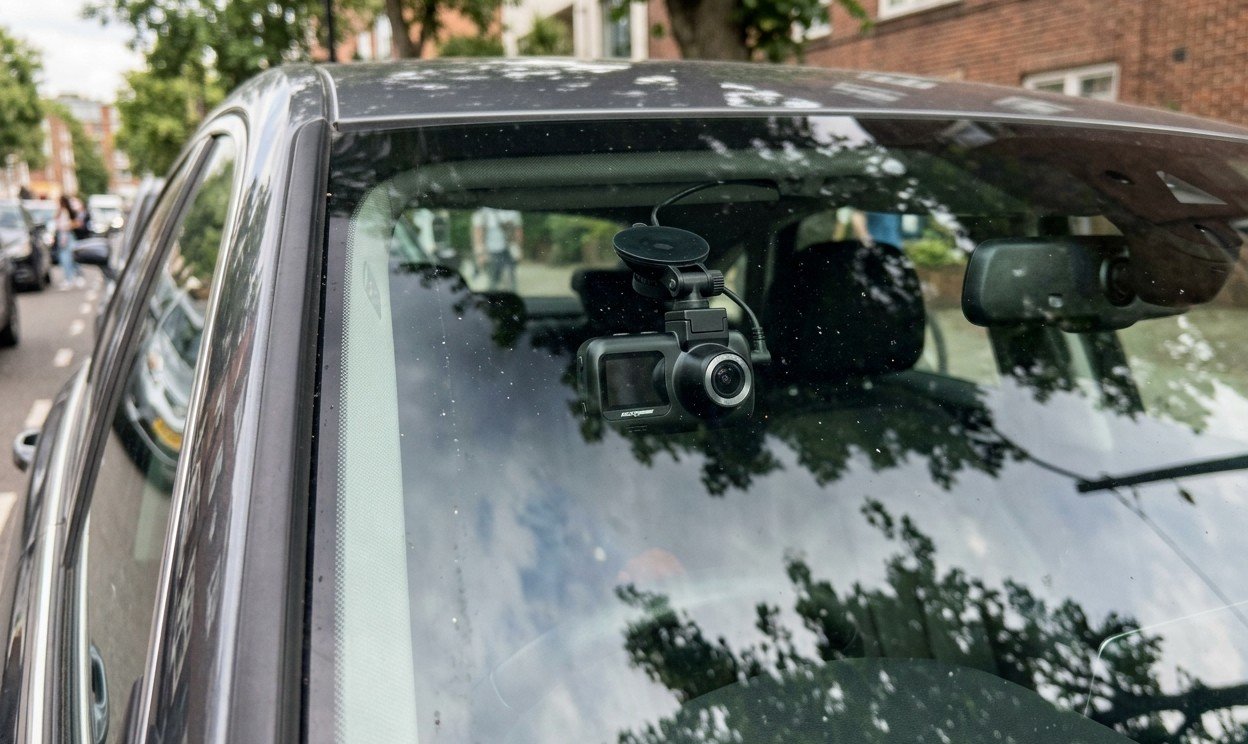
A dash cam is a windscreen or mirror-mounted camera that records continuously while a vehicle runs, overwriting the oldest footage in a loop and locking any clip where its sensor registers an impact. The best dash cams in Australia combine a sensor that performs after dark, a power system that survives a hot parked car, and enough storage to hold a drive without overwriting the part that matters.
Three formats cover the category. Single channel cameras record the road ahead only and install with one cable. Dual channel systems add a rear camera on a long cable to cover the vehicle behind. Three channel cameras add an interior lens, which is what rideshare and delivery drivers need.
The specification that matters most is the one buyers skip past: power storage. Cameras built around a lithium battery swell and fail in a car parked in the Australian sun, where dashboard temperatures pass 70 degrees, while a supercapacitor keeps working. Only one camera here is explicitly rated to 60 degrees, roughly 140 Fahrenheit, and that figure predicts survival better than resolution ever will.
This guide compares nine dash cams sold in Australia across those three formats, from mirror-mounted units that take over the rear-view glass to compact 4K cameras with supercapacitor power and multi-day parking modes.
Quick Picks
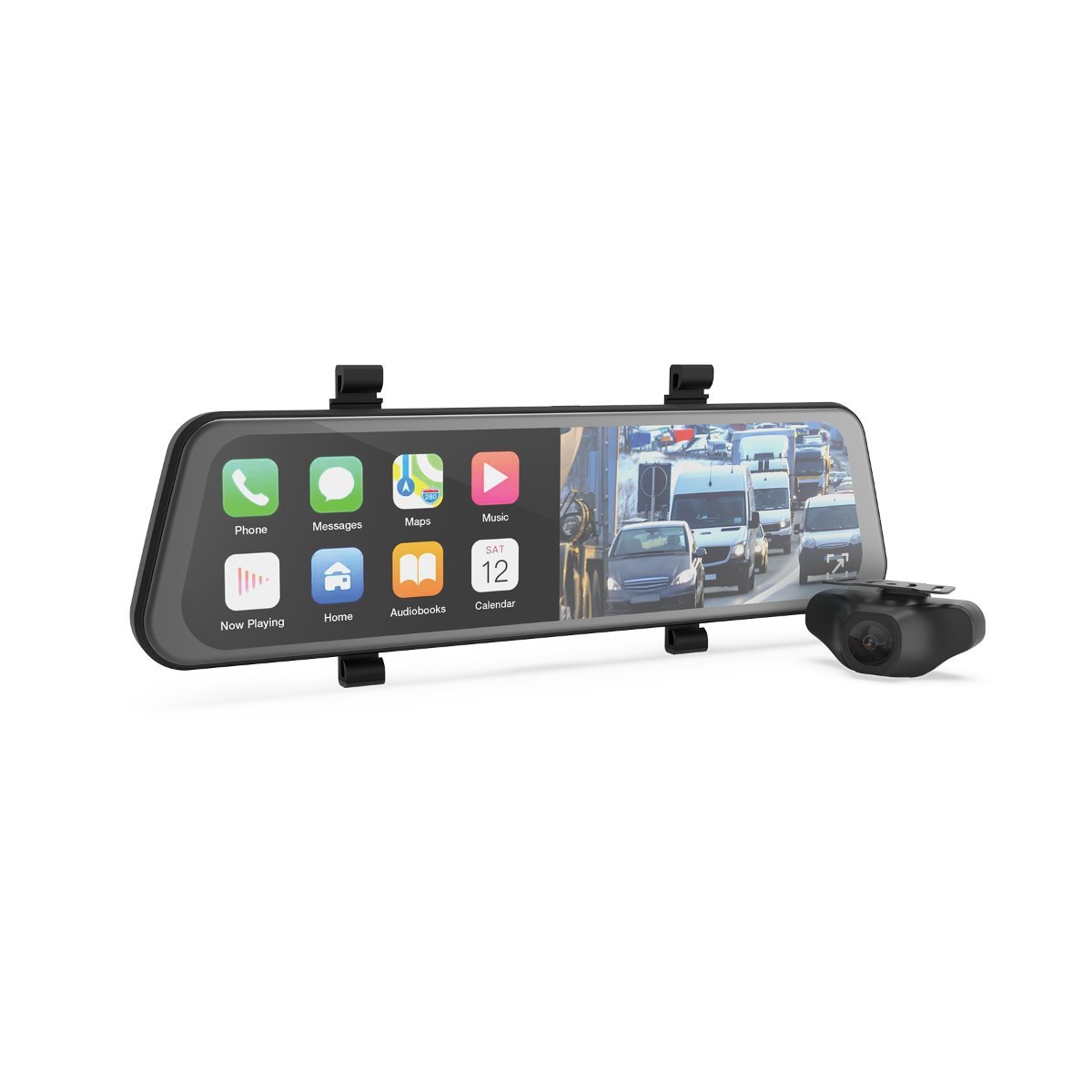
Parkmate 9.66 inch Mirror DVR
A 9.66 inch touchscreen straps over the factory mirror, recording 2K ahead and 1080p behind with nothing added to the windscreen.
CHECK CURRENT PRICE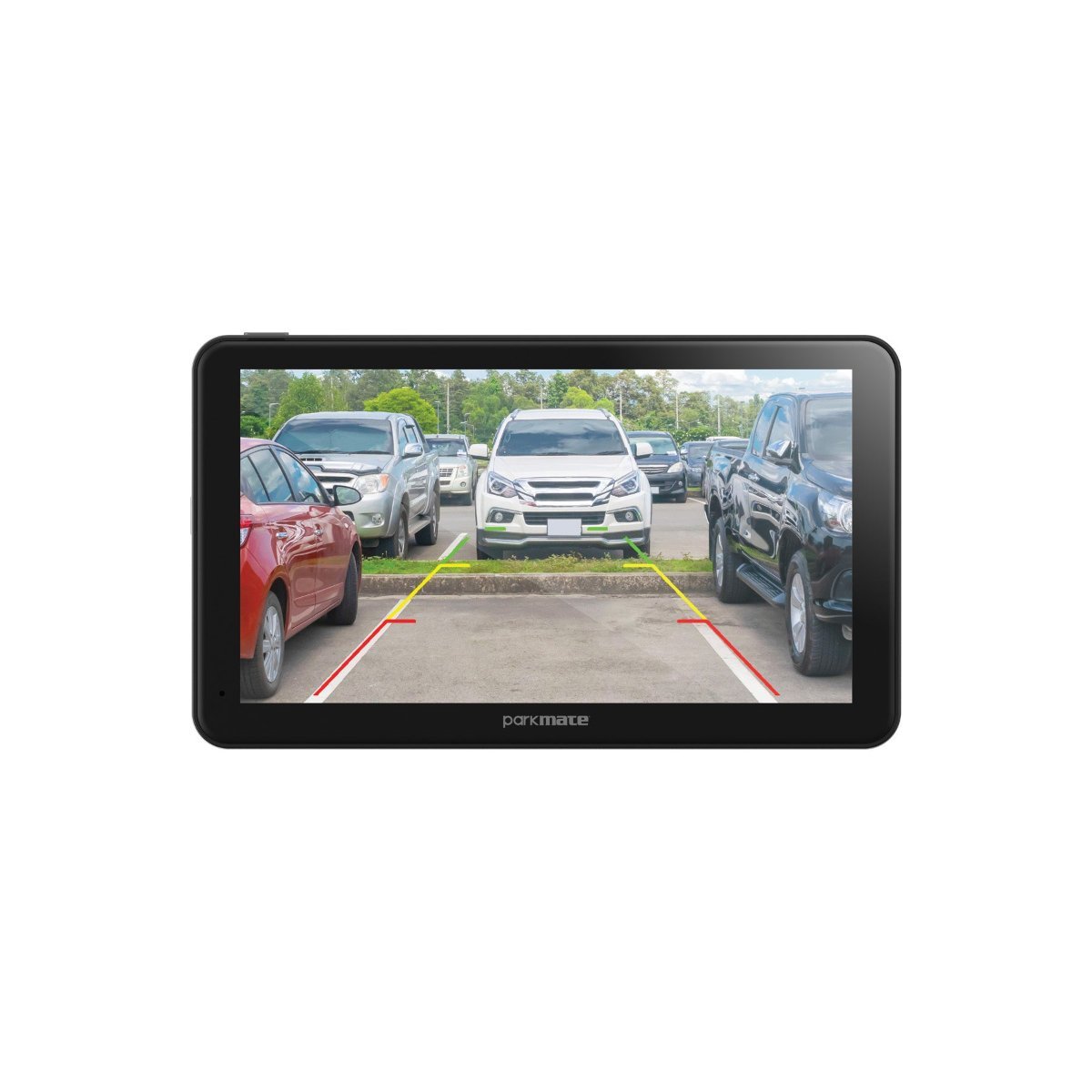
Parkmate PM-72W Dual Channel Smart Monitor
Wireless phone pairing for calls and audio on a 7 inch screen, with an 8 metre rear cable for wagons and dual cabs.
CHECK CURRENT PRICE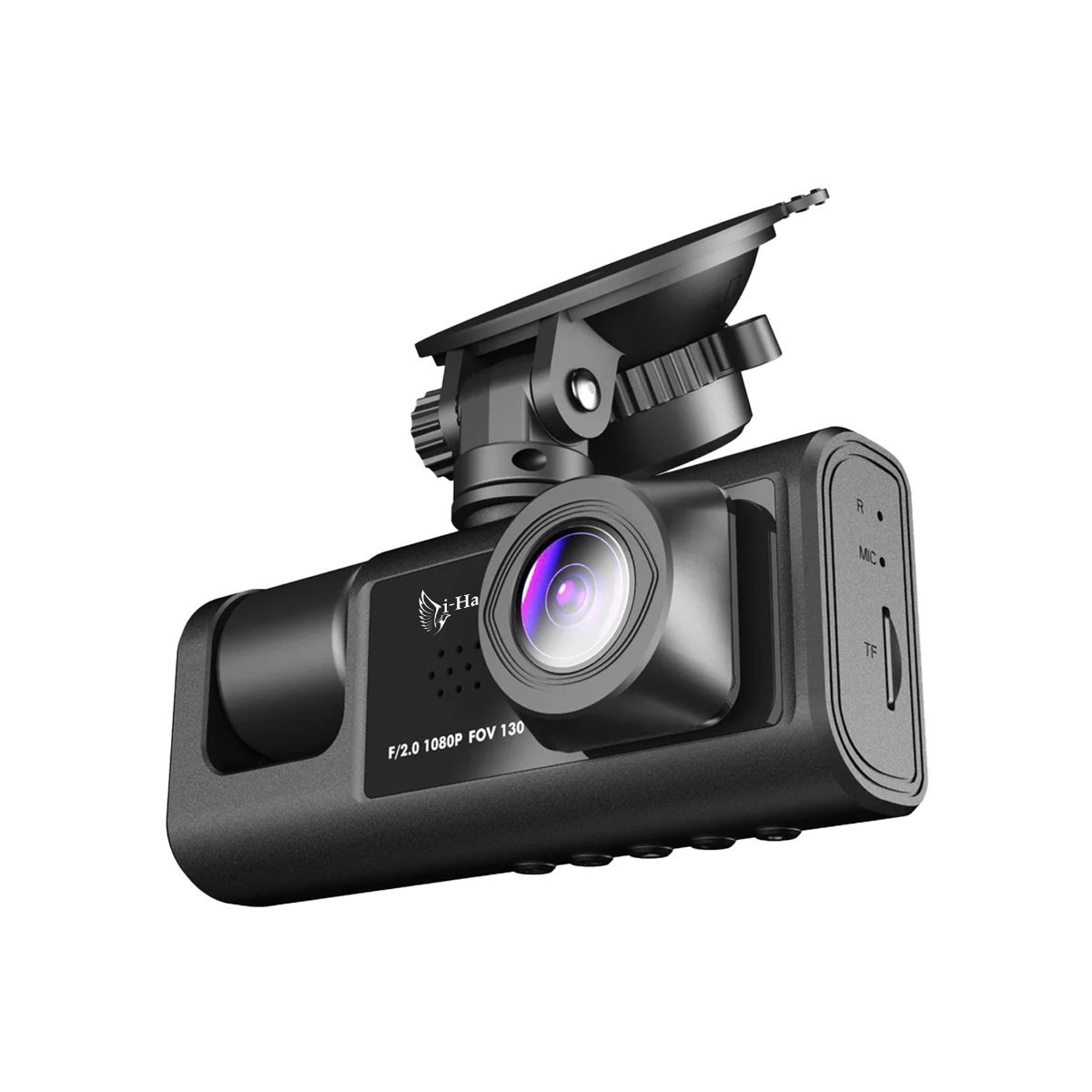
I-Hawk Defender Dual Dash Camera
Front and cabin coverage together at the lowest cost here, with picture-in-picture playback of both channels.
CHECK CURRENT PRICEBest Dash Cams in Australia Compared
| Product | Link | Type | Best For | Key Spec |
|---|---|---|---|---|
| Parkmate 9.66 inch Mirror DVR | Check price | Mirror DVR, dual channel | Keeping the windscreen clear | 2K + 1080p, 9.66in |
| Parkmate PM-72W Dual Channel Smart Monitor | Check price | Monitor, dual channel | Cars without infotainment | 1080p x2, 7in screen |
| Parkmate PM-51W Front Dash Camera | Check price | Monitor, single channel | Simple front-only installs | 1080p front, 5in |
| Parkmate 5 inch Mirror DVR | Check price | Mirror DVR, dual channel | Two channels without a bright screen | 1080p x2, 5in mirror |
| I-Hawk Defender Dual Dash Camera | Check price | Front and interior | Rideshare on a budget | 1080p + cabin cam |
| Garmin Dash Cam Mini 3 | Check price | Compact single channel | Staying out of sight | 1080p, screen-free |
| DDPAI Z50 Pro 4K Dash Cam | Check price | Dual channel 4K | Long parked surveillance | 4K + 1080p, 48h park |
| REDTIGER F17 4K Three Channel Dash Cam | Check price | Three channel 4K | Rideshare and delivery work | 4K + cabin + rear |
| 70mai A810S 4K Dash Cam | Check price | Dual channel 4K | Cars parked in extreme heat | 4K x2, 60C rated |
1. Parkmate 9.66 inch Mirror DVR – Best Mirror Replacement
A 9.66 inch touchscreen straps over the rear-view mirror already fitted, so the camera adds no extra object to the windscreen and nothing new enters the driver line of sight.
Recording runs 2K at the front across a 150 degree field and 1080p at the rear through an IP67-rated camera on a 140 degree lens. Lane departure warning, a three-axis impact sensor and a 24 hour parking mode are all built in.
A mirror unit only works if it fits the mirror already there, and on some vehicles the straps sit awkwardly over a large factory housing. Measure first, because where it does fit this is the least intrusive way to run two channels.
Pros
- Replaces the mirror rather than cluttering the windscreen
- 2K front recording with an IP67 rear camera
- Lane departure warning and 24 hour parking mode included
Cons
- Fit depends on the size of the factory mirror housing
- A full-width screen can be distracting at night until dimmed
Key specs: 2K front and 1080p rear, 150 degree front and 140 degree rear field of view, IP67 rear camera, 9.66 inch IPS touchscreen, lane departure warning, three-axis G-sensor, 24 hour parking mode, FM transmitter, reversing guidelines
CHECK CURRENT PRICE2. Parkmate PM-72W Dual Channel Smart Monitor – Best for Phone Integration
This behaves as much like a head unit as a dash cam, pairing wirelessly with a phone to handle calls and audio through a 7 inch touchscreen.
Both channels record at 1080p, the rear camera is IP67 rated on a 150 degree lens, and the supplied 8 metre cable reaches the back of a wagon or a dual cab. Voice control and a reversing assistant come as standard.
Seven inches of screen on the dashboard is a real presence in a small cabin and needs careful positioning to stay legal and out of view. Older vehicles without infotainment gain most, since one unit covers calls, audio and recording together.
Pros
- Wireless phone pairing for hands-free calls and audio
- 8 metre rear cable suits wagons and dual cabs
- Voice control and reversing assistant included
Cons
- A 7 inch dash-mounted screen takes real cabin space
- Both channels cap at 1080p
Key specs: 1080p front and 1080p rear, 150 degree rear lens, IP67 rear camera, 7 inch IPS touchscreen, 8 metre rear cable, Bluetooth hands-free calling, FM transmitter, voice control, reversing assistant
CHECK CURRENT PRICE3. Parkmate PM-51W Front Dash Camera – Best Single Channel Setup
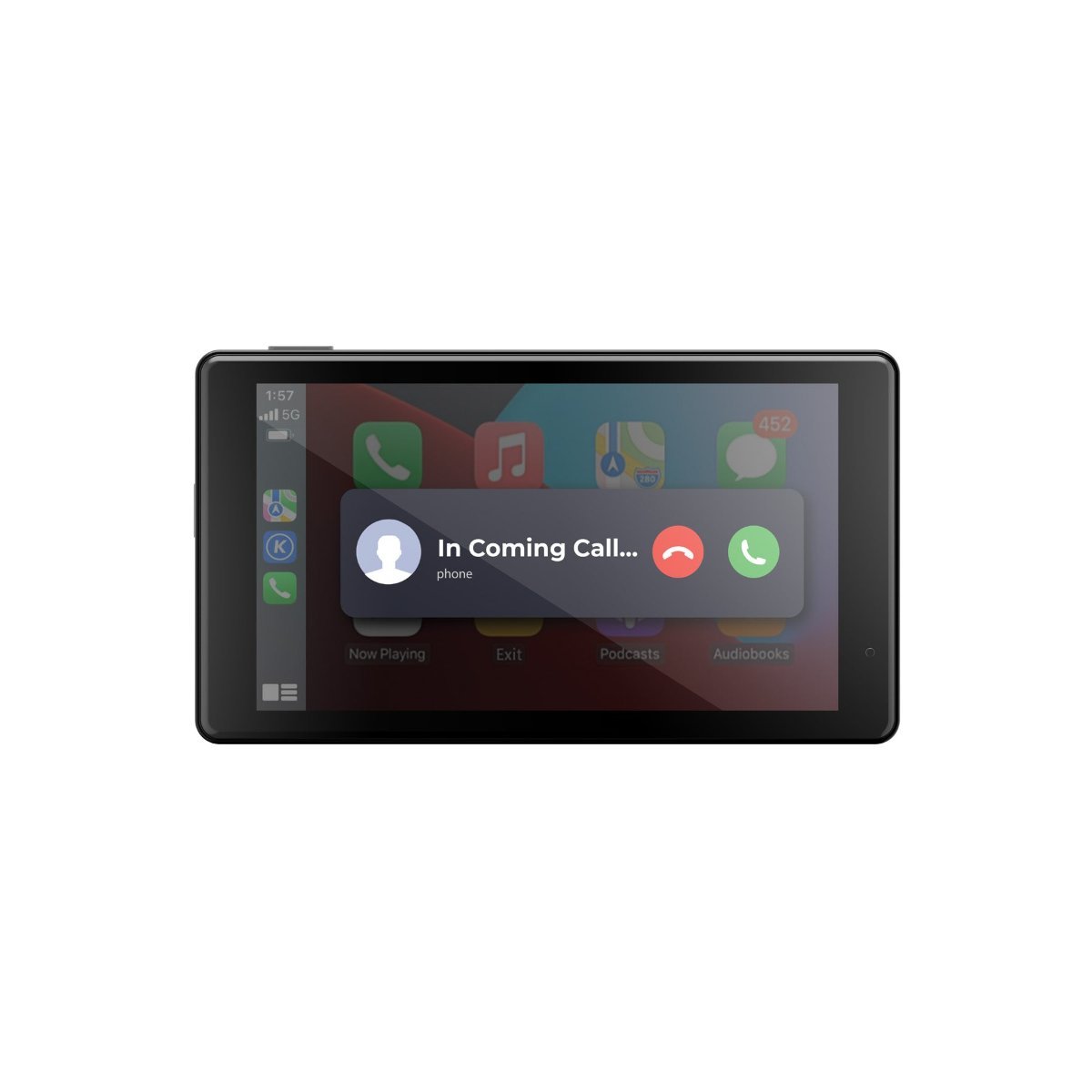
Stripping back to one front channel keeps installation to a single cable and a single camera, which is the entire appeal for anyone unwilling to run wiring to the boot.
A 5 inch IPS screen handles playback and phone connection, the lens covers 150 degrees, and hands-free calling plus an FM transmitter are included. Both windscreen and dash suction mounts ship in the box.
No rear channel means no record of anyone who runs into the back of the car, which is a common enough claim to matter. For a city runabout that mainly needs front-facing proof, the simpler install is a fair trade.
Pros
- Single-cable install with no wiring run to the rear
- Windscreen and dash mounts both supplied
- Hands-free calling and FM transmitter included
Cons
- No rear channel at all
- Records at 1080p only
Key specs: 1080p front only, 150 degree field of view, 5 inch IPS screen, wireless phone connection, hands-free calling, FM transmitter, windscreen and dash suction mounts
CHECK CURRENT PRICE4. Parkmate 5 inch Mirror DVR – Best Compact Mirror Unit
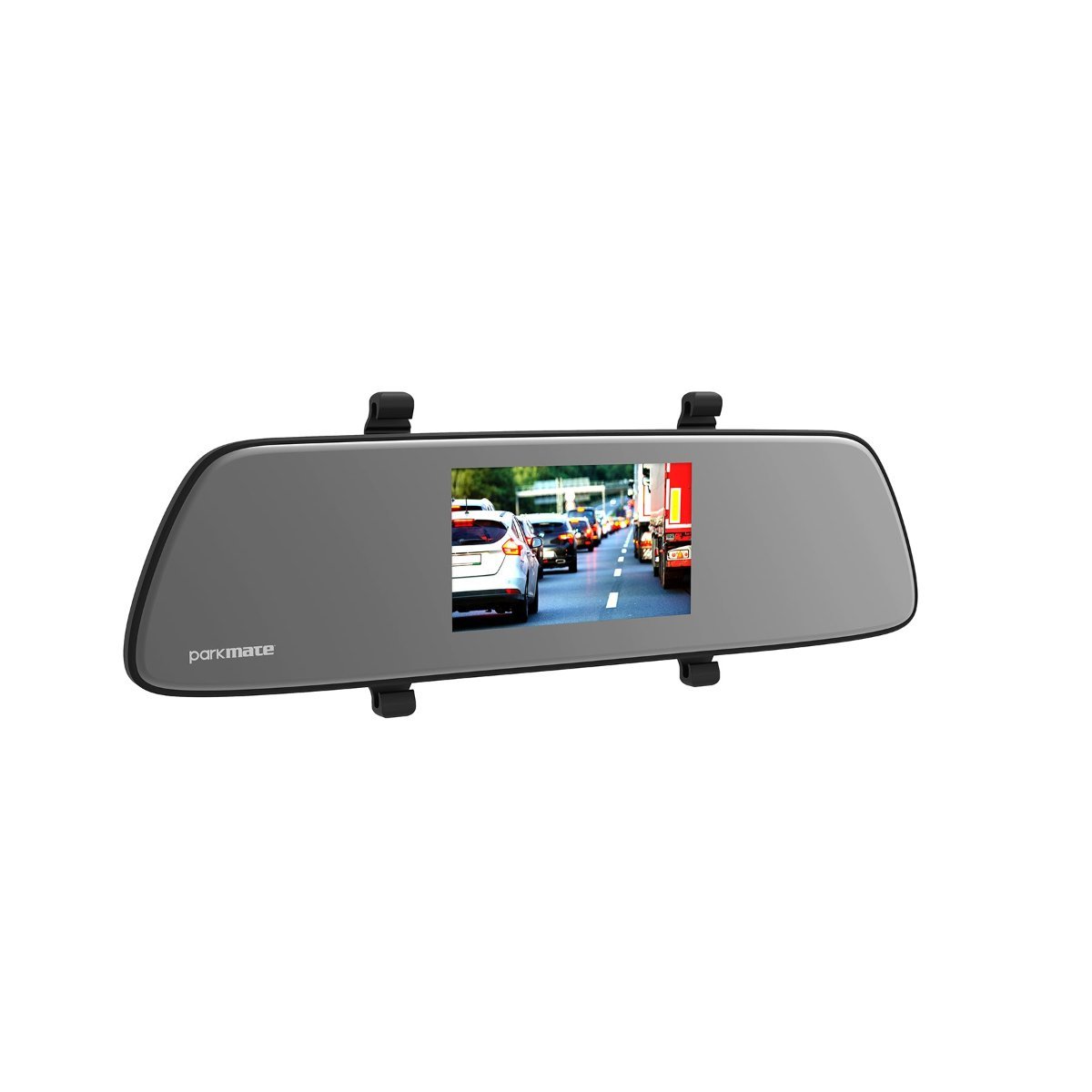
Where the 9.66 inch unit covers the full width of the glass, this keeps its screen to 5 inches and leaves the rest of the mirror working as a mirror.
Both channels record 1080p, the front lens spans 150 degrees and the IP67 rear covers 140, with lane departure warning and an automatic reversing monitor that overlays gridlines when reverse engages.
Dropping to 1080p at the front costs some plate-reading detail against the 2K unit heading this guide. Drivers who found full-width mirror screens too bright after dark get the same two-channel coverage without that glare.
Pros
- Smaller screen leaves most of the mirror usable
- Lane departure warning and reversing gridlines
- IP67 rear camera
Cons
- 1080p front loses detail against the 2K mirror unit
- Fit still depends on the factory mirror
Key specs: 1080p front and 1080p rear, 150 degree front and 140 degree rear field of view, IP67 rear camera, 5 inch touchscreen mirror, lane departure warning, automatic reversing monitor with gridlines
CHECK CURRENT PRICE5. I-Hawk Defender Dual Dash Camera – Best Budget Pick
Two channels at this price usually means a rear camera on a long cable, but the second lens here points into the cabin instead.
The front records 1080p across 130 degrees while the interior camera adjusts to cover the cabin, and picture-in-picture playback shows both on a 50mm screen. Storage takes microSD to 128GB with loop recording and impact detection.
A 200mAh battery holds only enough charge to close the file safely after power cuts, so parking surveillance needs a hardwired feed. Rideshare and delivery drivers needing cabin coverage on a tight budget are the natural fit.
Pros
- Front and interior coverage at the lowest cost here
- Picture-in-picture playback of both channels
- Runs from 12/24V or USB-C
Cons
- A 50mm screen makes reviewing footage awkward
- 200mAh battery cannot support parking surveillance
Key specs: 1080p front on a 130 degree lens plus adjustable interior camera, 50mm IPS screen, picture-in-picture playback, microSD to 128GB, loop recording, G-sensor, 200mAh battery, 3.4m 12/24V cable or USB-C, suction mount
CHECK CURRENT PRICE6. Garmin Dash Cam Mini 3 – Best Discreet Design
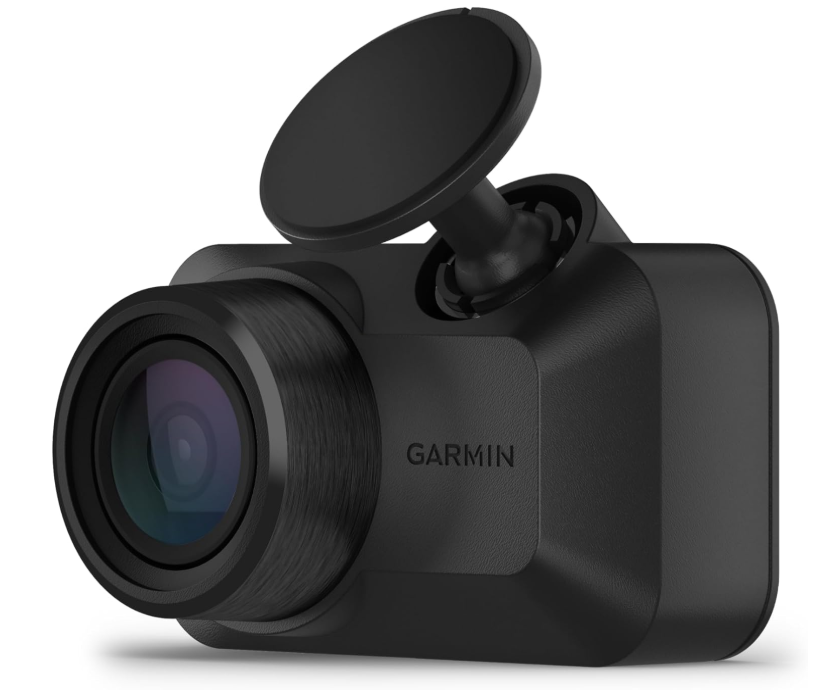
About the size of a car key and carrying no screen at all, this tucks behind the rear-view mirror where neither the driver nor a passing thief registers it.
A polarising filter is built into the lens, cutting the windscreen reflections that ruin footage on bright days, and voice commands start and stop recording without a touch. Up to four cameras synchronise together.
Recording stops at 1080p while cheaper cameras here shoot 4K, and parking alerts, live view and cloud storage all sit behind a paid subscription. Anyone wanting a camera nobody notices, from a brand with real service support, will accept both.
Pros
- Key-sized body hides completely behind the mirror
- Built-in polariser cuts windscreen glare
- Synchronises up to four cameras
Cons
- 1080p only, where cheaper cameras here record 4K
- Parking alerts, live view and cloud storage need a paid subscription
Key specs: 1080p, 140 degree field of view, no screen, built-in polarising filter, wifi, voice control, parking alerts and cloud vault by subscription, multi-camera sync up to four units
CHECK ON AMAZON7. DDPAI Z50 Pro 4K Dash Cam – Best Parking Mode
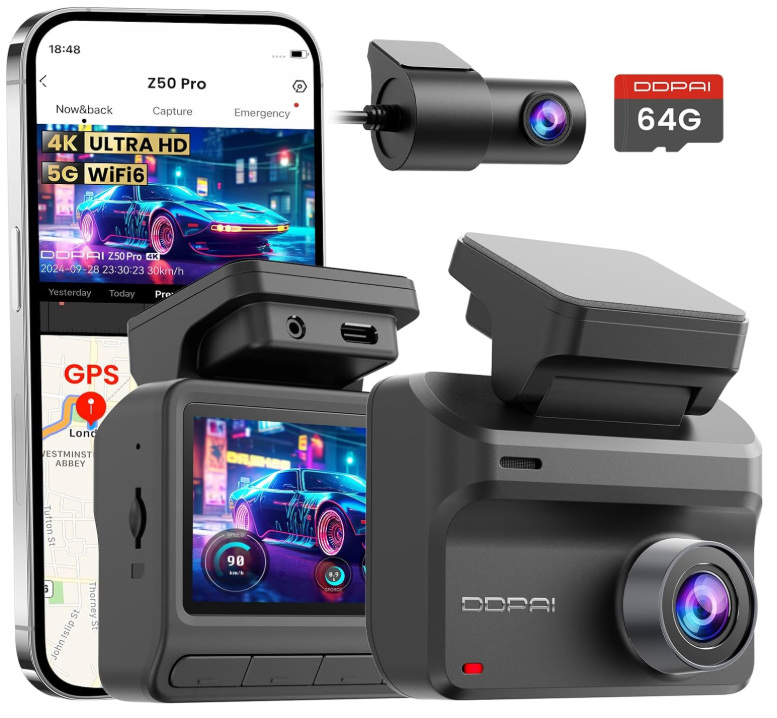
Parking surveillance is where most cameras quietly give up, and 48 hours of dual-channel time-lapse is the longest window anything in this guide offers.
The front shoots 4K across 143 degrees and the rear 1080p, a supercapacitor replaces the lithium battery that fails first in a hot car, and wifi 6 moves clips to a phone at around 13MB per second. A 64GB card is included, with support to 512GB.
That parking mode only runs once a hardwire kit is fitted, an extra purchase and usually an extra job. The 124 degree rear lens is the narrowest here too, so it sees less of an adjacent lane than the front does.
Pros
- 48 hours of dual-channel time-lapse parking coverage
- Supercapacitor instead of a heat-sensitive battery
- Wifi 6 offloads footage far faster than 2.4GHz cameras
Cons
- Parking mode needs a separately purchased hardwire kit
- 124 degree rear lens is the narrowest in this guide
Key specs: 4K front on a 143 degree lens and 1080p rear on 124 degrees, 3 inch IPS screen, GPS, wifi 6 at 5GHz, supercapacitor power, 64GB card included and expandable to 512GB, 48 hour dual-channel time-lapse parking mode with hardwire kit
CHECK ON AMAZON8. REDTIGER F17 4K Three Channel Dash Cam – Best for Rideshare Drivers
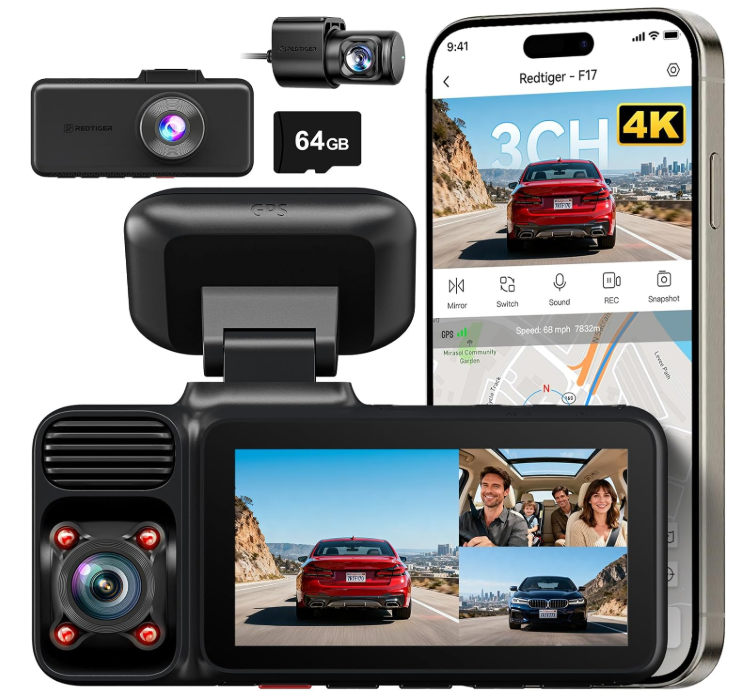
Three cameras record simultaneously here, covering the road ahead at 2160p, the cabin at 1080p and the road behind at 1080p.
Cabin footage is the part most three-channel cameras get wrong after dark, and four infrared lights fix it by lighting the interior without dazzling anyone. A Sony STARVIS 2 sensor handles the front, a supercapacitor powers it, and an 18 month warranty applies.
Running all three channels pulls front resolution below its maximum, so the choice is between complete coverage and the sharpest possible detail ahead. Anyone carrying paying passengers needs the cabin channel more than the extra pixels.
Pros
- True three-channel coverage of road, cabin and rear
- Four infrared lights make cabin footage usable at night
- Sony STARVIS 2 sensor with supercapacitor power
Cons
- Front resolution drops when all three channels run
- Parking mode needs a hardwire kit before it works
Key specs: 2160p front, 1080p interior and 1080p rear, Sony STARVIS 2 sensor, 150 degree front, 160 degree cabin and 155 degree rear fields of view, four infrared lights, GPS, 5.8GHz wifi, supercapacitor, 64GB card included, 18 month warranty
CHECK ON AMAZON9. 70mai A810S 4K Dash Cam – Best for Hot Climates
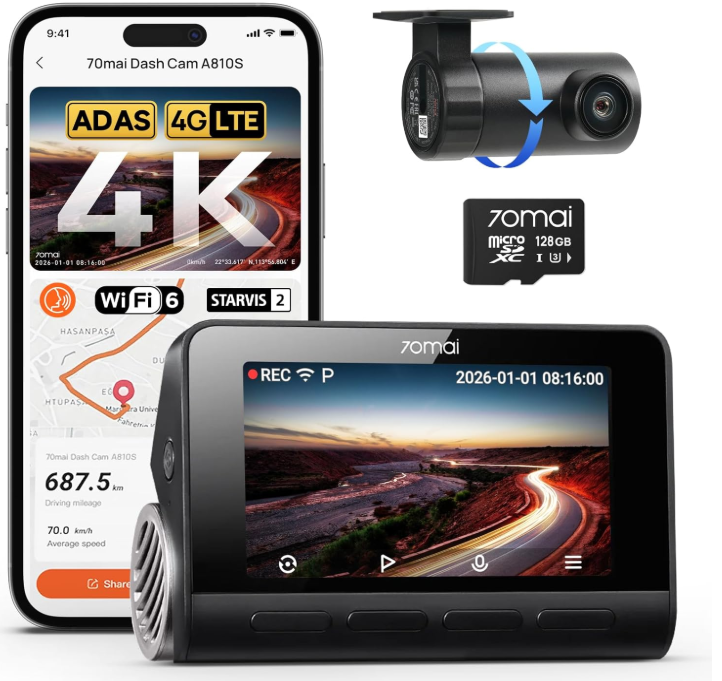
Heat is what kills dash cams parked in the Australian sun, and this is the only unit here rated to keep operating at 60 degrees.
A Sony STARVIS 2 IMX678 sensor behind an f/1.7 lens records 4K front and rear, wifi 6 handles transfers, and five-constellation GPS logs position. Motion detection keeps a rolling buffer of up to three minutes before an event, so the lead-up survives rather than just the impact.
It costs several times the cheapest 4K camera listed and has relatively few reviews behind it so far. For a car living outdoors in Perth, Darwin or western Sydney, the temperature rating decides whether any of the other specifications ever matter.
Pros
- Supercapacitor rated to 60 degrees, the best heat spec here
- Sony STARVIS 2 IMX678 sensor with an f/1.7 lens
- Pre-event buffer captures up to three minutes before an incident
Cons
- Costs several times the cheapest 4K camera here
- Relatively few reviews so far
Key specs: 4K front and rear, Sony STARVIS 2 IMX678 sensor, f/1.7 aperture, five-constellation GPS, wifi 6, supercapacitor rated from -10 to 60 degrees, up to 512GB storage, motion detection with up to three minute pre-event buffer, lane departure and collision warnings, voice control
CHECK ON AMAZONHow to Choose a Dash Cam
Check the power source before the resolution. Cameras built on a lithium battery swell and fail in a car parked in the Australian sun, where dashboard temperatures routinely pass 70 degrees. A supercapacitor tolerates that heat and only needs enough charge to close the current file safely, which predicts whether a camera survives more than two summers better than any other specification.
Sensor beats megapixels after dark. Most incidents worth reviewing happen in poor light, and a Sony STARVIS sensor at 1080p resolves a numberplate better than a budget 4K sensor does. The same sensor families appear in the cameras carried by consumer drones, which is why they handle glare and low light far better than a specification sheet suggests.
Decide how many channels you actually need. A front camera covers most claims. A rear channel matters for anyone regularly stopped in traffic, since it captures the driver who runs into the back of you. An interior lens only justifies its resolution cost for rideshare and delivery drivers, or for parents lending the car to a learner.
Parking mode is rarely included in the price. Almost every camera advertising 24 hour surveillance needs a hardwire kit sold separately, plus an install that taps the fuse box. Budget for both, or accept that recording stops with the ignition, which is exactly when most car park damage happens.
Match the card to the footage. A 4K dual-channel camera fills a 64GB card in a few hours, so loop recording can overwrite an incident before anyone saves it if the card is undersized. Buy a high-endurance card near the maximum the camera supports, and reformat it in the camera every few months, because constant rewriting wears consumer cards out quickly.
Know what the footage is for. Insurers and police accept dash cam video, and most states take submissions through an online portal, so GPS and timestamp overlays are worth having because they establish speed and location. A dash cam covers the vehicle while it moves, while home security cameras cover it parked in the driveway, and the two answer different questions.
Frequently Asked Questions
Are dash cams legal in Australia?
Yes, in every state and territory. The camera must not obstruct the driver view of the road, which in practice means mounting it behind the rear-view mirror. Recording audio of passengers without telling them raises separate surveillance issues, so check your state rules if you carry passengers.
Do I need a front and rear dash cam?
A front camera covers most claims. A rear channel is worth adding for anyone regularly stopped in heavy traffic, because it captures the vehicle that runs into the back of you, which is the one incident a front-facing camera can never record.
What is a supercapacitor and why does it matter?
It stores just enough power to close the current video file safely once the ignition cuts. Unlike a lithium battery it does not swell or degrade at high temperature, which matters enormously in a car parked in the Australian sun where dashboard temperatures pass 70 degrees.
How long does dash cam footage last before it is overwritten?
Loop recording overwrites the oldest file once the card fills. A 4K dual-channel camera fills a 64GB card in a few hours, while a 1080p single channel might last a day. Impact-locked clips are protected from the loop, though they still consume the card over time.
Does a dash cam record while the car is parked?
Only with parking mode enabled, and that almost always requires a separately sold hardwire kit drawing power from the fuse box. Without it, recording stops with the ignition, so damage in a car park goes uncaptured.
What memory card should I use?
A high-endurance microSD card rated for continuous recording, at or near the maximum capacity the camera supports. Standard cards are not built for constant rewriting and fail sooner. Reformat the card in the camera every few months to keep it reliable.
Verdict
For a car that lives outside, the 70mai A810S is the one worth paying for, because a supercapacitor rated to 60 degrees is what stops a dash cam dying over its second summer. Drivers carrying passengers should take the REDTIGER F17 instead, where four infrared lights make the cabin channel genuinely usable at night rather than a dark smear. And anyone who simply wants two channels without another gadget stuck to the glass should look at the Parkmate 9.66 inch Mirror DVR, which records 2K ahead and 1080p behind from the mirror already fitted.