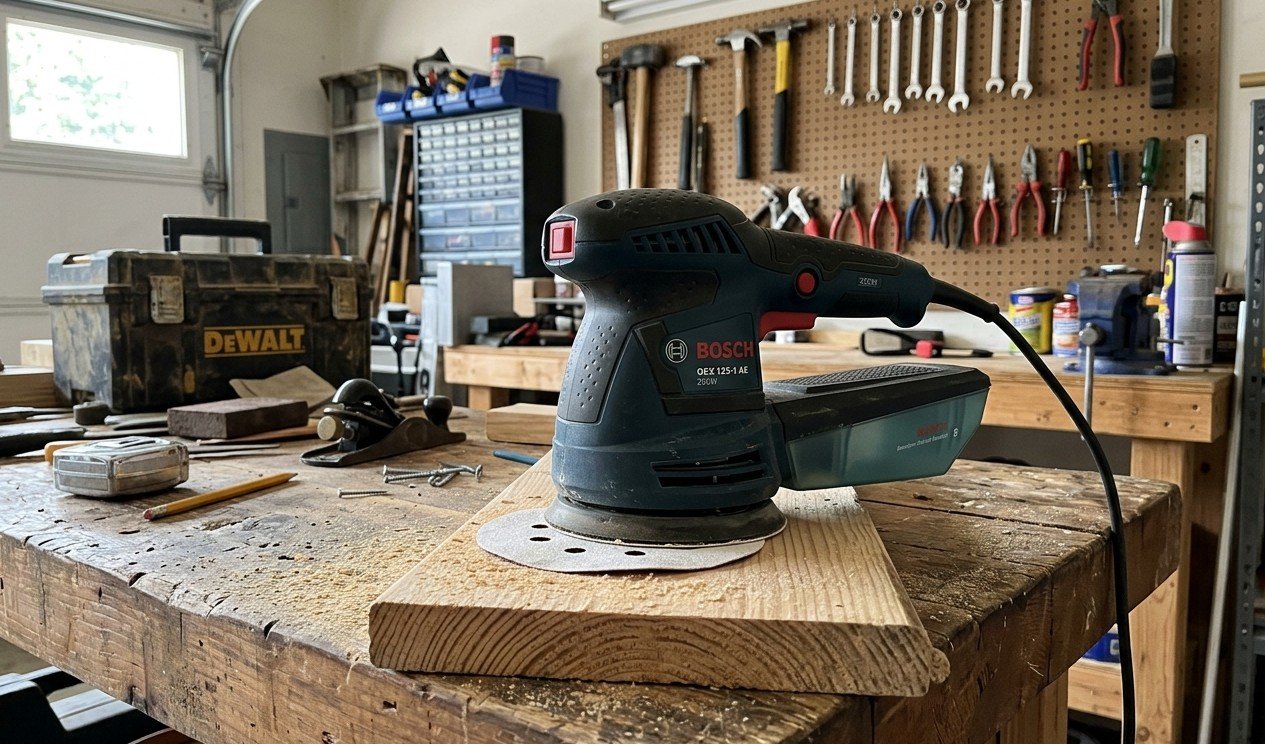
A random orbital sander spins its pad while simultaneously moving it in small ellipses, so no abrasive grain follows the same path twice, and the best random orbital sanders in Australia are the ones whose orbit size and dust extraction suit the work. That dual motion is what leaves a surface free of the swirl marks a plain rotary sander cuts in.
Three variables separate the machines. Orbit diameter decides whether a sander strips fast or finishes fine, corded or cordless decides where it can work, and dust extraction decides how much of the debris ends up captured rather than airborne. Pad size is near-universal at 125mm, so it rarely settles a decision.
Orbit diameter is the number most buyers never check, and the sanders here range from 2.5mm to 5mm, or roughly one tenth to one fifth of an inch. Speed ranges run from about 4,000 to 12,000 orbits per minute, and a wide range matters more than a high ceiling.
This guide compares six random orbital sanders sold in Australia on orbit size, power, dust capture and battery platform. Cutting work before sanding is covered separately in the guide to circular saws.
Best Random Orbital Sanders in Australia Compared
| Product | Link | Type | Best For | Key Spec |
|---|---|---|---|---|
| Bosch 370W Random Orbital Sander | Check price | Corded 370W | Sanding and polishing | 125mm pad, speed preselection |
| Stanley FatMax 480W Random Orbital Sander | Check price | Corded 480W | Dusty jobs | 4,000 to 12,000 OPM, 125mm |
| Bosch 270W Random Orbital Sander | Check price | Corded 270W | Light finishing work | 125mm pad, speed preselection |
| Milwaukee M18 Random Orbital Sander | Check price | 18V cordless | Existing 18V tool owners | 125mm pad, 1.41kg bare |
| MAXXT 350W Brushless Random Orbital Sander | Check price | Corded 350W brushless | Fine finishing | 2.5mm orbit, brushless, electronic brake |
| Cordless Random Orbital Sander for 20V Batteries | Check price | 20V cordless | Clean indoor work | 5 inch pad, 3 speeds, brushless |
1. Bosch 370W Random Orbital Sander – Best for Curved Surfaces
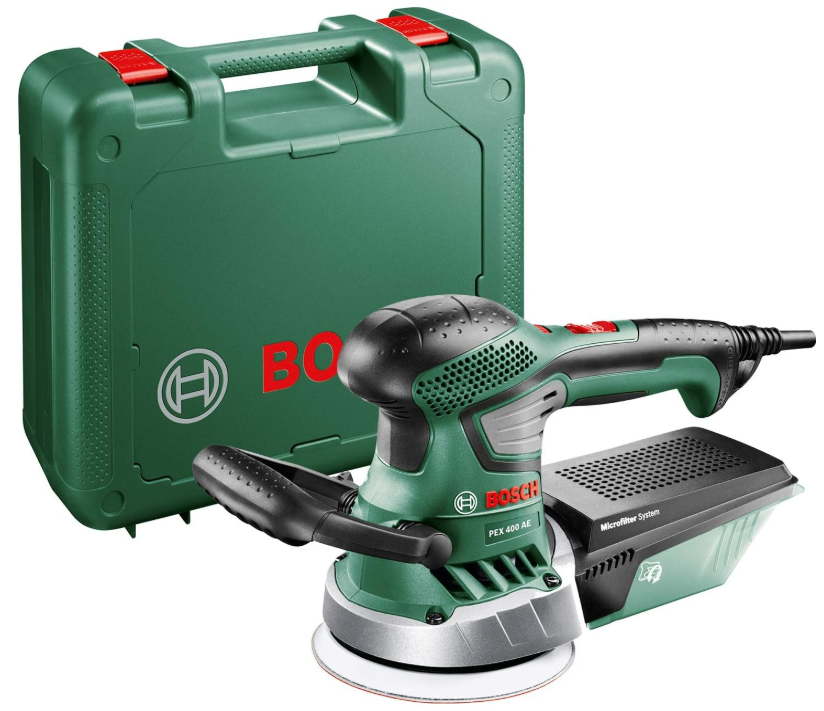
Electronic speed preselection sits on this 370W corded machine, letting the orbit rate be matched to the material before the trigger is pulled. The pad measures 125mm and the tool doubles as a polisher.
Curved work is where the random orbit pattern earns its name, because the pad both spins and oscillates so no single scratch pattern is repeated. Wood, plaster, painted, varnished and polished surfaces are all within its range.
A corded tool means a lead to manage and a power point within reach, which is the trade for consistent power that never fades. For general household refinishing across mixed materials, the speed dial is the control that matters most.
Pros
- Electronic speed preselection
- Doubles as a polisher
- Suits flat and curved surfaces
- Consistent corded power
Cons
- Cord limits working radius
- No battery platform to share
Key specs: 370W corded random orbital sander and polisher; 125mm pad; electronic speed preselection; for wood, plaster, painted, varnished and polished surfaces.
CHECK ON AMAZON2. Stanley FatMax 480W Random Orbital Sander – Best Dust Sealing
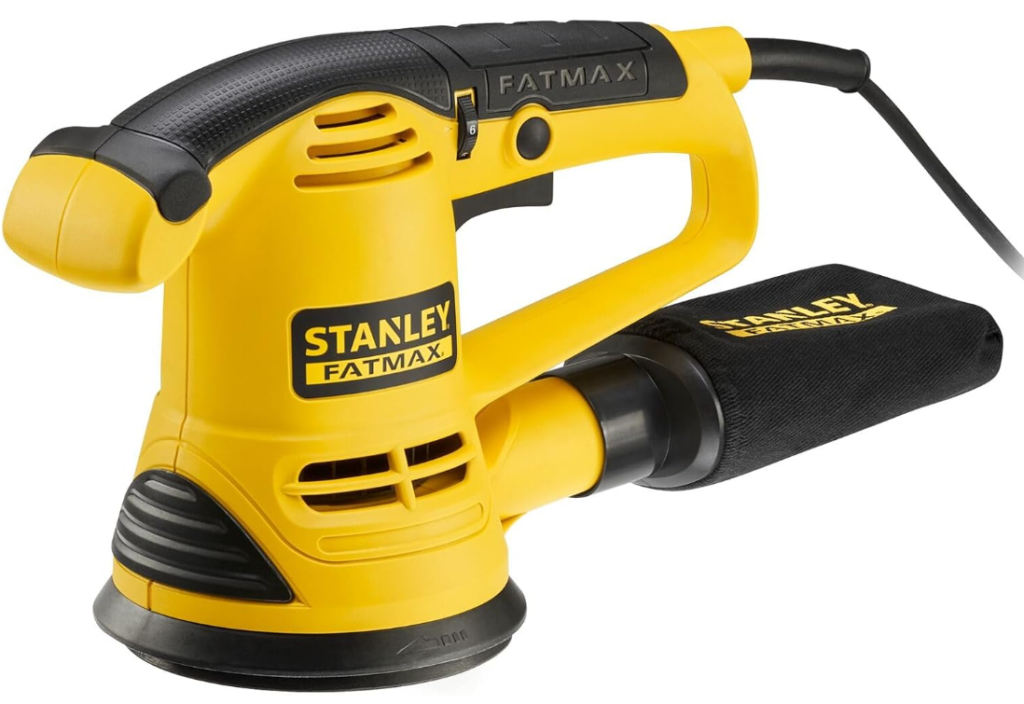
At 480W this is the most powerful corded unit here, with variable speed running from 4,000 to 12,000 orbits per minute. A quick-fit paper attachment changes abrasive without tools.
Dust-sealed components are the notable part, keeping fine particles out of the switch and bearings rather than only capturing them at the pad. Sanding is the dustiest common power tool job, and grit ingress is what usually kills a cheap machine.
The wide speed range covers stripping at the top end and finishing at the bottom, though the extra power adds weight over the Bosch units. For anyone sanding old paint or plaster where dust is unavoidable, the sealing is the reason to choose it.
Pros
- 480W with 4,000 to 12,000 OPM range
- Dust-sealed internal components
- Quick-fit paper attachment
- Wide speed range covers strip and finish
Cons
- Heavier than lower-wattage rivals
- Corded only
Key specs: 480W corded random orbital sander; 125mm pad; variable speed 4,000 to 12,000 RPM/OPM; dust-sealed components; quick-fit paper attachment.
CHECK ON AMAZON3. Bosch 270W Random Orbital Sander – Best Lightweight Corded
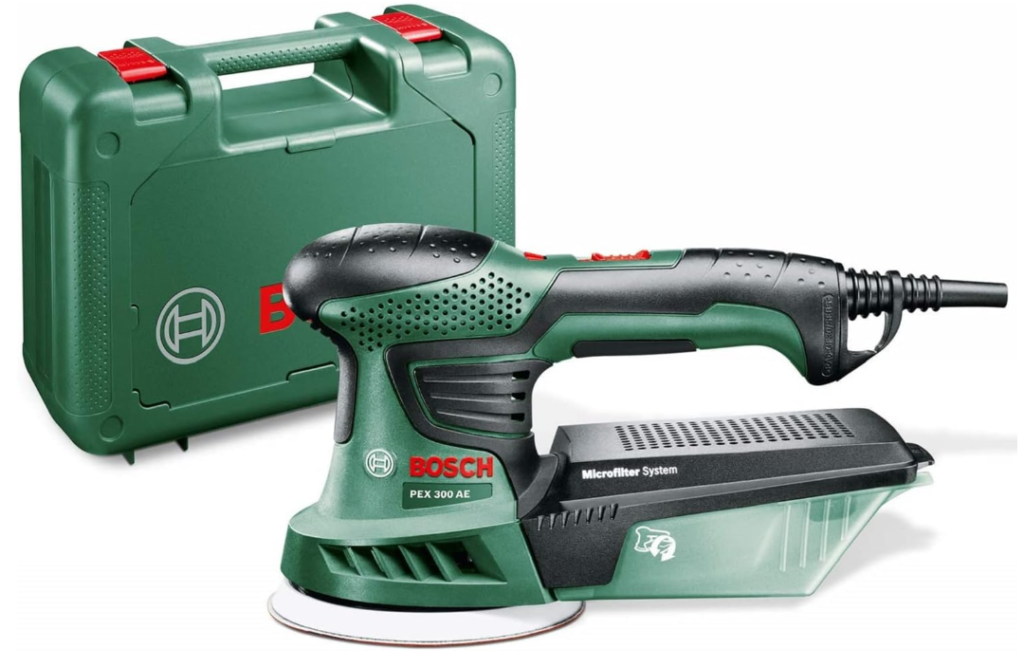
This is the lower-powered sibling of the 370W unit above, keeping the same 125mm pad and electronic speed preselection in a lighter body. It handles the same material range of wood, plaster and painted or varnished surfaces.
Dropping 100W matters less on finishing passes than on stripping, where the heavier machine pulls ahead. Held overhead or at arm length on a door or cabinet, the lower weight is felt within minutes.
Anyone stripping thick old paint should step up to more power rather than fight this one through it. For finishing, polishing and occasional weekend jobs, the reduced weight is worth more than the wattage lost.
Pros
- Lighter than the 370W version
- Electronic speed preselection
- Doubles as a polisher
- Same 125mm pad size
Cons
- Underpowered for heavy stripping
- Corded only
Key specs: 270W corded random orbital sander and polisher; 125mm pad; electronic speed preselection; for wood, plaster, painted, varnished and polished surfaces.
CHECK ON AMAZON4. Milwaukee M18 Random Orbital Sander – Best Cordless Platform
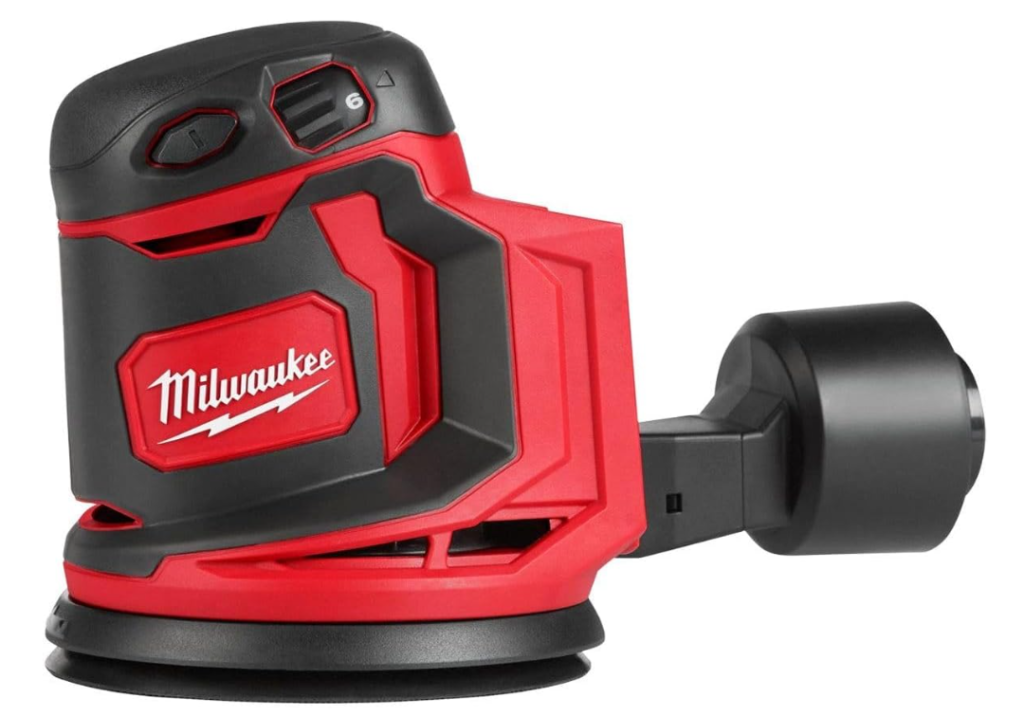
Sold as a bare unit on the 18V platform, this arrives without a battery or charger and weighs 1.41kg on its own. The pad is 125mm, matching the corded machines above.
Removing the cord changes where a sander can work, which matters on a roof, a fence line or anywhere a lead cannot reach. Weight without a battery is low, though a large pack adds noticeably to what the hand carries.
Buying this only makes sense with batteries already on the same platform, since the cost of a starter kit outweighs any corded unit here. For a tradesperson already invested in the system, it is the obvious pick.
Pros
- Cordless freedom for outdoor work
- Light at 1.41kg bare
- Shares batteries across the platform
- 125mm pad matches corded units
Cons
- No battery or charger included
- Only sensible for existing platform owners
Key specs: 18V cordless random orbital sander; bare unit with no battery or charger; 125mm pad; 1.41kg tool weight.
CHECK ON AMAZON5. MAXXT 350W Brushless Random Orbital Sander – Best Fine Finish
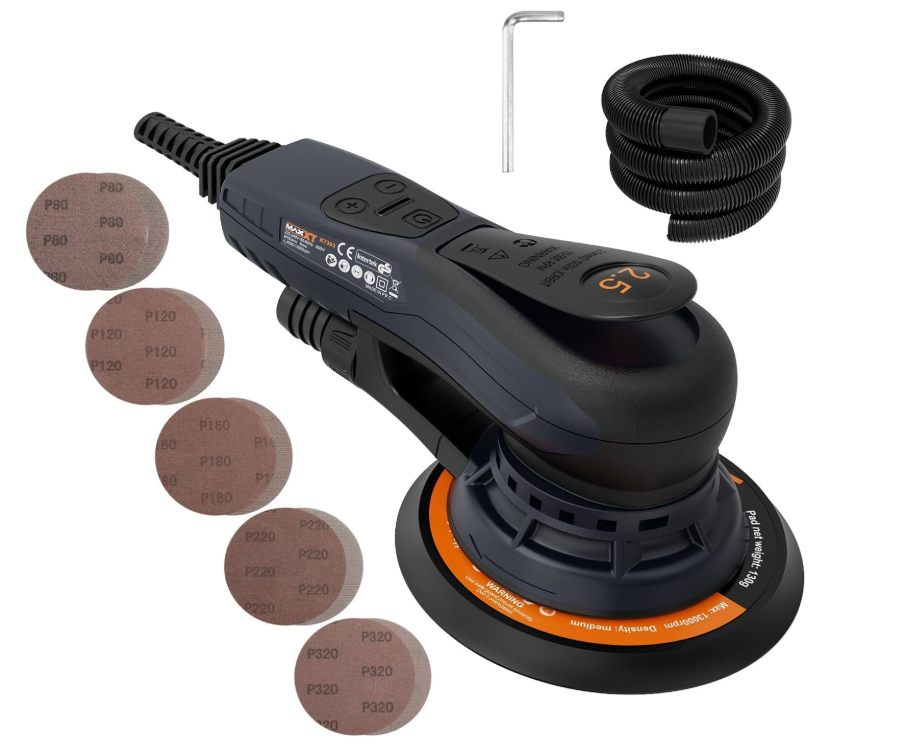
A 2.5mm orbit diameter is the defining number here, roughly half the throw of a general-purpose sander, driven by a 350W EC brushless motor. Two speed control modes adjust how the tool responds.
Smaller orbits remove material more slowly but leave a finer scratch pattern, which is what a surface needs before staining or clear coating. Electronic braking stops the pad quickly once the trigger releases, avoiding the gouge that a coasting disc leaves.
That fine orbit makes it slow for stripping, so it is the wrong tool for taking back a heavily painted surface. As a finishing sander used after coarser work, the smaller throw is exactly the point.
Pros
- 2.5mm orbit leaves a fine scratch pattern
- EC brushless motor
- Electronic pad braking
- Two speed control modes
Cons
- Slow for heavy stripping
- Corded only
Key specs: 350W corded random orbital sander; EC brushless motor; 2.5mm orbit diameter; two speed control modes; electronic pad braking.
CHECK ON AMAZON6. Cordless Random Orbital Sander for 20V Batteries – Best Dust Capture
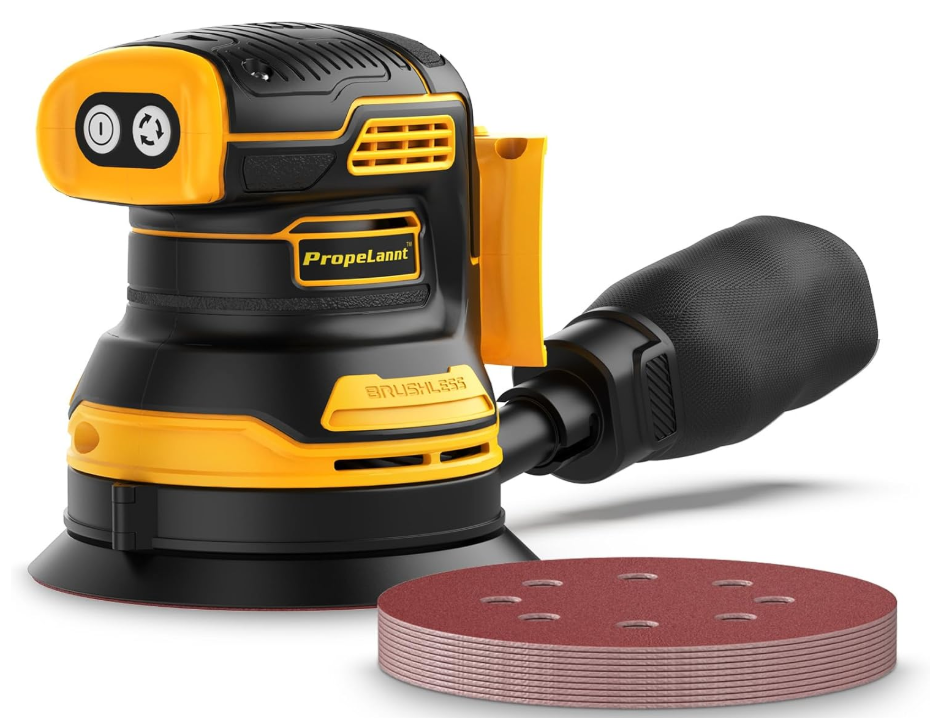
This bare tool runs on 20V MAX and 60V Flex batteries from an existing platform, pairing a brushless motor with three variable speeds across a 5 inch pad. Coarse and fine sandpaper are included in the box.
Its dust control system is the standout, capturing the overwhelming majority of debris at the pad rather than letting it settle across the room. Working indoors on furniture is where that difference is felt most.
No battery is included, and it fits one manufacturer battery family only, so it is useless without that platform already in the shed. For someone holding those packs who wants clean indoor sanding, it covers both requirements at once.
Pros
- Strong dust capture at the pad
- Brushless motor with 3 variable speeds
- Includes 40 and 80 grit sandpaper
- Runs on an existing 20V battery platform
Cons
- Battery not included
- Locked to one battery family
Key specs: Cordless random orbital sander; bare tool for 20V MAX and 60V Flex batteries; brushless motor; 3 variable speeds; 5 inch pad; dust collection system; 40P and 80P sandpaper included.
CHECK ON AMAZONHow to Choose a Random Orbital Sander in Australia
Choose orbit diameter by the job, not the badge. A 5mm orbit removes material quickly and suits stripping paint or levelling timber. A 2.5mm orbit takes longer but leaves a finer scratch pattern, which is what a surface needs before stain or clear coat goes on.
Take dust extraction seriously. Sanding produces the finest airborne dust of any common power tool, and old paint may contain lead in houses built before 1970. A sander with an effective onboard collector or a vacuum port keeps that out of the air, and a P2 mask remains sensible regardless.
Decide corded or cordless on where the work happens. Corded machines hold power indefinitely and never stop mid-job, which suits bench and indoor work. Cordless suits fences, decks and roof work where no power point is within reach, but bare tools are only economic if the battery platform is already owned.
Look for a wide speed range rather than a high top speed. Stripping wants the fast end and finishing wants the slow end, so a machine spanning 4,000 to 12,000 orbits per minute is more useful than one fixed near the top. Electronic pad braking is worth having, since a coasting disc set down carelessly leaves a gouge.
Check what dust sealing the tool has, not just what it collects. Grit that reaches the switch and bearings is what ends the life of most cheap sanders, so sealed components matter as much as the collection bag. This is the difference between a tool that lasts one renovation and one that lasts ten.
Budget for abrasives, and match the hole pattern. Discs are consumable and the ongoing cost easily exceeds the tool over a large project, so hook-and-loop pads with a common hole pattern keep resupply cheap. Australian Consumer Law covers a sander that fails early regardless of the stated warranty, and for related drilling and driving work see the guide to impact drivers.
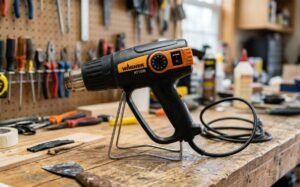
Before you start sanding, a heat gun softens old paint so most of it scrapes straight off.
Frequently Asked Questions
What is the difference between an orbital and a random orbital sander?
A plain orbital sander vibrates its square pad in a fixed pattern, which can leave repeating marks. A random orbital sander spins a round pad while also moving it in ellipses, so the abrasive path never repeats and the finish is free of visible swirls.
What orbit size should I choose?
Around 5mm for stripping and fast material removal, and about 2.5mm to 3mm for finishing before a coating goes on. A larger orbit works faster but leaves a coarser scratch pattern that shows through stain and clear finishes.
Do I need dust extraction on a sander?
Yes. Sanding creates very fine airborne dust, and paint in houses built before 1970 may contain lead. An onboard collector helps, connecting the tool to a vacuum helps more, and a P2 mask should be worn either way.
Is a cordless sander powerful enough?
Modern brushless cordless sanders handle most household work without difficulty. The practical limits are runtime and the cost of batteries, so cordless makes most sense for someone already holding packs from the same platform.
What speed should I sand at?
Use the higher end of the range for stripping and rapid removal, and the lower end for finishing, thin veneers and heat-sensitive surfaces such as plastics or painted trim. Running too fast on a finishing pass burnishes the surface rather than smoothing it.
How often should sanding discs be replaced?
As soon as cutting slows noticeably or the abrasive clogs with paint or resin. A worn disc generates heat instead of removing material, which burnishes timber and shortens the life of the pad underneath.
Verdict
For general household refinishing across mixed materials, the Bosch 370W Random Orbital Sander pairs speed preselection with a polishing function, which covers more of a weekend project than any single-speed machine. Where old paint and plaster make dust unavoidable, the Stanley FatMax 480W Random Orbital Sander is the one built to survive it, sealing its switch and bearings against the grit that ends most cheap sanders. Anyone preparing timber for stain should choose the MAXXT 350W Brushless Random Orbital Sander instead, because its 2.5mm orbit leaves the fine scratch pattern a clear finish will not disguise.