Every robot window cleaner in this guide relies on suction alone to stay stuck to a pane of glass, sometimes several storeys up, which is why the safety rope in the box is not a throwaway accessory. A robot window cleaner is a battery-backed device that grips glass with vacuum suction, sprays a section with water, and drags a microfibre pad across it in a programmed route, cleaning a sealed window from whichever side the unit is started on. The best robot window cleaner in Australia is the one that keeps that suction hold through a power interruption, not just the one with the highest suction number printed on the box.
Two designs cover what is sold here. **Suction-and-spray robots** hold themselves flat against the glass with a single vacuum motor and drag a spray-and-wipe pad in a Z or N shaped route, and nine of the ten picks below use this layout. **Dual-wheel robots** add two rotating cleaning discs on the underside that spin against the glass to lift dried-on grime, closer to how a person scrubs by hand than a flat pad wiping past it. Suction is quoted in Pa across every listing, and a bigger number does not automatically mean a securer hold, since plate shape and edge sealing matter just as much as the raw figure.
Suction across the ten robots compared here runs from 2800Pa up to 8000Pa on paper, but backup battery capacity decides what actually happens if the power lead gets bumped or a household fuse trips mid-clean. A unit with a basic 500mAh backup holds its position for a few minutes only; one built around a proper UPS can stay stuck to the glass for up to 20 minutes. That gap matters more on an upper-floor window than the headline suction figure does, since a robot that loses its grip on a ground-floor window drops onto a windowsill, and three storeys up it drops onto whatever, or whoever, happens to be underneath.
Ten robot window cleaners make up this comparison, spanning a slim suction unit through to a dual-wheel model built for scrubbing exterior grime nobody wants to squeegee by hand three storeys up. Coastal salt air in Sydney and Perth, and traffic grime on any inner-Melbourne high-rise, both build up on outside glass faster than a still, inland suburb ever sees.
Quick Picks

Round Window Cleaning Robot with Edge Detection
A border-detection sensor keeps this one gripped edge-to-edge on large sliding doors and balcony panels instead of wandering toward the frame.
CHECK ON AMAZON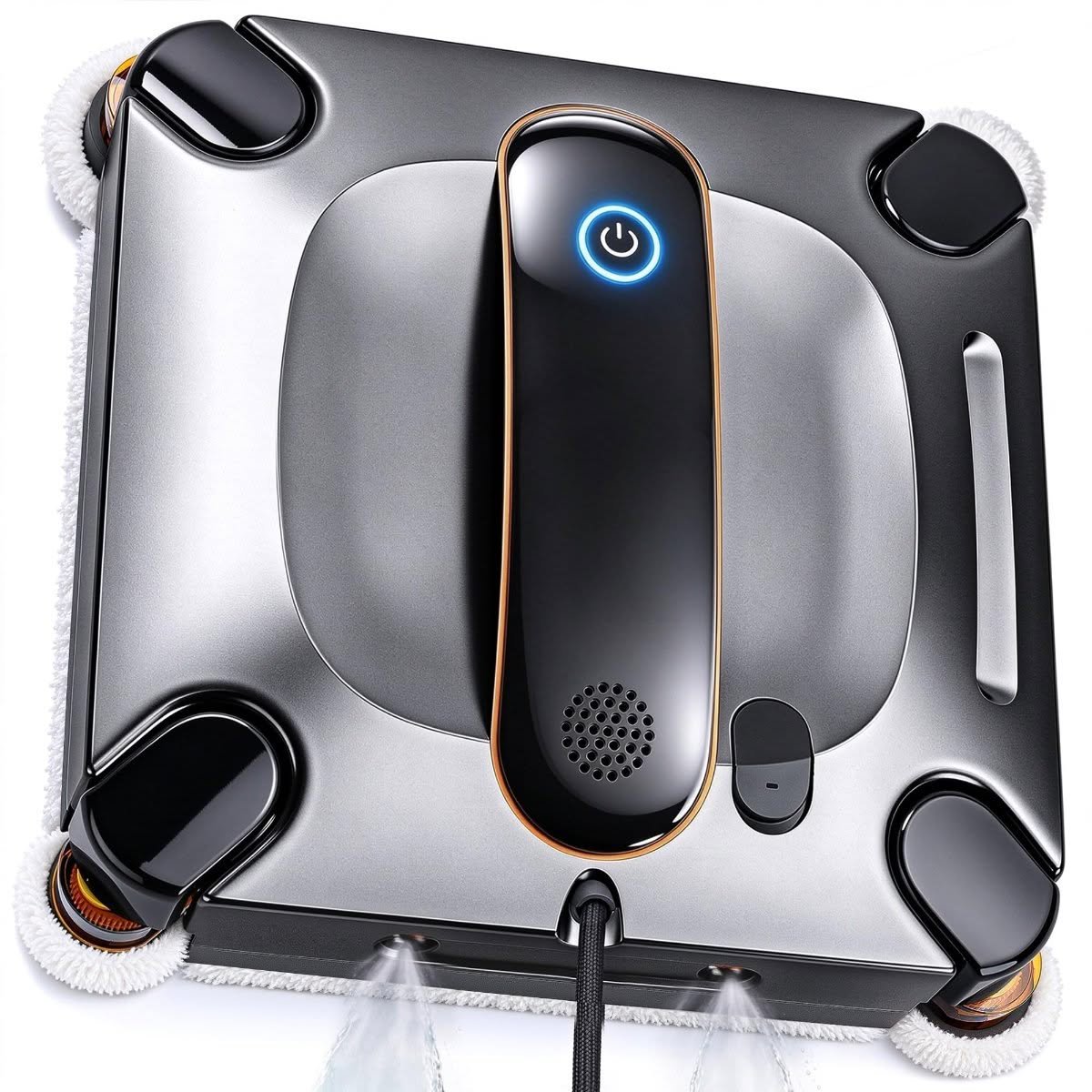
5000Pa Bionic Arm Window Cleaning Robot
Four bionic arms and rotating corner pads reach the frame edges, with 5000Pa suction and Tuya app control.
CHECK ON AMAZON
2800Pa Window Cleaning Robot
A straightforward robot that doubles up on mirrors, tiles and glass doors around the house.
CHECK ON AMAZONBest Robot Window Cleaner Australia Compared
| Product | Link | Type | Best For | Key Spec |
|---|---|---|---|---|
| Round Window Cleaning Robot with Edge Detection | Check price | Round, edge-sensing | Edge Detection | 2800-3200Pa auto, 500mAh backup |
| Dual Spray 3800Pa Window Cleaning Robot | Check price | Square, dual spray | Dual Spray Cleaning | 3800Pa, 55ml tank, app and remote |
| 5000Pa Bionic Arm Window Cleaning Robot | Check price | Square, bionic arms | Corner Cleaning | 5000Pa, 95ml tank, app |
| 2800Pa Window Cleaning Robot | Check price | Square, simple | Multi-Surface Versatility | 2800Pa, versatile surfaces |
| HOBOT 388 | Check price | Dual rotating wheels | for Outdoor Glass | Ultrasonic spray, 20min UPS |
| ECOVACS WINBOT Lite | Check price | Compact, dual nozzle | Compact Design | Win-SLAM 4.0, 5 modes |
| ECOVACS WINBOT W1S | Check price | Full-size, 360-swivel | Anti-Fall Safety | Win-SLAM 3.0, anti-fall sensors |
| AlfaBot GLS480 | Check price | Square, 5 modes | Multi-Mode Cleaning | 4-nozzle ultrasonic, Dry Wipe mode |
| Magivaac Robot Window Cleaner | Check price | Compact, dual mops | for Small Windows | Dual rotating mops, lightweight |
| Swihauk Window Cleaning Robot | Check price | Square, budget | Budget Pick | 5600Pa, AI path planning |
1. Round Window Cleaning Robot with Edge Detection – Best Edge Detection
A round shape and dual-pad design set this apart from the square-bodied picks further down this list, and a border-detection sensor keeps it gripped edge-to-edge across large panes, sliding doors and balcony glass instead of drifting toward the frame. Suction auto-adjusts between 2800 and 3200Pa depending on how much resistance the motor senses, instead of running flat-out for the whole cycle.
A 500mAh backup battery is enough to hold the unit in place if the power cord gets bumped, but it does not keep the cleaning cycle running – everything pauses until power returns, then picks up from where it stopped. The Bluetooth app pairs with voice prompts that call out each stage, handy for checking progress on a window several rooms away without walking over to look.
The 4.6 metre safety rope and carabiner are worth clipping on properly instead of leaving coiled in the box, since a strata building’s balcony glass is exactly the surface this robot is built for, and exactly where a dropped unit becomes someone else’s problem below. Ten reusable cleaning cloths in the box cover several sessions before a wash is needed.
Pros
- Round dual-pad design with a border-detection sensor for edge-to-edge coverage
- Auto-adjusting 2800-3200Pa suction matches motor effort to resistance
- Bluetooth app with voice-guided progress prompts
- 4.6 metre safety rope rated to hold real weight, carabiner included
Cons
- Backup battery only holds position, it does not keep cleaning through a power cut
- At 1.77kg it is heavier than the slimmer square-bodied picks on this list
Key specs: Model X21; round dual-pad design; 2800-3200Pa auto-adjusting suction; 500mAh backup battery (hold only); 70ml tank; Bluetooth app and remote; 4.6m safety rope; 1.77kg.
CHECK ON AMAZON2. Dual Spray 3800Pa Window Cleaning Robot – Best Dual Spray Cleaning
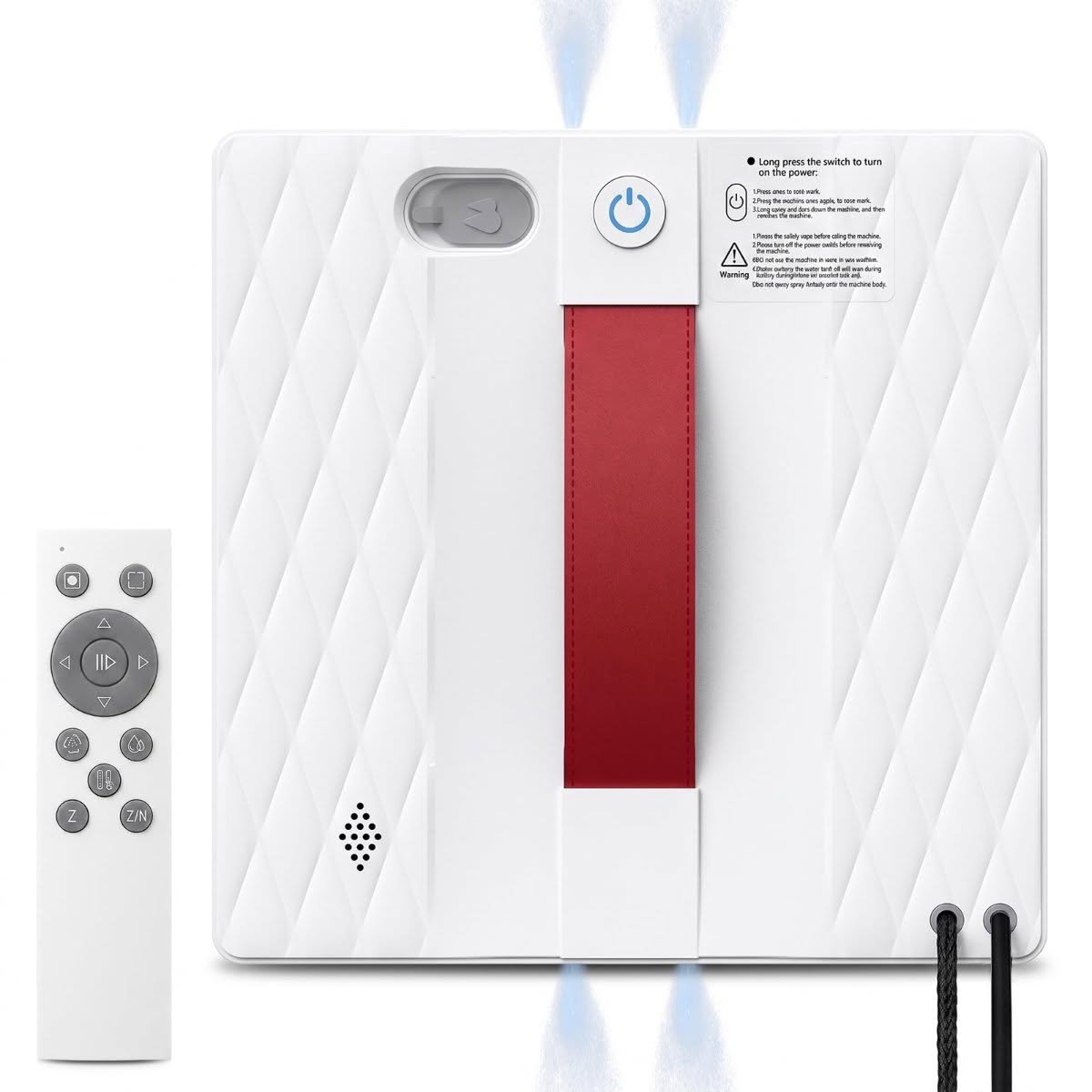
Four spray heads off a 55ml tank soak the glass as the pad moves, which is the difference between a wipe and a clean on salt film (coastal Perth or Gold Coast balcony glass is the test). Suction is quoted at 3800Pa, and three routes (N, Z and N+Z) cover most window shapes.
Control comes from the remote or the app, whichever you prefer, and the listing says high-precision sensors detect the edge of the glass so it can work on frameless panes. A 500mAh battery holds it against the glass if power drops mid-cycle, which is a grace period and not a runtime. The same robot is sold for glass doors, mirrors and tiles.
A 55ml tank is smaller than the 95ml and 100ml tanks on the models further down, so a run of big sliding doors means a refill. Next to the round robot at number 1 there is no adaptive suction either: it holds 3800Pa the whole way, which is plenty for a flat pane and a bit blunt for a dusty one.
Pros
- 3800Pa suction with four spray nozzles
- N, Z and N+Z cleaning routes
- Remote and app control
- Edge sensors for frameless glass
Cons
- 55ml tank means refills on a long run of windows
- Suction is fixed at 3800Pa, with no adjustment for different glass
Key specs: 3800Pa suction, 55ml tank, four spray nozzles, N, Z and N+Z routes, remote and app control, edge-detection sensors, 500mAh backup battery, glass, mirrors and tiles
CHECK ON AMAZON3. 5000Pa Bionic Arm Window Cleaning Robot – Best Corner Cleaning
Corners are where most window robots give up, and this one adds four bionic arms with rotating corner pads to a large square cloth to push the clean right out to the frame. Suction is quoted at 5000Pa, a step up on the 3800Pa robot at number 2, with frameless detection for suitable panes.
A 95ml tank feeds four nozzles with automatic or manual spray, and the Tuya app and the included remote give Z and N deep cleaning, up-and-down and left-and-right routes and a spot mode for stubborn marks. The listing quotes up to 30 minutes of power-off protection from the 500mAh backup battery if mains power drops.
It runs from the mains, so the cable length and the nearest power point decide which windows it reaches. A second-storey window in a Melbourne terrace usually needs a power board. The listing gives no weight or noise figure, and the arms are extra moving parts that can wear.
Pros
- Four bionic arms and rotating corner pads reach the frame edges
- 5000Pa suction
- Four nozzles and a 95ml tank, automatic or manual spray
- Tuya app and remote control
- Up to 30 minutes of power-off protection
Cons
- Mains cable limits which windows it reaches
- No weight or noise figure on the listing
- Bionic arms add moving parts that can wear
Key specs: 5000Pa suction, four bionic arms with rotating corner pads, four spray nozzles, 95ml tank, Tuya app and remote, Z, N and spot modes, frameless detection, 500mAh backup battery (up to 30 minutes)
CHECK ON AMAZON4. 2800Pa Window Cleaning Robot – Best Multi-Surface Versatility
This is the stripped-back design in the range, running a fixed 2800Pa suction with gyro-assisted navigation along a Z-shaped path. It skips the app and the extra spray nozzles the models above carry.
Where it earns its keep is versatility: the same unit is marketed and built for glass doors, mirrors and tiles, not just windows, which suits a household that wants one device instead of a drawer full of single-purpose cleaning gadgets. A wireless remote covers start, stop and mode selection without any of the smart-home setup the app-driven picks need.
Pros
- Simplest pick to run, with nothing to set up beyond the remote
- Built for glass doors, mirrors and tiles, not just windows
- Gyro-assisted Z-shaped navigation needs no manual programming
- Simple wireless remote, no app or account required
Cons
- No spray-nozzle automation, water application is more basic than the newer models above
- Fixed 2800Pa suction with no adjustment for different glass conditions
Key specs: 2800Pa suction; gyro navigation, Z-shaped route; wireless remote; suited to glass, mirrors and tiles.
CHECK ON AMAZON5. HOBOT 388 – Best for Outdoor Glass

HOBOT has built window robots since long before most of the other names here existed, and the 388 is the one model here that scrubs rather than just wipes: two rotating cleaning wheels turn at up to 70RPM, imitating a hand-cleaning motion instead of dragging a flat pad across the glass in one direction.
An ultrasonic nozzle sprays water or detergent automatically as it works, and a pneumatic pad auto-adjusts pressure against the glass so it keeps scrubbing through a heavily soiled section instead of skating over it. A built-in UPS holds the unit against the glass for up to 20 minutes if power is lost, by far the longest grace period of any pick on this list, and the 4.5 metre safety rope is rated to hold up to 200kg.
The 388 is only available through a third-party Australian seller, not an official HOBOT storefront, so check stock before you plan around it.
Pros
- Dual rotating wheels scrub, not just wipe, closer to hand cleaning
- Ultrasonic auto-spray with a pressure-adjusting pneumatic pad
- Built-in UPS holds position for up to 20 minutes on power loss, the longest of any pick here
- 4.5 metre safety rope rated to 200kg
Cons
- Only available through a third-party seller
Key specs: Dual rotating wheels (up to 70RPM); ultrasonic auto-spray; pneumatic auto-adjusting pad; built-in UPS (20 min hold); 5m power cord; 4.5m safety rope (200kg rated); app and remote control.
CHECK ON AMAZON6. ECOVACS WINBOT Lite – Best Compact Design
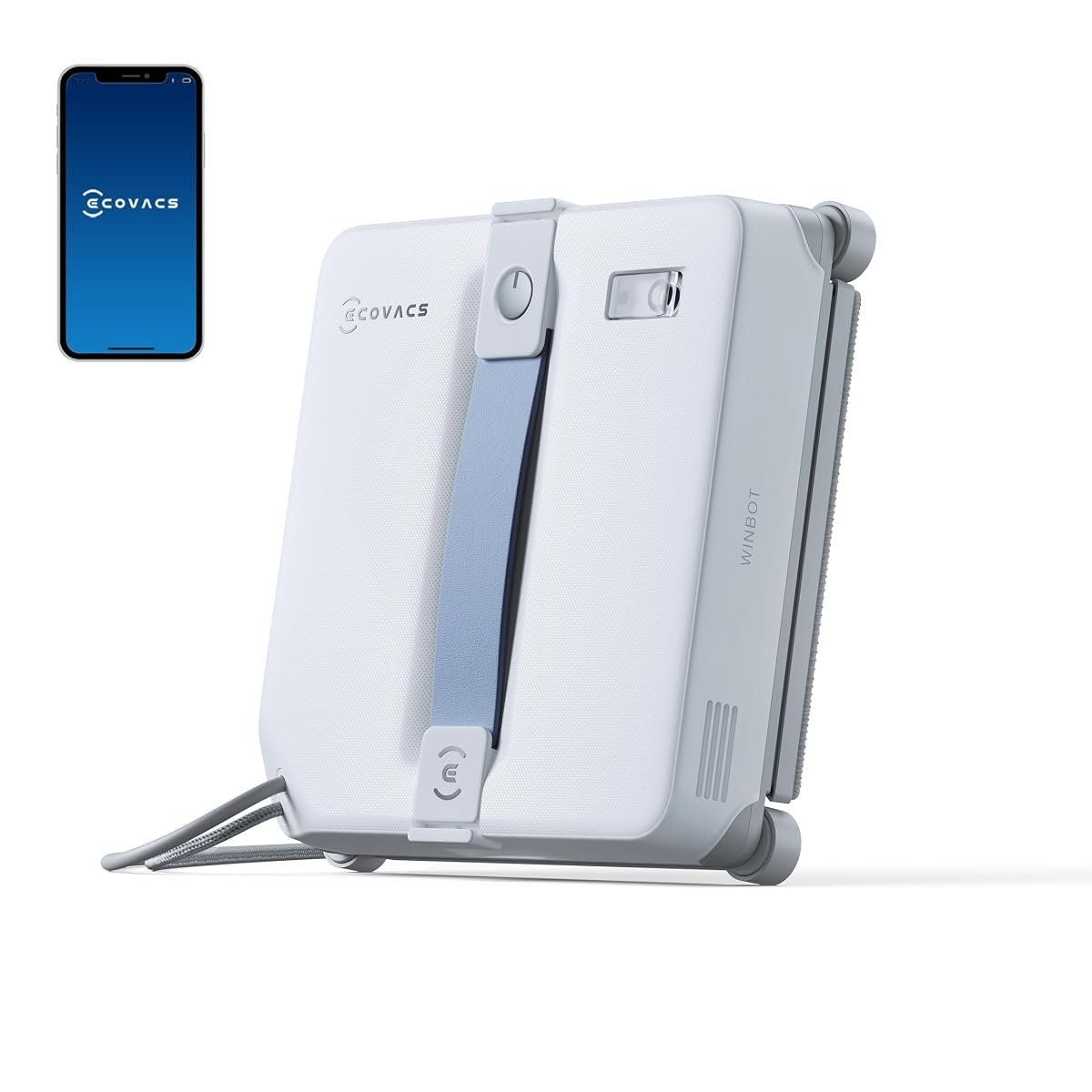
ECOVACS built its name on robot vacuums before window robots, and that engineering shows in the WIN-SLAM 4.0 navigation mapping each pane before the first pass rather than cleaning blind. The Lite trims the flagship WINBOT range down to a smaller footprint, with dual ultrasonic-spray nozzles and 5 smart cleaning modes covering everything from a light dust to a proper deep clean.
A 9-stage protection system covers the fall risk that matters most with any suction-based robot: sudden power loss, low suction detection and impact sensing all trigger a safety response instead of leaving the unit to rely on one single fail-safe. It ships from ECOVACS’ own Australian storefront, not a third-party reseller, which matters for warranty claims down the track.
Compact does mean a smaller cleaning path per pass than the full-size W1S below it on this list, so a run of several large windows takes noticeably longer session by session. For a single average-sized window or an apartment with modest glass, that trade-off barely registers.
Pros
- WIN-SLAM 4.0 navigation maps the pane before cleaning instead of working blind
- 9-stage protection system covering power loss, low suction and impact
- Sold through ECOVACS’ own Australian storefront, not a third-party reseller
- 5 smart cleaning modes from light dust to deep clean
Cons
- Smaller cleaning path per pass than the full-size W1S below
- Compact design means more passes needed on a run of large windows
Key specs: Compact design; dual ultrasonic-spray nozzles; Win-SLAM 4.0 navigation; 9-stage protection system; 5 smart cleaning modes; sold via ECOVACS AU storefront.
CHECK ON AMAZON7. ECOVACS WINBOT W1S – Best Anti-Fall Safety

A 360-degree swivel head and a Cross Auto-Spray Dual Direction system are what separate the full-size W1S from the compact Lite above it: the swivel lets the unit reorient itself against tilted, floor-to-ceiling or oddly angled glass instead of cleaning only in one fixed direction. A 60ml reservoir keeps a microfibre cloth damp through a longer session, with a rated 400 percent water retention that a basic pad does not match.
WIN-SLAM 3.0 navigation scans and maps each window before the cleaning path begins, and real-time sensors keep monitoring progress through the cycle to confirm nothing gets missed on a complicated window shape. Anti-fall sensors are the headline safety feature, specifically designed to detect a loss of grip before it becomes a drop instead of reacting after the fact.
The WINBOT line handles awkward second-storey windows most people cannot reach safely by hand, but a connected window robot depends on an app and a battery, so check the app support and battery details on the listing before you commit.
Pros
- 360-degree swivel head adapts to tilted or floor-to-ceiling glass
- Cross Auto-Spray Dual Direction with a 400 percent water retention microfibre pad
- WIN-SLAM 3.0 navigation with real-time progress monitoring
- Anti-fall sensors built to detect a loss of grip before it drops
Cons
- Corded design and the need for regular pad rinsing make it more hands-on than the box photos suggest
Key specs: 360-degree swivel head; Cross Auto-Spray Dual Direction; 60ml reservoir; Win-SLAM 3.0 navigation; anti-fall sensors; sold via ECOVACS AU storefront.
CHECK ON AMAZON8. AlfaBot GLS480 – Best Multi-Mode Cleaning
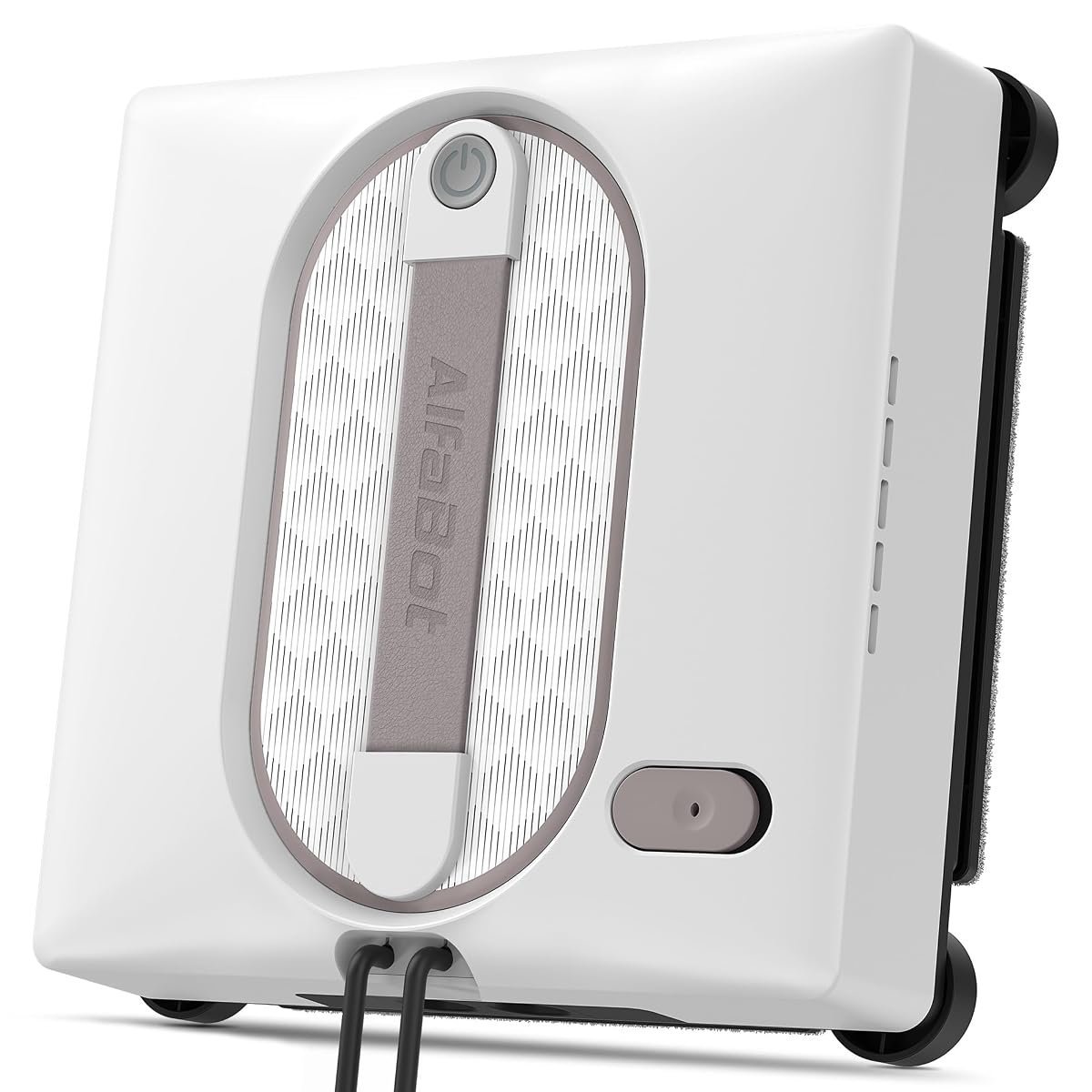
Five adaptive modes give more control than the two or three most competitors offer: Auto and Deep cover routine and heavy grime, Spot repeats five times over one stubborn mark instead of the whole pane, Edge concentrates on corners and borders, and Dry Wipe skips the spray entirely for a light dust pass that will not leave streaks drying in direct sun.
Four ultrasonic spray nozzles distribute water evenly instead of dumping it from one point, and a UPS backup keeps the unit powered through a brief outage instead of just holding position. Anti-collision and anti-fall sensing round out the safety features.
Automatic path planning handles the route so nobody has to pre-select Z versus N versus a combined pattern before starting, one less decision than the app-controlled robots earlier on this list ask for.
Pros
- Five adaptive modes including a spray-free Dry Wipe setting for light dusting
- Four-nozzle ultrasonic spray for even water distribution
- UPS backup keeps the unit powered, not just holding position, through a brief outage
- Automatic path planning with no manual route selection needed
Cons
- Sold through a third-party marketplace seller, not a dedicated AlfaBot storefront
Key specs: 5 adaptive modes (Auto, Deep, Spot, Edge, Dry Wipe); 4-nozzle ultrasonic spray; UPS backup power; anti-collision and anti-fall sensing; automatic path planning.
CHECK ON AMAZON9. Magivaac Robot Window Cleaner – Best for Small Windows

A compact body built to be easy to lift on and off the glass, instead of left permanently mounted between cleans, is the whole idea here. Two rotating mops handle the actual cleaning motion, and dual spraying nozzles wet the pane ahead of them, a similar principle to HOBOT’s dual-wheel design further up this guide but in a lighter, smaller unit.
Remote control and smart app compatibility cover the basics, and a built-in backup battery holds the unit against the glass if the power lead is knocked loose. It suits a small bathroom window, a narrow laundry pane or an apartment with modest glass better than a full-size window wall, where the smaller cleaning path would mean far more passes.
Pros
- Compact and properly lightweight, easy to lift on and off the glass
- Dual rotating mops plus dual spray nozzles wet the glass ahead of cleaning
- Remote control and smart app compatibility included
- Suits small bathroom or laundry windows better than a full-size unit would
Cons
- Smaller cleaning path means more passes on anything larger than a modest window
Key specs: Model LEN-RWC10; dual rotating mops; dual spraying nozzles; built-in backup battery; remote and smart app control; compact, lightweight build.
CHECK ON AMAZON10. Swihauk Window Cleaning Robot – Best High-Suction Pick

This pick carries a higher suction figure, 5600Pa, than every one of the first four models in this guide, plus AI path planning and edge detection that many window robots skip entirely. Six rags are included, enough to rotate through several cleaning sessions before a wash is needed.
A safety system covers the basics expected here: detecting a drop in suction and responding before the unit loses its grip. What it does not carry is the brand history of the ECOVACS and HOBOT picks above.
Pros
- 5600Pa suction figure
- 5600Pa suction is higher on paper than every directly-sourced pick above it
- AI path planning and edge detection included
- Six rags included for several cleaning sessions
Cons
- No established brand history to fall back on if something goes wrong
Key specs: 5600Pa suction; AI path planning; edge detection; safety system; 6 cleaning rags included.
CHECK ON AMAZONHow to Choose the Best Robot Window Cleaner in Australia
Match backup battery capacity to how high the window actually sits. A ground-floor or single-storey window forgives a basic 500mAh backup that only holds position through a brief outage. Anything above the first floor is worth paying more for a longer hold time, or a genuine UPS, since the consequence of a dropped unit scales with height.
Check the maximum glass size against the actual window, not just the average room. Most robots here top out around 3 to 3.5 metres in one dimension, which covers a standard sliding door but not always a full-height feature window. Measure the largest pane in the house before assuming any robot here will cover it in one pass.
Suction in Pa is a starting point, not the whole spec sheet. A 2800Pa unit with good edge sealing can hold as securely as an 8000Pa unit with a poor gasket, and several entries in this guide auto-adjust suction rather than running at a fixed maximum the whole cycle. Read the plate-and-seal design alongside the number, not instead of it.
Always test the safety rope’s anchor point before trusting it on an upper floor. A window frame, an internal hook or a solid piece of furniture near the window all make reasonable anchor points; a curtain rail or a loose fitting does not. Clip the rope on and give it a firm tug before starting the first real clean at height, not after.
Frameless glass needs edge detection more than a framed window does. A framed window gives a robot a physical lip to sense; frameless glass, common on newer apartment balconies and sliding doors, relies entirely on the unit’s own sensors to know where the pane ends. Check that a frameless-specific claim actually appears in the listing before buying for this exact use case.
A robot window cleaner and a robot vacuum solve two completely different problems, and buying one does not replace the other. One cleans vertical glass with suction and a wet pad; the other cleans horizontal floors with brushes and a dry or damp mop. Anyone setting up a fuller robotic cleaning routine should treat our guide to the best robot vacuum and mop in Australia as a separate purchase decision, not an upgrade path from a window robot.
You’ll Also Want
Compatible ECOVACS Winbot cleaning solution and pad refills keep the streak-free result going once the included pads wear thin, instead of replacing the whole unit. Replacement Microfibre Cleaning Pads
A manual squeegee and bucket kit, the same basic tool Bunnings sells by the checkout, covers the one window shape or angle a robot cannot reach, without needing a second robot just for the awkward spots. Telescopic Window Squeegee
Somewhere to rest a freshly used, still-damp robot between windows saves a bench or windowsill from water marks during a longer cleaning session. Heat Resistant Silicone Mat
Frequently Asked Questions
What does the suction rating in Pa actually mean on a robot window cleaner?
Pa (Pascals) measures how hard the unit’s vacuum motor pulls to hold itself against the glass, and listings in this category range from around 2800Pa up to 8000Pa. A dusty, greasy or slightly wet pane reduces the effective grip well below the number on the box, which is why most manufacturers recommend a quick wipe-down before the robot’s first pass on a window that has not been cleaned in a while.
What happens if the power goes out while a robot window cleaner is running?
A backup battery, usually 500 to 600mAh on smaller models, holds the unit in place for a few minutes so it does not immediately fall. Models with a proper UPS can hold position for up to 20 minutes. Either way, the cleaning cycle pauses instead of continuing, and resumes once power returns.
Can a robot window cleaner safely clean an upstairs or balcony window?
Most models include a safety rope rated to hold real weight, and this should always be anchored to a solid window frame, hook or fixture before starting, not left coiled in the box. A longer battery backup matters more at height, since a dropped unit becomes a genuine hazard to whatever or whoever is below.
Does a robot window cleaner work on frameless glass?
Many do, provided the listing specifically mentions frameless compatibility and edge or border detection. Frameless glass, common on newer balconies and sliding doors, gives the unit no physical lip to sense, so it relies entirely on onboard sensors to judge where the pane ends. Check this claim before buying for a frameless-glass household specifically.
How is a robot window cleaner different from a robot vacuum or mop?
A robot window cleaner grips vertical glass with vacuum suction and drags a wet pad across it in a programmed route. A robot vacuum or mop instead rolls across horizontal floors on wheels, using brushes or a mop pad. The two solve completely different cleaning problems and neither substitutes for the other in a household routine.
Do robot window cleaners need special cleaning solution, or just water?
Plain water is enough for most routine cleans, and several models spray water automatically from an onboard tank instead of needing manual application. A mild glass-cleaning solution can help on heavier grime, but check the manufacturer’s guidance first, since some ultrasonic spray nozzles are designed around water alone and can clog with a thicker cleaning liquid.
Verdict
Anyone renting or in an apartment with a strata body corporate to answer to should look first at the round edge-detection pick at number 1, since its 4.6 metre rope and border sensor are built for exactly that balcony-glass scenario. A household chasing the deepest clean on properly grimy exterior glass gets more from the HOBOT 388’s scrubbing wheels than from any suction-only design here, provided the third-party seller does not put buyers off. For a single average window with no drama involved, the app-controlled pick or the Swihauk both do the job without asking for a strata meeting first.