The best budget action camera in Australia is the one that survives the conditions you film in and holds the picture steady while you move, not the one printing the largest resolution on the box. An action camera is a fixed-lens camera built to be mounted, knocked about and submerged, which is a different job to the one a phone or a compact camera does.
Almost everything in this price range claims 4K. The claim is usually true and almost never the deciding factor, because the sensor behind the lens and the stabilisation applied afterwards do the real work. That divides the category four ways: caseless waterproof, housing-dependent, dual-screen vlogging, and entry Full HD.
Waterproofing is where the numbers turn specific and worth reading closely. Depth ratings here run from 5 metres to 18 metres with no housing fitted, roughly 16 to 59 feet, and reach 40 metres with the supplied case on the cheaper models. Sensor size, the frame rate available at 4K and battery capacity in milliamp-hours all tell you more than the megapixel figure.
Where a listing contradicts itself, and two of these do, the entry below says so rather than repeating whichever number is larger. The ten cameras run from those needing no housing to those that cannot get wet without one.
Quick Picks
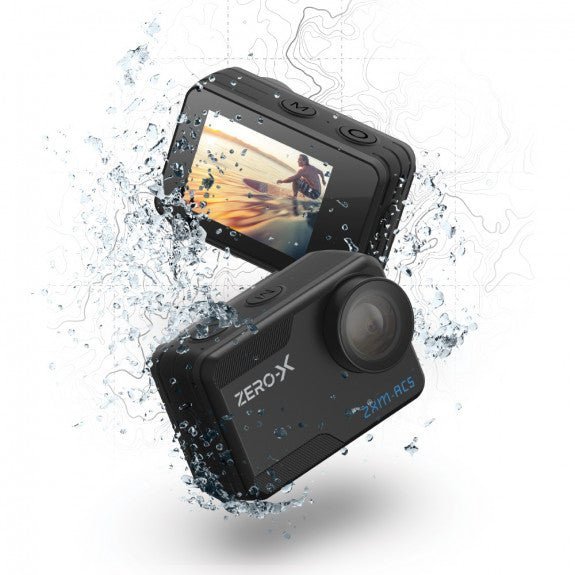
Zero-X ZXM-AC5
Waterproof to ten metres with no case, so the touch screen still works wet.
CHECK CURRENT PRICE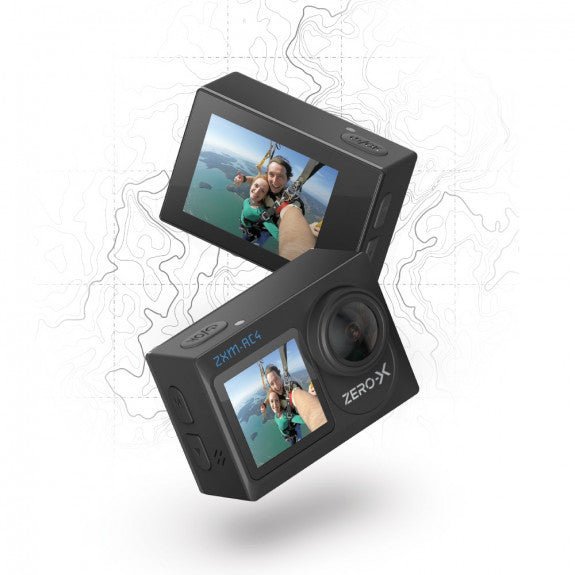
Zero-X ZXM-AC4
A front screen at a price where almost nothing else includes one.
CHECK CURRENT PRICE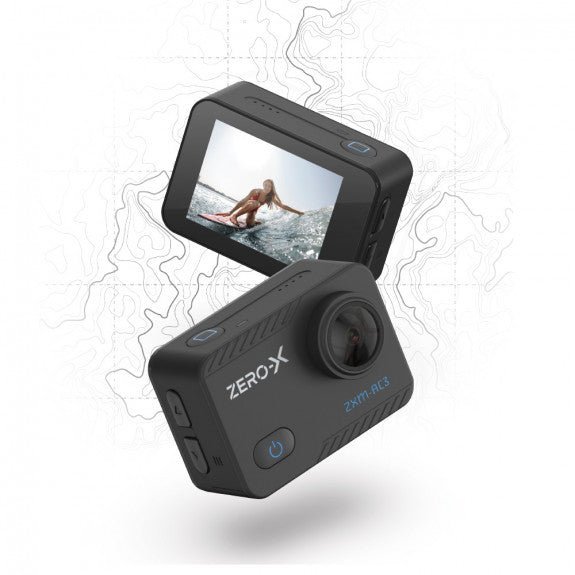
Zero-X ZXM-AC3
Ten accessories in the box, including the bike mount most buyers forget to budget for.
CHECK CURRENT PRICEBest Budget Action Camera in Australia Compared
| Product | Link | Type | Best For | Key Spec |
|---|---|---|---|---|
| Zero-X ZXM-AC5 | Check price | Caseless waterproof | Swimming and snorkelling | 10 m caseless, 12MP Sony sensor |
| Zero-X ZXM-AC4 | Check price | Dual screen | Filming yourself | 1.4 in front screen, 12MP HDR |
| Zero-X ZXM-AC3 | Check price | Housing-dependent | A complete kit in one box | 12MP HDR, 10-piece kit |
| Zero-X ZX-10 | Check price | Entry Full HD | Handing to a child | 1080p, 400mAh, 2.0 in LCD |
| DJI Osmo Action 4 | Check price | Caseless waterproof | Water, dusk and cold | 18 m caseless, 1/1.3 in sensor, 4K/120 |
| GoPro Hero (2024) | Check price | Caseless waterproof | Helmet and handlebar mounting | 86 g, 5 m caseless, 4K |
| AKASO Brave 7 LE | Check price | Dual screen | Rain and rough handling | IPX7 body, 40 m housed, 6-axis EIS |
| AKASO V50 Elite | Check price | Housing-dependent | Slow motion and smooth panning | 4K/60fps, 720p/240fps |
| Dragon Touch Vision 3 | Check price | Housing-dependent | A complete first setup | 4K/30, 18-piece kit, 2 batteries |
| AKASO EK7000 | Check price | Housing-dependent | Spending as little as possible | 4K/30, WiFi, housed |
1. Zero-X ZXM-AC5 – Best Caseless Waterproofing
Ten metres of waterproofing with no housing fitted is what separates this from the rest of the range, and it is the single most useful specification in the category. Behind it sits a 12MP Sony sensor, a 2.0-inch rear touch screen and a 900mAh battery rated to about 90 minutes of recording.
A camera that is waterproof in its own right behaves completely differently to one that needs a plastic case. There is no fogging between lens and housing, the microphone is not muffled, and the touch screen still works, which together decide whether footage from a pool or a beach is usable.
The listing quotes 4K but never states a frame rate, which is the gap to be aware of because 4K at a low frame rate looks worse than clean 1080p. Choose it if water is part of the plan and you want the touch screen working while wet.
Pros
- Waterproof to 10 m with no case fitted
- 12MP Sony sensor
- Touch screen usable while wet
- Image stabilisation included
Cons
- 4K frame rate not published anywhere on the listing
- Top of the Zero-X range on price
Key specs: 12MP Sony sensor, 4K UHD video, waterproof to 10 m caseless, 2.0 in rear LCD touch screen, 900mAh battery to about 90 minutes, WiFi, timelapse and slow motion
CHECK CURRENT PRICE2. Zero-X ZXM-AC4 – Best Front Screen for Vlogging
A 1.4-inch screen on the front alongside the 2.0-inch touch screen on the back is the feature buyers normally pay flagship money for. The sensor is the same 12MP Sony unit with HDR, and the 900mAh battery is shared with the model above.
Framing yourself without a second screen is guesswork, and guesswork is why so much self-shot footage has a head cut off at the top. That one addition changes the hit rate more than any sensor upgrade at this level would.
Unlike the model above it, this one is waterproof only inside the supplied case, with no depth or IP rating published for the bare camera. It suits talking to camera on land rather than filming in water.
Pros
- 1.4 in front screen for self-framing
- 12MP Sony sensor with HDR
- Electronic image stabilisation
- Costs less than the caseless model above
Cons
- Waterproof only inside the supplied case
- No depth or IP rating published
Key specs: 12MP Sony sensor with HDR, 4K UHD video, dual screens with 2.0 in rear touch and 1.4 in front, electronic image stabilisation, 900mAh battery, WiFi
CHECK CURRENT PRICE3. Zero-X ZXM-AC3 – Best Accessory Kit
The same 12MP HDR Sony sensor, electronic stabilisation and 900mAh battery as the two models above, minus the front screen, and with a ten-piece accessory kit in the box. That kit covers a waterproof case, a bike mount and two quick-release mounts.
Accessories are where cheap cameras quietly cost more than they appear to, because a camera with no mounts is a camera that stays in a drawer. Getting the bike mount and quick releases included removes the second purchase most buyers do not budget for.
Waterproofing depends entirely on the supplied case here, with no rating on the camera itself. This is the Zero-X to pick if the requirement is one box that covers everything rather than the best individual specification.
Pros
- Ten-piece accessory kit included
- Same 12MP HDR sensor as the dearer models
- Electronic image stabilisation
- Bike and quick-release mounts in the box
Cons
- Waterproof only inside the supplied case
- No front screen
Key specs: 12MP Sony sensor with HDR, 4K UHD video, 2.0 in IPS touch screen, electronic image stabilisation, 900mAh battery, WiFi, 10-piece accessory kit
CHECK CURRENT PRICE4. Zero-X ZX-10 – Best First Camera for a Child
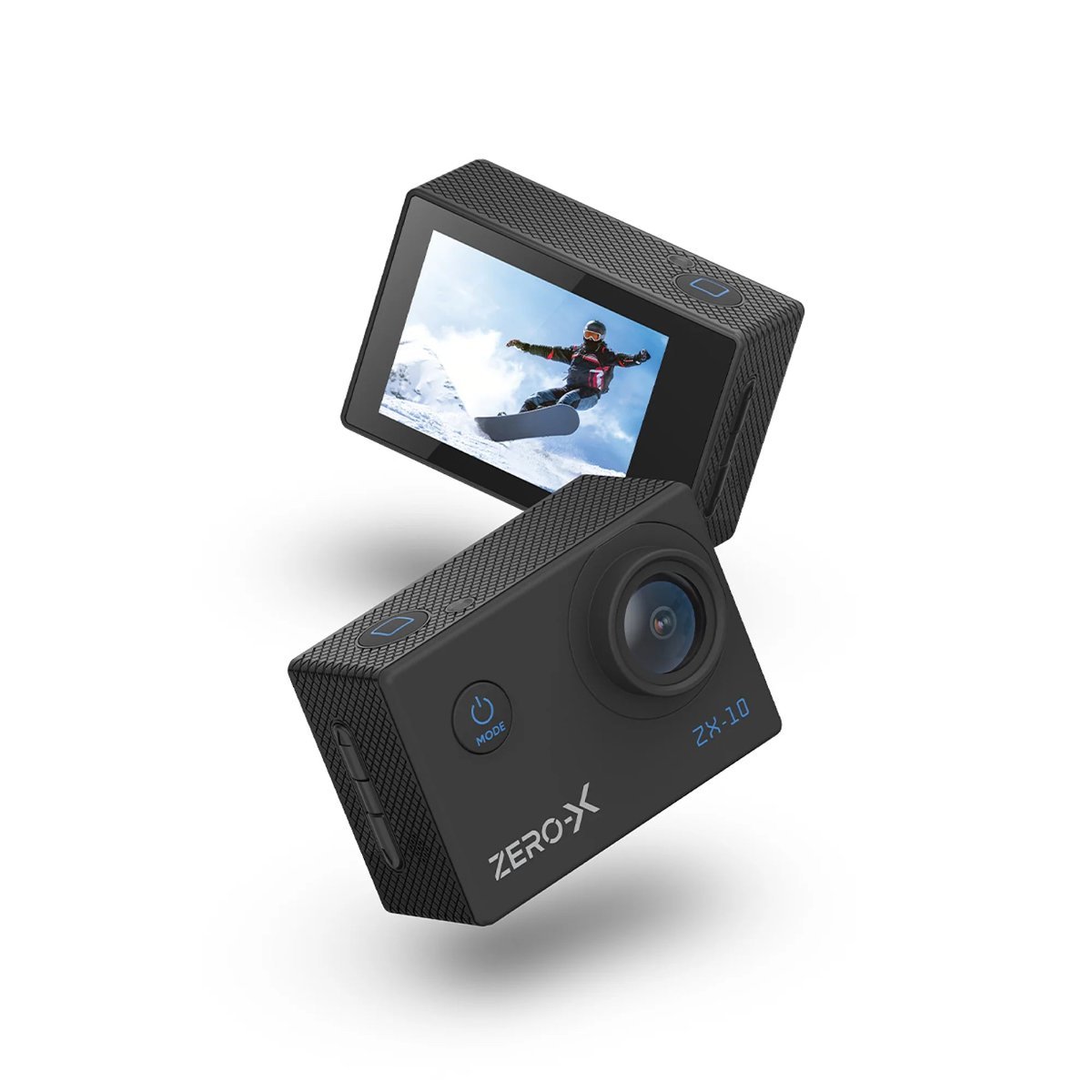
This one claims 1080p rather than 4K, and that honesty is the reason it is in the guide. A 400mAh battery, a 2.0-inch LCD, a quick-release mount and a waterproof case are the whole specification, with no WiFi listed.
A camera claiming Full HD and delivering it is more useful than one claiming 4K it cannot really produce, which is a genuine problem at the bottom of this market. Footage from this holds up on a phone screen, which is where most of it will be watched.
There is no stabilisation claim and no sensor detail published, so expect visible shake when it is moving fast. Buy it as a first camera for a child or a spare that can be lost without much regret.
Pros
- Claims only 1080p, which it can actually deliver
- Cheapest in-stock option here
- Quick-release mount and case included
- Simple enough for a child to operate
Cons
- No stabilisation claim and no sensor detail
- 400mAh battery and no WiFi
Key specs: 1080p Full HD video, 2.0 in LCD, 400mAh battery to about 90 minutes, built-in microphone, quick-release mount and waterproof casing
CHECK CURRENT PRICE5. DJI Osmo Action 4 – Best Sensor and Depth Rating
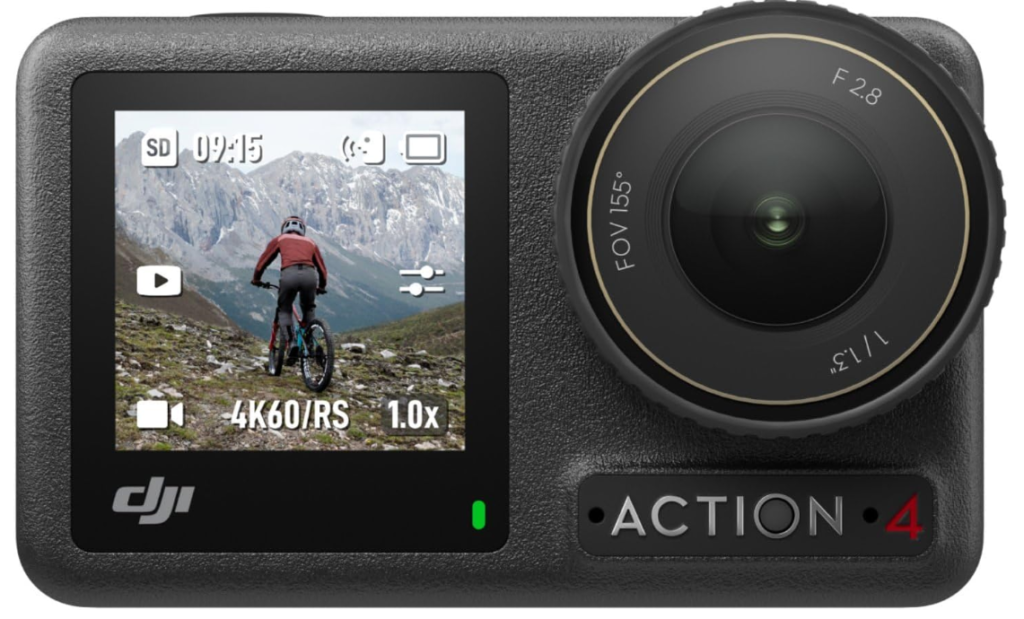
A 1/1.3-inch CMOS sensor at f/2.8 is physically far larger than anything else in this guide, and it shoots 4K at up to 120 frames per second across a 155-degree field of view. Waterproofing is 18 metres with no housing at all, or 60 metres with the case.
Sensor area is what decides low-light performance, and it cannot be compensated for in software. This is why footage at dusk, underwater or under cloud holds together here while cheaper cameras turn grainy. A rated 160 minutes of operation and function down to minus 20 degrees extend that advantage further.
It sits at the top of what could reasonably be called budget, and it is the most capable camera listed by a clear margin. If any of the filming involves water or low light, this is where the money should go.
Pros
- 1/1.3 in sensor, the largest here
- 18 m waterproof with no housing
- 4K at up to 120fps
- Rated 160 minutes and operates to minus 20C
Cons
- Top of the budget range on price
- Accessories cost extra beyond the standard combo
Key specs: 1/1.3 in CMOS sensor at f/2.8, 4K up to 120fps, 155 degree field of view, 10-bit and D-Log M colour, 18 m caseless and 60 m with case, 160 minute rated operation
CHECK ON AMAZON6. GoPro Hero (2024) – Best Mount Ecosystem
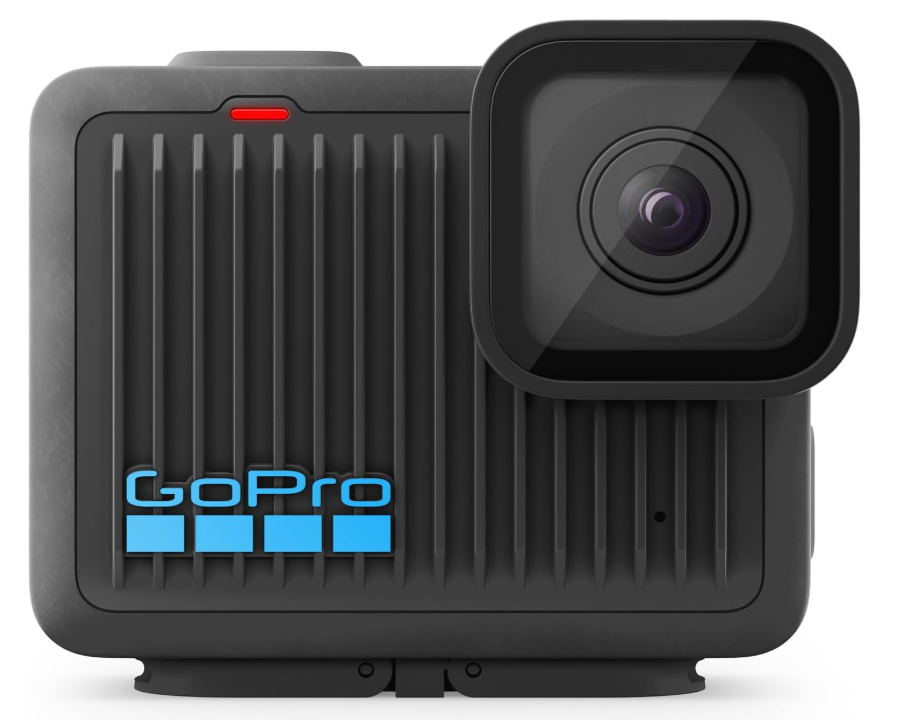
Eighty-six grams and 44 percent less mass than the brand’s larger model, waterproof to 5 metres without a case, with 4K video and 12MP stills. It is the smallest and lightest camera in this guide.
Weight matters once a camera lives on a helmet, and the mount ecosystem matters more still. Two decades of third-party mounts, clamps and harnesses are built around this fitting, which is a practical advantage no specification sheet captures.
The specification is thin for the outlay: 5 metres of depth, 12MP stills and about 60 minutes of recording at the highest setting are all beaten by the DJI above it at lower cost. Choose it for the mounts and the size, not the numbers.
Pros
- Lightest camera here at 86 g
- Largest third-party mount ecosystem
- Waterproof to 5 m with no case
- Simple touch interface
Cons
- Specification is weak for the price
- About 60 minutes recording at the top setting
Key specs: 4K UHD video, 12MP stills, waterproof to 5 m caseless, 86 g, about 60 minutes continuous at the highest setting, LCD touch screen
CHECK ON AMAZON7. AKASO Brave 7 LE – Best Weatherproof Body
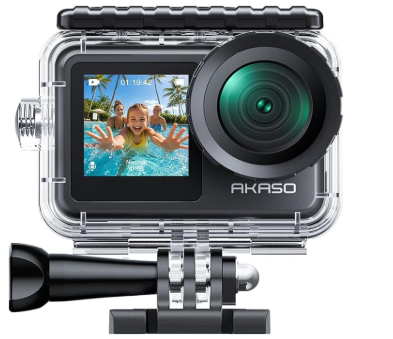
An IPX7 rating on the bare camera body plus 40 metres with the included housing, 6-axis electronic stabilisation, a 2-inch rear touch screen, a front colour screen and two 1350mAh batteries. External microphone support is included.
IPX7 on the body is the detail that matters, because it means rain, spray and snow do not require fitting a case first. Every cheaper camera in this guide is only weatherproof once sealed in plastic, which is the step people skip and then regret.
It is not rated for submersion without the housing, so IPX7 covers weather rather than swimming. This is the most complete mid-range package here for anything filmed outdoors in Australian weather.
Pros
- IPX7 rating on the bare body
- 6-axis electronic stabilisation
- Two 1350mAh batteries included
- Front screen plus external mic support
Cons
- IPX7 covers weather, not submersion
- Sensor is far smaller than the DJI above
Key specs: 4K at 30fps, 20MP stills, IPX7 body plus 40 m with included housing, 6-axis EIS 2.0, 2 in rear touch screen and front colour screen, two 1350mAh batteries, external mic support
CHECK ON AMAZON8. AKASO V50 Elite – Best Frame Rate
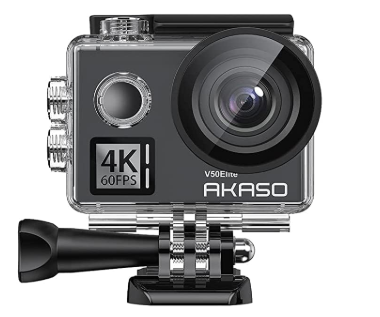
Four thousand pixels wide at a true 60 frames per second, with 2.7K at 60, 1080p at 120 and 720p at 240 for slow motion. Stills are 20MP, there is 8x zoom, voice control and a touch screen, and the improved housing is rated to 40 metres.
Frame rate is the biggest single specification jump available in this price band, because almost everything cheaper stops at 4K and 30 frames. Doubling that makes panning shots noticeably smoother and gives real headroom to slow footage down in an edit.
The camera itself carries no water rating, so the housing is mandatory around water. It suits anyone who intends to edit the footage rather than post it straight off the card.
Pros
- True 4K at 60fps
- 720p at 240fps for slow motion
- Voice control and 8x zoom
- Housing rated to 40 m
Cons
- No water rating on the bare camera
- Screen size not published
Key specs: 4K at 60fps plus 2.7K/60, 1080p/120 and 720p/240, 20MP stills, advanced EIS, 8x zoom, voice control, 40 m with included case
CHECK ON AMAZON9. Dragon Touch Vision 3 – Best Starter Bundle
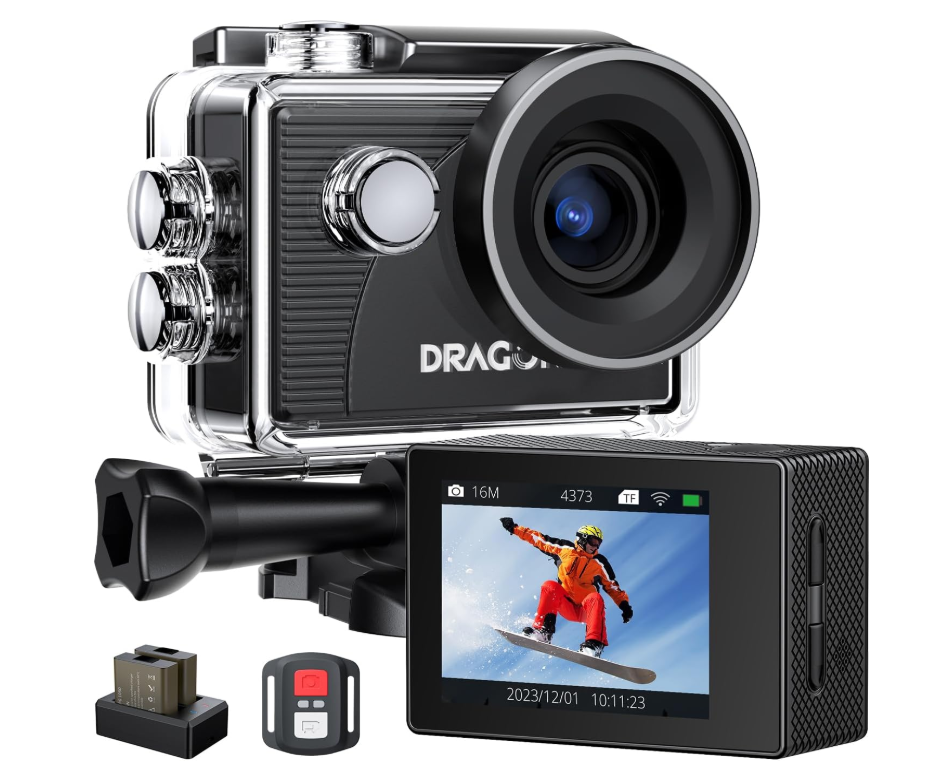
Four thousand pixels at 30 frames, 20MP stills, a 170-degree field of view and an eighteen-piece accessory kit that fits the standard mount pattern. Two 1050mAh batteries are included, each rated to about 90 minutes, along with a wrist-worn wireless remote.
Two batteries and eighteen mounts in the box is a genuinely complete starting position, and the remote is unusual at this level. Compatibility with the standard mount pattern means the accessory market stays open rather than being locked to one brand.
The camera has no water rating of its own and depends on the case to 30 metres. It is the only properly branded alternative at the bottom of this range, which makes it the realistic choice for a first setup.
Pros
- Eighteen-piece accessory kit
- Two batteries included
- Wireless wrist remote
- Fits standard mount pattern
Cons
- No water rating without the case
- 4K capped at 30fps
Key specs: 4K at 30fps, 20MP stills, 170 degree field of view, 4x digital zoom, two 1050mAh batteries, WiFi, wrist remote, 18-piece accessory kit, 30 m with case
CHECK ON AMAZON10. AKASO EK7000 – Best Absolute Budget Pick
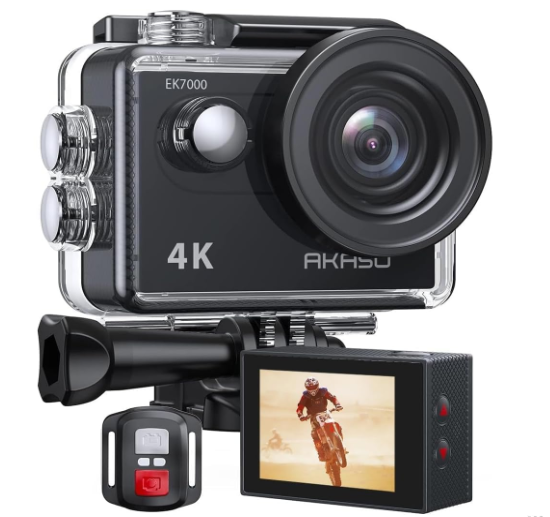
Four thousand pixels at 30 frames with WiFi, electronic stabilisation and a bundled housing. This is the cheapest camera here from a brand with an actual service presence rather than a reseller label.
At the bottom of this market the choice is usually between a branded camera and an unbranded one at a similar price, and the branded one wins on firmware, spare parts and warranty rather than on specification. That is the argument for this one.
The listing contradicts itself on two specifications, quoting both 20MP and 16MP for stills and both 40 and 30 metres for depth, so neither figure should be relied on before the box is open. Waterproofing needs the housing in any case.
Pros
- Cheapest properly branded 4K option here
- WiFi and electronic stabilisation
- Housing included
- Established firmware and spares support
Cons
- Listing contradicts itself on megapixels and depth
- No rating on the bare camera
Key specs: 4K at 30fps and 2.7K at 30fps, electronic stabilisation, WiFi, bundled waterproof housing. Listing states both 20MP and 16MP for stills and both 40 m and 30 m for depth
CHECK ON AMAZONHow to Choose a Budget Action Camera
Read the depth rating twice, once for the camera and once for the case. A camera rated to 40 metres in a housing is not waterproof at all on its own. Caseless ratings are the ones that matter day to day, because the case is the step people skip, and a housing also fogs between lens and plastic and muffles the microphone.
Find the frame rate behind the 4K claim. Resolution without a frame rate is half a specification. Four thousand pixels at 30 frames is the norm at this level and perfectly usable; below 30 it stutters, and at 60 it opens up smooth panning and slow motion. Several listings in this category omit the number entirely, which is itself informative.
Treat sensor size as the one thing software cannot fix. Stabilisation, colour and sharpening are all processing, and processing improves with firmware. Sensor area does not change, and it is what decides whether dusk, cloud and underwater footage holds together or turns to noise.
Count the batteries and the mounts before comparing prices. A camera with one battery and no mounts needs a second purchase to be useful, and that purchase is rarely in the comparison. Two batteries and a mount kit in the box can make a dearer camera the cheaper option.
Check the mount pattern is the standard one. The two-prong fitting used across most of this category means third-party clamps, harnesses and helmet mounts all fit, which matters if the camera is going on a bike or a board. It is also why an action camera pairs naturally with an electric scooter for commuting footage, and why the same edit often mixes ground clips with aerial ones from drones.
Match the card to the bitrate, not to the price. A 4K camera writing high-bitrate video needs a card rated at least U3 or V30, and a slower card causes dropped frames that look like a camera fault. Australian Consumer Law guarantees apply regardless of the written warranty, so a camera that floods at its stated depth rating is a fault under that law rather than user error.
Frequently Asked Questions
Do budget action cameras really shoot 4K?
Most genuinely record a 4K file, but the frame rate and the sensor behind it decide whether the footage looks better than good 1080p. A small sensor upscaling to 4K at a low frame rate produces a worse result than a clean Full HD recording, which is why the frame rate is worth finding before the resolution.
What waterproof rating does an action camera need?
For rain and spray, an IPX7 body rating is enough and means no case is needed. For swimming or snorkelling you want a caseless depth rating of at least 5 to 10 metres. Ratings that only apply with the supplied housing are fine for occasional use but the housing fogs and muffles audio.
Is electronic stabilisation good enough on a cheap action camera?
On a bike or while walking, yes. Electronic stabilisation crops the frame slightly and corrects shake in software, and it has improved enough that mid-range cameras handle most movement well. It struggles with sharp jolts and low light, where cropping and noise compound each other.
Do cheap action cameras work with GoPro mounts?
Almost all of them do, because the two-prong fitting has become the category standard. That means helmet mounts, chest harnesses, suction mounts and clamps are interchangeable across brands, so an accessory bought for one camera usually fits the next.
How long do action camera batteries last?
Between about 60 and 160 minutes depending on capacity and settings, with 4K and stabilisation both drawing more power. Recording in short bursts rather than continuously extends it considerably, and cameras supplied with two batteries effectively double the usable time for no extra cost.
Can an action camera replace a phone for video?
Not as a general camera, but it does things a phone cannot. Mounting, submersion and surviving impacts are the point, and no phone is designed to be strapped to a helmet or taken to ten metres. For handheld footage in good light a modern phone will usually look better.
The Verdict
The cheapest camera here is not the best value in it. Where any of the filming involves water or low light, the DJI Osmo Action 4 is the clear answer, because an 18 metre caseless depth rating and a 1/1.3-inch sensor are specifications nothing else in this guide approaches. Where the camera will live on a helmet or a handlebar and mounts matter more than sensor area, the GoPro Hero opens the largest accessory ecosystem in the category for the least money. And for a camera that will be handed to a child and eventually dropped in sand, the Zero-X ZX-10 claims only 1080p, which makes it the one listing here whose specification can be taken entirely at face value.